1. What they are
Two unknowns need two equations
- A single equation with two unknowns has infinitely many solutions, so a second equation is required to pin them down
- Simultaneous equations are solved together, and the answer is the pair of values satisfying both at once
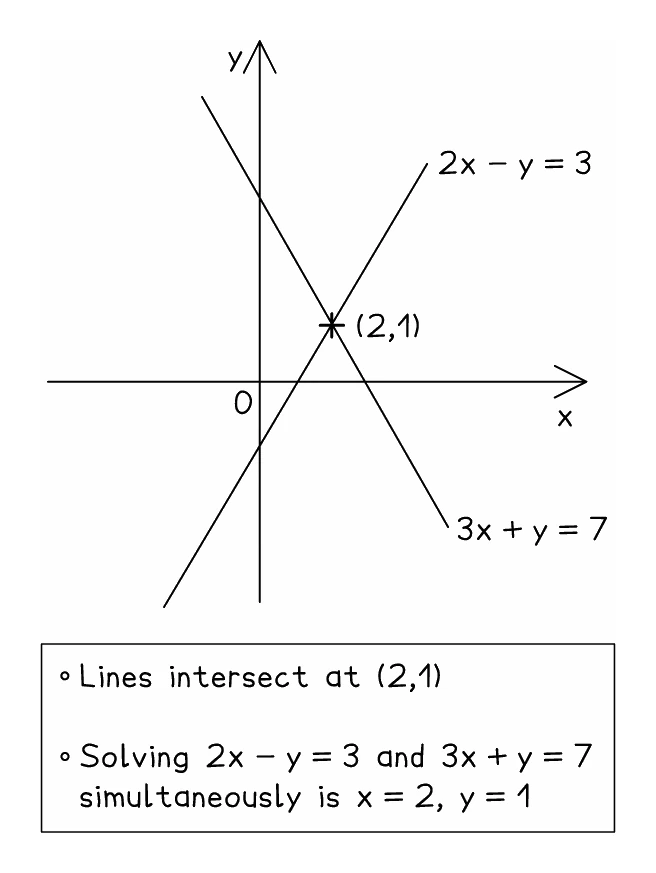
- They are linear when every term is a number or a number times one unknown, so nothing is squared and the unknowns are never multiplied together
- Each solution should be checked in the equation that was not used to find it
2. Solving by elimination
Matching a coefficient
- Elimination removes one unknown by adding or subtracting the two equations
- Multiply one or both equations so that one unknown has coefficients of equal size
- Subtract when those coefficients have the same sign, and add when the signs are opposite
- Solve the resulting single-unknown equation, then substitute back to find the other
Worked example
Elimination with both equations scaled
Solve 3x + 5y = 31 and 2x + 3y = 20.
Solution:
- Elimination needs one letter to have the same coefficient in both equations, and here neither does
- Match the y terms: 5 and 3 both divide into 15, so multiply the first equation by 3 and the second by 5
- Multiply every term, the constant included, or the equation stops being true
- 9x + 15y = 93 and 10x + 15y = 100
- The matched terms now have the same sign, so subtracting removes them
- Subtracting the first from the second: 10x − 9x = 1x, 15y − 15y = 0, 100 − 93 = 7, so x = 7
- Substitute back into either original equation: 3 × 7 + 5y = 31
- 21 + 5y = 31, so 5y = 10 and y = 2
- The solution is x = 7, y = 2
- Check in the equation not used for the substitution: 2 × 7 + 3 × 2 = 14 + 6 = 20
- Had the matched terms carried opposite signs, they would be added instead
3. Solving by substitution
When one unknown is already isolated
- Rearrange one equation to make an unknown the subject, then substitute that expression into the other
- This suits an equation such as 2x − y = 1, which rearranges easily to y = 2x − 1
- Substituting gives one equation in one unknown
- With 4x + 3y = 27, substituting y = 2x − 1 gives 4x + 3(2x − 1) = 27, so 10x = 30 and x = 3, giving y = 5
- Substitution is the method that also handles non-linear pairs
Worked example
Solving by substitution
Solve the simultaneous equations y = 2x + 1 and 3x + y = 11.
Solution:
- One equation already has y on its own, so substitute that expression into the other
- 3x + (2x + 1) = 11
- Collect: 5x + 1 = 11
- Subtract 1: 5x = 10, so x = 2
- Substitute back into the isolated equation: y = 2 × 2 + 1 = 5
- The solution is x = 2, y = 5
- Check in the equation not used for the substitution: 3 × 2 + 5 = 11
4. One linear and one non-linear equation
Always substitute
- Where one equation contains a squared term, elimination will not work and substitution is used instead
- Make an unknown the subject of the linear equation, then substitute into the non-linear one
- The result is a quadratic, so bring everything to one side to equal zero, then factorise, or use the formula or completing the square when it does not factorise
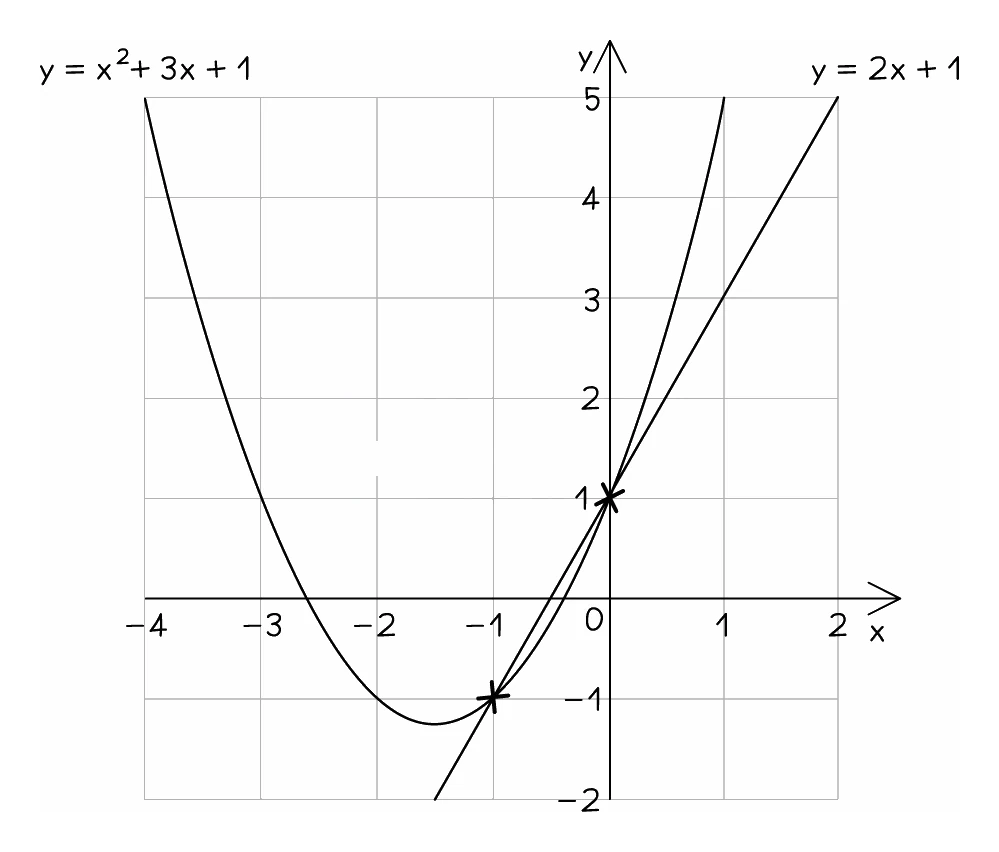
- Two solutions for one unknown give two matching values of the other, so answers come in pairs
- A quadratic with a repeated root gives a single solution pair, and graphically that is a line touching the curve rather than cutting it
- A quadratic with no real solutions means the line and the curve never meet, so the pair has no solution at all
- Powers no higher than two appear in this specification
Worked example
A linear and a quadratic equation
Solve y = x² − 4 and y = 3x simultaneously.
Solution:
- Elimination does not work on a non-linear pair, so always substitute
- Both right-hand sides are equal to y, so they are equal to each other: x² − 4 = 3x
- One unknown is now gone, leaving a quadratic to solve
- Bring every term to one side so it equals zero, which is the only form that can be factorised usefully: x² − 3x − 4 = 0
- Two numbers multiplying to −4 and adding to −3 are −4 and 1
- Factorise: (x − 4)(x + 1) = 0
- A product is zero only if a bracket is zero, so x = 4 or x = −1
- Substitute each value back to get its partner, using the simpler equation y = 3x
- The solutions are x = 4, y = 12 and x = −1, y = −3
- Expect two solution pairs here and give both, keeping each x with its own y
- Check the first in the other equation: 4² − 4 = 12
Exam tip
Show the substitution that finds each y
Work out each y on its own line, such as y = 3 × 4 = 12, rather than writing the pairs straight down. If a slip in the quadratic makes your x-values wrong after a correct start, most schemes still give a mark for substituting both of them correctly into one of the two equations, but only when that working is shown.
Worked example
A line and a curve, answers to 2 decimal places
Solve y = 3x + 2 and y = 2x² + x − 1 simultaneously, rounding each value to 2 decimal places.
Solution:
- Set the two expressions for y equal: 2x² + x − 1 = 3x + 2
- Bring every term to one side: 2x² − 2x − 3 = 0
- This does not factorise, so use the quadratic formula with a = 2, b = −2 and c = −3
- x = (2 ± √((−2)² − 4 × 2 × (−3))) ÷ (2 × 2) = (2 ± √28) ÷ 4
- So x = 1.8228… or x = −0.8228…
- Keep the unrounded values and substitute each into the linear equation: y = 3 × 1.8228… + 2 = 7.4686… and y = 3 × (−0.8228…) + 2 = −0.4686…
- The solutions are x = 1.82, y = 7.47 and x = −0.82, y = −0.47
- Check the first in the curve's equation: 2 × (1.8228…)² + 1.8228… − 1 = 7.4686…
- Working out y from the rounded values 1.82 and −0.82 gives 7.46 and −0.46, both wrong in the second decimal place
- Graphically these solutions are the points where the line and the curve cross, which is why there can be two of them
5. Forming simultaneous equations
From a described situation
- Introduce a letter for each unknown and state precisely what each represents, including units
- Each separate fact in the question becomes one equation
- Solve, then answer in context rather than leaving the letters bare
Worked example
Forming and solving from a context
Two coffees and three teas cost £11.40. Four coffees and one tea cost £13.80. Find the cost of each drink.
Solution:
- Let c be the cost of a coffee and t the cost of a tea, both in pounds
- The two facts give 2c + 3t = 11.40 and 4c + t = 13.80
- Rearrange the second: t = 13.80 − 4c
- Substitute into the first: 2c + 3(13.80 − 4c) = 11.40
- Expand: 2c + 41.40 − 12c = 11.40, so −10c = −30 and c = 3.00
- Then t = 13.80 − 12.00 = 1.80
- A coffee costs £3.00 and a tea costs £1.80
- Check: 2(3.00) + 3(1.80) = 11.40