1. Sets and their elements
Describing a set
- Any well-defined group of things forms a set, and each thing belonging to it is an element of that set
- Elements can be anything: numbers, letters, or coordinate pairs
- Writing the elements inside curly brackets defines a set directly
- The factors of 12 form the set {1, 2, 3, 4, 6, 12}
- A rule can replace the list, written with a colon read as "such that"
- {x : x is an integer, 1 ⩽ x ⩽ 5} is another way of writing {1, 2, 3, 4, 5}
- {(x, y) : y = mx + c} is the set of points lying on that line
- Capital letters name sets and lower-case letters name elements
The universal set
- The universal set holds everything under consideration in that question, and this specification writes it as ℰ, a script capital E
- Every other set in the question is contained within it
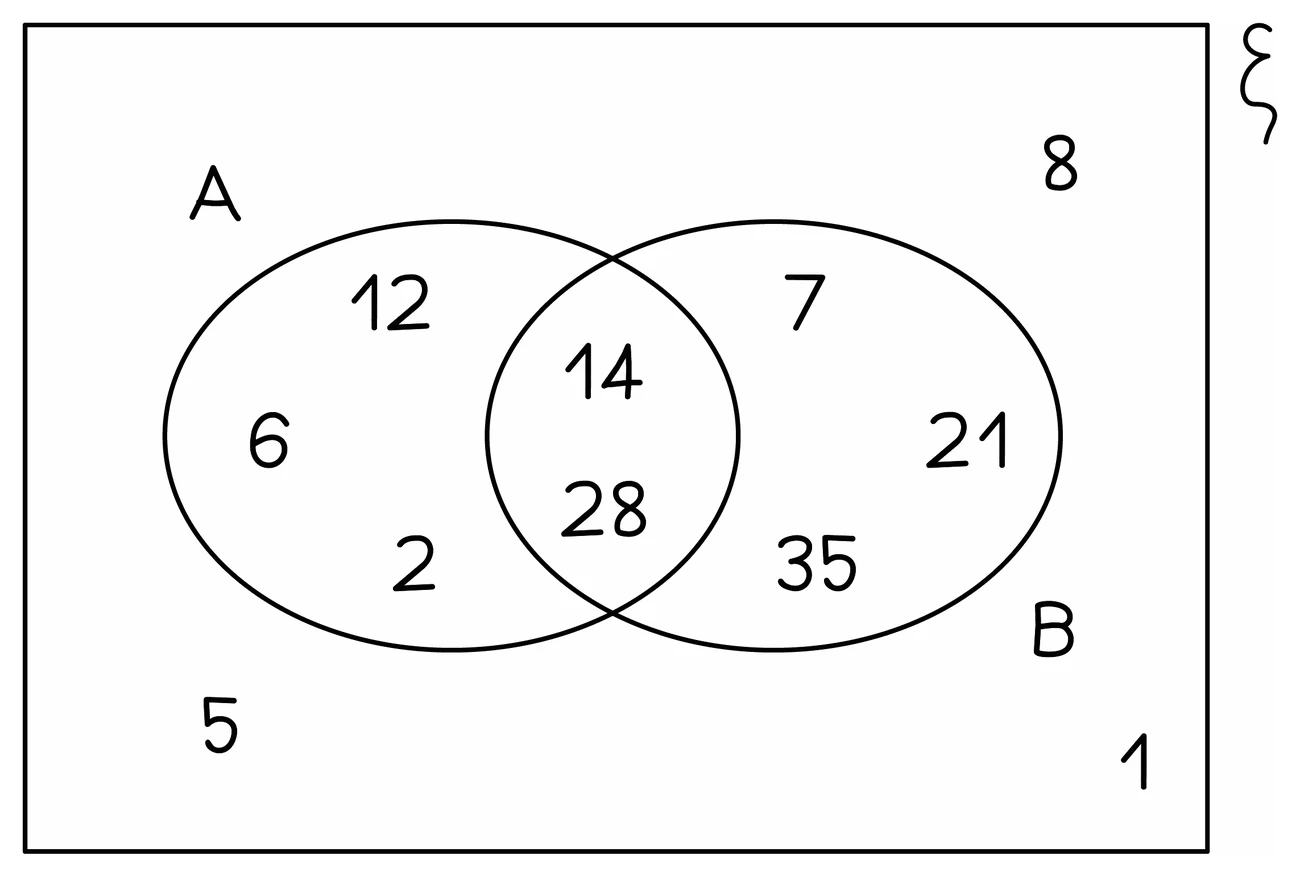
- Other material uses the Greek letter xi, ξ, or the letter U for the same thing, and the diagram below is labelled that way, but ℰ is the symbol the syllabus lists and the one printed on these papers
2. The notation
Symbols required by the specification
| Symbol | Meaning |
|---|---|
| n(A) | The number of elements in A |
| ∈ | is an element of |
| ∉ | is not an element of |
| A′ | The complement of A: everything in ℰ that is not in A |
| ∅ | The empty set, containing no elements |
| ℰ | The universal set |
| A ⊆ B | A is a subset of B |
| A ⊈ B | A is not a subset of B |
| A ∪ B | The union of A and B |
| A ∩ B | The intersection of A and B |
- Union collects everything appearing in either set, or in both, and each element is written once
- Intersection keeps only what appears in both sets
- A subset relationship holds when every element of the first set also lies in the second
- The complement is found by taking the universal set and removing the named set
Worked example
Reading set notation
ℰ = {x : x is an integer, 1 ⩽ x ⩽ 10}, P = {2, 3, 5, 7} and Q = {1, 3, 5, 7, 9}. Write down n(P), P ∩ Q, P ∪ Q and P′.
Solution:
- n(P) counts the elements of P, so n(P) = 4
- P ∩ Q keeps only what is in both: {3, 5, 7}
- P ∪ Q collects everything in either, listing each once: {1, 2, 3, 5, 7, 9}
- P′ removes P from the universal set: {1, 4, 6, 8, 9, 10}
3. Venn diagrams
How the diagram is built
- A Venn diagram shows sets as circles inside a rectangle, where the rectangle is the universal set
- Overlapping circles share the elements that lie in both sets
- Anything belonging to no named set is written inside the rectangle but outside every circle
- This specification limits Venn diagrams to two or three sets
Regions and operations
- Each operation corresponds to a region of the diagram, which is what makes the notation easy to apply
- The union covers both circles entirely; the intersection covers only the overlap
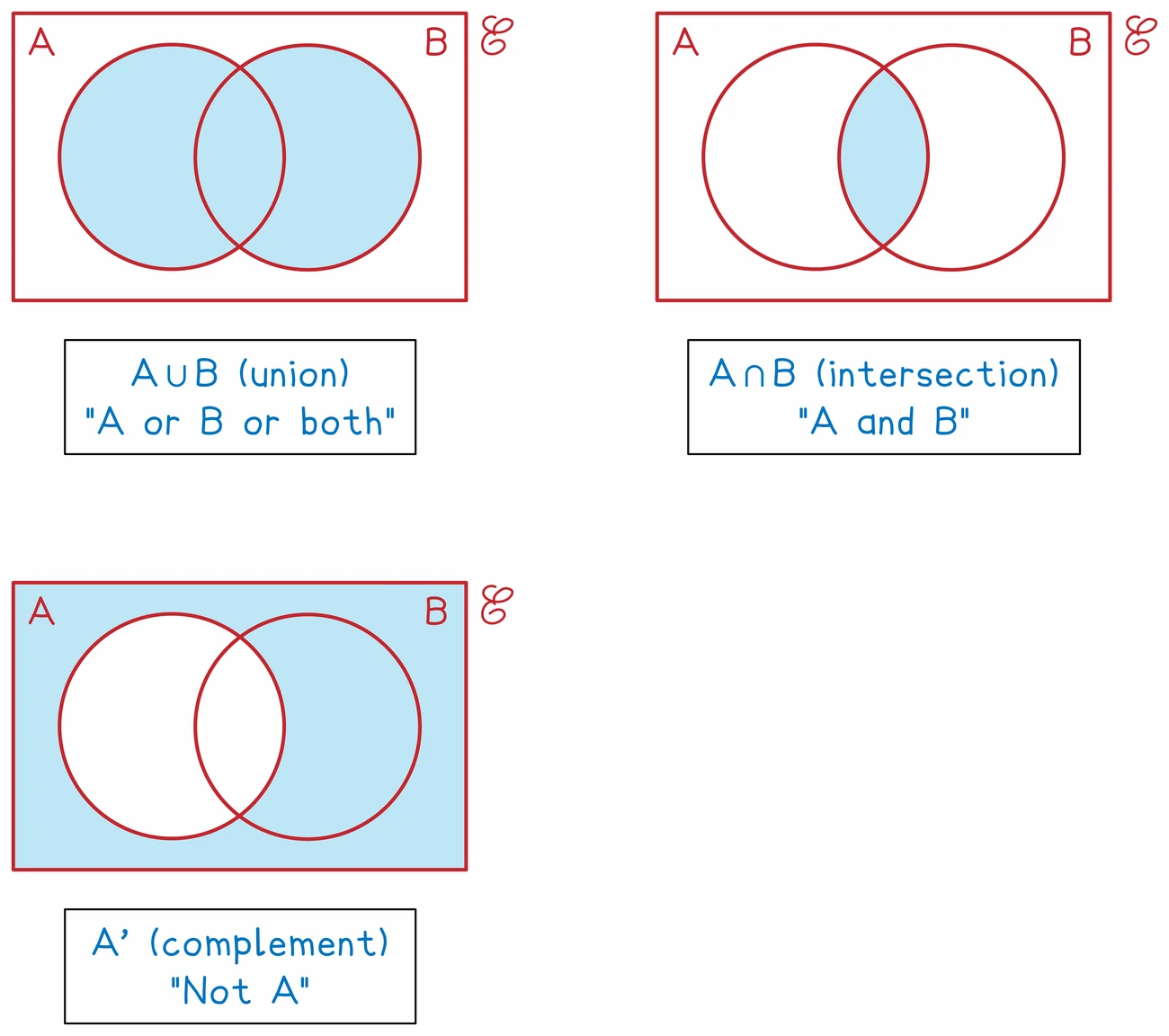
- A complement shades everything outside the named set but still inside the rectangle
- Combined expressions are read from the inside out, so (A ∪ B)′ means shade everything the union does not cover
Counting from a diagram
- n(A) counts every element inside circle A, including those in the overlap
- Elements in the overlap belong to both sets and are counted once in a union
Worked example
Placing elements in a three-set Venn diagram
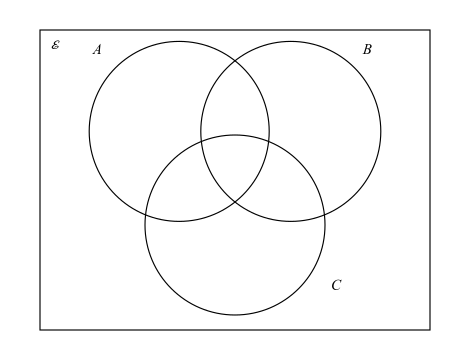
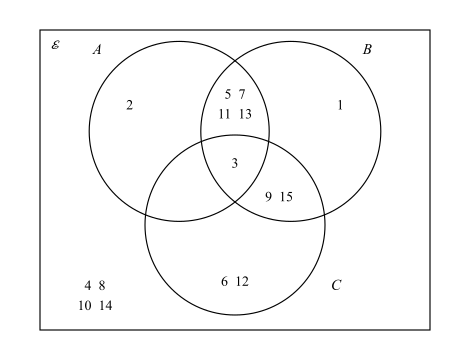
ℰ = {x : x is an integer, 1 ⩽ x ⩽ 15}, A = {prime numbers}, B = {odd numbers} and C = {multiples of 3}. Complete the Venn diagram for A, B and C, then find n(A ∩ C ∩ B′).
Solution:
- List each set from ℰ first: A = {2, 3, 5, 7, 11, 13}, B = {1, 3, 5, 7, 9, 11, 13, 15} and C = {3, 6, 9, 12, 15}
- Fill the centre first: 3 is the only number in all three sets
- In A and B but not C: 5, 7, 11, 13
- In B and C but not A: 9, 15
- In A and C but not B: nothing, because 3 is the only prime that is a multiple of 3 and it is already in the centre
- A only: 2, the only even prime; B only: 1, which is odd but not prime; C only: 6, 12
- Outside all three circles: 4, 8, 10, 14
- Check the count: 1 + 4 + 2 + 0 + 1 + 1 + 2 + 4 = 15, so every element of ℰ is placed exactly once
- n(A ∩ C ∩ B′) counts the empty region, so n(A ∩ C ∩ B′) = 0, a number, not ∅
Worked example
Counting from a Venn diagram
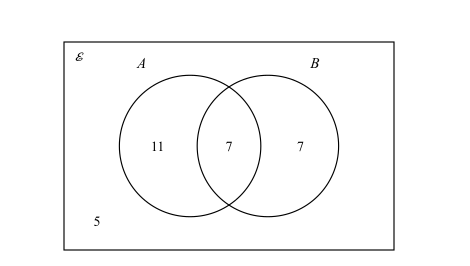
In a group of 30 students, 18 study art (A) and 14 study biology (B). 7 study both. Show this on a Venn diagram, then work out how many study neither.
Solution:
- Fill the overlap first, because the two given totals each already include it
- The intersection holds 7
- Art only = 18 − 7 = 11
- Biology only = 14 − 7 = 7
- Those three regions hold 11 + 7 + 7 = 25 students
- The universal set holds 30, so the region outside both circles holds 30 − 25 = 5
- Check by adding all four regions: 11 + 7 + 7 + 5 = 30
- Writing 18 in the art circle and 14 in the biology circle would count the 7 twice and total 39