1. The language of sequences
Terms and positions
- A sequence is a list of numbers written in a fixed order and governed by a rule
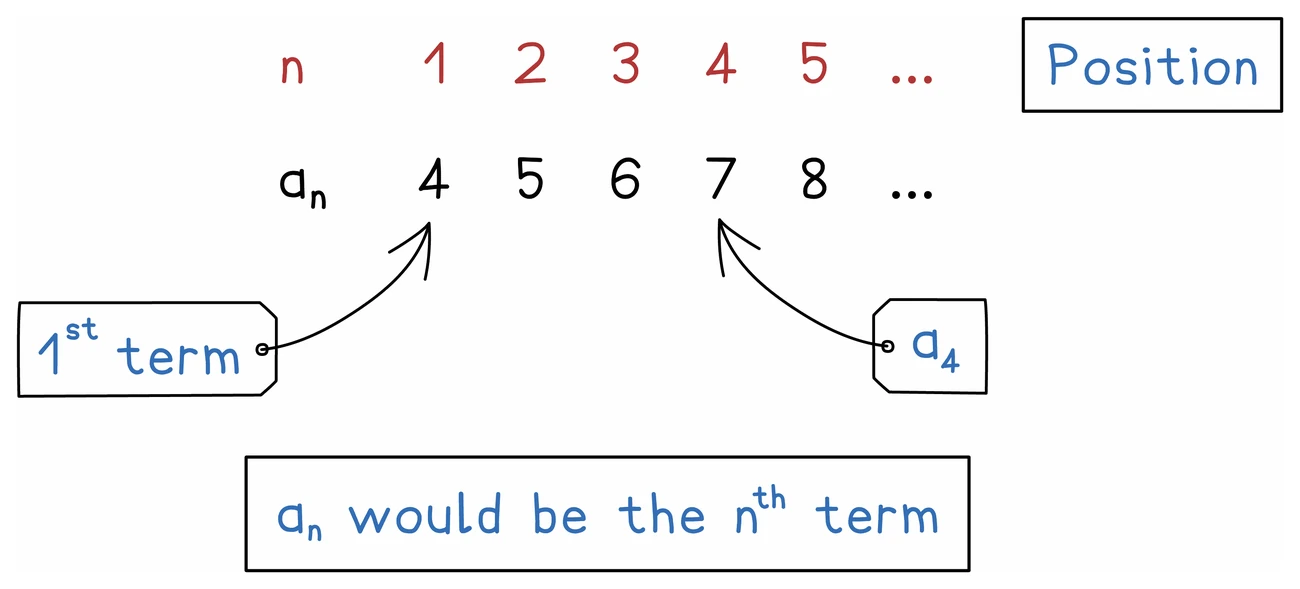
- Each number in the list is a term, and where it sits in the list is its position
- The letter n stands for the position, so n = 1 marks the first term, n = 2 the second, and so on
- Writing the position above each term before you start is the single most useful habit in this topic
- A sequence can also be described by a growing pattern of shapes, in which case counting the dots, sticks or squares in each picture produces the numbers
Two ways of describing a rule
- A term-to-term rule says what to do to one term to reach the next, such as add 9 each time or halve each time
- It is quick to use but only moves one step at a time, so reaching the 60th term means writing out 59 steps
- A position-to-term rule, usually called the nth term, is an expression in n that produces any term directly
- With nth term 6n − 1, substituting n = 1, 2, 3 gives 5, 11, 17, and substituting n = 100 gives 599 in one line
- With nth term n² − 2, the first three terms are −1, 2 and 7, and the 100th term is 9998
- A question asking for a specific far-off term is really asking you to find the nth term first
Subscript notation
- A sequence can be named with a letter, and its terms labelled by position using a subscript
- If a sequence is called T, then T₁ is its first term, T₅ its fifth, and Tₙ its nth
- Questions use this to link two sequences without writing either out, for example by defining a third sequence as Cₙ = Aₙ + Bₙ
- The subscript is a position label, never a multiplier
Worked example
Position, term and the two kinds of rule
A sequence begins 5, 8, 11, 14. Write down the term-to-term rule, find the nth term, and work out the 50th term.
Solution:
- Write the position numbers above the terms: 1, 2, 3, 4
- The gaps are 8 − 5 = 3, 11 − 8 = 3 and 14 − 11 = 3, so the gap is constant
- The term-to-term rule is "add 3", which needs the previous term to use it
- A constant gap of 3 means the nth term contains 3n
- 3n alone gives 3, 6, 9, 12, which is 2 short of every term
- The nth term is 3n + 2, which is a position-to-term rule
- The 50th term is 3 × 50 + 2 = 152, found without listing the terms in between
- Check on a term other than the first: n = 3 gives 11, which matches
2. Continuing a sequence
Look at the gaps first
- Write the differences between consecutive terms underneath the sequence
- Equal differences mean the sequence goes up or down in fixed steps, so add the same amount again
- Differences that themselves form a pattern still tell you what comes next
- In 5, 6, 8, 12, 20 the differences are 1, 2, 4 and 8, doubling at every step; one more doubling gives 16, and 20 + 16 = 36
- Where the differences give nothing, test whether each term is being multiplied by the same number instead
Number sequences worth recognising
- Square numbers: 1, 4, 9, 16, 25, 36, 49, 64, 81, 100, 121, 144, 169, 196, 225
- Cube numbers: 1, 8, 27, 64, 125, 216
- Triangular numbers: 1, 3, 6, 10, 15, 21, formed by adding 1, then 2, then 3, and so on
- Prime numbers: 2, 3, 5, 7, 11, 13, which follow no difference pattern at all
- Recognising these on sight turns many sequence questions into a one-line comparison
Worked example
Recognising a familiar sequence
Write down the next two terms of each sequence: (a) 1, 4, 9, 16 (b) 2, 4, 8, 16 (c) 1, 3, 6, 10
Solution:
- (a) The gaps are 3, 5 and 7, which are not constant, so this is not linear
- These are the square numbers 1², 2², 3², 4²
- The next two are 5² and 6², giving 25 and 36
- (b) Each term is double the one before, so the rule is multiplicative rather than additive
- Doubling 16 gives 32, and doubling again gives 64, so the next two are 32 and 64
- (c) The gaps are 2, 3, 4, increasing by one each time
- These are the triangular numbers, and the next gaps are 5 and 6
- The next two terms are 15 and 21
- Check the gaps first every time: a constant gap means linear, a constant multiplier means exponential
3. Linear sequences
Finding the nth term
- A linear sequence changes by the same amount at every step, and that fixed step is what the nth term is built on
- The nth term takes the form (step)n + (term before the first)
- Find the step from the differences, then work backwards one place from the first term to get the number that follows n
- A sequence that decreases has a negative step, and the number that follows n is then larger than the first term
- Always test the formula on the second or third term before writing it down
Worked example
An increasing and a decreasing sequence
Find the nth term of 7, 11, 15, 19, … and of 20, 14, 8, 2, …
Solution:
- For 7, 11, 15, 19 the differences are all 4, so the formula starts 4n
- Going back one step from 7 gives 3, so the nth term is 4n + 3
- Check with n = 3: 4 × 3 + 3 = 15, which matches the third term
- For 20, 14, 8, 2 the differences are all −6, so the formula starts −6n
- Going back one step from 20 gives 26, so the nth term is 26 − 6n
- Check with n = 4: 26 − 24 = 2, which matches the fourth term
Testing whether a number belongs
- Set the nth term equal to the value in question and solve the equation for n
- A whole-number answer means the value is in the sequence, and n tells you which term it is
- A fraction or a decimal answer means the value never appears in the list, and saying so is what earns the mark
- For the sequence with nth term 4n + 3, solving 4n + 3 = 95 gives n = 23, so 95 is the 23rd term
- Solving 4n + 3 = 100 gives n = 24.25, which is not a position, so 100 never appears
4. Quadratic and cubic sequences
Comparing with the squares and the cubes
- A quadratic sequence has n² in its nth term, and its first differences change while the second differences stay equal
- A cubic sequence has n³ in its nth term, and it is the third differences that settle down to a constant
- The fastest route into a straightforward one is to write the square or cube numbers underneath and compare term by term
- A constant gap means adding or subtracting that number, and a constant ratio means multiplying
Exam tip
Write the differences even when you spot the squares
Write the rows of differences down, even when you compare with the square or cube numbers as in the example below. In every scheme for this type, a constant second difference (the third for a cubic) earned one of the two marks on its own; two schemes wanted at least two of its values shown. Any answer of the right type, quadratic or cubic, earned that mark too, so never leave the answer blank.
Worked example
Comparing with a familiar sequence
Find the nth term of 4, 7, 12, 19, 28 and of 3, 10, 29, 66, 127.
Solution:
- Write the square numbers under the first sequence: 1, 4, 9, 16, 25
- Every term is 3 more than the square below it, so the nth term is n² + 3
- Check with n = 5: 25 + 3 = 28, which matches
- Write the cube numbers under the second sequence: 1, 8, 27, 64, 125
- Every term is 2 more than the cube below it, so the nth term is n³ + 2
- Check with n = 4: 64 + 2 = 66, which matches
- A sequence can also be the squares or cubes starting from a later point, in which case the bracket shifts
- 9, 16, 25, 36 are the square numbers from 3² onwards, so the nth term is (n + 2)²
5. The difference method for a harder quadratic
Building the formula in two parts
- When the sequence is not simply the squares shifted, the second differences still give the start of the formula
- Halve the second difference: that number multiplies n²
- Write out that multiple of the square numbers, then subtract it term by term from the original sequence
- What is left is always a linear sequence, so find its nth term by the method in section 3
- Adding the two parts together gives the complete nth term
Worked example
A quadratic with three parts
Find the nth term of 3, 6, 13, 24, 39.
Solution:
- First differences: 3, 7, 11, 15
- Second differences: 4, 4, 4, so the sequence is quadratic
- Half of 4 is 2, so the formula contains 2n²
- Write out 2n²: 2, 8, 18, 32, 50
- Subtract term by term: 3 − 2 = 1, 6 − 8 = −2, 13 − 18 = −5, 24 − 32 = −8
- Those leftovers are 1, −2, −5, −8, a linear sequence with step −3 and previous term 4, giving 4 − 3n
- Adding the two parts: the nth term is 2n² − 3n + 4
- Check with n = 5: 50 − 15 + 4 = 39, which matches
- The same routine handles a cubic, except that the constant third difference is divided by 6 to give the multiple of n³
- For 2, 15, 52, 125, 246 the third differences are 12, so the formula contains 2n³, and subtracting 2n³ leaves 0, −1, −2, −3, whose nth term is 1 − n, making the answer 2n³ − n + 1
6. Exponential sequences
Multiplying by a fixed number
- An exponential sequence is built by repeated multiplication: every term is the one before it times a fixed multiplier
- Divide any term by the one before it to find that multiplier, and check it is the same all the way along
- The differences never settle to a constant here, so a sequence that grows unusually fast is worth testing for a multiplier straight away
- The nth term is built from the powers of the multiplier: write out those powers and compare, exactly as with the squares
- A multiplier greater than 1 makes the sequence grow; a multiplier between 0 and 1 makes it shrink towards zero
Worked example
Growing and shrinking
Find the nth term of 3, 15, 75, 375 and of 80, 40, 20, 10.
Solution:
- In the first sequence 15 ÷ 3 = 5, 75 ÷ 15 = 5 and 375 ÷ 75 = 5, so the multiplier is 5
- The powers of 5 are 5, 25, 125, 625, and every term is three fifths of the power above it
- So the nth term is (3 ÷ 5) × 5ⁿ, which is written more neatly as 3 × 5ⁿ⁻¹
- Check with n = 4: 3 × 125 = 375, which matches
- In the second sequence each term is half the one before, so the multiplier is 1/2
- Working back one step from 80 gives 160, so the nth term is 160 ÷ 2ⁿ
- Check with n = 4: 160 ÷ 16 = 10, which matches
7. Working with two sequences at once
Fractions and combinations
- A sequence of fractions is usually two separate sequences stacked, so find the nth term of the tops and of the bottoms independently
- In 1/3, 4/5, 9/7, 16/9 the tops are the square numbers and the bottoms go up in twos from 3, giving nth term n² ÷ (2n + 1)
- Where a question defines one sequence in terms of two others, write out the terms of each, combine them, and then find the nth term of the result
- It is often quicker to combine the two nth term expressions directly
- If sequence A has nth term 4n − 1 and sequence B has nth term n², then the sequence formed by adding them has nth term n² + 4n − 1
- Some questions give the terms as expressions in x and tell you the type of sequence, which turns into an equation to solve
- For an exponential sequence, the ratio between the first pair equals the ratio between the second pair, and setting those equal gives the equation
Worked example
A sequence of fractions
Find the nth term of 1/3, 2/5, 3/7, 4/9.
Solution:
- Treat the numerators and the denominators as two separate sequences
- Numerators: 1, 2, 3, 4, a constant gap of 1 starting at 1, so the nth term is n
- Denominators: 3, 5, 7, 9, a constant gap of 2, so the formula contains 2n
- 2n alone gives 2, 4, 6, 8, which is 1 short each time, so the denominator is 2n + 1
- The nth term is n / (2n + 1)
- Check at n = 4: 4 / (8 + 1) = 4/9, which matches