1. What the curve looks like
Shape and symmetry
- A quadratic graph has equation y = ax² + bx + c, with a not zero
- The curve is smooth and has a vertical line of symmetry, and it is drawn freehand rather than with a ruler
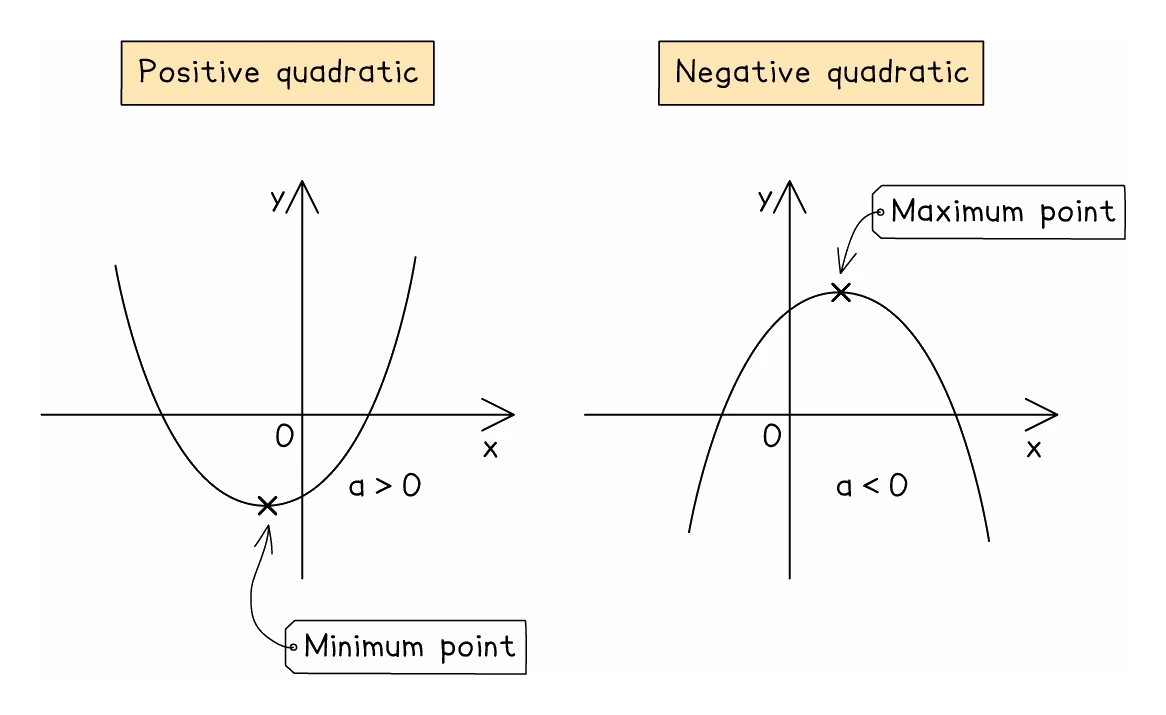
- A positive a opens the curve upwards, giving a u-shape with a lowest point
- A negative a opens it downwards, giving an n-shape with a highest point
- That highest or lowest point is the turning point, and the line of symmetry is the vertical line through it
- The curve always meets the y-axis, at (0, c), because substituting x = 0 leaves only the constant
- Against the x-axis there are three possibilities: it cuts through at two points, just touches at one, or misses the axis entirely, depending on where the turning point sits
Where it crosses the x-axis
- The crossing points are the values of x that make y zero, so they come from solving ax² + bx + c = 0
- The quadratic-equation methods find them: factorising when the quadratic factorises, and otherwise completing the square or the formula
- Two crossings mean the turning point is on the opposite side of the axis from the opening; one crossing means the turning point sits exactly on the axis
- No crossing means the whole curve stays on one side of the axis, which the completed square form shows immediately
- The line of symmetry sits half way between two crossings, so averaging them gives its equation quickly
2. Sketching from the equation
What a sketch must show
- A sketch is not a plotted graph: it needs the right shape and the key points labelled, not accurate scales
- Work through the same four things every time
- Decide u-shape or n-shape from the sign of a
- Mark the y-axis crossing at (0, c)
- Solve for the x-axis crossings, if there are any, and mark them
- Mark the turning point if the question asks for it
- Draw the curve through those points, keeping it symmetrical about the vertical line through the turning point
Worked example
A curve that crosses the *x*-axis twice
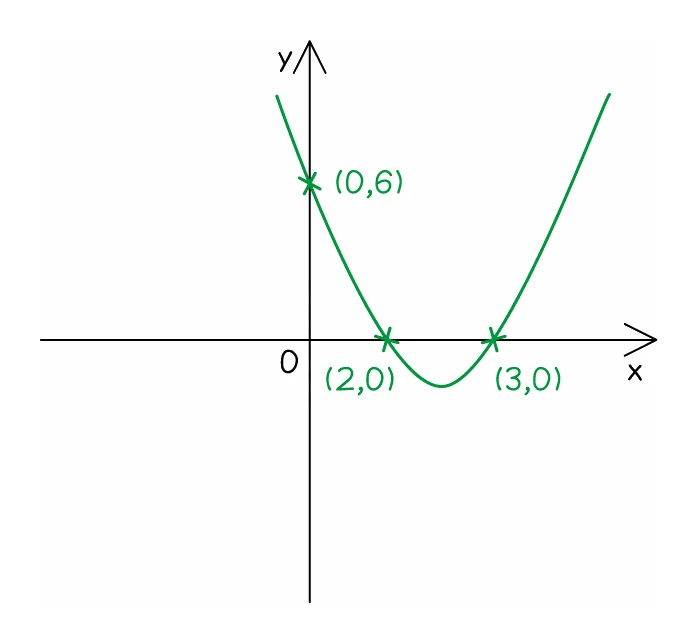
Sketch the curve y = x² − 5x + 6, showing clearly where it meets the axes.
Solution:
- The number in front of x² is positive, so the curve is a u-shape
- The constant term is the y-axis crossing, so the curve passes through (0, 6)
- For the x-axis crossings, solve x² − 5x + 6 = 0
- Two numbers multiplying to 6 and adding to −5 are −2 and −3, so (x − 2)(x − 3) = 0
- The curve meets the x-axis at (2, 0) and (3, 0)
- A u-shaped curve through the three marked points: (0, 6) on the y-axis, and (2, 0) and (3, 0) on the x-axis
Worked example
A curve that never meets the *x*-axis
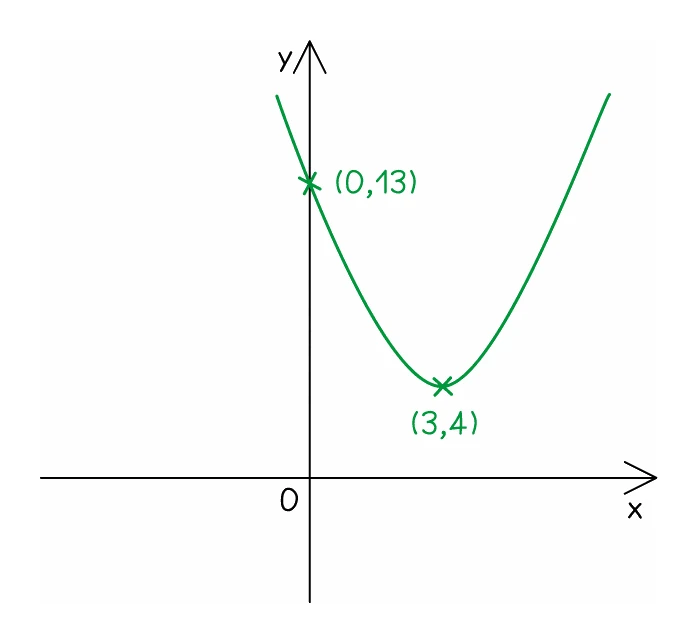
Sketch the graph of y = x² − 6x + 13, showing the y-axis crossing and the coordinates of the turning point.
Solution:
- The number in front of x² is positive, so the curve is a u-shape and its turning point is a minimum
- The y-axis crossing is at (0, 13)
- Complete the square to find the turning point
- Half of −6 is −3, so x² − 6x is (x − 3)² − 9
- y = (x − 3)² − 9 + 13, which is y = (x − 3)² + 4
- The turning point is at (3, 4)
- That minimum sits above the x-axis on a u-shaped curve, so the curve never crosses the x-axis at all
Worked example
A curve that touches the *x*-axis once
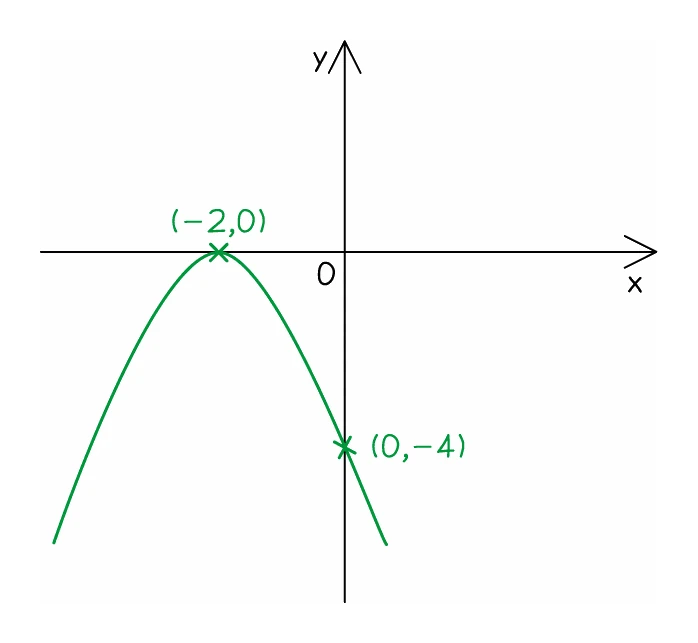
Sketch the graph of y = −x² − 4x − 4, showing the root, the y-axis crossing and the turning point.
Solution:
- The number in front of x² is negative, so the curve is an n-shape with a maximum
- The y-axis crossing is at (0, −4)
- Factorise: −x² − 4x − 4 = −(x² + 4x + 4) = −(x + 2)²
- Setting y = 0 gives (x + 2)² = 0, so x = −2 is the only solution
- A repeated solution means the curve touches the x-axis rather than cutting through it, so (−2, 0) is both the root and the turning point
3. The turning point
From the completed square form
- Rewriting the equation as y = a(x − p)² + q puts the turning point at (p, q), and the line of symmetry at x = p
- Watch the sign: it is the value that makes the bracket zero, so y = (x + 3)² − 1 turns at (−3, −1)
- The number a changes how steep the curve is but not where it turns
- A positive a makes the turning point a minimum and a negative a makes it a maximum
- Finding the turning point this way is explicitly required by this specification
Worked example
An n-shaped curve and its maximum
Find the turning point of y = 12 + 4x − x² and say whether it is a maximum or a minimum.
Solution:
- Rewrite in the usual order: y = −x² + 4x + 12
- Take out the −1 from the first two terms: y = −[x² − 4x] + 12
- Half of −4 is −2, so x² − 4x is (x − 2)² − 4
- Substitute back: y = −[(x − 2)² − 4] + 12
- Multiply through the bracket: y = −(x − 2)² + 4 + 12, so y = −(x − 2)² + 16
- The turning point is (2, 16), and since the number in front of the squared bracket is negative it is a maximum
- Check by substituting x = 2 into the original: 12 + 8 − 4 = 16
From the two axis crossings
- Where the curve does cross the x-axis twice, the turning point lies half way between the crossings
- Average the two crossing values to get the x-coordinate, then substitute it back to get the y-coordinate
- For y = x² − 2x − 8 the crossings are at 4 and −2, so x = 1 and y = 1 − 2 − 8 = −9, giving (1, −9)
4. Finding the equation from a graph
Using the crossings
- If the graph shows both x-axis crossings, write the equation as y = a(x − x₁)(x − x₂) using those two values
- Then substitute one further known point, usually the y-axis crossing, and solve for a
- Expanding at the end is optional unless the question asks for a particular form
- Give the line of symmetry as an equation, x = p, rather than as a single number
Worked example
Building the equation from the crossings
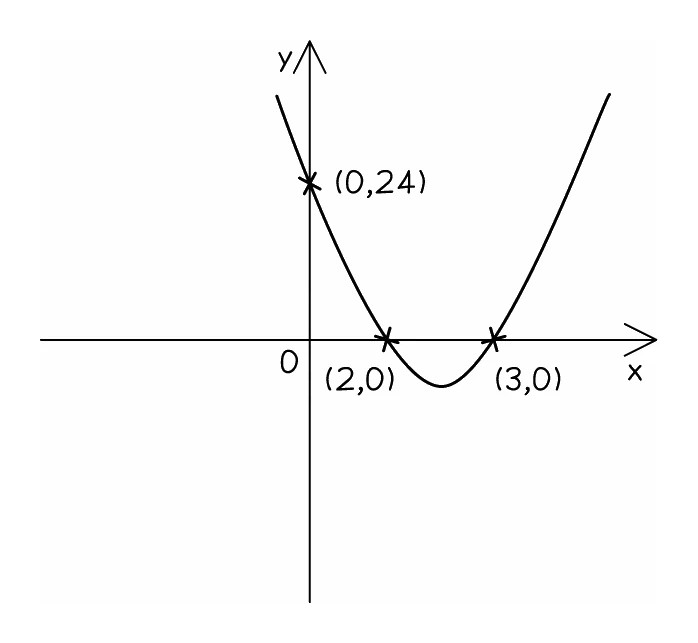
Find the equation of the curve shown.
Solution:
- The two x-axis crossings are at x = 2 and x = 3, so start from y = a(x − 2)(x − 3)
- Substitute the third point, x = 0 and y = 24
- 24 = a(0 − 2)(0 − 3)
- 24 = a × (−2) × (−3), so 24 = 6a and a = 4
- The equation is y = 4(x − 2)(x − 3)
- Expanded, that is y = 4x² − 20x + 24
- Check: substituting x = 0 gives 24, which is the y-axis crossing shown
Using the turning point
- If the graph shows the turning point instead, write the equation as y = a(x − p)² + q with those coordinates filled in
- Substitute one other point on the curve and solve for a
Worked example
Building the equation from the turning point
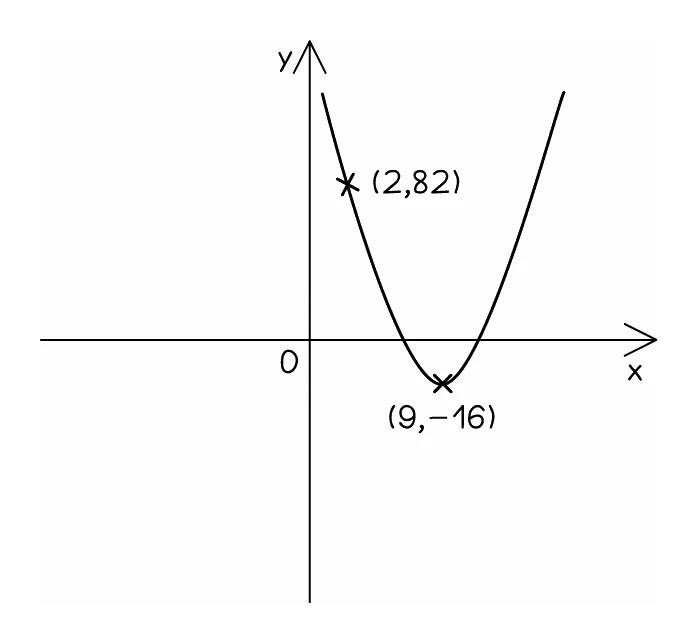
Find the equation of the curve shown.
Solution:
- The turning point is at (9, −16), so start from y = a(x − 9)² − 16
- Substitute the other point, x = 2 and y = 82
- 82 = a(2 − 9)² − 16
- 82 = a × (−7)² − 16, so 82 = 49a − 16
- 98 = 49a, giving a = 2
- The equation is y = 2(x − 9)² − 16
- Expanded, that is y = 2x² − 36x + 146