1. Getting the equation ready
The standard shape
- A quadratic equation contains a squared term and nothing of higher power, and its standard shape is ax² + bx + c = 0, where a is not zero
- All three methods below need zero on one side, so rearranging comes before choosing a method
- Collect everything on the side that leaves the x² term positive; if the squared term ends up negative, multiply every term by −1
- 12 − x² = 4x becomes 0 = x² + 4x − 12, which is easier to work with than −x² − 4x + 12 = 0
- The rearranged equation usually has three terms, and reaching it correctly is worth a mark on its own even before any solving happens
- Most quadratics give two solutions; some give one repeated value, and a few have none
Which method to use
- Factorising is quickest whenever the expression factorises with whole numbers
- The formula always works, and is the method to reach for when the numbers are awkward or the answer is wanted as a decimal
- Completing the square always works too, and is the method asked for when the question wants a squared bracket or a turning point
- A question that says "solve" without naming a method leaves the choice to you, so a failed attempt at factorising costs only time, not marks
Worked example
Getting an equation into the standard shape
Solve 2x² = 5x + 12.
Solution:
- Nothing can be done until every term is on one side and the other side is zero
- Subtract 5x and 12 from both sides: 2x² − 5x − 12 = 0
- Three terms with a number in front of x², so try factorising first
- Find two numbers multiplying to 2 × (−12) = −24 and adding to −5: they are −8 and 3
- Split the middle term: 2x² − 8x + 3x − 12 = 0
- Group: 2x(x − 4) + 3(x − 4) = 0, so (2x + 3)(x − 4) = 0
- A product is zero only if a bracket is zero, so 2x + 3 = 0 or x − 4 = 0
- x = −1.5 or x = 4
- Check the first: 2 × (−1.5)² = 4.5, and 5 × (−1.5) + 12 = 4.5
2. Solving by factorising
Why a zero product helps
- If two quantities multiply to give zero then at least one of them must be zero, and this is the whole idea behind the method
- Factorise the left-hand side into two brackets, then set each bracket equal to zero in turn
- Each of those small equations is linear and gives one solution
- Where the brackets are (x + m) and (x + n), the solutions are simply −m and −n, but that shortcut fails as soon as a bracket has a number in front of x
Worked example
Two brackets with numbers in front of x
Solve 4x² − 4x − 15 = 0.
Solution:
- The equation already has zero on one side, so factorise straight away
- Two numbers multiplying to 4 × (−15) = −60 and adding to −4 are −10 and 6
- Split the middle term: 4x² − 10x + 6x − 15 = 0
- Group in pairs: 2x(2x − 5) + 3(2x − 5) = 0
- Factorise: (2x − 5)(2x + 3) = 0
- Set each bracket to zero: 2x − 5 = 0 gives x = 2.5, and 2x + 3 = 0 gives x = −1.5
- The solutions are x = 2.5 or x = −1.5
Exam tip
Give both roots only when two are asked for
When a question asks you to solve and prints two answer spaces, give both roots, even if x is a speed and one root is negative: the answer mark needs the pair. When it asks for one quantity, such as a length, a radius or a speed, and prints one space, give only the root that makes sense. The last mark is for that value alone, and two schemes withheld it from an answer giving both roots.
When x itself is a factor
- An equation with no constant term, such as 3x² = 7x, factorises to x(3x − 7) = 0
- Treat the lone x as a bracket of its own, so it supplies the solution x = 0
- Never divide both sides by x to tidy the equation up, because dividing by something that might be zero throws that solution away
- Losing x = 0 in this way leaves only one of the two solutions, so the answer is incomplete
3. Writing an expression in completed square form
The rule for the first two terms
- Completing the square rewrites a quadratic so that x appears only once, inside a squared bracket
- Halve b and call the result p; the pair of terms x² + bx can then be replaced by (x + p)² − p²
- The subtraction removes the extra p² that expanding the bracket creates
- A negative b changes the sign inside the bracket but never the sign in front of p²
- x² − 14x becomes (x − 7)² − 49
- Once the first two terms are replaced, add on whatever constant the original had and tidy the numbers
- Expanding your answer takes seconds and confirms it is right
When a number sits in front of x²
- Remove it as a factor from the x² and x terms, leaving the constant sitting outside
- Complete the square inside, multiply back through, and simplify until the expression reads a(x + p)² + q
- Square brackets around the inner working keep it clearly separate from the squared bracket
Worked example
Completing the square with a leading number
Write 2x² − 12x + 5 in the form a(x + p)² + q.
Solution:
- Completing the square rewrites the expression so x appears once, inside a squared bracket
- The method needs the coefficient of x² to be 1, so take that factor out of the first two terms only, leaving the constant outside
- 2x² − 12x + 5 = 2[x² − 6x] + 5
- Inside the bracket, halve the coefficient of x: half of −6 is −3, so the bracket becomes (x − 3)²
- But (x − 3)² expands to x² − 6x + 9, which is 9 too many, so subtract it back
- x² − 6x = (x − 3)² − 9
- Substitute that in: 2[(x − 3)² − 9] + 5
- Multiply the 2 through the square brackets, making sure it reaches the −9 as well: 2(x − 3)² − 18 + 5
- Collect the constants: 2(x − 3)² − 13
- Check by expanding: 2(x² − 6x + 9) − 13 = 2x² − 12x + 18 − 13 = 2x² − 12x + 5
- Leaving the 2 outside only the bracket, as 2(x − 3)² − 9 + 5, is the standard slip
Reading off the turning point
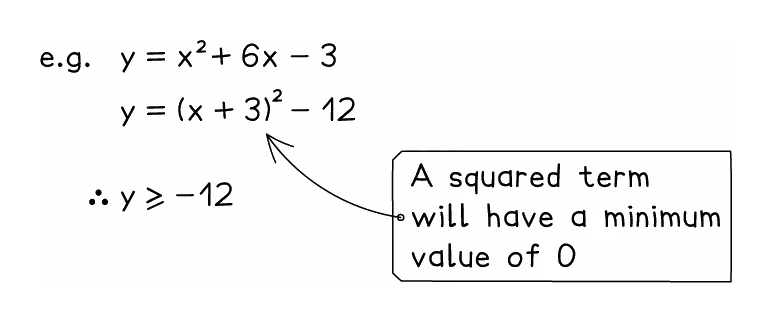
- A squared bracket can never be negative, so the smallest value it takes is zero, which happens when the bracket itself is zero
- For y = a(x + p)² + q the curve turns at (−p, q), and the minus sign in the x-coordinate is the step most often missed
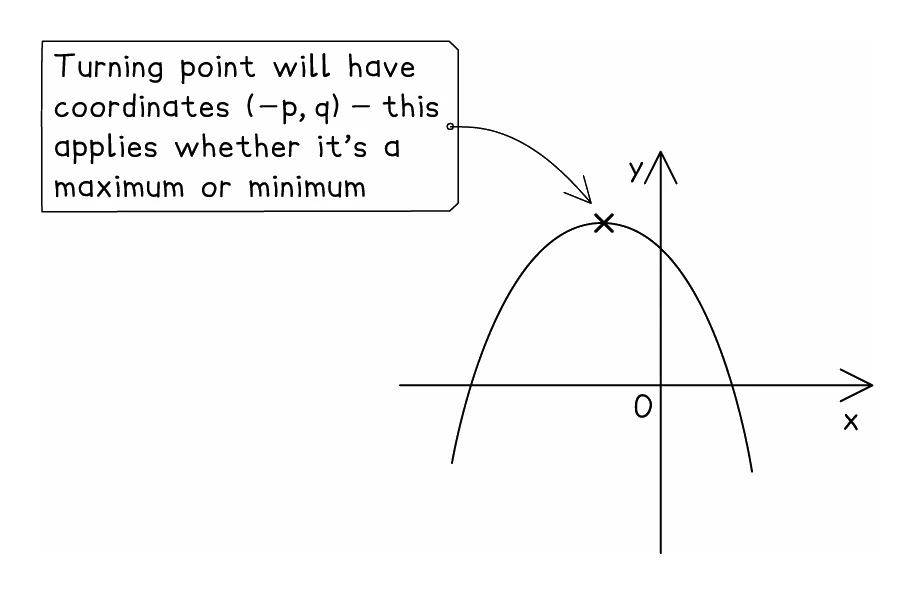
- A positive a makes that point a minimum, and a negative a makes it a maximum
- From 2(x − 3)² − 13 the bracket is zero at x = 3, so the turning point is (3, −13) and it is a minimum
- The same "a square is never negative" argument is what proves a quadratic expression is always above some value
4. Solving by completing the square
Undoing the square
- To solve, complete the square, isolate the squared bracket, then square root both signs
- Writing ± at the square root stage is what produces the two solutions; forgetting it loses one of them
- Finish by dealing with the number inside the bracket, which shifts both solutions equally
- Leave the squared bracket intact once you have it, because multiplying it out again undoes the work
- When there is a number in front of x² in an equation, you may divide every term on both sides by it first; an expression being written in completed-square form must keep it as a factor instead
Worked example
Solving and leaving the answer exact
Solve x² − 10x + 4 = 0, giving your answers in exact form.
Solution:
- "Exact" rules out a decimal, so the answer will contain a surd and completing the square gives it directly
- The coefficient of x² is already 1, so no factor needs taking out
- Halve the coefficient of x: half of −10 is −5, so the bracket is (x − 5)²
- (x − 5)² expands to x² − 10x + 25, which is 25 too many, so x² − 10x = (x − 5)² − 25
- The equation becomes (x − 5)² − 25 + 4 = 0
- Collect the constants: (x − 5)² − 21 = 0
- Add 21 to both sides to isolate the square: (x − 5)² = 21
- Take the square root of both sides, keeping both signs, since two numbers square to 21
- x − 5 = ±√21
- Add 5: x = 5 + √21 or x = 5 − √21
- Leave the surd as it stands: a decimal such as 9.58 is only an approximation, so it cannot replace the exact answer
5. The quadratic formula
Using the printed formula
- The formula is printed in the List of formulas at the front of the paper, so it does not have to be memorised
- For ax² + bx + c = 0 with a not zero, x = (−b ± √(b² − 4ac)) ÷ 2a
- Read a, b and c off the rearranged equation, taking the sign in front of each with it
- Write the substituted line out in full before evaluating anything, because that line is where the method marks sit
- Put brackets around every negative value as you substitute, since −b with b negative is a positive number
- Work the + and the − versions separately to get the two solutions
Worked example
Answers to two decimal places
Solve 3x² − 7x − 5 = 0. Give each answer correct to 2 decimal places.
Solution:
- The expression does not factorise, and the answers are wanted as decimals, so use the formula printed on page 2 of the paper
- Read the three coefficients off the equation with their signs: a = 3, b = −7, c = −5
- Substitute, putting brackets round every negative so no sign is lost
- x = (−(−7) ± √((−7)² − 4 × 3 × (−5))) ÷ (2 × 3)
- Write that whole line down before touching the calculator: a mark is given for the value under the root and another for the full substitution
- Under the root: (−7)² = 49, and −4 × 3 × (−5) = +60, so the value is 49 + 60 = 109
- x = (7 ± √109) ÷ 6, and √109 = 10.4403…
- The ± gives two answers, and both are wanted
- Plus: x = (7 + 10.4403…) ÷ 6 = 2.9067…
- Minus: x = (7 − 10.4403…) ÷ 6 = −0.5734…
- Rounded as asked: x = 2.91 or x = −0.57
- Keep the full accuracy until this last line: rounding √109 to 10.4 first gives (7 + 10.4) ÷ 6 = 2.90, which is wrong
Exact answers from the formula
- When the question asks for an exact answer, stop before rounding and simplify the surd instead
- Take out the largest square factor of the number under the root, then cancel any factor shared by every part of the fraction
- A number under the root that is a perfect square means the quadratic would have factorised, which is a useful check
- Solutions such as (7 ± √109) ÷ 6 are already exact and need no decimal at all