1. What proportion means
The symbol and the constant
- Two quantities are in proportion when a change in one forces a matching change in the other by a fixed rule
- The symbol ∝ is read "is proportional to", and knowing it is a stated requirement of the syllabus
- A statement using ∝ is not an equation, so it cannot be calculated with until it is turned into one
- Turning it into an equation introduces a fixed number, written k, that stays the same for every pair of values in the question
- Once k is known the relationship is completely determined, and any further part of the question is a substitution
The four steps that answer every question
- Write the equation with k in it, taken straight from the wording
- Substitute the pair of values you are given and solve for k
- Rewrite the equation with that number in place of k
- Use the finished equation to answer whatever the question asks next
- Marks are awarded step by step, so the equation containing k scores before any number is worked out
Worked example
The four steps in order
y is proportional to x. When x = 3, y = 12. Find y when x = 7.
Solution:
- Write the proportion statement as an equation with k in it: this line, or the next one with the given pair put in, earns the first method mark
- y = kx
- Substitute the given pair to find k: 12 = k × 3
- k = 4
- Write the full equation: y = 4x
- Substitute the new value: y = 4 × 7 = 28
- Spotting 12 ÷ 3 = 4 in your head gives the same k, but write the k line anyway: it keeps its method mark even if a later step goes wrong
2. Direct proportion
Recognising it
- In direct proportion the two quantities rise and fall together, and their ratio never changes
- Written in symbols, y ∝ x, which becomes y = kx
- Doubling one quantity doubles the other, and halving one halves the other
- Plotted on axes the relationship is a straight line through the origin, and k is its steepness
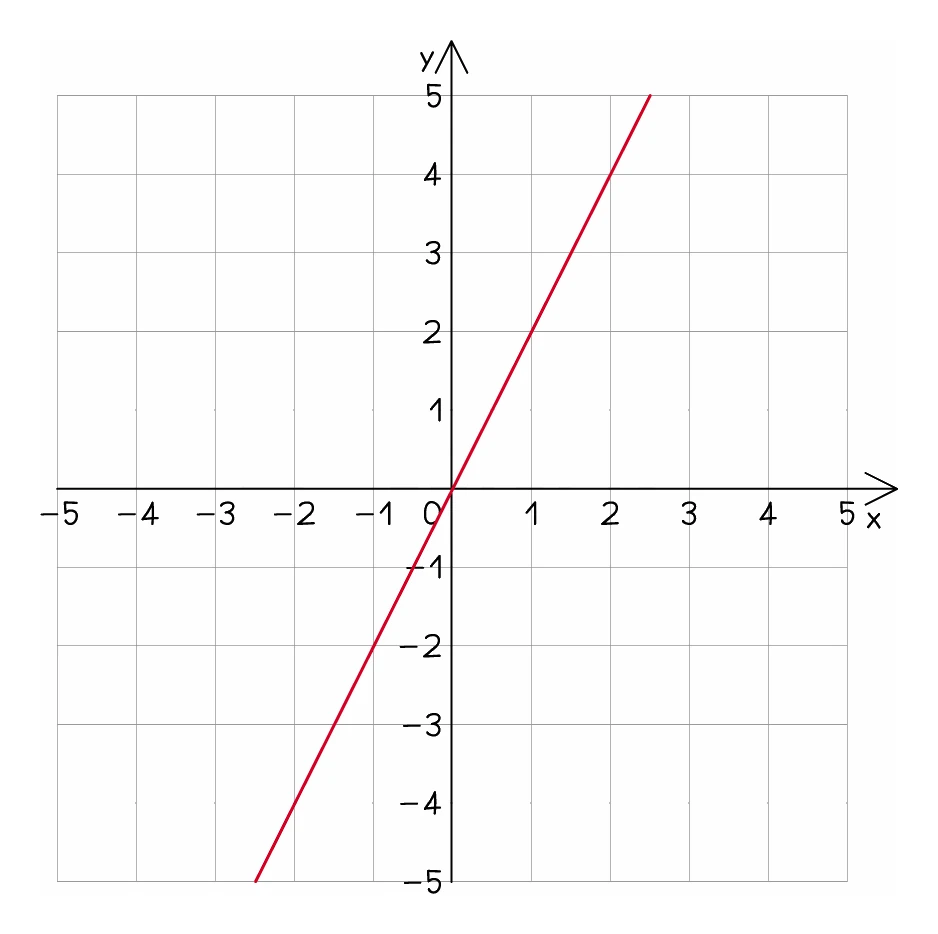
- The wording in question papers is usually just "w is proportional to x": the word "directly" is often left out altogether
Worked example
Finding the equation and using it
p is proportional to q. When q = 9, p = 45. Find p when q = 14.
Solution:
- The statement gives the equation p = kq
- Substitute the given pair: 45 = k × 9
- Divide by 9: k = 5
- The finished equation is p = 5q
- Substitute q = 14: p = 5 × 14
- So p = 70
3. Inverse proportion
Recognising it
- In inverse proportion one quantity rises as the other falls, and it is their product that stays fixed
- Written in symbols, y ∝ 1 ÷ x, which becomes y = k ÷ x
- Doubling one quantity halves the other, and multiplying one by 3 divides the other by 3
- The graph is a curve that approaches each axis without ever touching it, quite unlike the straight line of direct proportion
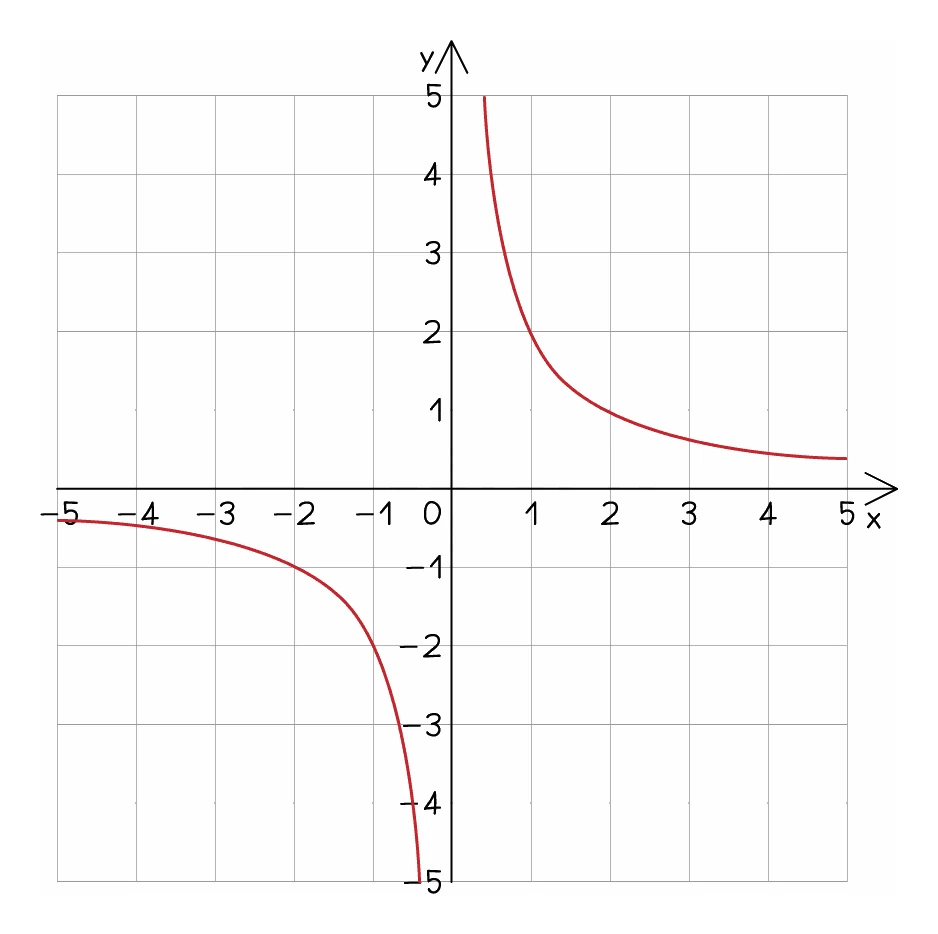
- Real contexts are usually a fixed total shared out: more workers means less time, more speed means less travelling time
Worked example
An inverse relationship
T is inversely proportional to n. When n = 5, T = 12. Find T when n = 8.
Solution:
- The statement gives the equation T = k ÷ n
- Substitute the given pair: 12 = k ÷ 5
- Multiply by 5: k = 60
- The finished equation is T = 60 ÷ n
- Substitute n = 8: T = 60 ÷ 8
- So T = 7.5
4. Powers, roots and expressions
When it is not simply x
- The syllabus allows proportion to a square, a square root, a cube or a cube root, and the method never changes
- Only the equation in step one differs, so read the wording carefully and translate it exactly
| y is proportional to… | Equation to write down |
|---|---|
| x | y = kx |
| the square of x | y = kx² |
| the square root of x | y = k√x |
| the cube of x | y = kx³ |
| the cube root of x | y = k∛x |
| y is inversely proportional to… | Equation to write down |
|---|---|
| x | y = k ÷ x |
| the square of x | y = k ÷ x² |
| the square root of x | y = k ÷ √x |
| the cube of x | y = k ÷ x³ |
| the cube root of x | y = k ÷ ∛x |
- Questions frequently use a whole expression rather than a single letter, such as being proportional to (x + 2)² or to √(t + 2)
- In that case the bracket travels through the working untouched: substitute the value of the letter into the bracket first, then work out the power or root
Worked example
Proportional to a square
y is proportional to the square of x, where x > 0. When x = 4, y = 48. Find x when y = 108.
Solution:
- The wording gives y = kx²
- Substitute the given pair: 48 = k × 4², which is 48 = 16k
- Divide by 16: k = 3
- The finished equation is y = 3x²
- Now substitute y = 108: 108 = 3x²
- Divide by 3: x² = 36
- Square root: x = 6 or x = −6, and the question says x > 0
- So x = 6
Exam tip
Two method marks before the answer
When a question asks for one new value, the second method mark is for using your own k with the new value, so finish that step even if your k looks wrong. For inverse proportion, one line of equal products earns both method marks at once. In the next example y × (x + 3)² never changes, so 2 × (1 + 3)² = y × (5 + 3)² is that line.
Worked example
Inversely proportional to a bracket
y is inversely proportional to (x + 3)². When x = 1, y = 2. Find y when x = 5.
Solution:
- The wording gives y = k ÷ (x + 3)²
- Substitute the given pair: 2 = k ÷ (1 + 3)², so 2 = k ÷ 16
- Multiply by 16: k = 32
- The finished equation is y = 32 ÷ (x + 3)²
- Substitute x = 5: y = 32 ÷ (5 + 3)² = 32 ÷ 64
- So y = 0.5