1. Combining two events
The two rules
- Where two things happen one after the other, two rules cover almost everything
- "And" means multiply, so the probability of A happening and then B is P(A) × P(B), using the probability of B once A has happened
- "Or" means add, so the probability of one case or another, when the two cannot both happen, is the sum of their probabilities
- Rephrasing a question in terms of "and" and "or" first is what turns it into a calculation
- "Both counters are red" is red and red
- "One of each colour" is red and blue or blue and red
- The probability of all the possible cases together is 1, which is a quick check on any full list
- Where a question asks for at least one, it is usually faster to work out the probability of none and subtract from 1
With and without replacement
- With replacement means the item goes back, so the second probability is the same as the first and the events are independent
- Without replacement means it does not, so the totals change and the second probability depends on what happened first
- Both the top and the bottom of the second fraction can change: the bottom always drops by one, and the top drops by one only for whatever was taken
- Keeping fractions unsimplified while working makes them far easier to add at the end
Worked example
With and without replacement
A bag holds 5 red counters and 7 blue counters. Two counters are taken. Find the probability that both are red (a) with replacement, (b) without replacement.
Solution:
- There are 5 + 7 = 12 counters, so the first pick is red with probability 5/12
- (a) With replacement, the counter goes back, so nothing changes for the second pick
- P(red then red) = 5/12 × 5/12 = 25/144
- (b) Without replacement, one red has gone, so 4 reds remain out of 11 counters
- The denominator drops by one because a counter was removed; the numerator drops only because the one removed was red
- P(red then red) = 5/12 × 4/11 = 20/132 = 5/33
- The second answer is smaller, which makes sense: removing a red makes a second red less likely
Exam tip
Two picked from a group means without replacement
Picking without replacement is set in 9 of the 21 papers, and the question does not always use those words: two people or objects chosen from a group cannot be the same one twice, so the second fraction is out of one fewer. Working the other kind of pick (with replacement for without, or the reverse) usually scores one mark at most out of three or four, so decide which kind it is before the first fraction.
2. Tree diagrams
Building one
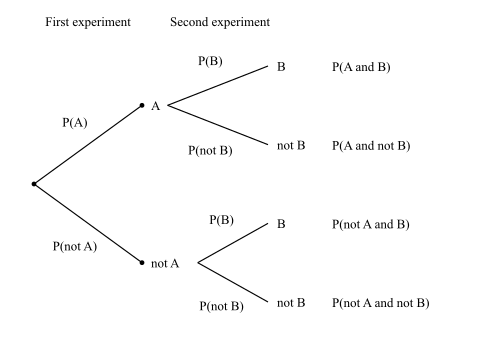
- A tree diagram sets out two or more stages, with a branch for each outcome at each stage
- The syllabus states the convention these papers follow: outcomes at the ends of the branches, probabilities beside them
- Each pair or group of branches from one point must add to 1, which fills in any missing probability
- When a question prints a tree diagram, it asks you to complete it first, and that alone carries marks
Reading one
- Follow one complete route across the diagram and multiply the probabilities you pass, which gives that path its own probability
- Add between separate paths when more than one outcome satisfies the question
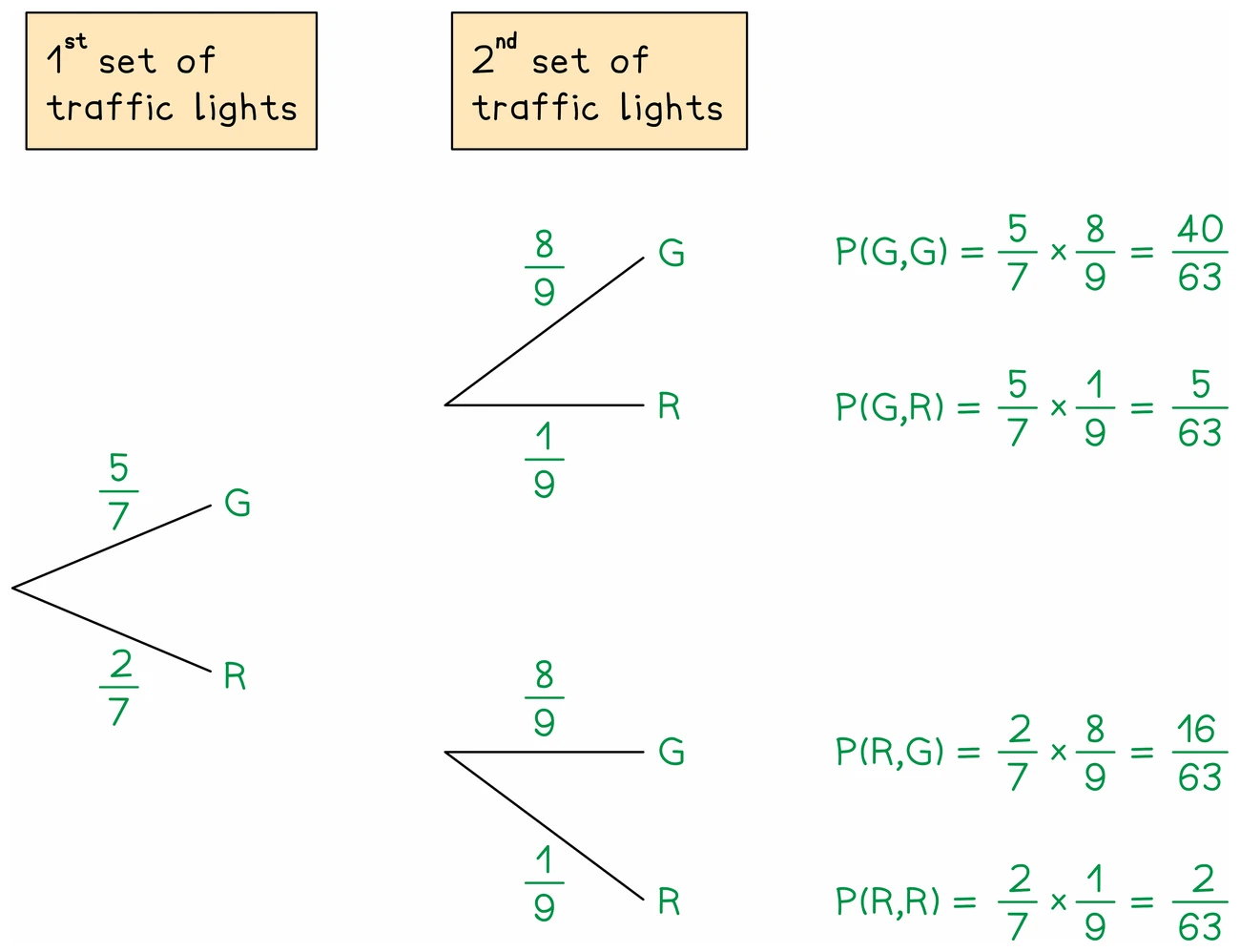
- The probabilities of all the complete paths add to 1
- For "without replacement", the second set of branches carries different numbers depending on which first branch you came along
Worked example
Two counters without replacement
A bag holds 6 green counters and 4 white counters. Two counters are taken at random without replacement. Find the probabilities that both are green, that one of each colour is taken, and that at least one is white.
Solution:
- There are 10 counters, so the first probabilities are 6/10 for green and 4/10 for white
- If a green is taken first, 5 greens and 4 whites remain out of 9
- If a white is taken first, 6 greens and 3 whites remain out of 9
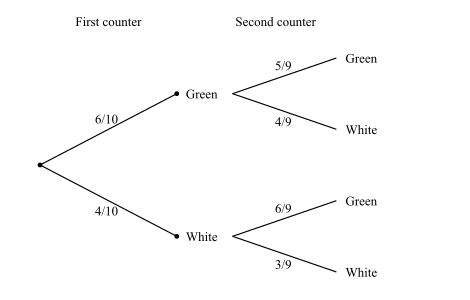
- P(both green) = 6/10 × 5/9 = 30/90, which simplifies to 1/3
- One of each means green then white or white then green
- P(one of each) = 6/10 × 4/9 + 4/10 × 6/9 = 24/90 + 24/90 = 48/90 = 8/15
- At least one white is everything except both green, so subtract from 1
- P(at least one white) = 1 − 30/90 = 60/90 = 2/3
- Check: both green, both white and one of each come to 30/90 + 12/90 + 48/90 = 1
3. Venn diagrams
Reading a probability off
- A Venn diagram may show the individual items, or just how many fall in each region
- Either way, the probability is the count in the regions you want divided by the total count
- Fill in the overlap first, then work outwards, because the numbers given usually include the overlap
- If 18 play football, 14 play tennis and 7 play both, then 11 play only football and 7 play only tennis
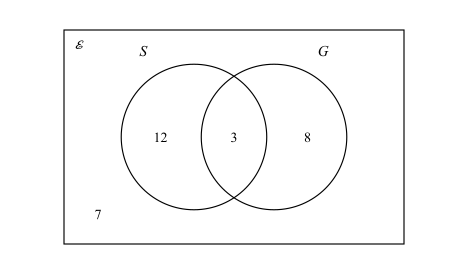
- The region outside both circles holds everything in neither, and it is easy to forget when totalling
- The notation P(A ∩ B) for "both" and P(A ∪ B) for "either" may be used
Worked example
Probabilities from a Venn diagram
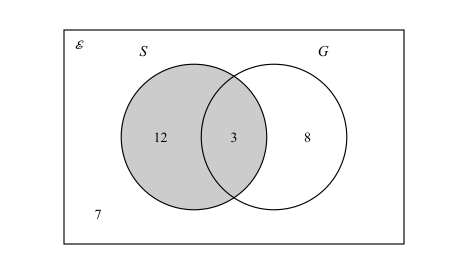
In a group of 30 students, 18 play football, 14 play tennis and 7 play both. Find the probability that a student chosen at random plays neither sport. Then two of the football players are chosen at random: what is the probability that exactly one of them also plays tennis?
Solution:
- Start with the overlap: 7 play both
- Football only = 18 − 7 = 11, and tennis only = 14 − 7 = 7
- Those three regions hold 11 + 7 + 7 = 25 students
- So the number playing neither is 30 − 25 = 5
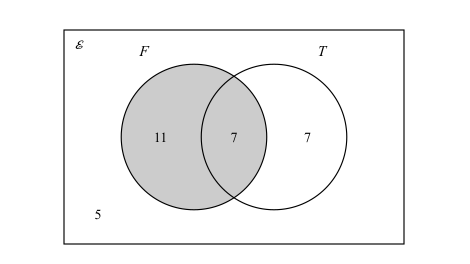
- P(neither) = 5/30 = 1/6
- For the second part, both students come from the football circle, so the first pick is out of 18, not 30
- Of those 18, the 7 in the overlap play tennis and the 11 in football only do not
- Two different students are chosen, so the second pick is out of the 17 who are left
- Exactly one plays tennis means tennis then not, or not then tennis
- P(exactly one) = 7/18 × 11/17 + 11/18 × 7/17 = 77/306 + 77/306 = 154/306 = 77/153
4. Sample space diagrams
Laying out every outcome
- Where two experiments happen together, a table shows every combination in a grid
- The syllabus calls it a sample space diagram, and a question may print it as a table of the possible outcomes, sometimes partly filled in for you to complete
- Put one experiment along the top and the other down the side, then fill each cell with the combined result
- The number of cells is the total number of outcomes, and counting the cells that satisfy an event gives the numerator
- Complete the whole grid before counting, since a systematic table makes miscounting almost impossible
- A restricted question, such as "given that the total is odd", means counting only within the cells that meet the condition