1. Primes and prime factors
Prime numbers
- Prime numbers are those divisible by nothing except themselves and 1, giving them a factor count of exactly two
- The primes begin 2, 3, 5, 7, 11, 13, 17, 19, 23, 29 and continue without end
- Every even number beyond 2 has 2 as a third factor, which leaves 2 as the sole even prime
- 1 is not prime, because it has a single factor rather than two
Prime factors
- Broken down far enough, any integer greater than 1 is a product of primes alone, and those primes are its prime factors
- 30 is built from 2, 3 and 5, since 2 × 3 × 5 = 30
- Every integer above 1 has exactly one set of prime factors, whatever route is taken to find them
- This uniqueness is what allows prime factors to be used for comparing two numbers
2. Writing a number as a product of prime factors
Building a factor tree
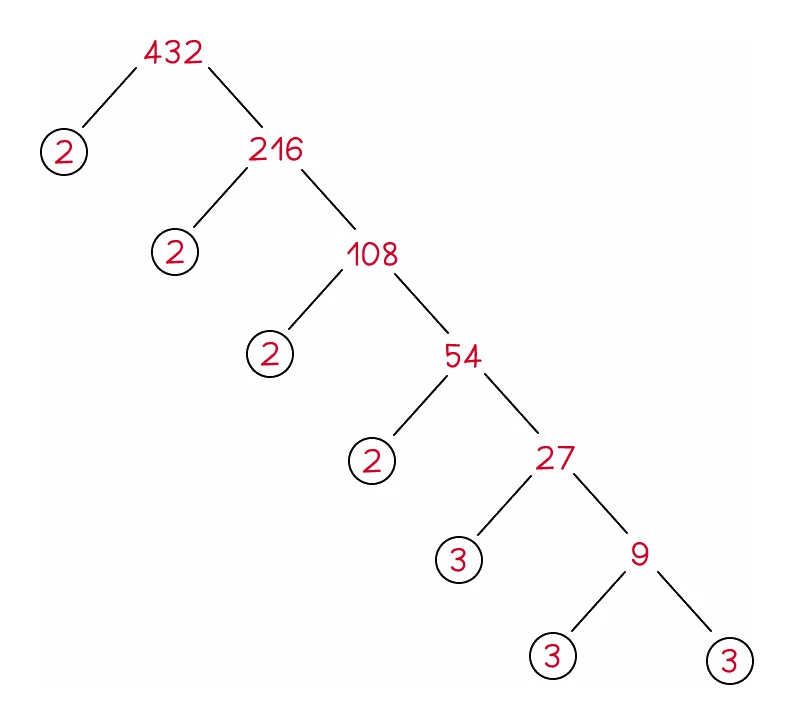
- Split the number into any factor pair, then split each factor again
- Continue down every branch until only primes remain, circling each prime as it appears
- Dividing repeatedly by the smallest prime that fits produces a prime at every stage and keeps the tree tidy
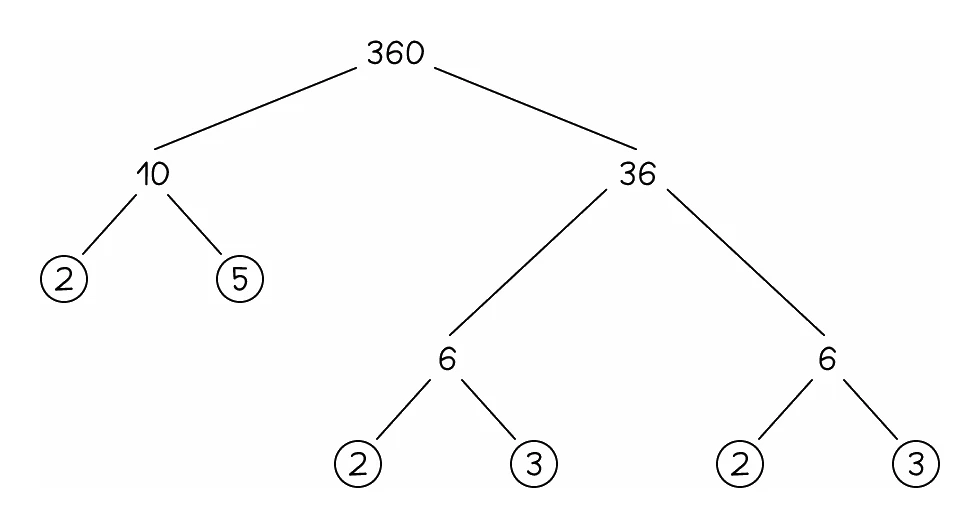
- Splitting by a convenient number such as 10 is equally valid, but non-prime results must then be split further
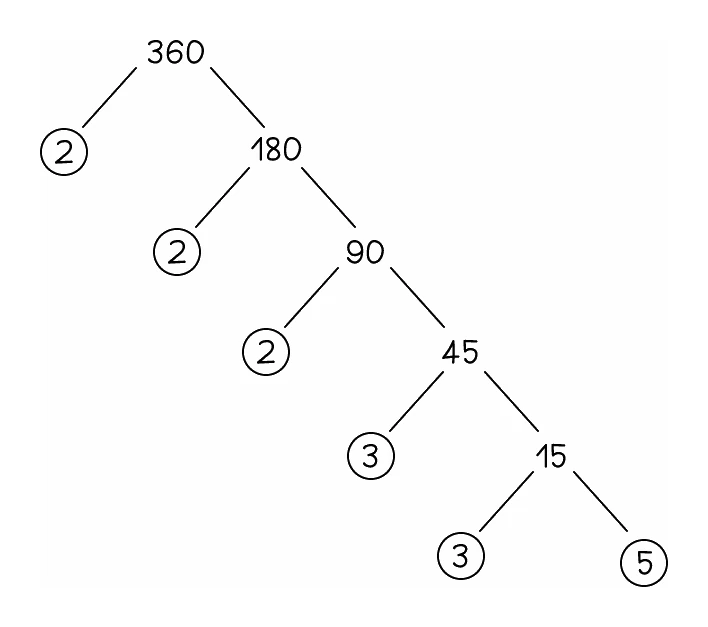
- The circled primes are the same whichever pairs were chosen
Writing the answer
- Multiply the circled primes together, writing them in ascending order
- 252 = 2 × 2 × 3 × 3 × 7
- Collect repeated primes into index form, which is the form to give whenever a question asks for index form or the simplest form
- 252 = 2² × 3² × 7
Worked example
A number as a product of its prime factors
Write 360 as a product of its prime factors, in index form.
Solution:
- Split 360 into any two factors and keep splitting until every branch ends on a prime
- 360 = 36 × 10
- 36 = 6 × 6, and each 6 = 2 × 3
- 10 = 2 × 5
- The primes at the ends of the branches are 2, 3, 2, 3, 2, 5
- Collect them in ascending order: 2 × 2 × 2 × 3 × 3 × 5
- In index form, 360 = 2³ × 3² × 5
- Check by multiplying back: 8 × 9 × 5 = 360
- Starting from a different split, such as 360 = 4 × 90, gives the same answer: the tree's shape does not matter
Worked example
A product of primes from a number already in primes
N = 2⁴ × 3 × 7. Write 18N² as a product of its prime factors, in index form.
Solution:
- There is no need to work out N: use its indices
- Squaring doubles every index (3 and 7 count as 3¹ and 7¹): N² = 2⁸ × 3² × 7²
- Only N is squared, not the 18, so write 18 in primes on its own: 18 = 2 × 3²
- Multiplying adds the indices of each prime: 2⁸ × 2 = 2⁹, 3² × 3² = 3⁴, and 7² is unchanged
- 18N² = 2⁹ × 3⁴ × 7²
3. Highest common factor and lowest common multiple
What each one means
- Where a single value divides two numbers exactly, it is a common factor of the pair, and 1 always qualifies
- The highest common factor, or HCF, is the largest such value
- A value sitting in both numbers' times tables is a common multiple
- Of the infinitely many such values, the smallest is the lowest common multiple, or LCM
- The HCF is what cancels a fraction to its simplest form; the LCM is what supplies a common denominator
Finding them by listing
- List every factor of both numbers, then take the largest value common to the two lists
- List the multiples of both, then take the smallest value common to the two lists
- Listing is quick for small numbers and unreliable for large ones
Finding them from prime factors
- Decompose both numbers into primes first
- Place the primes the two numbers share in the overlap of a Venn diagram, taking each shared prime only as many times as it appears in both
- Place the remaining primes in the outer region belonging to their own number
- Multiplying the overlap gives the HCF; multiplying everything in the whole diagram gives the LCM
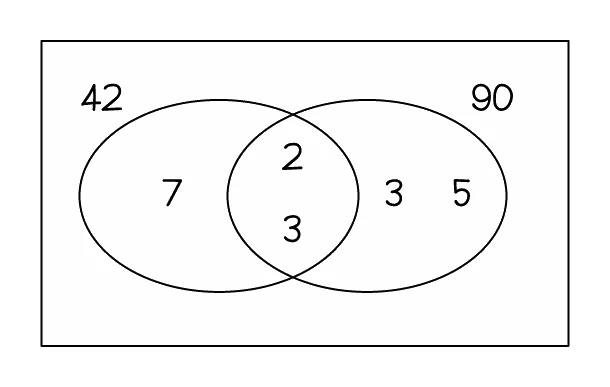
- Where no primes are shared, the overlap holds a 1 and the HCF is 1
Worked example
Finding the HCF and LCM from prime factors
Find the highest common factor and the lowest common multiple of 60 and 144.
Solution:
- Decompose each into primes
- 60 = 2² × 3 × 5
- 144 = 2⁴ × 3²
- Both contain 2 and 3. Take the lower index of each for the shared part: 2² and 3
- HCF = 2² × 3 = 12
- For the LCM collect every prime occurring anywhere, each at its highest index: 2⁴, 3² and 5
- LCM = 16 × 9 × 5 = 720
Exam tip
Keep the prime factor working on the page
Before you give an HCF or LCM, write both numbers as products of primes, or draw a factor tree or division table for each, splitting right down to primes. That working earned a mark on its own even when the final answer was wrong. The same holds when a single number has to be written as a product of primes: a correct tree or table earned a mark there too.
Worked example
HCF and LCM of algebraic terms
Find the highest common factor and the lowest common multiple of 20p⁴q² and 30p³q⁵.
Solution:
- Deal with the number part and each letter separately
- 20 = 2² × 5 and 30 = 2 × 3 × 5, so the numbers have HCF 2 × 5 = 10 and LCM 2² × 3 × 5 = 60
- For the HCF, each letter takes its lower power: p³ and q²
- HCF = 10p³q²
- For the LCM, each letter takes its higher power: p⁴ and q⁵
- LCM = 60p⁴q⁵
- Check: 20p⁴q² = 10p³q² × 2p and 30p³q⁵ = 10p³q² × 3q³, and 2p and 3q³ share no factor, so no larger term divides both
4. Using prime factor decomposition
Recognising squares and cubes
- A number is a square number exactly when every index in its prime factor decomposition is even
- 1225 = 5² × 7², so it is a square
- A number is a cube number exactly when every index is a multiple of 3
- 3375 = 3³ × 5³, so it is a cube
- This test settles the question without any square rooting
Finding a square root from prime factors
- Halve every index, then multiply the result out
- 1225 = 5² × 7², so its square root is 5 × 7 = 35
- The same idea works for a cube root by dividing every index by 3
- 3375 = 3³ × 5³, so its cube root is 3 × 5 = 15
Finding an exact square root that is not an integer
- Where the indices are not all even, split off the largest even part of each
- Group the even-indexed primes together, since those come out of the root whole
- Whatever is left stays under the root sign as a surd
- 300 = 2² × 3 × 5², which regroups as (2² × 5²) × 3
- The square part gives 2 × 5 = 10, leaving √300 = 10√3
- This is how an exact answer is produced on the non-calculator papers, where a decimal would not be accepted as exact
Worked example
A square root from prime factors
Given that 3600 = 2⁴ × 3² × 5², find √3600 without a calculator.
Solution:
- A square root halves every index, so pair the primes up
- 2⁴ becomes 2², 3² becomes 3¹, and 5² becomes 5¹
- √3600 = 2² × 3 × 5
- 4 × 3 × 5 = 60
- Every index in 3600 is even, which is exactly what makes it a square number
- Check: 60 × 60 = 3600