1. Powers and roots
Powers
- A power, also called an index or exponent, is shorthand for repeated multiplication of one value by itself
- 7² means 7 × 7
- 2⁴ means 2 × 2 × 2 × 2
- The number being multiplied is the base, and the raised number is the index
- Any number raised to the power 1 is unchanged
- Any non-zero number raised to the power 0 equals 1
Square roots
- Taking a square root reverses squaring
- Squaring destroys sign, so two different values square to the same positive result
- 9 and −9 both square to 81, and each therefore counts as a square root of 81
- The symbol √ denotes the positive square root only
- √81 = 9
- Writing ± in front of the symbol calls for both roots
- ±√81 = ±9
- No negative number has a real square root, since no real number squares to give a negative
- A root that is not exact can be trapped between the two nearest whole roots
- 16 and 25 are the square numbers either side of 20, so √20 lies between 4 and 5
Cube roots and higher roots
- A cube root reverses cubing, and every number has exactly one real cube root
- ∛216 = 6, and ∛(−216) = −6
- Cubing preserves sign, which is why negatives cause no difficulty here
- An nth root is the value that, raised to the power n, returns the original number
- An even value of n behaves like the square root: two real roots for a positive number, none for a negative
- An odd value of n behaves like the cube root: exactly one real root, of the same sign as the number
2. Square and cube numbers
Recognising them
- Multiplying any integer by itself produces a square number
- Recognising them on sight is what makes surds, factorising and Pythagoras quick, so the first fifteen are worth committing to memory
| n | 1 | 2 | 3 | 4 | 5 | 6 | 7 | 8 | 9 | 10 | 11 | 12 | 13 | 14 | 15 |
|---|---|---|---|---|---|---|---|---|---|---|---|---|---|---|---|
| n² | 1 | 4 | 9 | 16 | 25 | 36 | 49 | 64 | 81 | 100 | 121 | 144 | 169 | 196 | 225 |
- Multiplying an integer by itself twice over produces a cube number
| n | 1 | 2 | 3 | 4 | 5 | 10 |
|---|---|---|---|---|---|---|
| n³ | 1 | 8 | 27 | 64 | 125 | 1000 |
- The square root of an integer that is not a square number is irrational, and is called a surd
- √11 is a surd, whereas √121 is simply 11
3. Laws of indices
The rules
- The multiplying and dividing laws apply only where the terms share the same base
| Law | What it does | Example |
|---|---|---|
| aᵐ × aⁿ = aᵐ⁺ⁿ | Multiplying adds the indices | 5⁶ × 5³ = 5⁹ |
| aᵐ ÷ aⁿ = aᵐ⁻ⁿ | Dividing subtracts the indices | 9⁷ ÷ 9⁴ = 9³ |
| (aᵐ)ⁿ = aᵐⁿ | A power of a power multiplies the indices | (2⁵)³ = 2¹⁵ |
| (ab)ⁿ = aⁿbⁿ | A power spreads across a product | (4 × 7)² = 4² × 7² |
| a⁰ = 1 | Any non-zero base to the power 0 | 12⁰ = 1 |
| a⁻ⁿ = 1 ÷ aⁿ | A negative index gives the reciprocal | 3⁻² = 1/9 |
| a^(1/n) = ⁿ√a | A unit fraction index is a root | 16^(1/2) = 4 |
| a^(m/n) = (ⁿ√a)ᵐ | Root first, then power | 27^(2/3) = 3² = 9 |
- Taking the root before applying the power keeps the numbers small, which matters without a calculator
- A negative index never makes the answer negative: it makes it a reciprocal
Worked example
Negative and fractional powers by hand
Without a calculator, find the value of 64^(−2/3) and 81^(3/4).
Solution:
- Leave the minus sign until last: 64^(−2/3) = 1 ÷ 64^(2/3)
- The denominator of the index is 3, so take the cube root: ∛64 = 4
- The numerator is 2, so square the result: 4² = 16
- So 64^(2/3) = 16, and 64^(−2/3) = 1/16
- For 81^(3/4), the denominator 4 means a fourth root: 3⁴ = 81, so ⁴√81 = 3
- The numerator 3 means cube it: 3³ = 27
- Rooting first keeps the numbers small: cubing 81 first gives 531 441, whose fourth root is far harder to find by hand
Exam tip
Write down the root or the reciprocal step
When finding a fractional or negative power is worth two marks, one is for a written step and one for the exact answer. For a positive fractional power the root on its own scored (∛216 = 6 for 216^(2/3)); for a negative power the step that scored was the reciprocal, such as 1/3³ or 27⁻¹ for 9^(−3/2). Write that line before the final value: if the last step slips, it still earns a mark.
Making the bases match
- Where the two bases differ but one is a power of the other, rewrite so that they match, and the laws then apply
- 4 = 2², so 2⁵ × 4³ = 2⁵ × (2²)³ = 2⁵ × 2⁶ = 2¹¹
- Powers of 2, 3, 5 and 7 are the ones worth recognising, since those are the bases questions use most
- Bases with no such relationship stay apart, so 2³ × 5² cannot be shortened by these laws at all
Worked example
Using the laws, and matching the bases
Simplify 2⁵ × 2³ ÷ 2², and solve 4ˣ = 8.
Solution:
- Multiplying powers of the same base adds the indices: 2⁵ × 2³ = 2⁸
- Dividing subtracts them: 2⁸ ÷ 2² = 2⁶
- So the expression is 2⁶, which is 64
- For the equation, the two sides have different bases, so rewrite both as powers of 2
- 4 = 2², so 4ˣ = (2²)ˣ = 2²ˣ, and 8 = 2³
- The equation becomes 2²ˣ = 2³
- Equal powers of the same base must have equal indices, so 2x = 3 and x = 1.5
4. Standard form
The required shape
- Standard form writes a number as a × 10ⁿ, where n is an integer and a satisfies 1 ⩽ a < 10
- The condition on a is what makes the form standard: exactly one non-zero digit sits before the decimal point
- The sign of n records the size of the number
- n is positive for numbers of 10 or more
- n is zero for numbers from 1 up to but not including 10
- n is negative for numbers between 0 and 1
Writing a number in standard form
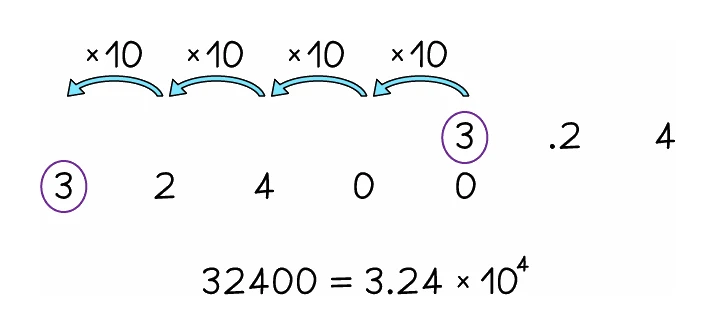
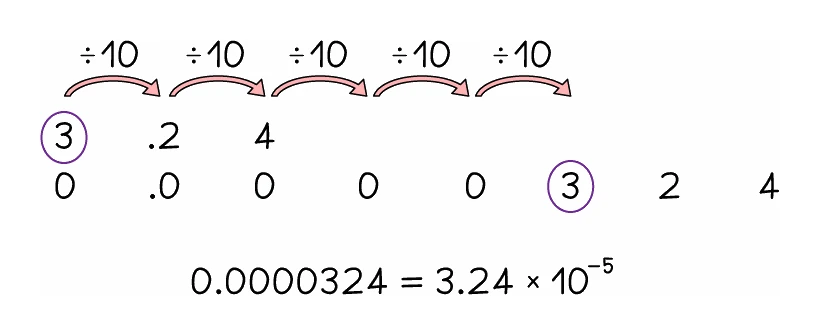
- Place the decimal point so that one non-zero digit lies in front of it, giving a
- Count how many places the digits moved: that count is n
- Moving the point left gives a positive index, moving it right gives a negative one
- 68 500 becomes 6.85 × 10⁴
- 0.00092 becomes 9.2 × 10⁻⁴
Worked example
Writing numbers in standard form
Write 62 700 000 and 0.000 47 in standard form.
Solution:
- Standard form is a × 10ⁿ with 1 ⩽ a < 10
- For 62 700 000, put the point after the first non-zero digit: 6.27
- Count how far the point moved: from after the last zero to after the 6 is 7 places left
- Moving left means a positive index, so 62 700 000 = 6.27 × 10⁷
- For 0.000 47, the first non-zero digit is 4, giving 4.7
- The point moved 4 places right, and moving right means a negative index
- 0.000 47 = 4.7 × 10⁻⁴
- Check each by counting back: 6.27 with the point moved 7 places right rebuilds 62 700 000
5. Calculating in standard form
Multiplying and dividing
- Deal with the ordinary numbers and the powers of ten separately
- Multiply or divide the ordinary numbers as usual
- Add the indices when multiplying, and subtract them when dividing
- Check the result is still in standard form, and correct it if not
- (5 × 10⁴) × (3 × 10⁶) gives 15 × 10¹⁰, which is rewritten as 1.5 × 10¹¹
- (8 × 10³) ÷ (2 × 10⁷) gives 4 × 10⁻⁴, which already qualifies
- Subtracting a negative index is where sign errors appear, so write the subtraction out in full
Worked example
Dividing when the result needs rewriting
Work out (1.2 × 10⁻²) ÷ (4 × 10³), giving the answer in standard form.
Solution:
- Divide the ordinary numbers: 1.2 ÷ 4 = 0.3
- Subtract the indices: −2 − 3 = −5, giving 10⁻⁵
- This gives 0.3 × 10⁻⁵, which is not standard form because 0.3 is below 1
- Write 0.3 as 3 × 10⁻¹, so the result becomes 3 × 10⁻¹ × 10⁻⁵
- Add the indices: 3 × 10⁻⁶
Adding and subtracting
- Powers of ten cannot be added, so the two numbers must first be written with the same index
- Rewrite the smaller number using the larger number's index, then add or subtract the ordinary parts
- Restore standard form at the end if the result has drifted outside the range for a
Worked example
Adding two numbers in standard form
Work out (4.2 × 10⁵) + (3.5 × 10⁴), giving the answer in standard form.
Solution:
- The indices differ, so rewrite the second number with an index of 5
- 3.5 × 10⁴ = 0.35 × 10⁵
- Add the ordinary parts: 4.2 + 0.35 = 4.55
- This gives 4.55 × 10⁵
- Since 4.55 lies between 1 and 10, the answer is already in standard form: 4.55 × 10⁵