1. Place value
Reading the value of a digit
- Place value is the value a digit carries because of where it sits in a number
- Each column is worth ten times the column immediately to its right
- In 5 273, the digits are worth 5 thousands, 2 hundreds, 7 tens and 3 ones
- The value of a digit is the digit itself multiplied by its column heading
- The 2 in 5 273 is worth 200, not 2
- Large numbers are written with a thin space every three digits, counting leftwards from the ones column
- 41276309 is written 41 276 309
- Reading in words follows the same grouping: 41 276 309 is forty-one million, two hundred and seventy-six thousand, three hundred and nine
Place value after the decimal point
- The decimal point separates two parts: whole units sit to its left, and fractions of a unit to its right
- The columns after the point are tenths, hundredths, thousandths, and so on
- In 8.407, the 4 is worth 4 tenths, the 0 is worth 0 hundredths and the 7 is worth 7 thousandths
- A decimal is read digit by digit after the point: 8.407 is read as eight point four zero seven
- Zeros between the point and a non-zero digit are not optional, because they hold the later digits in their columns
- 0.07 and 0.7 differ by a factor of ten
Worked example
Reading a large number
Write 6 208 034 in words, and write down the value of the digit 2.
Solution:
- Group the digits in threes from the right: 6 | 208 | 034
- The groups are millions, thousands and ones
- In words: six million, two hundred and eight thousand and thirty-four
- The 2 sits in the hundred-thousands column, so its value is 200 000
- The zeros are not optional: they hold the 8 in the thousands column and the 3 in the tens column
2. Ordering numbers
Putting numbers in order
- Ascending order runs from smallest to largest; descending order runs from largest to smallest
- To compare whole numbers, compare the highest place value first, then work rightwards until the digits differ
- To compare decimals, give every number the same number of decimal places by padding with zeros
- 3.6, 3.58 and 3.605 become 3.600, 3.580 and 3.605, so the order is 3.58, 3.6, 3.605
- Length of a decimal is not a guide to its size: 0.9 is larger than 0.4999
Ordering negative numbers
- On a number line, values increase from left to right, so any negative number is smaller than any positive number
- Among negatives, the further a number is from zero, the smaller its value
- −11 is smaller than −4
- With a mixed list, order the negatives and the positives separately, then place all the negatives first
Worked example
Ordering a mixed list of decimals
Write these numbers in ascending order: 0.62, −1.4, 0.7, −0.35, 1.08, −1.09
Solution:
- Separate the signs: negatives are −1.4, −0.35, −1.09; positives are 0.62, 0.7, 1.08
- Pad the negatives to the same number of decimal places: −1.40, −0.35, −1.09
- The further from zero, the smaller the value, so the negatives run −1.40, −1.09, −0.35
- Pad the positives: 0.62, 0.70, 1.08, which are already in order
- Ascending order: −1.4, −1.09, −0.35, 0.62, 0.7, 1.08
3. Types of number
Integers and natural numbers
- The integers run in both directions from zero without fractional parts: … −3, −2, −1, 0, 1, 2, 3 …
- Counting from 1 upwards gives the natural numbers 1, 2, 3, 4, …, a set that leaves zero out
- A number written as a decimal or a fraction is only an integer if it simplifies to a whole number
- 18/3 is an integer because it equals 6
Multiples
- A multiple of an integer is the result of multiplying it by a positive integer
- The multiples of 7 are 7, 14, 21, 28, 35, …
- A common multiple of two integers is a multiple of both
- 24 is a common multiple of 6 and 8
- Multiples can be written algebraically: the multiples of n are n, 2n, 3n, 4n, …
Factors
- A factor of an integer divides into it exactly, leaving no remainder
- Beyond 1, no integer has fewer than two factors, since 1 and the number itself always divide it
- Factors are found in pairs, which is why testing only up to the square root is enough
- For 24: 1 × 24, 2 × 12, 3 × 8, 4 × 6, giving factors 1, 2, 3, 4, 6, 8, 12, 24
- A common factor of two integers is a factor of both
- 5 is a common factor of 20 and 35
Divisibility tests
- Divisibility tests decide whether a number is a factor without dividing, which matters on the non-calculator papers
| Divisible by | Test | Example |
|---|---|---|
| 2 | Last digit is even | 4 918 |
| 3 | Digit sum is a multiple of 3 | 5 121, since 5+1+2+1 = 9 |
| 4 | Last two digits form a multiple of 4 | 7 316, since 16 ÷ 4 = 4 |
| 5 | Last digit is 0 or 5 | 8 470 |
| 6 | Passes both the 2 test and the 3 test | 2 934 |
| 8 | Last three digits form a multiple of 8 | 9 512, since 512 ÷ 8 = 64 |
| 9 | Digit sum is a multiple of 9 | 6 741, since 6+7+4+1 = 18 |
| 10 | Last digit is 0 | 3 250 |
Primes, squares, cubes and roots
- A prime number has exactly two factors, 1 and itself
- Among the primes only 2 is even, since every other even number has 2 as a third factor
- 1 is not prime, because it has only one factor
- A square number is an integer multiplied by itself: 1, 4, 9, 16, 25, 36, …
- A cube number is an integer multiplied by itself twice: 1, 8, 27, 64, 125, …
- The square root of a number is the value that squares to give it, written √
- √49 = 7, because 7² = 49
- The cube root reverses cubing, written ∛
- ∛125 = 5, because 5³ = 125
Worked example
Factors, multiples and primes
Write down all the factors of 36. State which of them are prime, and write down the first three common multiples of 4 and 6.
Solution:
- Find the factors in pairs: 1 × 36, 2 × 18, 3 × 12, 4 × 9, 6 × 6
- The pairs stop once they meet, at 6 × 6, so nothing beyond 6 needs testing
- The factors are 1, 2, 3, 4, 6, 9, 12, 18, 36
- Test each for exactly two factors: 1 has one factor, 4 has three, 9 has three
- The prime factors are 2 and 3
- For the common multiples, list each set: 4, 8, 12, 16, 20, 24, 28, 32, 36 and 6, 12, 18, 24, 30, 36
- The first three values in both lists are 12, 24 and 36
4. Negative numbers
Adding and subtracting
- A subtracted negative reverses into an addition
- 8 − (−5) = 8 + 5 = 13
- An added negative reverses into a subtraction
- 6 + (−9) = 6 − 9 = −3
- Two signs written next to each other collapse to one: two like signs give a plus, two unlike signs give a minus
Multiplying and dividing
- Matching signs on the two values produce a positive result
- (−7) × (−3) = 21 and (−24) ÷ (−6) = 4
- Opposing signs produce a negative result
- (−7) × 3 = −21 and 24 ÷ (−6) = −4
- With a longer product, count the negative factors: an even count gives a positive, an odd count gives a negative
Negatives in context
- Temperature below zero is the most common context
- A temperature of 2 °C falling by 9 °C gives 2 − 9 = −7 °C
- Money owed is written as a negative balance
- A balance of −£150 that receives a £90 repayment becomes −150 + 90 = −£60
- Depth below sea level and floors below ground are also recorded as negatives
Worked example
Calculations with negative numbers
Work out each of the following. (a) (−6) + 11 (b) 4 − (−7) (c) (−5) × (−8) (d) 36 ÷ (−9)
Solution:
- (a) Adding a positive moves up the number line: −6 + 11 = 5
- (b) The subtracted negative reverses to an addition: 4 + 7 = 11
- (c) Both factors are negative, so the result is positive: 5 × 8 = 40
- (d) The signs differ, so the result is negative: 36 ÷ 9 = 4, giving −4
5. Reciprocals
Finding a reciprocal
- Inverting a number gives its reciprocal: 1 is divided by the number, and the result is what the original must be multiplied by to reach 1
- Every non-zero value and its reciprocal have a product of exactly 1
- For a fraction, numerator and denominator swap places
- Inverting 3/8 gives 8/3
- The reciprocal of an integer n is 1/n
- The reciprocal of 5 is 1/5
- A decimal is easiest to invert by first writing it as a fraction
- 0.4 = 2/5, so its reciprocal is 5/2 = 2.5
- Zero has no reciprocal, because division by zero is undefined
- In index form the reciprocal of a is a⁻¹
Worked example
Finding the reciprocal of a mixed number
Write down the reciprocal of 2 1/4.
Solution:
- Convert the mixed number to a top-heavy fraction: 2 1/4 = 9/4
- Swap numerator and denominator: the reciprocal is 4/9
- Check: 9/4 × 4/9 = 36/36 = 1
6. Mathematical symbols
Symbols to recognise
| Symbol | Meaning | Example |
|---|---|---|
| = | is equal to | 4x + 1 = 9 |
| ≠ | is not equal to | 5 − 2 ≠ 2 − 5 |
| ≈ | is approximately equal to | π ≈ 3.14 |
| ≡ | is identically equal to | 6x + 9 ≡ 3(2x + 3) |
| > | is greater than | 7 > −1 |
| < | is less than | −4 < 0 |
| ⩾ | is greater than or equal to | x ⩾ 2 |
| ⩽ | is less than or equal to | x ⩽ 10 |
| ± | plus or minus | x = 4 ± 3 means x = 7 or x = 1 |
- Brackets group part of a calculation so it is carried out first
- Indices, also called powers, show repeated multiplication: 2⁵ = 2 × 2 × 2 × 2 × 2 = 32
- An identity written with ≡ holds for every value of the letter, whereas an equation written with = holds only for particular values
Words used for the four operations
| Operation | Words used in questions |
|---|---|
| Addition | total, sum, plus, increase by |
| Subtraction | take away, difference, less than, minus |
| Multiplication | product, lots of, times |
| Division | share, per, quotient, divide |
7. Addition and subtraction
Column addition
- Write the numbers one above the other with the place-value columns lined up
- Add each column working right to left
- When a column totals ten or more, write the ones digit below the line and carry the tens digit into the next column
Column subtraction
- Write the number being subtracted underneath the number it is taken from
- Work right to left, and where the upper digit is too small, exchange one unit down from the neighbouring column
- Exchanging turns one unit of the left-hand column into ten of the current column
Worked example
Column addition with carrying
Work out 4 726 + 895 without a calculator.
Solution:
- Estimate first: 4 700 + 900 = 5 600
- Ones: 6 + 5 = 11, so write 1 and carry 1
- Tens: 2 + 9 + 1 = 12, so write 2 and carry 1
- Hundreds: 7 + 8 + 1 = 16, so write 6 and carry 1
- Thousands: 4 + 1 = 5
- The total is 5 621, which is close to the estimate of 5 600
8. Multiplication and division
Column multiplication
- Multiply the top number by each digit of the bottom number in turn, working right to left
- Write a zero as a place holder for each column moved leftwards through the bottom number
- Add the partial products to reach the final answer
The grid method
- The grid method splits each number into its place-value parts, so no carrying is needed until the final addition
- For 246 × 34, split 246 into 200, 40 and 6, and 34 into 30 and 4
| × | 200 | 40 | 6 |
|---|---|---|---|
| 30 | 6 000 | 1 200 | 180 |
| 4 | 800 | 160 | 24 |
- Adding every cell gives 6 000 + 1 200 + 180 + 800 + 160 + 24 = 8 364
The lattice method
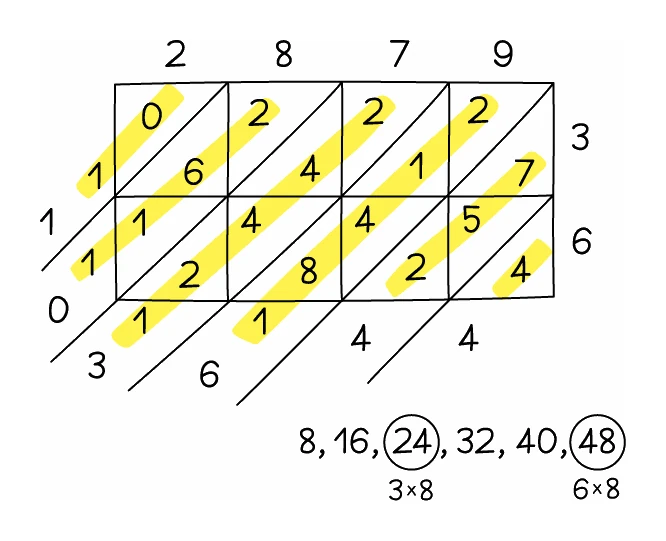
- Every product stays a single-digit pair in this layout, which is what makes it reliable for longer numbers
- Each cell is split by a diagonal, with the tens digit above the diagonal and the ones digit below
- The digits are then summed along each diagonal, carrying leftwards where a diagonal totals ten or more
Short division
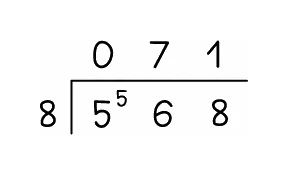
- Short division divides by a single digit, carrying any remainder into the next digit of the number
- The remainder at each step is written as a small digit in front of the next digit
- Only one written method for each operation needs to be known, provided it is used accurately
Shortcuts worth spotting
- Multiplying or dividing by a power of ten shifts every digit along the place-value columns, one column for each zero
- 380 ÷ 10 = 38, 45 ÷ 100 = 0.45 and 28 ÷ 1000 = 0.028
- 3.7 × 100 = 370
- Writing the leading zeros in first makes the shift easier to see, so 0028 ÷ 1000 becomes 0.028
- A division by a larger number can be simplified first, exactly as a fraction is cancelled
- 1008 ÷ 28 is 1008/28, which halves to 504/14 and again to 252/7, and short division finishes it as 36
- Halving repeatedly divides by a power of 2, so 568 ÷ 8 is 284, then 142, then 71
Worked example
A long multiplication and a short division
Without a calculator, work out 384 × 27 and 4 718 ÷ 7.
Solution:
- For the multiplication, split 27 into 20 and 7 and multiply separately
- 384 × 20 = 7 680
- 384 × 7 = 2 688
- Add the partial products: 7 680 + 2 688 = 10 368
- Estimate as a check: 400 × 27 = 10 800, so 10 368 is sensible
- For the division, work left to right carrying each remainder
- 7 into 4 does not go, so carry the 4 onto the next digit to make 47
- 7 into 47 goes 6 times with 5 left over, so write 6 and carry the 5 onto the 1 to make 51
- 7 into 51 goes 7 times with 2 left over, so write 7 and carry the 2 onto the 8 to make 28
- 7 into 28 goes 4 times exactly
- The answer is 674, and 7 × 674 = 4 718 confirms it
9. Operations with decimals
Adding and subtracting decimals
- Line the decimal points up underneath one another before adding or subtracting
- Fill any short columns with zeros so every number has the same number of decimal places
- The decimal point in the answer sits directly below the points in the question
Multiplying decimals
- Multiplying by a power of ten turns a decimal into an integer, and the change is undone at the end
- For 1.4 × 2.05, work out 14 × 205 = 2 870, then divide by 10 and by 100 to give 2.87
- Counting decimal places gives the same result: the answer has as many decimal places as the two numbers together
- 1.4 has one and 2.05 has two, so the answer has three before trailing zeros are removed
- An estimate settles where the point belongs: 1.4 × 2.05 is roughly 1.5 × 2 = 3, so 2.87 is sensible and 28.7 is not
Dividing decimals
- Multiply both numbers by the same power of ten until the divisor is a whole number
- 3.15 ÷ 0.05 becomes 315 ÷ 5 = 63
- The answer is unchanged because both numbers were scaled equally
Worked example
Subtracting decimals by exchanging
A length of ribbon measures 7.5 m. A piece measuring 0.86 m is cut off. Work out the length remaining.
Solution:
- Estimate first: 7.5 − 0.9 = 6.6 m
- Write 7.5 as 7.50 so both numbers have two decimal places
- Hundredths: 0 is smaller than 6, so exchange from the tenths column, giving 10 − 6 = 4
- Tenths: 4 is smaller than 8, so exchange from the ones column, giving 14 − 8 = 6
- Ones: 6 − 0 = 6
- The remaining length is 6.64 m, which is close to the estimate
10. Order of operations
BIDMAS
- Operations are carried out in a fixed order, remembered as BIDMAS or BODMAS
| Letter | Stands for | Note |
|---|---|---|
| B | Brackets | Innermost brackets first |
| I | Indices | Powers and roots |
| D M | Division and Multiplication | Equal rank, worked left to right |
| A S | Addition and Subtraction | Equal rank, worked left to right |
- Division and multiplication share a rank, so 24 ÷ 6 × 2 is 8, not 2
- Addition and subtraction likewise share a rank, so 10 − 4 + 3 is 9, not 3
Hidden brackets in fractions and roots
- A fraction line acts as a bracket around the whole numerator and the whole denominator
- (7 + 5)/(9 − 3) is worked as 12 ÷ 6 = 2
- A root sign acts as a bracket around everything underneath it
- √(9 + 16) is √25 = 5, which is not the same as √9 + √16 = 7
- These brackets have to be typed in explicitly on a calculator, because the layout that makes them obvious on paper is lost on the keypad
Worked example
Applying BIDMAS
Work out (9 − 4) + 3 × 2³.
Solution:
- Brackets first: 9 − 4 = 5, so the calculation becomes 5 + 3 × 2³
- Indices next: 2³ = 8, giving 5 + 3 × 8
- Multiplication before addition: 3 × 8 = 24, giving 5 + 24
- Addition last: 5 + 24 = 29
11. Rational and irrational numbers
Rational numbers
- Any value expressible as one integer over another, with a non-zero denominator, is a rational number
- Every integer is rational, because it can be written over a denominator of 1
- Every terminating decimal is rational
- 0.35 = 7/20
- Every recurring decimal is rational
- 0.333… = 1/3
Irrational numbers
- An irrational number admits no such integer-over-integer form
- Its decimal form never terminates and never settles into a repeating block
- The square root of a positive integer that is not a square number is irrational, and is called a surd
- √7 is irrational, but √36 is not, because it equals 6
- π is irrational
- A non-zero rational number multiplied by an irrational number is still irrational
- 5√2 and π/4 are both irrational
Worked example
Naming an irrational number in a range
Write down an irrational number between 3 and 4. Explain how you know it is irrational.
Solution:
- Square both ends of the range: 3² = 9 and 4² = 16
- Any square root of a number between 9 and 16 therefore lies between 3 and 4
- Choose a value in that range that is not a square number, such as 10
- √10 is one possible answer, and √11, √12, √13, √14 and √15 all work equally well
- It is irrational because 10 is not a square number, so its square root neither terminates nor recurs
- √16 would not do, because 16 is a square number and √16 = 4, which is rational