1. Turning words into algebra
Naming the unknown
- Choose a letter for the quantity you do not know, and state what it represents together with its units
- Where two quantities are related, define the simpler one first and build the other from it
- If a second number is 5 more than the first, call them n and n + 5
Translating common phrases
| Phrase | Expression |
|---|---|
| 4 more than a number | n + 4 |
| 7 less than a number | n − 7 |
| Three times a number | 3n |
| A number halved | n/2 |
| A number squared, then doubled | 2n² |
- Words signalling each operation: sum, total and increase for addition; difference, less than and decrease for subtraction; product, times and double for multiplication; shared, split and halved for division
- Brackets preserve the order the words describe
- "add 1, then multiply by 3" is 3(n + 1), which differs from "multiply by 3, then add 1", which is 3n + 1
Worked example
Turning a sentence into an equation
Ann is 4 years older than Ben. Their ages add to 34. Form an equation and find Ben's age.
Solution:
- Name the unknown first, and choose the smaller quantity so the other is written in terms of it
- Let Ben's age be b
- Ann is 4 years older, so Ann's age is b + 4
- Their ages add to 34, which gives the equation b + (b + 4) = 34
- Collect: 2b + 4 = 34
- Subtract 4: 2b = 30, then divide by 2: b = 15
- Ben is 15 years old
- Answer the question asked: b = 15 alone is not an answer about ages, and checking gives 15 + 19 = 34
2. Forming an equation
Building the statement
- An equation needs two expressions for the same quantity, set equal
- Read the sentence for the fact that links them: a total, a perimeter, an angle sum, or two costs being equal
- Check the expression before solving by substituting a trial value
Worked example
Consecutive integers
Three consecutive integers have a sum of 84. Find the integers.
Solution:
- Name the unknown first, and choose the one the others can be written from
- Let the smallest integer be n
- Consecutive means each is one more than the last, so the other two are n + 1 and n + 2
- Writing all three in terms of a single letter is what makes this solvable with one equation
- Their sum is 84, which gives n + (n + 1) + (n + 2) = 84
- Collect the three n terms and the two numbers: 3n + 3 = 84
- Subtract 3 from both sides: 3n = 81
- Divide by 3: n = 27
- The integers are 27, 28 and 29
- Answer the question rather than stopping at n = 27, and check: 27 + 28 + 29 = 84
Worked example
Showing that journey times give a quadratic
A cyclist rides 20 km at x km/h and then a further 12 km at (x + 2) km/h. The whole ride takes 3 hours. Show that 3x² − 26x − 40 = 0, and find the speed for the first part of the ride.
Solution:
- Time is distance ÷ speed, so the two parts take 20/x hours and 12/(x + 2) hours
- The two times add up to the whole ride, so write that equation down before simplifying: 20/x + 12/(x + 2) = 3
- If one part had instead taken a stated time longer than the other, the times would be subtracted
- Multiply every term by x(x + 2): 20(x + 2) + 12x = 3x(x + 2)
- Expand: 32x + 40 = 3x² + 6x
- Collect every term on the right: 3x² − 26x − 40 = 0, the equation printed in the question
- Factorise: (3x + 4)(x − 10) = 0, so x = 10 or x = −4/3
- A speed cannot be negative, so x = 10 and the first part is ridden at 10 km/h
- Check: 20 ÷ 10 + 12 ÷ 12 = 2 + 1 = 3 hours
3. Equations from shapes
Using the property of the shape
- A shape supplies the equation through one of its known properties
- The most useful are the perimeter as a sum of sides, the angle sum of a triangle being 180°, the angle sum of a quadrilateral being 360°, and the equal sides or angles of an isosceles triangle
- For a polygon with n sides, the interior angles sum to 180(n − 2)
- Mark the diagram with the expressions before forming the equation
Worked example
Perimeter of a rectangle
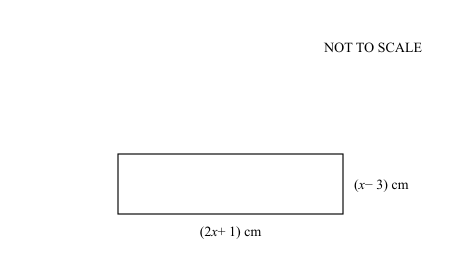
A rectangle has length (2x + 1) cm and width (x − 3) cm. Its perimeter is 38 cm. Find the length and the width.
Solution:
- The property of the shape supplies the equation, so name it before writing anything: a rectangle's perimeter is twice the length plus twice the width
- 2((2x + 1) + (x − 3)) = 38
- Simplify inside the bracket by collecting like terms: 2x + x = 3x, and 1 − 3 = −2
- 2(3x − 2) = 38
- Divide both sides by 2 rather than expanding, which keeps the numbers small: 3x − 2 = 19
- Add 2: 3x = 21, so x = 7
- x = 7 is not the answer: the question asks for two lengths
- Length = 2 × 7 + 1 = 15 cm, width = 7 − 3 = 4 cm
- Check against the perimeter given: 2(15 + 4) = 2 × 19 = 38 cm, and both sides are positive, which a length must be
Worked example
Showing that an area gives a quadratic
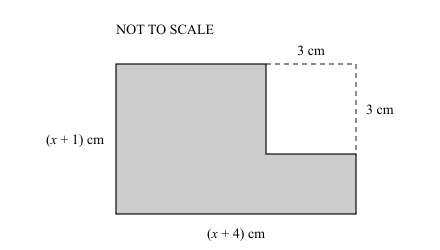
The diagram shows a rectangle (x + 4) cm long and (x + 1) cm wide. A square of side 3 cm has been cut from one corner, and the shaded area that is left is 31 cm². Show that x² + 5x − 36 = 0.
Solution:
- The area fact supplies the equation: the rectangle's area minus the square's area equals the shaded area
- Write it with the brackets still in place, before expanding anything: (x + 4)(x + 1) − 3² = 31
- Expand the brackets: x² + x + 4x + 4 − 9 = 31
- Collect like terms: x² + 5x − 5 = 31
- Subtract 31 from both sides: x² + 5x − 36 = 0, the equation printed in the question
- The working runs from your own equation to the printed one with every line shown, which is what the last mark needs
- As a check, x = 4 satisfies it (16 + 20 − 36 = 0) and gives an 8 cm by 5 cm rectangle with 40 − 9 = 31 cm² shaded
Exam tip
Write the equation down even if you cannot finish
The equation you form earns marks before you expand or simplify anything. In a "show that", the unsimplified line, such as (x + 4)(x + 1) − 3² = 31 above, is worth the first one or two marks; in a word problem the formed equation earns the first mark. Those marks stay even if you never reach the printed quadratic or the answer, so write the equation down even when you cannot see how to finish.
4. Answering in context
Finishing the question
- The value of the letter is rarely the answer on its own: the question asked about the situation
- Convert back to what was asked, with units and the quantity named
- Where the question asks for a different quantity from the one you called x, substitute to find it
- Reject any solution the context forbids, such as a negative length or a fractional number of people