1. Coordinates on the grid
Reading and plotting a point
- The grid used throughout this course has a horizontal x-axis and a vertical y-axis, meeting at the origin
- The origin is the point (0, 0), and every other point is described by how far it lies from there in each direction
- A pair of coordinates is written in brackets with the horizontal value first: (x, y)
- Positive x moves right and negative x moves left; positive y moves up and negative y moves down
- (4, 3) sits four to the right and three up
- (−2, −5) sits two to the left and five down
- Plot a point with a small cross or a solid dot, and write its letter beside it when the question names it, so it is clear which point is which
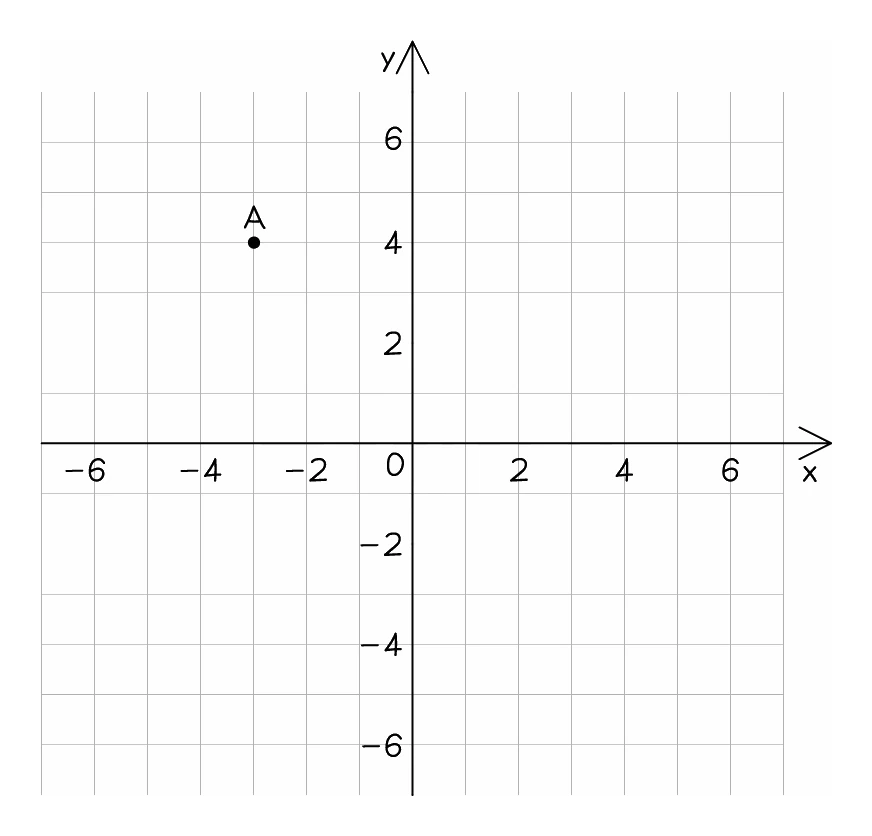
- Check the scale on the axes before counting: one square is frequently worth more than one unit, and assuming otherwise puts every answer out by a factor
- The steepness of the line joining two points is dealt with separately, under linear graphs
2. The midpoint of a line segment
Averaging the two ends
- The midpoint is the point exactly half way along, so it is the same distance from each end
- Finding it means averaging the two ends one direction at a time: average the x values, then average the y values
- For ends (x₁, y₁) and (x₂, y₂) the midpoint is ((x₁ + x₂) ÷ 2, (y₁ + y₂) ÷ 2)
- This formula is not printed anywhere in the paper, so it has to be known
- Each coordinate is worked out independently, and each one is worth a mark, so a slip in one does not cost the other
- A half in the answer is perfectly normal and should be left as 0.5 or ½ rather than rounded away
Worked example
Midpoint from two given points
A is the point (−7, 2) and B is the point (3, 9). Find the coordinates of the midpoint of AB.
Solution:
- Average the x values: (−7 + 3) ÷ 2 = −4 ÷ 2 = −2
- Average the y values: (2 + 9) ÷ 2 = 11 ÷ 2 = 5.5
- The midpoint of AB is (−2, 5.5)
Working backwards from the midpoint
- A question may give one end and the midpoint and ask for the other end
- Whatever the step is from the given end to the midpoint, the same step continues to the far end
- In numbers, double the midpoint value and subtract the known end, in each direction separately
- Checking is quick: average your answer with the given end and confirm the midpoint comes back
Worked example
Finding the far end
M(7, 4) is the midpoint of AB, and A is the point (3, −1). Find the coordinates of B.
Solution:
- In the x direction: 2 × 7 − 3 = 14 − 3 = 11
- In the y direction: 2 × 4 − (−1) = 8 + 1 = 9
- So B is (11, 9)
- Check: the midpoint of (3, −1) and (11, 9) is ((3 + 11) ÷ 2, (−1 + 9) ÷ 2) = (7, 4)
Worked example
A point that divides a segment in a ratio
A is the point (−1, 9) and B is the point (9, 4). P lies on AB with AP : PB = 3 : 2. Find the coordinates of P.
Solution:
- The ratio 3 : 2 cuts AB into 3 + 2 = 5 equal parts, and P is 3 of them along from A (the midpoint is the 1 : 1 case)
- From A to B, x changes by 9 − (−1) = 10 and y changes by 4 − 9 = −5
- One part is 10 ÷ 5 = 2 in x and −5 ÷ 5 = −1 in y
- Three parts on from A: x = −1 + 3 × 2 = 5 and y = 9 + 3 × (−1) = 6
- So P is (5, 6)
- Check: from P to B is 9 − 5 = 4 in x and 4 − 6 = −2 in y, which is two parts, so AP : PB = 3 : 2
3. The length of a line segment
Pythagoras on the grid
- The distance between two points is the hypotenuse of a right-angled triangle drawn with one horizontal and one vertical side
- The horizontal side is the difference in the x values and the vertical side is the difference in the y values
- So the length is √((x₂ − x₁)² + (y₂ − y₁)²)
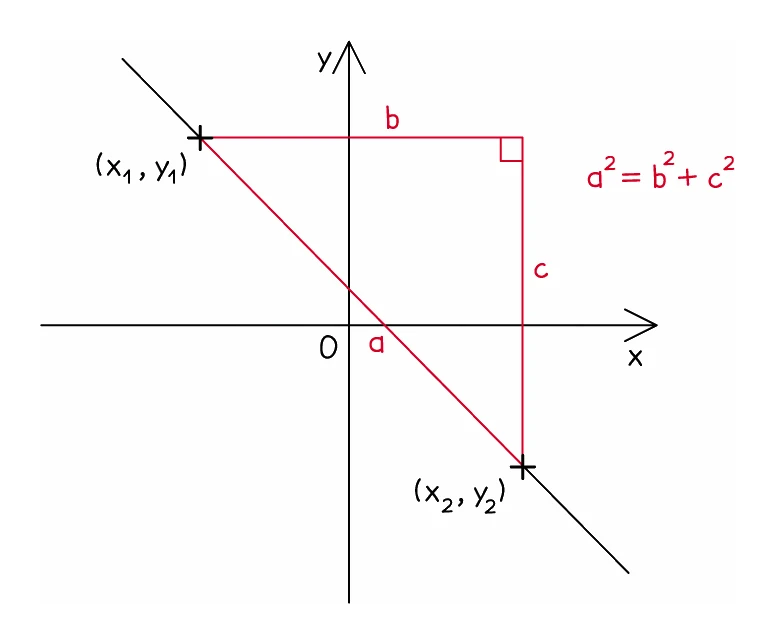
- Squaring removes any minus sign, so it does not matter which point is taken first
- Like the midpoint formula, this one is not printed in the paper
- Writing the two differences down before squaring them earns a mark on its own, and the completed substitution earns another
- Put brackets around negative coordinates as you subtract them, since a subtraction of a negative is where the sign errors happen
Worked example
A length that is a whole number
C is the point (2, −5) and D is the point (14, 4). Calculate the length of CD.
Solution:
- Difference in x: 14 − 2 = 12
- Difference in y: 4 − (−5) = 9
- Square and add: 12² + 9² = 144 + 81 = 225
- Take the square root: √225 = 15
- The length of CD is 15 units
Leaving the answer as a surd
- Where the number under the root is not a perfect square, the exact answer is a surd
- Simplify it by taking out the largest square factor, exactly as in the surds topic
- Questions on this specification regularly ask for the length in surd form, or state that it equals k√n and ask for k
- Without a calculator, leave a length that is not a whole number as an exact surd; on the calculator paper a decimal correct to 3 significant figures (or to the accuracy the question gives) also scores, unless the question asks for a surd or an exact answer
Worked example
A length in surd form
A is the point (−1, 4) and B is the point (5, 1). Find the exact length of AB, writing the surd in its simplest form.
Solution:
- Difference in x: 5 − (−1) = 6
- Difference in y: 1 − 4 = −3
- Square and add: 6² + (−3)² = 36 + 9 = 45
- So the length is √45
- The largest square factor of 45 is 9, and 45 = 9 × 5
- √45 = √9 × √5 = 3√5
- The length of AB is 3√5 units