1. Congruent shapes
Same shape, same size
- Two shapes are congruent when neither their form nor their measurements differ in any way
- Turning one round, flipping it over or sliding it somewhere else leaves it congruent, since a rotation, a reflection and a translation all move a shape without resizing it
- An enlargement changes a shape's size unless its scale factor is 1 or −1, so those are the only enlargements whose image is congruent to the original (a scale factor of −1 turns the shape through 180°)
- To decide whether two shapes are congruent, match up the sides and check that corresponding lengths are equal, then do the same for the angles
- The two shapes need not face the same way, so match corresponding parts rather than comparing them where they sit
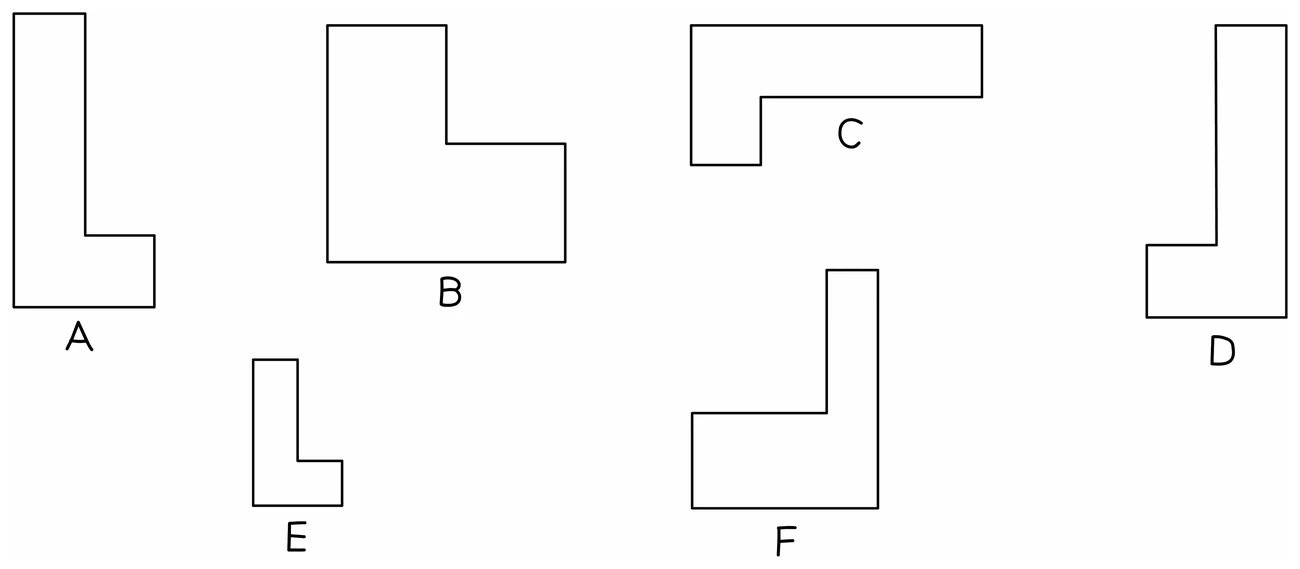
- Tracing paper settles it quickly on a diagram drawn to scale
2. Similar shapes
Same shape, different size
- Two shapes are similar when one is an enlargement of the other, turned or flipped over if need be, which means their angles match and every pair of corresponding sides shares the same ratio
- Papers usually say "mathematically similar", occasionally just "similar", and either phrasing is the signal to look for a scale factor
- Congruence is the special case of similarity where the scale factor is 1, so congruent shapes are similar but similar shapes are usually not congruent
Proving it
- For triangles, equal angles are enough: if the three angles match, the sides are automatically in proportion
- State each pair of equal angles and give the geometrical reason, exactly as in an angles question
- The reasons are usually vertically opposite angles, alternate or corresponding angles on parallel lines, or angles shared by both triangles
- For shapes that are not triangles, equal angles are not enough on their own: every pair of corresponding sides must also give the same scale factor (a square and a long rectangle have equal angles but are not similar)
- Similar triangles frequently overlap on the diagram or sit point to point in an hourglass, and redrawing them separately, facing the same way, prevents mismatching the sides
Worked example
Showing that two triangles are similar
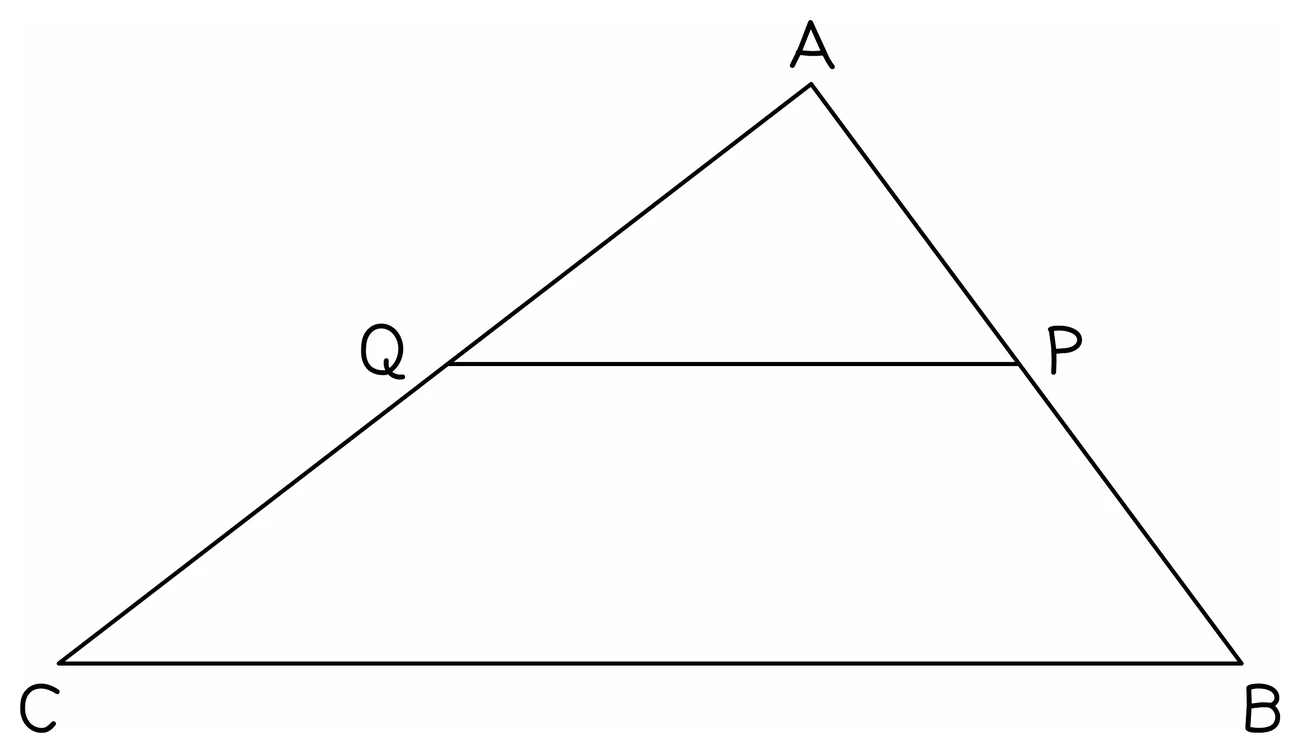
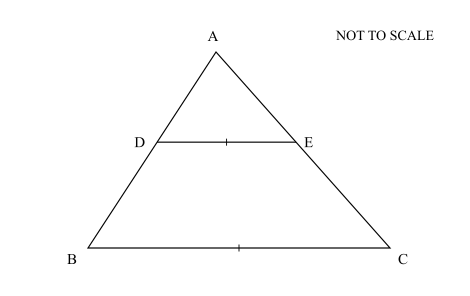
In triangle ABC, the line DE is parallel to BC, with D on AB and E on AC. Show that triangle ADE is similar to triangle ABC.
Solution:
- Similarity needs every pair of corresponding angles to be equal, so take them one pair at a time and name the reason each time
- Angle A is shared by both triangles, so angle DAE = angle BAC (the angle is common)
- DE is parallel to BC, and AB crosses both, so angle ADE = angle ABC (corresponding angles are equal)
- For the same reason with AC as the crossing line, angle AED = angle ACB
- All three pairs of corresponding angles are equal
- Therefore triangle ADE is similar to triangle ABC
- Naming the reason beside each pair is what earns the marks; listing the equal angles without reasons does not
- Write the letters in matching order, so that A pairs with A, D with B and E with C
3. Similar lengths
Finding a missing length
- Pick a pair of sides whose lengths are both known, one from each shape, and divide one by the other to get the scale factor
- Multiply to move towards the larger shape and divide to move towards the smaller one
- Choosing the direction that goes small to large keeps the scale factor above 1, which many find easier to check
- Pair the sides correctly before dividing: corresponding sides sit between the same pair of equal angles
- Sanity check the answer, since a length on the larger shape must come out larger
Exam tip
Pair whole sides in the ratio line
Write the matching sides as an equal pair of fractions before you solve: that line earns the method mark even if the arithmetic after it slips. Every length in it must be a whole side of its own triangle. When the diagram splits a line into two pieces, add the pieces, or take one away from the whole, to get that side before it goes into the fraction.
Worked example
A missing length on a similar shape
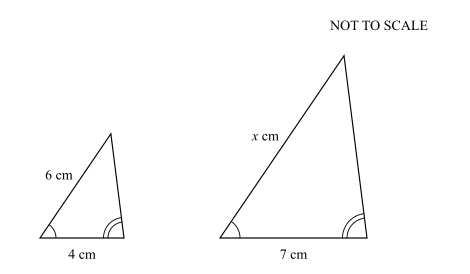
Two triangles are mathematically similar. A side of 4 cm on the smaller corresponds to 7 cm on the larger. Another side of the smaller is 6 cm. Find the corresponding side, x cm, on the larger.
Solution:
- Take the scale factor from the pair of sides that are both known
- Scale factor = 7 ÷ 4 = 1.75
- The missing side is on the larger shape, so multiply
- x = 6 × 1.75 = 10.5, so the side is 10.5 cm
- Check: 10.5 ÷ 6 = 1.75, matching the scale factor from the first pair
4. Similar areas and volumes
Powers of the same scale factor
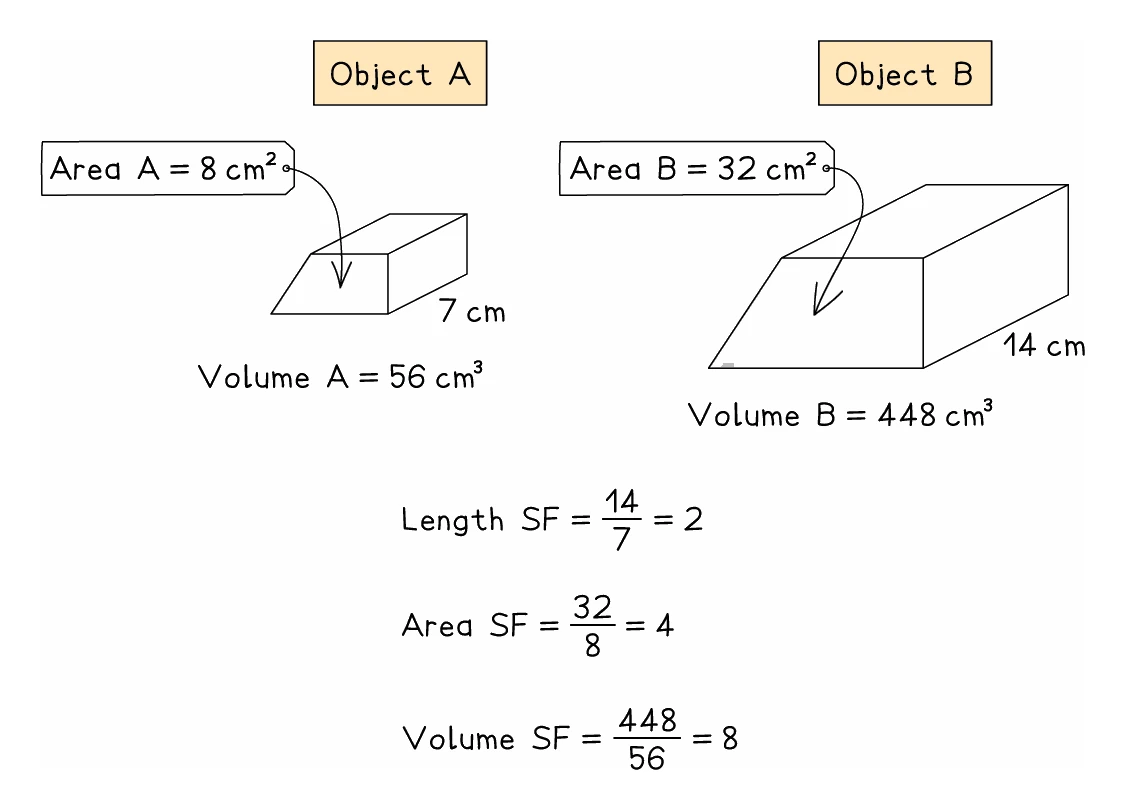
- Call the enlargement's scale factor k, measured on the lengths. Areas and volumes then scale by powers of that same k
| Quantity | Scales by | Recovering k |
|---|---|---|
| Length | k | — |
| Area | k² | take the square root |
| Volume | k³ | take the cube root |
- The powers follow from the units, since an area is two lengths multiplied together and a volume is three
- Multiplying an area by k instead of k², and using the ratio of two areas as if it were the length scale factor, are the standard errors in this topic
- Identify first whether each quantity given is a length, an area or a volume, because the whole method turns on that
Worked example
Volume from a length scale factor
Two cones are mathematically similar. The smaller has height 4 cm and volume 32 cm³. The larger has height 10 cm. Find the volume of the larger cone.
Solution:
- Heights are lengths, so they give the length scale factor
- k = 10 ÷ 4 = 2.5
- Volume scales by k³, so the volume scale factor is 2.5³ = 15.625
- Volume of the larger cone = 32 × 15.625
- Volume = 500 cm³
- Check as fractions: k = 5/2, so k³ = 125/8, and 32 × 125/8 = 4000/8 = 500
Exam tip
Go through the length scale factor
Given two areas or two volumes, turn their ratio into the length scale factor first: k = √(area ratio) or k = ∛(volume ratio). That line earns the first method mark on its own, whichever way up you write the fraction. Then raise it to the power you need: areas in the ratio 4 : 25 mean lengths in the ratio 2 : 5, so the volumes are in the ratio 8 : 125.
Worked example
Length from an area scale factor
Two similar shapes have areas of 45 cm² and 125 cm². A side of the smaller shape is 6 cm. Find the corresponding side of the larger.
Solution:
- The quantities given are areas, so they give the area scale factor
- Area scale factor = 125 ÷ 45 = 25/9
- The length scale factor is the square root of this
- k = √(25/9) = 5/3
- The missing side is on the larger shape, so multiply
- 6 × 5/3 = 10 cm
- Check: the areas would then be in the ratio (10/6)² = (5/3)² = 25/9, and 125 ÷ 45 = 25/9