1. What conditional probability means
A restricted total
- When one event is known to have occurred already, the chance of a second event is a conditional probability, signalled by the words given that
- Knowing that the first thing happened rules out some of the outcomes, so the calculation runs over a smaller set than usual
- Everything else stays the same: it is still successes divided by total, but the total is now only the outcomes that meet the condition
- The phrase to watch for is "given that", and it is almost always how these questions are introduced
- A useful way to think about it: the condition tells you which part of the diagram to look inside, and you never leave that part
Worked example
Choosing from a smaller group
Of 36 students, 19 study Spanish. Of those 19, 7 also study German. A student is chosen at random from those who study Spanish. Find the probability that the student also studies German.
Solution:
- The words "from those who study Spanish" restrict the group being chosen from
- The total is therefore 19, not 36
- Of that group, 7 also study German
- P(German, given Spanish) = 7/19
- Dividing by 36 would answer a different question: the probability of a student studying both, out of everyone, which is 7/36
- Writing the restricted total down before the fraction is what makes the difference visible
What is and is not required
- Neither the notation P(A|B) nor any conditional-probability formula is required by this syllabus, which says so in as many words
- What is required is calculating them from a Venn diagram, a tree diagram or a table
- So the whole topic is about reading the right region of a diagram rather than applying anything memorised
- Recognising the notation does no harm, but nothing is lost by not knowing it
2. From a Venn diagram or a table
Narrowing the total
- Identify the condition first and shade or ring the region it describes
- Count how many are in that region: this becomes the denominator
- Then count how many of those also satisfy the thing being asked for: this becomes the numerator
- The overall total is not used at all, which is exactly what makes it conditional
- The same method works on a two-way table, where the condition picks out one row or one column and the total for that row or column is the denominator
Worked example
A conditional probability from a Venn diagram
Of 40 people, 22 own a car, 16 own a bicycle and 9 own both. One person is chosen at random. Find the probability that a person who owns a car also owns a bicycle, and the probability that a person who owns a bicycle also owns a car.
Solution:
- Fill the overlap first: 9 own both
- Car only = 22 − 9 = 13, and bicycle only = 16 − 9 = 7
- Those regions hold 13 + 9 + 7 = 29, so 40 − 29 = 11 own neither
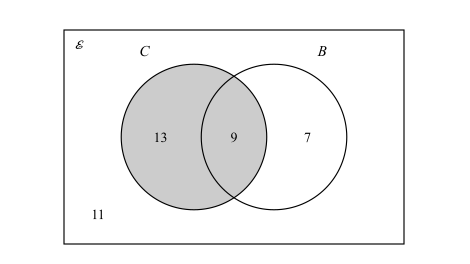
- For the first part the condition is owning a car, so the total is the 22 car owners, not 40
- Of those 22, the ones who also own a bicycle are the 9 in the overlap
- P(bicycle, given car) = 9/22
- For the second part the condition is owning a bicycle, so the total is now 16
- P(car, given bicycle) = 9/16
- The two answers differ, which shows the order of the condition matters
3. From a tree diagram
Where the branches already do it
- On a tree diagram the second set of branches is already conditional, because each one assumes that its first branch has happened
- So a "without replacement" question uses conditional probabilities on its second branches, whether or not it says so
- From a bag of 5 red and 3 blue counters, if the first taken is red then 4 reds remain out of 7, so P(second red, given first red) = 4/7
- Reading such a value straight off the tree needs no calculation at all
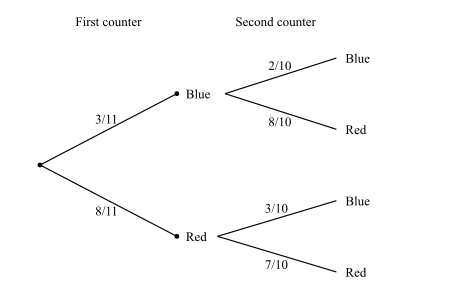
- Where the condition refers to the second stage instead, the paths have to be compared: find the probability of the paths that satisfy both, then divide by the probability of all the paths satisfying the condition
Worked example
Reading a condition off a tree
A bag holds 5 red and 7 blue counters. Two are taken at random without replacement. Given that the first counter is red, find the probability that the second is also red.
Solution:
- The condition fixes what has already happened: the first counter was red
- After it is removed, 11 counters remain and 4 of them are red
- P(second red, given first red) = 4/11
- That is exactly the number written on the second-stage branch of the tree diagram
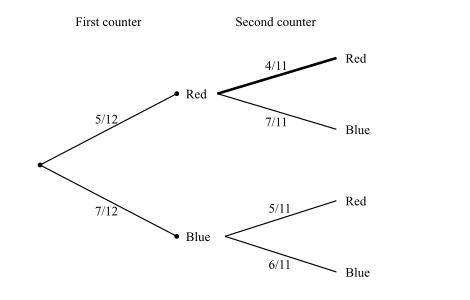
- No formula is needed: a tree diagram's second-stage probabilities are already conditional
- Multiplying 5/12 by 4/11 would answer a different question: the probability that both are red, which is 5/33
4. From a sample space
Counting inside the condition
- With a listed or tabulated sample space, cross out every outcome the condition excludes
- What remains is the new total, and the successes are counted from those survivors only
- Working from a completed grid makes this reliable, since the condition simply selects some of the cells
Worked example
A condition applied to a sample space
One fair spinner is numbered 1, 2, 3 and 4, and another fair spinner is numbered 2, 5 and 7. Both are spun and the two numbers are added. Given that the total is even, find the probability that the first spinner landed on 3.
Solution:
- There are 4 × 3 = 12 equally likely outcomes altogether
- The sample space shows every total, with the first spinner across the top and the second down the side
| + | 1 | 2 | 3 | 4 |
|---|---|---|---|---|
| 2 | 3 | 4 | 5 | 6 |
| 5 | 6 | 7 | 8 | 9 |
| 7 | 8 | 9 | 10 | 11 |
- The even totals are 4 and 6 in the first row, 6 and 8 in the second and 8 and 10 in the third, so 6 outcomes meet the condition
- You no longer divide by 12: the restricted total is 6 outcomes
- Of those 6 outcomes, the first spinner shows 3 in two of them, (3, 5) with total 8 and (3, 7) with total 10
- P(first spinner shows 3, given the total is even) = 2/6 = 1/3
- Dividing by 12 would answer a different question: the probability that the total is even and the first spinner shows 3, which is 2/12 = 1/6