1. Circumference and area
The two formulas
- The distance round a circle is its circumference, and the space inside is its area
- Both formulas are printed in the List of formulas at the front of the paper
- Area: A = πr²
- Circumference: C = 2πr, which is the same as C = πd because the diameter is twice the radius
- Read the diagram carefully to see whether the number given is the radius or the diameter, since halving or doubling at the wrong moment is the usual error
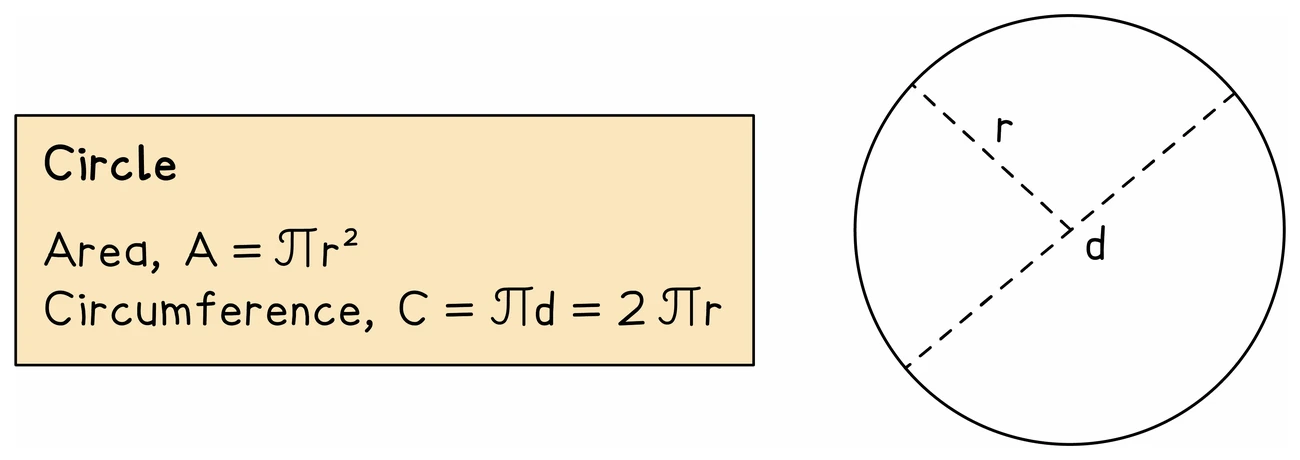
- Area needs the radius squared, so a diameter must be halved first
- Circumference is a length and takes units such as cm; area is a space and takes squared units such as cm²
Answers in terms of π
- Questions frequently ask for the answer "in terms of π", which means leaving π in the answer rather than multiplying it out
- Work in exact numbers throughout and collect the π at the end, so a circle of radius 5 has area 25π cm² and circumference 10π cm
- "In its simplest form" alongside it means the number in front of π should be fully simplified
- Only round when the question actually asks for a decimal, and then to whatever accuracy it states
Exam tip
Stop at the answer in terms of π
When a question asks only for the answer in terms of π, the final mark is for that form. The schemes give only the method marks for a decimal answer, even when the working is right, and that includes a value found with 3.14 or 22/7 in place of π. Write the answer with π in it on the answer line and leave it there.
Worked example
Circumference and area of a circle
A circle has radius 11 cm. Find its circumference and its area, in terms of π and then to 3 significant figures.
Solution:
- Circumference = 2πr = 2 × π × 11 = 22π cm
- To 3 significant figures that is 69.1 cm
- Area = πr² = π × 11² = π × 121 = 121π cm²
- To 3 significant figures that is 380 cm²
- Square the radius before multiplying by π: (π × 11)² would be a different number entirely
- The circumference is a length, so its units are cm; the area is in cm²
2. Arcs and sectors
The vocabulary
- An arc is part of the circumference, and a sector is the slice enclosed by two radii and an arc
- Two points on a circle cut it into a shorter minor arc and a longer major arc, and two radii likewise cut it into a minor and a major sector
- The angle at the centre between the two radii is usually labelled θ
- A question naming the major arc or sector wants the larger piece, so subtract the marked angle from 360° before doing anything else
The two formulas
- An arc and a sector are simply fractions of the whole circle, and the fraction is θ ÷ 360
- Arc length = (θ ÷ 360) × 2πr
- Sector area = (θ ÷ 360) × πr²
- Neither formula is printed in the paper, so both have to be known, although each is just the circle formula scaled by the fraction
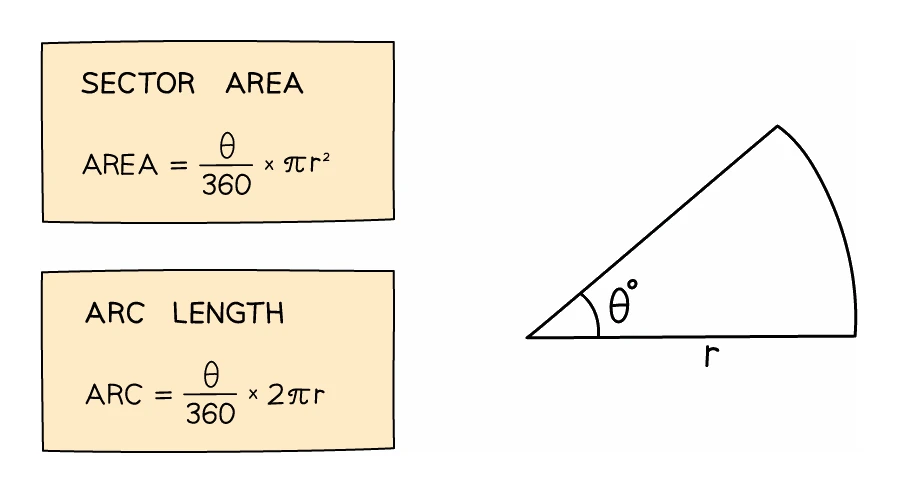
- θ can be any angle, and the syllabus explicitly includes major sectors, where θ is bigger than 180°
- To go all the way round a sector you travel along the arc and back down both radii, so its perimeter includes those two straight edges — routinely forgotten
Worked example
Arc, area and perimeter of a sector
A sector of a circle has radius 12 cm and sector angle 45°. Find its arc length, its area, and its perimeter. Give the first two in terms of π.
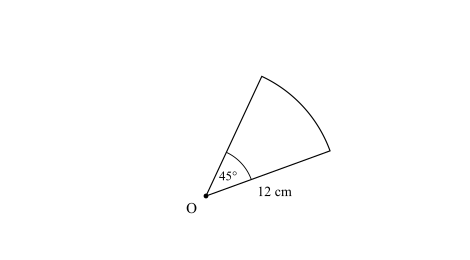
Solution:
- The fraction of the circle is 45 ÷ 360 = 1/8
- The full circumference is 2π × 12 = 24π cm
- Arc length = 1/8 × 24π = 3π cm
- The full area is π × 12² = 144π cm²
- Sector area = 1/8 × 144π = 18π cm²
- The perimeter is the arc plus both radii: 3π + 12 + 12
- Perimeter = (3π + 24) cm
Worked example
A major sector
A sector of a circle, centre O, has radius 10 cm. The minor sector angle is 72°. Find the area of the major sector and the length of the major arc, in terms of π.
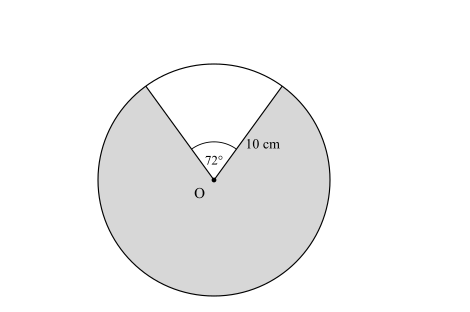
Solution:
- The major sector is the rest of the circle, so its angle is 360 − 72 = 288°
- The fraction is 288 ÷ 360 = 4/5
- The full area is π × 10² = 100π cm²
- Major sector area = 4/5 × 100π = 80π cm²
- The full circumference is 2π × 10 = 20π cm
- Major arc = 4/5 × 20π = 16π cm
- Check: the minor sector would be 1/5 of the circle, and 80π + 20π = 100π
3. Semicircles and compound shapes
Parts of circles
- A semicircle is half a circle, so work out the whole circle's area and take half of it
- Its perimeter is not half the circumference: it is the curved half plus the straight diameter across the bottom
- A semicircle of radius 6 cm has area 18π cm² and perimeter (6π + 12) cm
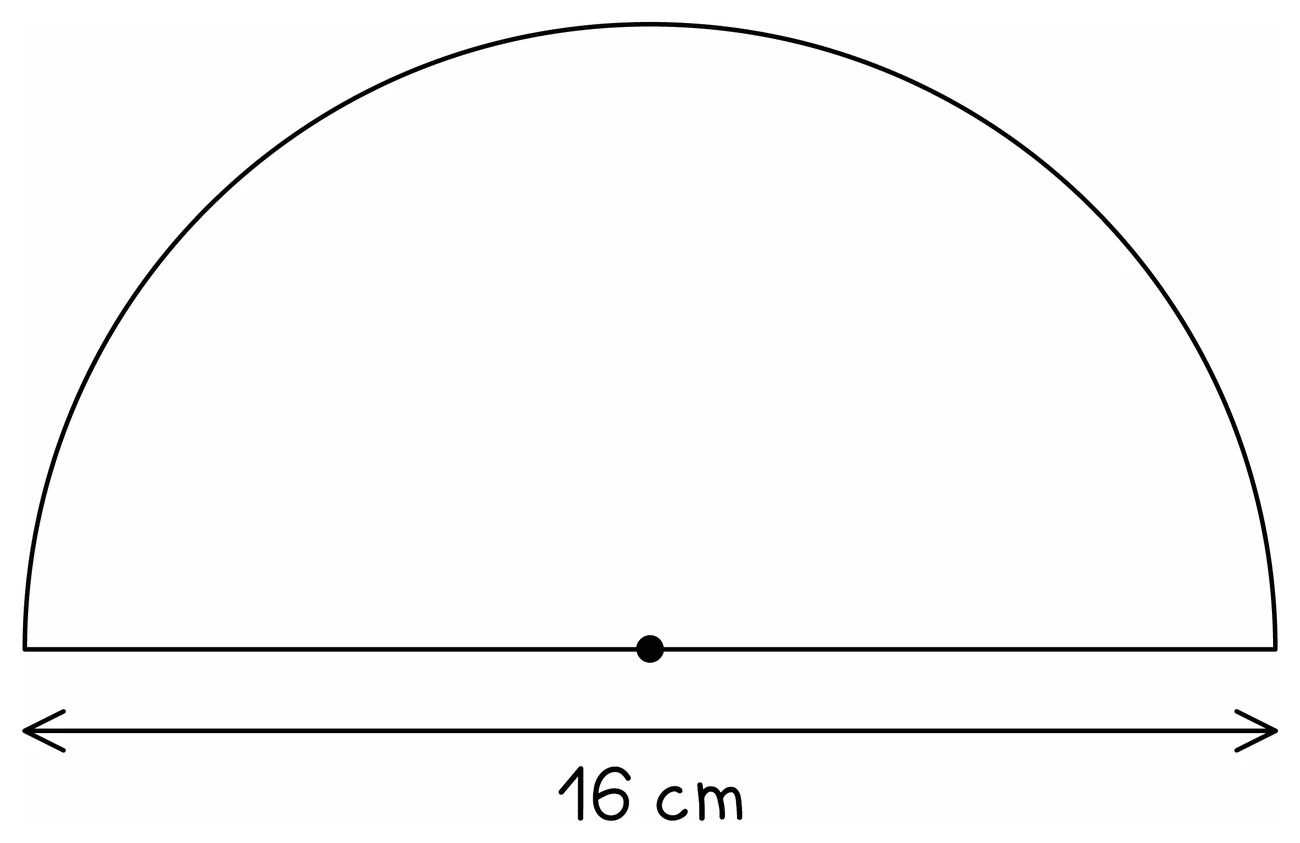
- A quarter circle works the same way, with two radii forming the straight edges
- Whenever a shape has a curved edge and a straight one, list the pieces of the perimeter before adding, so none is left out
Shapes built from circles
- Compound shapes combine circles or parts of circles with rectangles and triangles
- Add the pieces where the shape is built up, and subtract where a piece has been removed
- A shaded region between two circles with the same centre is the larger area minus the smaller
- Sketch the split and label each piece, since the separate areas carry the method marks
- Keep every part in terms of π until the end, which makes the final collecting much easier
Worked example
A semicircle's area and perimeter
A semicircle has diameter 12 cm. Find its area and its perimeter, in terms of π.
Solution:
- The radius is half the diameter, so r = 6 cm
- For the area, find the whole circle's area and halve it
- Whole circle: π × 6² = 36π
- Area of the semicircle = 36π ÷ 2 = 18π cm²
- The perimeter is not half the circumference: the straight edge counts too
- Curved part = half of 2π × 6 = 6π
- Straight part = the diameter = 12
- Perimeter = (6π + 12) cm
- Stopping at 6π is the standard error: it leaves out the 12 cm straight edge