Simultaneous Equations
Mathematics (Core) revision notes · Cambridge (CIE) · 0580 · Core
1. What they are
Two unknowns need two equations
- A single equation with two unknowns has infinitely many solutions, so a second equation is required to pin them down
- Simultaneous equations are solved together, and the answer is the pair of values satisfying both at once
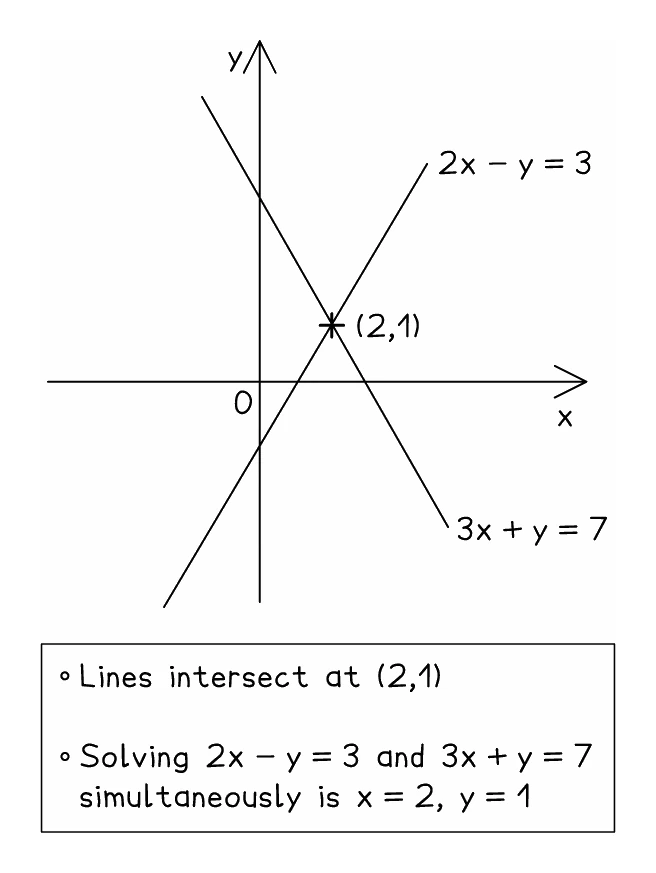
- They are linear when every term is a number or a number times one unknown, so nothing is squared and the unknowns are never multiplied together
- Each solution should be checked in the equation that was not used to find it
2. Solving by elimination
Matching a coefficient
- Elimination removes one unknown by adding or subtracting the two equations
- Multiply one or both equations so that one unknown has coefficients of equal size
- Subtract when those coefficients have the same sign, and add when the signs are opposite
- Solve the resulting single-unknown equation, then substitute back to find the other
Worked example
Elimination with both equations scaled
Solve 3x + 5y = 31 and 2x + 3y = 20.
Solution:
- Elimination needs one letter to have the same coefficient in both equations, and here neither does
- Match the y terms: 5 and 3 both divide into 15, so multiply the first equation by 3 and the second by 5
- Multiply every term, the constant included, or the equation stops being true
- 9x + 15y = 93 and 10x + 15y = 100
- The matched terms now have the same sign, so subtracting removes them
- Subtracting the first from the second: 10x − 9x = 1x, 15y − 15y = 0, 100 − 93 = 7, so x = 7
- Substitute back into either original equation: 3 × 7 + 5y = 31
- 21 + 5y = 31, so 5y = 10 and y = 2
- The solution is x = 7, y = 2
- Check in the equation not used for the substitution: 2 × 7 + 3 × 2 = 14 + 6 = 20
- Had the matched terms carried opposite signs, they would be added instead
Worked example
Adding to eliminate, with a negative answer
Solve 2x + 3y = −1 and 5x − 6y = 38.
Solution:
- Match the y terms: multiply every term of the first equation by 2, giving 4x + 6y = −2
- Now +6y and −6y have opposite signs, so adding the two equations removes them
- 4x + 5x = 9x, 6y − 6y = 0 and −2 + 38 = 36, so 9x = 36 and x = 4
- Substitute back into the first equation: 2 × 4 + 3y = −1
- 8 + 3y = −1, so 3y = −1 − 8 = −9 and y = −3
- The solution is x = 4, y = −3
- Check in the second equation: 5 × 4 − 6 × (−3) = 20 + 18 = 38
3. Solving by substitution
When one unknown is already isolated
- Rearrange one equation to make an unknown the subject, then substitute that expression into the other
- This suits an equation such as 2x − y = 1, which rearranges easily to y = 2x − 1
- Substituting gives one equation in one unknown
- With 4x + 3y = 27, substituting y = 2x − 1 gives 4x + 3(2x − 1) = 27, so 10x = 30 and x = 3, giving y = 5
Worked example
Solving by substitution
Solve the simultaneous equations y = 2x + 1 and 3x + y = 11.
Solution:
- One equation already has y on its own, so substitute that expression into the other
- 3x + (2x + 1) = 11
- Collect: 5x + 1 = 11
- Subtract 1: 5x = 10, so x = 2
- Substitute back into the isolated equation: y = 2 × 2 + 1 = 5
- The solution is x = 2, y = 5
- Check in the equation not used for the substitution: 3 × 2 + 5 = 11
4. Forming simultaneous equations
From a described situation
- Introduce a letter for each unknown and state precisely what each represents, including units
- Each separate fact in the question becomes one equation
- Solve, then answer in context rather than leaving the letters bare
Worked example
Forming and solving from a context
Two coffees and three teas cost £11.40. Four coffees and one tea cost £13.80. Find the cost of each drink.
Solution:
- Let c be the cost of a coffee and t the cost of a tea, both in pounds
- The two facts give 2c + 3t = 11.40 and 4c + t = 13.80
- Rearrange the second: t = 13.80 − 4c
- Substitute into the first: 2c + 3(13.80 − 4c) = 11.40
- Expand: 2c + 41.40 − 12c = 11.40, so −10c = −30 and c = 3.00
- Then t = 13.80 − 12.00 = 1.80
- A coffee costs £3.00 and a tea costs £1.80
- Check: 2(3.00) + 3(1.80) = 11.40