Rounding Estimation and Bounds
Mathematics (Core) revision notes · Cambridge (CIE) · 0580 · Core
1. Rounding to a place value
The rule
- Locate the digit sitting in the place value being rounded to
- Look at the single digit immediately to its right, and ignore everything beyond it
- That digit decides the direction: 5 or more rounds up, 4 or less leaves the digit unchanged
- Fill every place between the rounded digit and the decimal point with zeros, since dropping them would change the size of the number
- 4826 to the nearest hundred is 4800
- 4872 to the nearest hundred is 4900
Worked example
Rounding to the nearest ten, hundred and thousand
Write 63 948 correct to (a) the nearest ten, (b) the nearest hundred, (c) the nearest thousand.
Solution:
- (a) The tens digit is 4, and the digit to its right is 8, which is 5 or more, so the 4 rounds up to 5
- 63 948 = 63 950 to the nearest ten
- (b) The hundreds digit is 9, and the digit to its right is 4, so the 9 stays as it is
- 63 948 = 63 900 to the nearest hundred, with zeros filling the tens and ones columns
- Round 63 948 itself, not the answer to (a): 63 950 rounded to the nearest hundred would give 64 000, which is wrong
- (c) The thousands digit is 3, and the digit to its right is 9, so the 3 rounds up to 4
- 63 948 = 64 000 to the nearest thousand
- Every answer keeps the size of the original number: 639 in place of 63 900 would be a hundred times too small
2. Rounding to decimal places
Counting the places
- Decimal places are counted rightwards from the decimal point
- Apply the same rule: inspect the first digit beyond the place being kept
- 6.7183 to two decimal places is 6.72
Keeping the trailing zero
- An answer must show exactly as many decimal places as were asked for, including a final zero
- 0.4961 to two decimal places is 0.50, not 0.5
- This differs from place-value rounding, where the zeros before the decimal point keep the size of the number, while a final zero after the point shows the accuracy
- Where rounding up cascades through a 9, carry it as with ordinary addition
- 3.897 to two decimal places is 3.90, because 89 becomes 90
Worked example
Rounding where the digits carry
Round 0.4961 to two decimal places.
Solution:
- The second decimal place holds 9, and the digit to its right is 6
- Since 6 is at least 5, the 9 rounds up, which carries into the tenths column
- 49 hundredths becomes 50 hundredths
- The answer is 0.50, written with the final zero because two decimal places were requested
3. Rounding to significant figures
Finding the first significant figure
- Reading left to right, the first significant figure is the first non-zero digit
- In 5081 it is the 5
- In 0.00407 it is the 4
- Zeros in front of that digit only position the number and are never significant
- Zeros sitting between non-zero digits are significant, because they carry information
- The second significant figure of 5081 is the 0
Rounding and padding
- Count rightwards to the required figure, then apply the usual rounding rule
- Large numbers are padded with zeros out to the decimal point
- 5081 to two significant figures is 5100
- For a decimal, zeros fill the gap from the point up to where the significant figures begin
- 0.00407 to two significant figures is 0.0041
Worked example
Rounding to significant figures
Write 0.004 078 2 to 3 significant figures, and 46 851 to 2 significant figures.
Solution:
- The first significant figure is the first non-zero digit, so leading zeros never count
- In 0.004 078 2 the first significant figure is the 4, the second is the 0 after it, and the third is the 7
- The next digit is 8, which is 5 or more, so the 7 rounds up to 8
- 0.004 078 2 = 0.004 08 to 3 significant figures
- In 46 851 the first two significant figures are 4 and 6
- The next digit is 8, so the 6 rounds up to 7
- The place holders must stay, so the answer is 47 000, not 47
4. Estimation
Making the estimate
- Rounding every value to one significant figure turns an awkward calculation into one that can be done mentally
- 19.4 becomes 20 and 4.7 becomes 5
- When the question says 1 significant figure, round to exactly that, even where another rounding would make the arithmetic simpler
- Never round a value to zero: a zero denominator makes the calculation undefined, and a zero numerator destroys the estimate
Deciding whether the estimate is too big or too small
- For a sum or a product, rounding both values the same way settles it
| Operation | Both rounded up | Both rounded down |
|---|---|---|
| a + b | Overestimate | Underestimate |
| a × b | Overestimate | Underestimate |
- For a difference or a quotient the second value works in the opposite direction
| Operation | a up, b down | a down, b up |
|---|---|---|
| a − b | Overestimate | Underestimate |
| a ÷ b | Overestimate | Underestimate |
- Where the two roundings pull opposite ways, the direction cannot be decided without more care
Exam tip
Write every number at 1 significant figure
Set in 7 of the 22 papers, all on Paper 1, for two marks: one for the calculation rewritten with every number at 1 significant figure, one for its value. A single number left with more figures, even 4.0 written for 3.87, costs both and leaves one special-case mark at most. So for 58.3 × 0.214 ÷ 3.87, write 60 × 0.2 ÷ 4 on its own line and give its value, 3, as the estimate.
Worked example
Estimating and judging the direction
Estimate the value of 19.4 × 4.7, and state whether the estimate is too large or too small.
Solution:
- Round each value to one significant figure: 19.4 becomes 20 and 4.7 becomes 5
- Multiply the rounded values: 20 × 5 = 100
- The estimate is 100
- Both values were rounded up, and this is a product, so the estimate is an overestimate
- The exact value is 91.18, which confirms the direction
5. Upper and lower bounds
What the bounds are
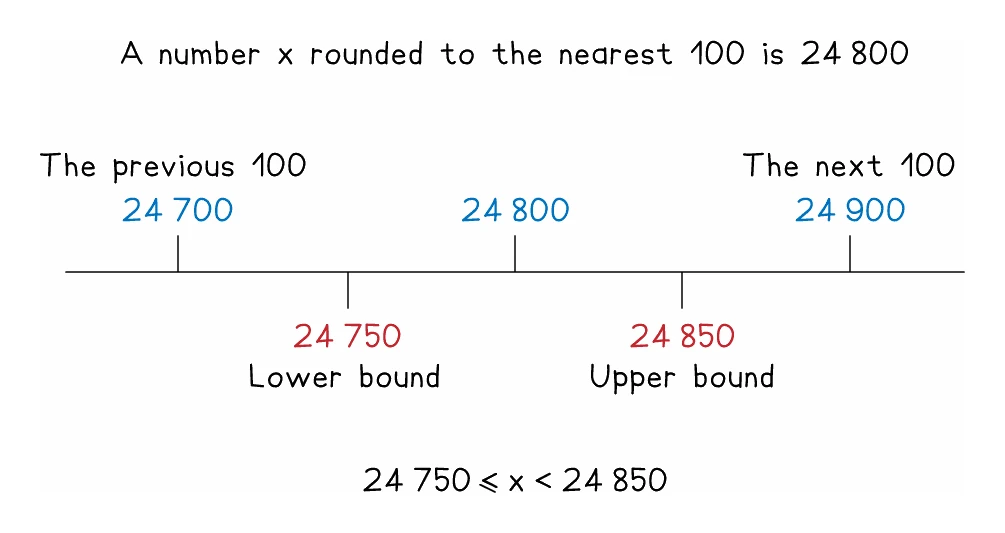
- A rounded value stands for a range of true values, and the bounds are the ends of that range
- The lower bound is the smallest value that would still round to the figure given
- The upper bound is the value the true figure must stay below
- Both lie half a unit of accuracy away from the rounded value, so they are the midpoints between it and its neighbours
- A true value may sit exactly on the lower bound, but reaching the upper bound would round it the other way, so only one end of the range is inclusive
Finding them
- Halve the degree of accuracy the value was rounded to
- Subtract that half-unit for the lower bound and add it for the upper bound
- A mass of 6.4 kg given to one decimal place has a half-unit of 0.05
- The bounds are 6.35 ⩽ m < 6.45
Exam tip
Lower bound on the left
Set in 9 of the 22 papers, always as a statement to complete, such as … ⩽ m < …, where each bound earns a mark only in its own place. The right pair written the wrong way round scores one mark instead of two. So the lower bound goes before ⩽ and the upper bound after <: a mass of 240 g to the nearest 10 g gives 235 ⩽ m < 245.
Worked example
Writing down a pair of bounds
A length is 8.6 cm, correct to 1 decimal place. Write down its lower and upper bounds.
Solution:
- 1 decimal place means the value was rounded to the nearest 0.1
- Half of 0.1 is 0.05, so the true length is within 0.05 cm of 8.6
- Lower bound = 8.6 − 0.05 = 8.55 cm
- Upper bound = 8.6 + 0.05 = 8.65 cm
- The lower bound is included and the upper bound is not, so 8.55 ⩽ length < 8.65
- 8.65 itself would round up to 8.7, which is why it is excluded even though it is written as the upper bound