Prime Factors, HCF and LCM
Mathematics (Core) revision notes · Cambridge (CIE) · 0580 · Core
1. Primes and prime factors
Prime numbers
- Prime numbers are those divisible by nothing except themselves and 1, giving them a factor count of exactly two
- The primes begin 2, 3, 5, 7, 11, 13, 17, 19, 23, 29 and continue without end
- Every even number beyond 2 has 2 as a third factor, which leaves 2 as the sole even prime
- 1 is not prime, because it has a single factor rather than two
Prime factors
- Broken down far enough, any integer greater than 1 is a product of primes alone, and those primes are its prime factors
- 30 is built from 2, 3 and 5, since 2 × 3 × 5 = 30
- Every integer above 1 has exactly one set of prime factors, whatever route is taken to find them
- This uniqueness is what allows prime factors to be used for comparing two numbers
2. Writing a number as a product of prime factors
Building a factor tree
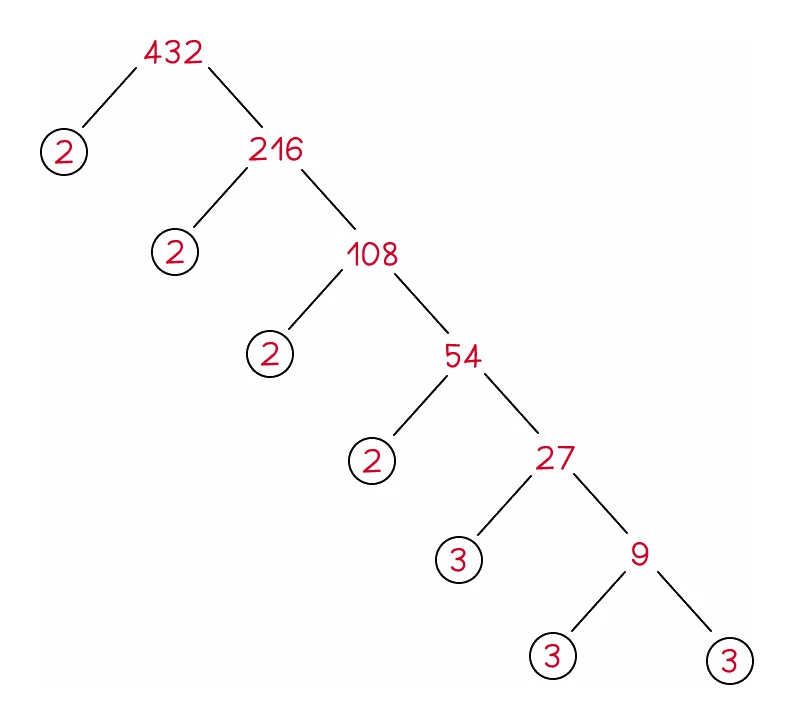
- Split the number into any factor pair, then split each factor again
- Continue down every branch until only primes remain, circling each prime as it appears
- Dividing repeatedly by the smallest prime that fits produces a prime at every stage and keeps the tree tidy
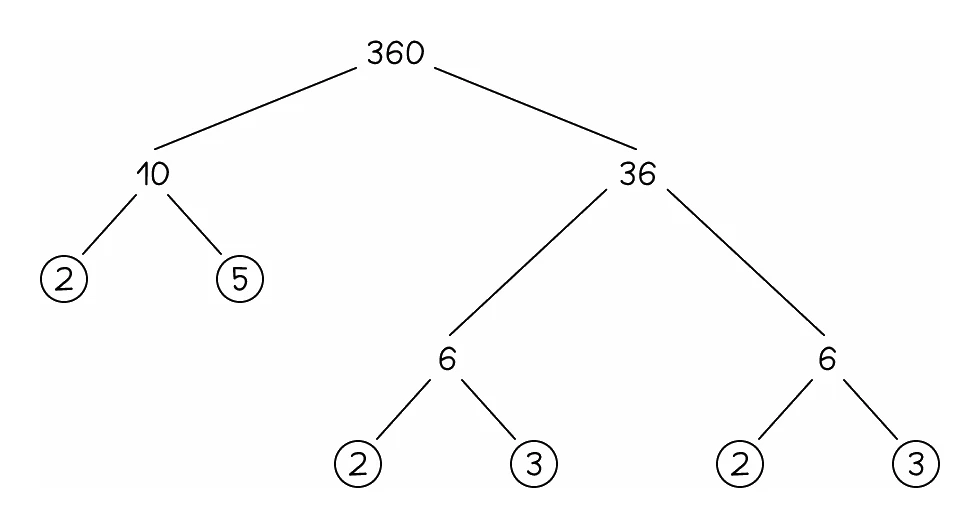
- Splitting by a convenient number such as 10 is equally valid, but non-prime results must then be split further
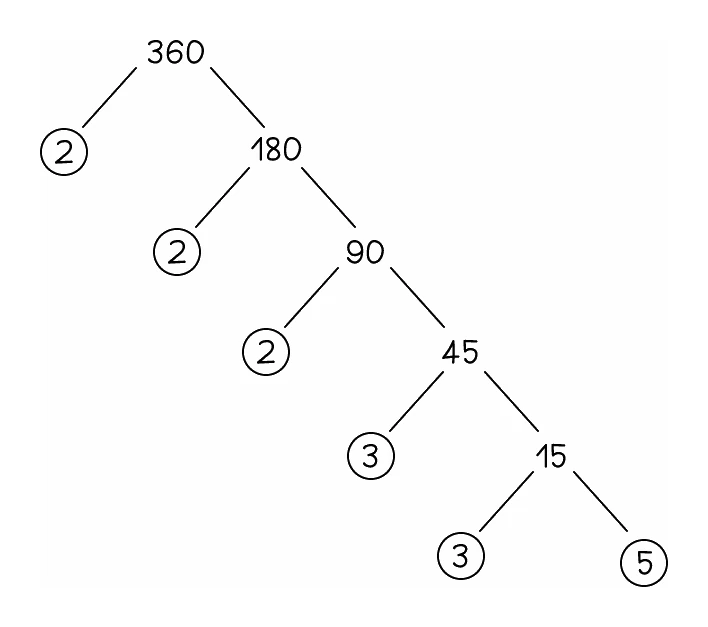
- The circled primes are the same whichever pairs were chosen
Writing the answer
- Multiply the circled primes together, writing them in ascending order
- 252 = 2 × 2 × 3 × 3 × 7
- Collect repeated primes into index form, which is the form to give whenever a question asks for index form or the simplest form
- 252 = 2² × 3² × 7
Worked example
A number as a product of its prime factors
Write 360 as a product of its prime factors, in index form.
Solution:
- Split 360 into any two factors and keep splitting until every branch ends on a prime
- 360 = 36 × 10
- 36 = 6 × 6, and each 6 = 2 × 3
- 10 = 2 × 5
- The primes at the ends of the branches are 2, 3, 2, 3, 2, 5
- Collect them in ascending order: 2 × 2 × 2 × 3 × 3 × 5
- In index form, 360 = 2³ × 3² × 5
- Check by multiplying back: 8 × 9 × 5 = 360
- Starting from a different split, such as 360 = 4 × 90, gives the same answer: the tree's shape does not matter
Worked example
A product of primes from a number already in primes
N = 2⁴ × 3 × 7. Write 18N² as a product of its prime factors, in index form.
Solution:
- There is no need to work out N: use its indices
- Squaring doubles every index (3 and 7 count as 3¹ and 7¹): N² = 2⁸ × 3² × 7²
- Only N is squared, not the 18, so write 18 in primes on its own: 18 = 2 × 3²
- Multiplying adds the indices of each prime: 2⁸ × 2 = 2⁹, 3² × 3² = 3⁴, and 7² is unchanged
- 18N² = 2⁹ × 3⁴ × 7²
3. Highest common factor and lowest common multiple
What each one means
- Where a single value divides two numbers exactly, it is a common factor of the pair, and 1 always qualifies
- The highest common factor, or HCF, is the largest such value
- A value sitting in both numbers' times tables is a common multiple
- Of the infinitely many such values, the smallest is the lowest common multiple, or LCM
- The HCF is what cancels a fraction to its simplest form; the LCM is what supplies a common denominator
Finding them by listing
- List every factor of both numbers, then take the largest value common to the two lists
- List the multiples of both, then take the smallest value common to the two lists
- Listing is quick for small numbers and unreliable for large ones
Finding them from prime factors
- Decompose both numbers into primes first
- Place the primes the two numbers share in the overlap of a Venn diagram, taking each shared prime only as many times as it appears in both
- Place the remaining primes in the outer region belonging to their own number
- Multiplying the overlap gives the HCF; multiplying everything in the whole diagram gives the LCM
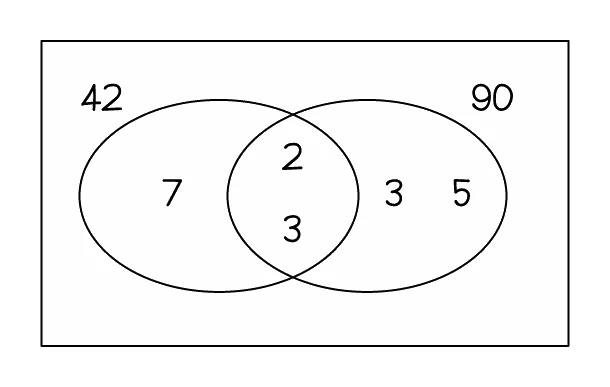
- Where no primes are shared, the overlap holds a 1 and the HCF is 1
Exam tip
Give the clock time
In a question about two buses or trains next leaving together, the LCM is the number of minutes until they next do. The schemes give two of the three marks for that number, in minutes or in hours and minutes; the last mark needs the clock time. Buses every 15 and 25 minutes that leave together at 09 10 next do so 75 minutes later, at 10 25.
Exam tip
Check the multiple is the lowest
A common multiple that is not the lowest earns just one mark. Multiplying the two numbers always gives a common multiple, but it is the lowest only when they share no prime factor: 12 × 18 = 216, yet the LCM is 36. Before you stop, divide your answer by each of its prime factors in turn; if a result is still a multiple of both numbers, go lower.
Worked example
Finding the HCF and LCM from prime factors
Find the highest common factor and the lowest common multiple of 60 and 144.
Solution:
- Decompose each into primes
- 60 = 2² × 3 × 5
- 144 = 2⁴ × 3²
- Both contain 2 and 3. Take the lower index of each for the shared part: 2² and 3
- HCF = 2² × 3 = 12
- For the LCM collect every prime occurring anywhere, each at its highest index: 2⁴, 3² and 5
- LCM = 16 × 9 × 5 = 720