1. What a percentage is
Hundredths in another form
- A percentage counts hundredths, so the per cent sign stands for division by 100
- Any percentage therefore has a fraction form and a decimal form
- 35% is 35/100 and 0.35
- Converting a fraction to a percentage means scaling it to a denominator of 100, or dividing out and multiplying by 100
- 7/20 scales to 35/100, which is 35%
- 3/8 divides to 0.375, which is 37.5%
- Percentages make competing fractions directly comparable, which is why questions ask for them
The multiplier
- The multiplier is the decimal a percentage corresponds to
- 18% has multiplier 0.18
- 126% has multiplier 1.26
- Multiplying by it is the fastest route to a percentage of an amount on the calculator papers
2. Finding a percentage of an amount
Building blocks without a calculator
- A few percentages are quick to find directly, and the rest are assembled from them
| Percentage | How to find it |
|---|---|
| 50% | Halve the amount |
| 25% | Halve it twice |
| 10% | Divide by 10 |
| 5% | Halve the 10% |
| 1% | Divide by 100 |
- Combine these to reach any figure the question asks for
- 35% is three lots of 10% plus one lot of 5%
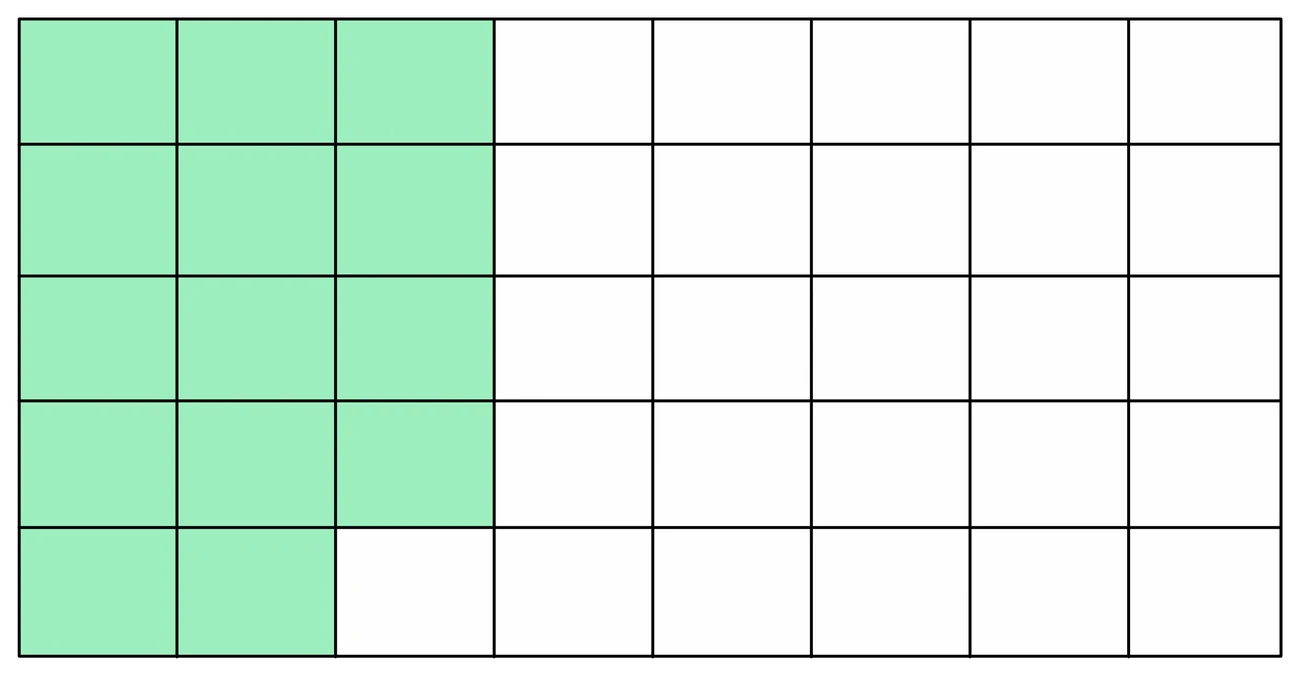
- Above 100%, the original amount is the 100%, so add the extra on
Using the multiplier
- Multiply the amount by the decimal equivalent
- 18% of 450 is 0.18 × 450 = 81
Worked example
A percentage of an amount, without a calculator
Work out 35% of 480.
Solution:
- Build the percentage from blocks that are easy to find
- 10% of 480 is 480 ÷ 10 = 48
- 30% is three lots of that: 3 × 48 = 144
- 5% is half of 10%: 48 ÷ 2 = 24
- 35% = 30% + 5% = 144 + 24 = 168
- Check with the multiplier: 0.35 × 480 = 168
Comparing two quantities
- Express the first quantity as a fraction of the second, then scale by 100
- Whichever quantity the question treats as the whole becomes the denominator
Worked example
One quantity as a percentage of another
(a) Ravi scores 39 out of 60 in a test. Work out his percentage score without a calculator.
(b) A bag holds 14 red, 21 blue and 35 green counters. Find the percentage of the counters that are blue.
Solution:
- (a) The test total, 60, is the whole, so it is the denominator: 39/60
- Simplify, then scale to a denominator of 100: 39/60 = 13/20 = 65/100, which is 65%
- (b) First find the whole: 14 + 21 + 35 = 70 counters
- Blue as a fraction of the whole: 21/70 = 3/10 = 0.3
- 0.3 × 100 = 30%
3. Percentage increase and decrease
Two routes
- Without a calculator, find the percentage itself, then add it to or subtract it from the original
- With a calculator, adjust the multiplier instead and do it in a single step
- An increase of p per cent has multiplier 1 + p/100, and a decrease has 1 − p/100
- An increase of 12% uses 1.12
- A decrease of 8% uses 0.92
- The single-step route is less error-prone because the original amount is never re-added by hand
Worked example
Increasing and decreasing by a percentage
(a) Increase 640 by 12%. (b) Decrease 250 by 8%.
Solution:
- (a) Adding 12% leaves 112% of the amount, giving a multiplier of 1.12
- 1.12 × 640 = 716.8
- (b) Removing 8% leaves 92% of the amount, giving a multiplier of 0.92
- 0.92 × 250 = 230
4. Percentage change, profit and loss
Measuring the change
- The change is measured against the starting value, never against the final one
- Percentage change = (change ÷ original) × 100, where the change is the new value minus the old
- A positive result is an increase and a negative result is a decrease
- Dividing the new value by the old gives the multiplier directly, and reading it back gives the same answer
- A multiplier of 1.2 is a 20% increase, and 0.75 is a 25% decrease
Profit and loss
- Goods are bought at a cost price and sold at a selling price, and the same formula applies with cost price as the original
- A selling price above the cost price is a percentage profit, and below it a percentage loss
- Checking the direction against common sense catches a sign error: selling for less than was paid cannot be a profit
Exam tip
Finish at the percentage change
Going from 80 to 92, the fraction 12 ÷ 80 = 0.15 and the line 92 ÷ 80 × 100 = 115 each earn the method mark, but the answer mark is for 15 alone. Multiply the fraction by 100, or take 100 off the 115, before you write the answer. A fall works the same way: 41 ÷ 50 × 100 = 82 is a decrease of 18%, not 82%.
Worked example
Percentage loss on a sale
An item bought for £120 is later sold for £90. Find the percentage loss.
Solution:
- The change is 90 − 120 = −£30
- Divide by the cost price, which is the original value: −30 ÷ 120 = −0.25
- Multiply by 100 to get −25
- The negative sign shows a decrease, so this is a 25% loss