Operations with Numbers and Decimals
Mathematics (Core) revision notes · Cambridge (CIE) · 0580 · Core
1. Mathematical symbols
Symbols to recognise
| Symbol | Meaning | Example |
|---|---|---|
| = | is equal to | 4x + 1 = 9 |
| ≠ | is not equal to | 5 − 2 ≠ 2 − 5 |
| ≈ | is approximately equal to | π ≈ 3.14 |
| ≡ | is identically equal to | 6x + 9 ≡ 3(2x + 3) |
| > | is greater than | 7 > −1 |
| < | is less than | −4 < 0 |
| ⩾ | is greater than or equal to | x ⩾ 2 |
| ⩽ | is less than or equal to | x ⩽ 10 |
| ± | plus or minus | x = 4 ± 3 means x = 7 or x = 1 |
- Brackets group part of a calculation so it is carried out first
- Indices, also called powers, show repeated multiplication: 2⁵ = 2 × 2 × 2 × 2 × 2 = 32
- An identity written with ≡ holds for every value of the letter, whereas an equation written with = holds only for particular values
Words used for the four operations
| Operation | Words used in questions |
|---|---|
| Addition | total, sum, plus, increase by |
| Subtraction | take away, difference, less than, minus |
| Multiplication | product, lots of, times |
| Division | share, per, quotient, divide |
2. Addition and subtraction
Column addition
- Write the numbers one above the other with the place-value columns lined up
- Add each column working right to left
- When a column totals ten or more, write the ones digit below the line and carry the tens digit into the next column
Column subtraction
- Write the number being subtracted underneath the number it is taken from
- Work right to left, and where the upper digit is too small, exchange one unit down from the neighbouring column
- Exchanging turns one unit of the left-hand column into ten of the current column
Worked example
Column addition with carrying
Work out 4 726 + 895 without a calculator.
Solution:
- Estimate first: 4 700 + 900 = 5 600
- Ones: 6 + 5 = 11, so write 1 and carry 1
- Tens: 2 + 9 + 1 = 12, so write 2 and carry 1
- Hundreds: 7 + 8 + 1 = 16, so write 6 and carry 1
- Thousands: 4 + 1 = 5
- The total is 5 621, which is close to the estimate of 5 600
3. Multiplication and division
Column multiplication
- Multiply the top number by each digit of the bottom number in turn, working right to left
- Write a zero as a place holder for each column moved leftwards through the bottom number
- Add the partial products to reach the final answer
The grid method
- The grid method splits each number into its place-value parts, so no carrying is needed until the final addition
- For 246 × 34, split 246 into 200, 40 and 6, and 34 into 30 and 4
| × | 200 | 40 | 6 |
|---|---|---|---|
| 30 | 6 000 | 1 200 | 180 |
| 4 | 800 | 160 | 24 |
- Adding every cell gives 6 000 + 1 200 + 180 + 800 + 160 + 24 = 8 364
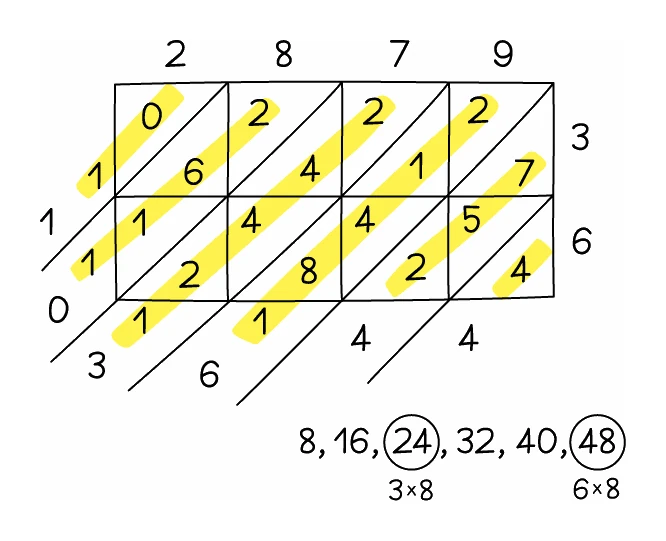
The lattice method
- Every product stays a single-digit pair in this layout, which is what makes it reliable for longer numbers
- Each cell is split by a diagonal, with the tens digit above the diagonal and the ones digit below
- The digits are then summed along each diagonal, carrying leftwards where a diagonal totals ten or more
Short division
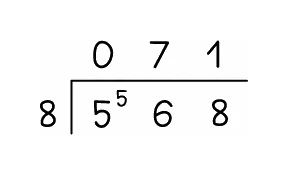
- Short division divides by a single digit, carrying any remainder into the next digit of the number
- The remainder at each step is written as a small digit in front of the next digit
- Only one written method for each operation needs to be known, provided it is used accurately
Shortcuts worth spotting
- Multiplying or dividing by a power of ten shifts every digit along the place-value columns, one column for each zero
- 380 ÷ 10 = 38, 45 ÷ 100 = 0.45 and 28 ÷ 1000 = 0.028
- 3.7 × 100 = 370
- Writing the leading zeros in first makes the shift easier to see, so 0028 ÷ 1000 becomes 0.028
- A division by a larger number can be simplified first, exactly as a fraction is cancelled
- 1008 ÷ 28 is 1008/28, which halves to 504/14 and again to 252/7, and short division finishes it as 36
- Halving repeatedly divides by a power of 2, so 568 ÷ 8 is 284, then 142, then 71
Worked example
A long multiplication and a short division
Without a calculator, work out 384 × 27 and 4 718 ÷ 7.
Solution:
- For the multiplication, split 27 into 20 and 7 and multiply separately
- 384 × 20 = 7 680
- 384 × 7 = 2 688
- Add the partial products: 7 680 + 2 688 = 10 368
- Estimate as a check: 400 × 27 = 10 800, so 10 368 is sensible
- For the division, work left to right carrying each remainder
- 7 into 4 does not go, so carry the 4 onto the next digit to make 47
- 7 into 47 goes 6 times with 5 left over, so write 6 and carry the 5 onto the 1 to make 51
- 7 into 51 goes 7 times with 2 left over, so write 7 and carry the 2 onto the 8 to make 28
- 7 into 28 goes 4 times exactly
- The answer is 674, and 7 × 674 = 4 718 confirms it
4. Operations with decimals
Adding and subtracting decimals
- Line the decimal points up underneath one another before adding or subtracting
- Fill any short columns with zeros so every number has the same number of decimal places
- The decimal point in the answer sits directly below the points in the question
Multiplying decimals
- Multiplying by a power of ten turns a decimal into an integer, and the change is undone at the end
- For 1.4 × 2.05, work out 14 × 205 = 2 870, then divide by 10 and by 100 to give 2.87
- Counting decimal places gives the same result: the answer has as many decimal places as the two numbers together
- 1.4 has one and 2.05 has two, so the answer has three before trailing zeros are removed
- An estimate settles where the point belongs: 1.4 × 2.05 is roughly 1.5 × 2 = 3, so 2.87 is sensible and 28.7 is not
Dividing decimals
- Multiply both numbers by the same power of ten until the divisor is a whole number
- 3.15 ÷ 0.05 becomes 315 ÷ 5 = 63
- The answer is unchanged because both numbers were scaled equally
Worked example
Subtracting decimals by exchanging
A length of ribbon measures 7.5 m. A piece measuring 0.86 m is cut off. Work out the length remaining.
Solution:
- Estimate first: 7.5 − 0.9 = 6.6 m
- Write 7.5 as 7.50 so both numbers have two decimal places
- Hundredths: 0 is smaller than 6, so exchange from the tenths column, giving 10 − 6 = 4
- Tenths: 4 is smaller than 8, so exchange from the ones column, giving 14 − 8 = 6
- Ones: 6 − 0 = 6
- The remaining length is 6.64 m, which is close to the estimate
5. Order of operations
BIDMAS
- Operations are carried out in a fixed order, remembered as BIDMAS or BODMAS
| Letter | Stands for | Note |
|---|---|---|
| B | Brackets | Innermost brackets first |
| I | Indices | Powers and roots |
| D M | Division and Multiplication | Equal rank, worked left to right |
| A S | Addition and Subtraction | Equal rank, worked left to right |
- Division and multiplication share a rank, so 24 ÷ 6 × 2 is 8, not 2
- Addition and subtraction likewise share a rank, so 10 − 4 + 3 is 9, not 3
Hidden brackets in fractions and roots
- A fraction line acts as a bracket around the whole numerator and the whole denominator
- (7 + 5)/(9 − 3) is worked as 12 ÷ 6 = 2
- A root sign acts as a bracket around everything underneath it
- √(9 + 16) is √25 = 5, which is not the same as √9 + √16 = 7
- These brackets have to be typed in explicitly on a calculator, because the layout that makes them obvious on paper is lost on the keypad
Worked example
Applying BIDMAS
Work out (9 − 4) + 3 × 2³.
Solution:
- Brackets first: 9 − 4 = 5, so the calculation becomes 5 + 3 × 2³
- Indices next: 2³ = 8, giving 5 + 3 × 8
- Multiplication before addition: 3 × 8 = 24, giving 5 + 24
- Addition last: 5 + 24 = 29
Worked example
Putting in one pair of brackets
Insert one pair of brackets in each line so that it is true.
(a) 3 + 9 × 4 − 2 = 21
(b) 3 + 9 × 4 − 2 = 46
Solution:
- Without brackets, BIDMAS gives 3 + 36 − 2 = 37, so the brackets have to change the order of working
- (a) 21 is less than 37, so make the multiplication smaller by bracketing the subtraction: 9 × (4 − 2) = 9 × 2 = 18
- Check the whole line: 3 + 18 = 21, so the answer is 3 + 9 × (4 − 2) = 21
- (b) 46 is more than 37, so make the multiplication bigger by bracketing the addition: (3 + 9) × 4 = 12 × 4 = 48
- Check the whole line: 48 − 2 = 46, so the answer is (3 + 9) × 4 − 2 = 46