1. Coordinates on the grid
Reading and plotting a point
- The grid used throughout this course has a horizontal x-axis and a vertical y-axis, meeting at the origin
- The origin is the point (0, 0), and every other point is described by how far it lies from there in each direction
- A pair of coordinates is written in brackets with the horizontal value first: (x, y)
- Positive x moves right and negative x moves left; positive y moves up and negative y moves down
- (4, 3) sits four to the right and three up
- (−2, −5) sits two to the left and five down
- Plot a point with a small cross or a solid dot, and write its letter beside it when the question names it, so it is clear which point is which
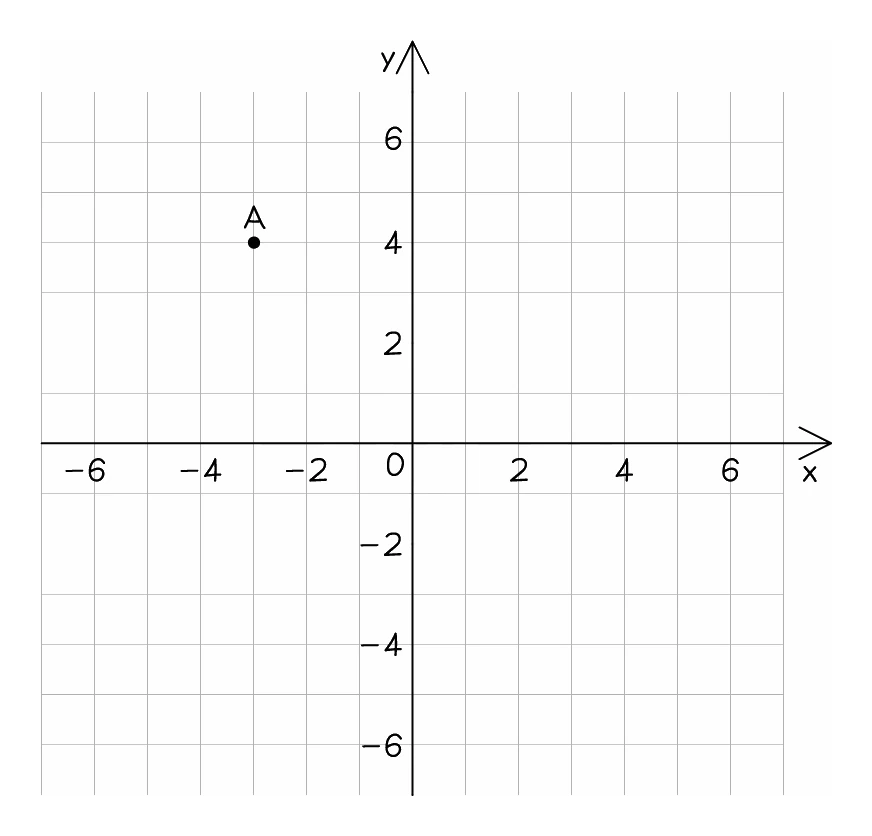
- Check the scale on the axes before counting: one square is frequently worth more than one unit, and assuming otherwise puts every answer out by a factor
2. Gradient
What the number tells you
- The gradient measures how steep a line is and which way it slopes
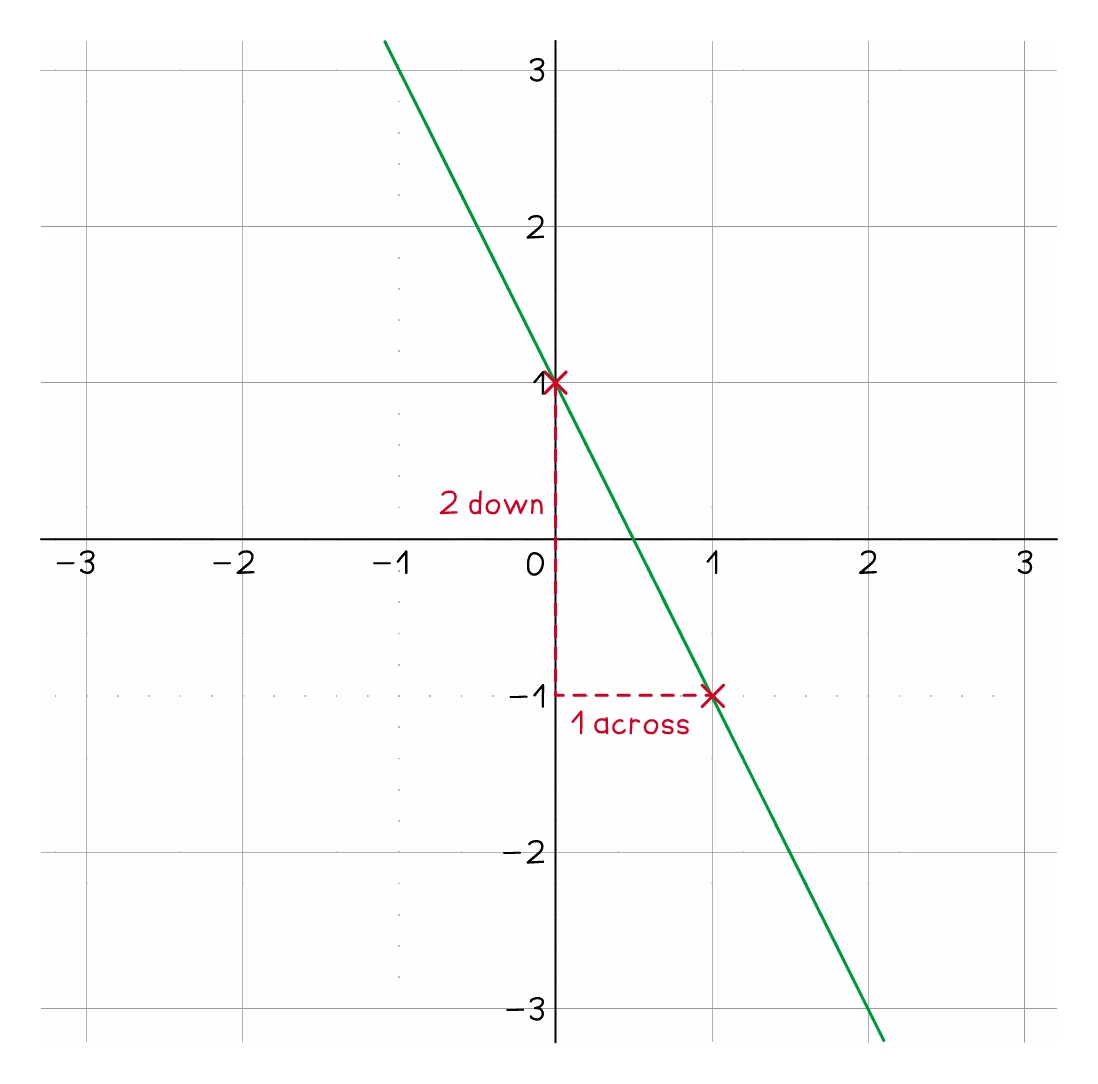
- A gradient of 3 means the line rises 3 for every 1 step to the right, and a gradient of −4 means it falls 4 for every 1 step to the right
- An uphill line, running from bottom left to top right, has a positive gradient; a downhill line has a negative one
- Comparing steepness ignores the sign, so a gradient of −5 is steeper than one of 2
- A horizontal line has gradient 0, and a vertical line has no gradient at all because there is no horizontal step to divide by
Measuring it
- On a printed grid, pick two points that sit on the line and complete a right-angled triangle between them
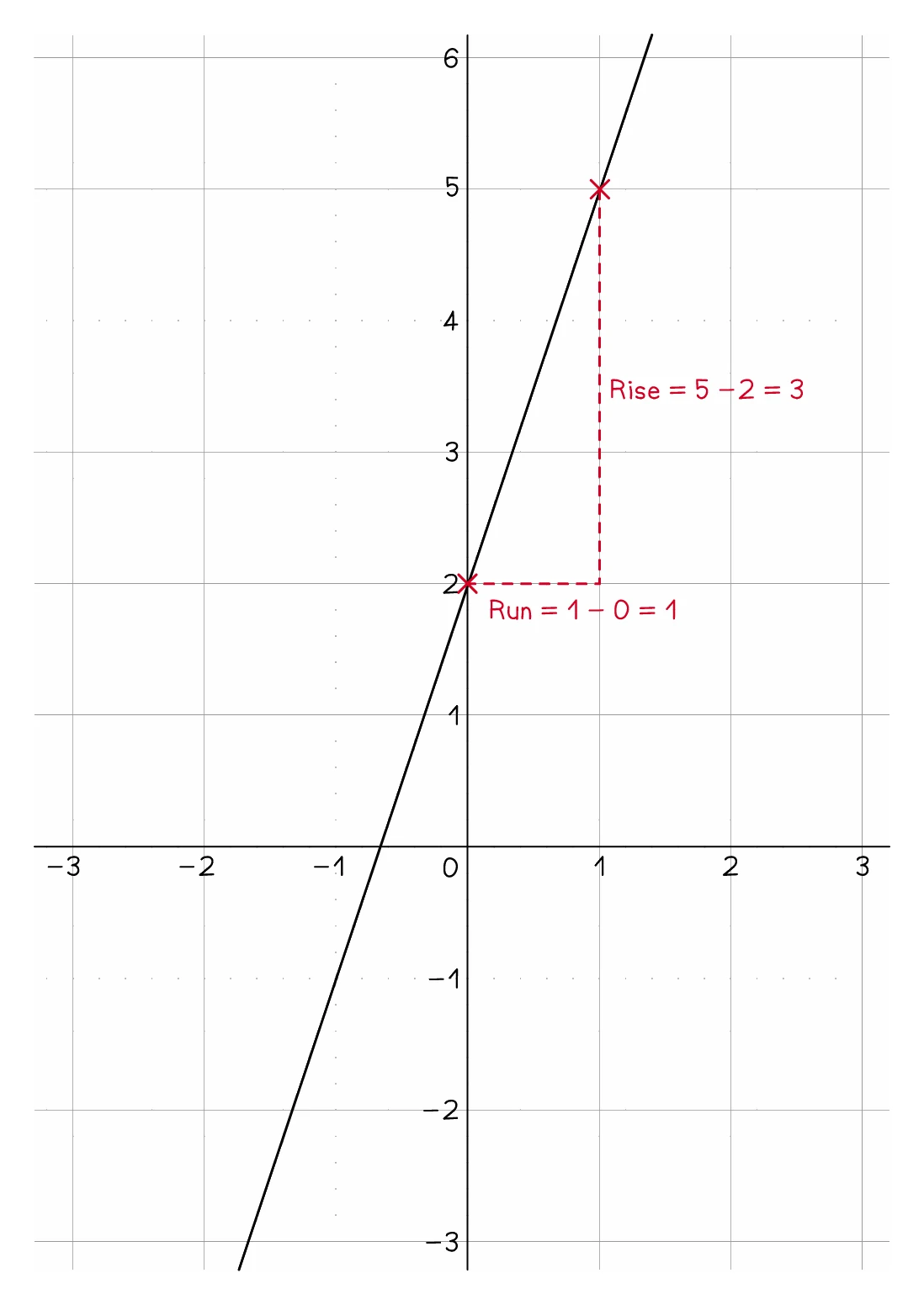
- The gradient is the vertical change divided by the horizontal change
- Choose two points that sit exactly on grid intersections and are far apart, because a short triangle magnifies any reading error
- Read the scales before counting squares: the two axes often use different scales, and one square is frequently not one unit
- Put the minus sign back in yourself for a downhill line, since the counting gives only the size
3. The straight-line equation
Reading a line from its equation
- Any straight line that is not vertical can be written y = mx + c: the number m sets its steepness and the number c fixes where it meets the y-axis
- The line therefore passes through (0, c)
- y = 4x − 9 has gradient 4 and meets the y-axis at −9
- y = 11 − 2x has gradient −2 and meets the y-axis at 11, so take the number attached to x, not the one written first
- A horizontal line has the form y = c, since every point on it has the same y value
- A vertical line has the form x = k, and it cannot be written as y = mx + c at all
- Answers must be given fully simplified, so tidy fractions and collect any like terms before writing the final line
Worked example
Reading a line from its equation
Write down the gradient and the y-axis crossing of y = 3x − 4.
Solution:
- The equation is already in the form y = mx + c
- The number in front of x is the gradient, so the gradient is 3
- The constant is where the line crosses the y-axis, at (0, −4)
Worked example
Where a line meets a horizontal line
The lines y = 25 − 4x and y = −3 cross at the point P. Find the coordinates of P.
Solution:
- Every point on y = −3 has a y-coordinate of −3, so P does too
- Substitute y = −3 into the other equation: −3 = 25 − 4x
- Subtract 25 from both sides: −28 = −4x
- Divide both sides by −4: x = 7
- P is (7, −3)
- Check in y = 25 − 4x: 25 − 4 × 7 = 25 − 28 = −3
- Give both coordinates when the point is asked for: the −3 comes straight from the horizontal line
4. Drawing a straight line
From an equation
- Build a small table of values by substituting three x values that are spread across the axes you are given
- Three points, not two: a slip in one of three points shows up because it misses the line through the other two, whereas two points always look convincing
- Plot the points and join them with a ruled line that runs the full width of the grid
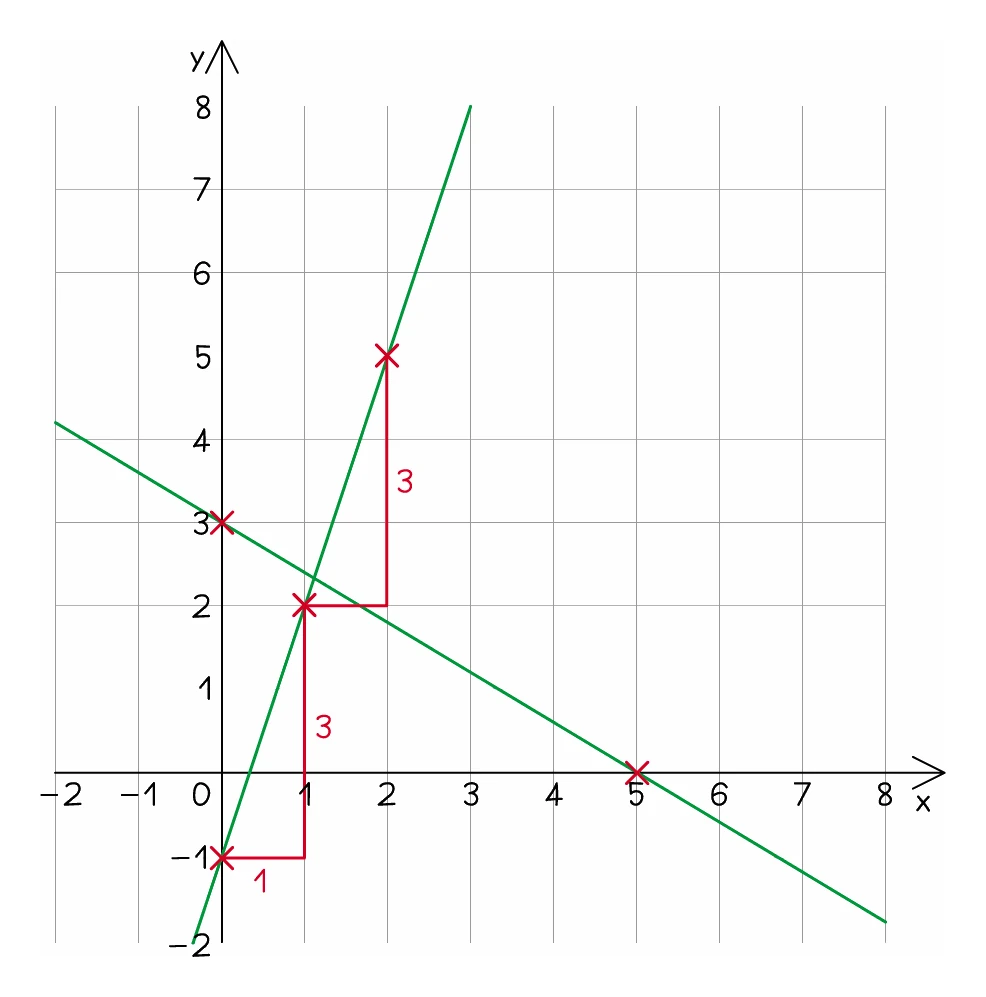
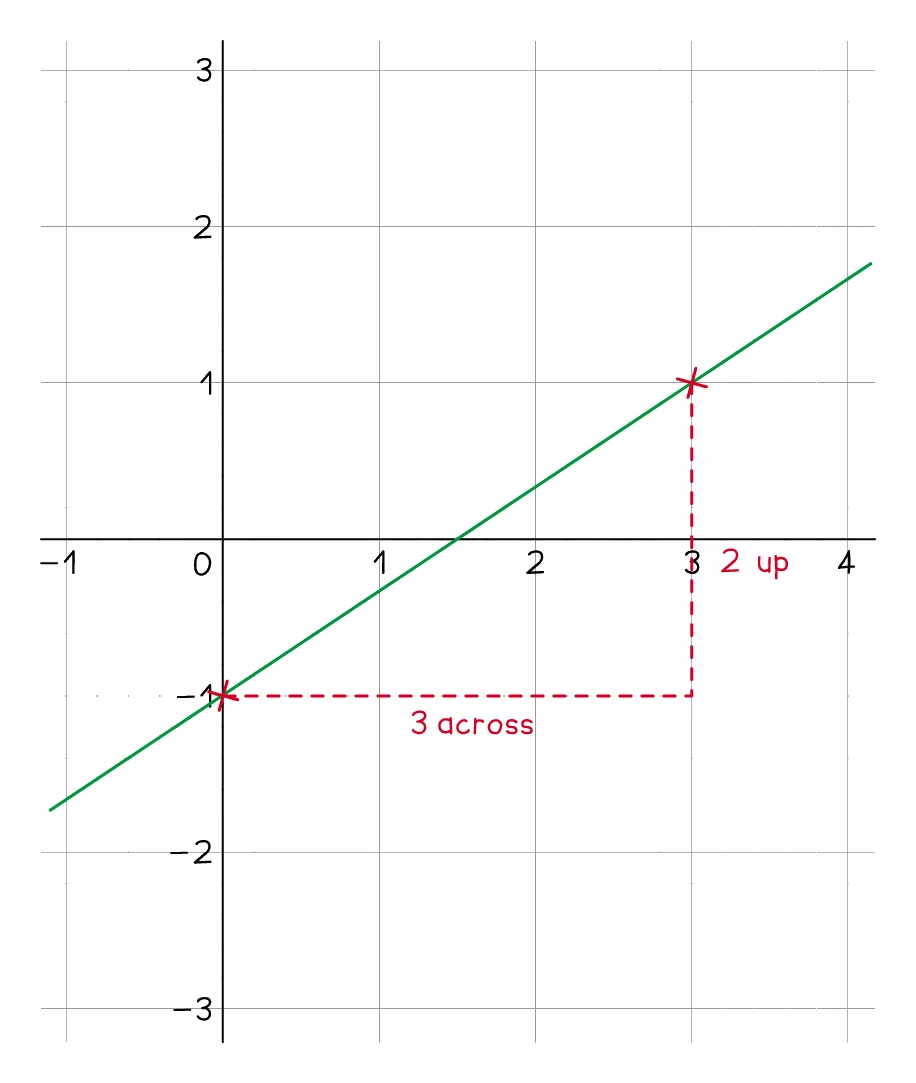
- Alternatively start at (0, c) and step out the gradient, going one right and m up each time, down instead if m is negative
- For a gradient written as a fraction, step across by the bottom number and up by the top number
Worked example
Drawing a line from its equation
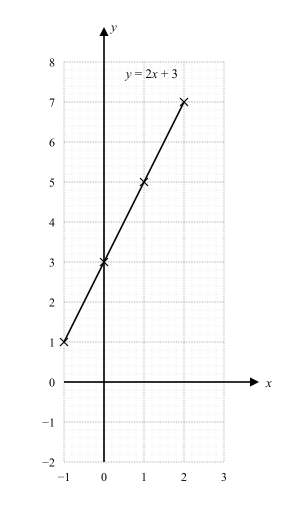
Draw y = 2x + 3 for x from −1 to 2.
Solution:
- Build a short table of values
- x = −1 gives y = 1; x = 0 gives 3; x = 1 gives 5; x = 2 gives 7
- Plot (−1, 1), (0, 3), (1, 5) and (2, 7), and join them with a ruled line
5. Finding the equation of a line
From a graph
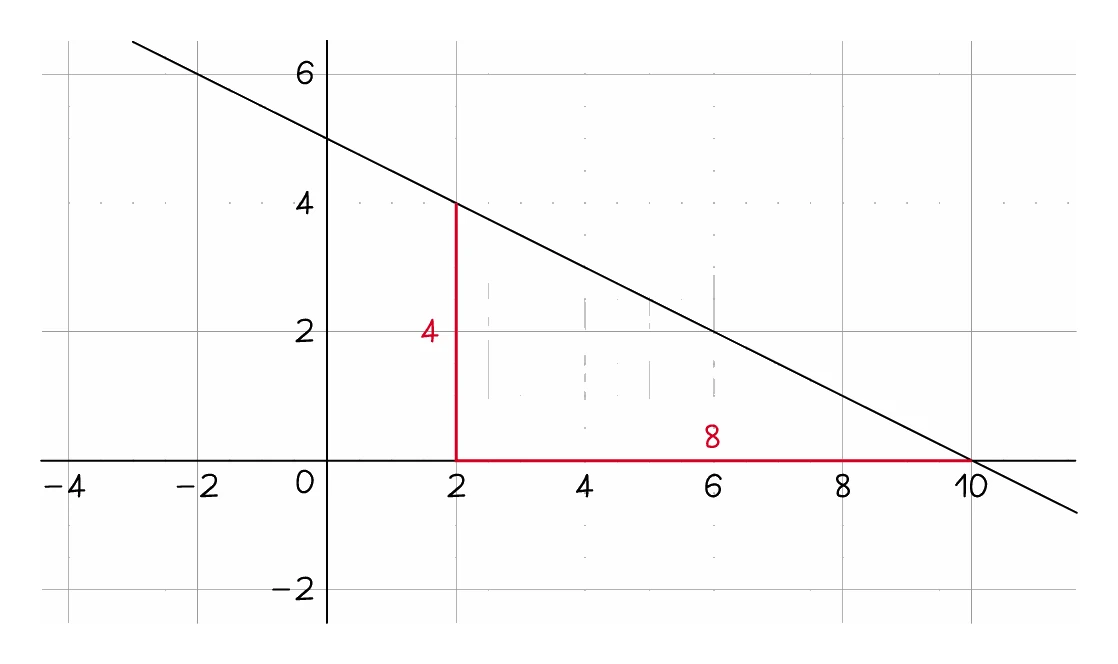
- Work out the gradient from a triangle, then read where the line crosses the y-axis
- Put both numbers into y = mx + c and write the equation out
- If the crossing point is off the edge of the grid, use a point the line does pass through instead
Exam tip
The equation is marked in pieces
Finding the equation of a line from a grid is marked in pieces. A right-angled triangle drawn on the grid, with the correct rise and run written on it, earns a method mark on its own. In the answer, the right gradient scores even with a wrong c, and the right c scores even with a wrong gradient, so always finish with a whole equation, y = mx + c.
Worked example
The equation of a line from a grid
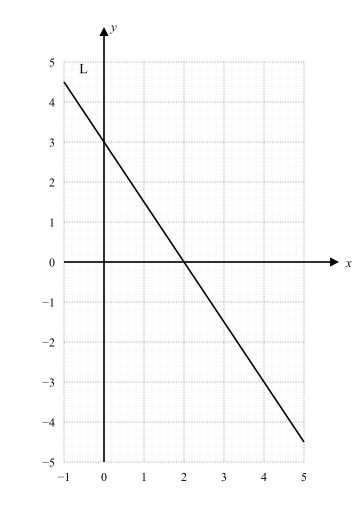
Line L is drawn on the grid below. Find its equation in the form y = mx + c.
Solution:
- Use two points where L crosses the grid exactly, as far apart as the grid allows: (0, 3) and (4, −3)
- Draw a right-angled triangle between them and read its sides off the grid
- The run is 4 to the right and the line drops 6, so the rise is −6 because L slopes downhill
- Gradient = rise ÷ run = −6 ÷ 4 = −1.5
- L crosses the y-axis at 3, so c = 3
- The equation is y = −1.5x + 3
- Check with the other point: −1.5 × 4 + 3 = −6 + 3 = −3
From a gradient and a point
- Write y = mx + c with the gradient filled in and c left as a letter
- Substitute the coordinates of the known point and solve the resulting equation for c
- Rewrite the equation with that value in place
Worked example
A gradient and one point
Find the equation of the line with gradient 5 that passes through (3, 7). Give your answer in the form y = mx + c.
Solution:
- Start from y = 5x + c
- Substitute x = 3 and y = 7: 7 = 5 × 3 + c
- So 7 = 15 + c
- Subtract 15: c = −8
- The equation is y = 5x − 8
6. Parallel lines
Same gradient, different intercept
- Two different lines are parallel exactly when their gradients are equal (or both are vertical), and they then never meet
- y = 7x + 2 and y = 7x − 5 are parallel; y = 7x + 2 and y = 4x + 2 are not
- Check by rearranging both equations into y = mx + c first, since a shared gradient can be hidden by the form
- To find the equation of a line parallel to a given one, copy the gradient across and then find the new intercept from the point you are given
Worked example
Parallel through a given point
A line is parallel to y = 7x + 2 and passes through (3, 8). Find its equation.
Solution:
- Parallel means the same gradient, so the new line is y = 7x + c
- Substitute x = 3 and y = 8: 8 = 21 + c
- Subtract 21: c = −13
- The line is y = 7x − 13