1. Solving linear equations
What makes an equation linear
- A linear equation contains an unknown whose highest power is 1, so there is no x² term
- Solving means isolating the unknown by undoing each operation applied to it
- Whatever is done to one side must be done to the other, which is what keeps the equation true
The method
- Undo additions and subtractions first, then multiplications and divisions
- Work one operation per line so each step is visible
Worked example
A two-step equation
Solve 5x − 8 = 22.
Solution:
- Adding 8 to each side clears the subtraction, leaving 5x = 30
- Since 5 multiplies the unknown, undo it by dividing each side by 5
- x = 6
2. Brackets, fractions and unknowns on both sides
Brackets
- Expand the bracket first, then solve as usual
- 3(2x + 5) = 39 expands to 6x + 15 = 39, giving 6x = 24 and x = 4
- Dividing through by the number outside also works, though it can create fractions
Fractions
- Multiply both sides by the denominator, so no term is left divided
- x/4 = 3 gives x = 12, and 2x/5 = 6 gives 2x = 30, so x = 15
- Terms without a denominator must be multiplied too, which is the step most often missed
Unknowns on both sides
- Remove the smaller unknown term by applying its inverse to both sides, which avoids negatives
- 7x − 4 = 2x + 21 becomes 5x − 4 = 21 after subtracting 2x
- Then 5x = 25 and x = 5
Worked example
Unknowns on both sides
Solve (a) 3(2x − 5) = 4x + 9, (b) 5y − 9 = 23 − 3y.
Solution:
- (a) Expand the bracket first: 6x − 15 = 4x + 9
- 4x is the smaller unknown term, so subtract 4x from both sides: 2x − 15 = 9
- Add 15 to both sides: 2x = 24
- x = 12
- Check: 3(2 × 12 − 5) = 3 × 19 = 57, and 4 × 12 + 9 = 57
- (b) The unknown term on the right is −3y, so add 3y to both sides: 8y − 9 = 23
- Add 9 to both sides: 8y = 32
- y = 4
- Check: 5 × 4 − 9 = 11, and 23 − 3 × 4 = 11
3. Turning words into algebra
Naming the unknown
- Choose a letter for the quantity you do not know, and state what it represents together with its units
- Where two quantities are related, define the simpler one first and build the other from it
- If a second number is 5 more than the first, call them n and n + 5
Translating common phrases
| Phrase | Expression |
|---|---|
| 4 more than a number | n + 4 |
| 7 less than a number | n − 7 |
| Three times a number | 3n |
| A number halved | n/2 |
| A number squared, then doubled | 2n² |
- Words signalling each operation: sum, total and increase for addition; difference, less than and decrease for subtraction; product, times and double for multiplication; shared, split and halved for division
- Brackets preserve the order the words describe
- "add 1, then multiply by 3" is 3(n + 1), which differs from "multiply by 3, then add 1", which is 3n + 1
Worked example
Turning a sentence into an equation
Ann is 4 years older than Ben. Their ages add to 34. Form an equation and find Ben's age.
Solution:
- Name the unknown first, and choose the smaller quantity so the other is written in terms of it
- Let Ben's age be b
- Ann is 4 years older, so Ann's age is b + 4
- Their ages add to 34, which gives the equation b + (b + 4) = 34
- Collect: 2b + 4 = 34
- Subtract 4: 2b = 30, then divide by 2: b = 15
- Ben is 15 years old
- Answer the question asked: b = 15 alone is not an answer about ages, and checking gives 15 + 19 = 34
4. Forming an equation
Building the statement
- An equation needs two expressions for the same quantity, set equal
- Read the sentence for the fact that links them: a total, a perimeter, an angle sum, or two costs being equal
- Check the expression before solving by substituting a trial value
Exam tip
Solve the equation you wrote
In a question that asks you to form an equation and solve it, the method marks for solving it follow through from your own equation. A correct first step, and a correct line such as 4x = 28 that it simplifies to, each still score even if the equation itself was wrong. So never stop after forming it: write the equation on its own line, as it earns marks too, then solve it step by step.
Worked example
Consecutive integers
Three consecutive integers have a sum of 84. Find the integers.
Solution:
- Name the unknown first, and choose the one the others can be written from
- Let the smallest integer be n
- Consecutive means each is one more than the last, so the other two are n + 1 and n + 2
- Writing all three in terms of a single letter is what makes this solvable with one equation
- Their sum is 84, which gives n + (n + 1) + (n + 2) = 84
- Collect the three n terms and the two numbers: 3n + 3 = 84
- Subtract 3 from both sides: 3n = 81
- Divide by 3: n = 27
- The integers are 27, 28 and 29
- Answer the question rather than stopping at n = 27, and check: 27 + 28 + 29 = 84
5. Equations from shapes
Using the property of the shape
- A shape supplies the equation through one of its known properties
- The most useful are the perimeter as a sum of sides, the angle sum of a triangle being 180°, the angle sum of a quadrilateral being 360°, and the equal sides or angles of an isosceles triangle
- For a polygon with n sides, the interior angles sum to 180(n − 2)
- Mark the diagram with the expressions before forming the equation
Worked example
Perimeter of a rectangle
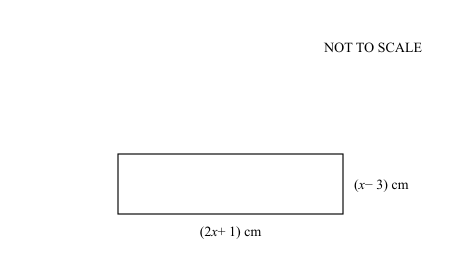
A rectangle has length (2x + 1) cm and width (x − 3) cm. Its perimeter is 38 cm. Find the length and the width.
Solution:
- The property of the shape supplies the equation, so name it before writing anything: a rectangle's perimeter is twice the length plus twice the width
- 2((2x + 1) + (x − 3)) = 38
- Simplify inside the bracket by collecting like terms: 2x + x = 3x, and 1 − 3 = −2
- 2(3x − 2) = 38
- Divide both sides by 2 rather than expanding, which keeps the numbers small: 3x − 2 = 19
- Add 2: 3x = 21, so x = 7
- x = 7 is not the answer: the question asks for two lengths
- Length = 2 × 7 + 1 = 15 cm, width = 7 − 3 = 4 cm
- Check against the perimeter given: 2(15 + 4) = 2 × 19 = 38 cm, and both sides are positive, which a length must be
6. Answering in context
Finishing the question
- The value of the letter is rarely the answer on its own: the question asked about the situation
- Convert back to what was asked, with units and the quantity named
- Where the question asks for a different quantity from the one you called x, substitute to find it
- Check that the answer makes sense in the context: a length must be positive, and a number of people must be a whole number