Introduction to Fractions
Mathematics (Core) revision notes · Cambridge (CIE) · 0580 · Core
1. What a fraction is
Numerator and denominator
- A fraction expresses one integer divided by another and is written with one number above the other
- The lower number, the denominator, states how many equal parts one whole has been split into
- The upper number, the numerator, states how many of those parts are being counted
- In 3/5, each whole is cut into five parts and three of them are taken
- A proper fraction has a numerator smaller than its denominator, so its value is below 1
- An improper fraction, also called a top-heavy fraction, has a numerator at least as large as its denominator, so its value is 1 or more
2. Equivalent fractions and simplifying
Equivalent fractions
- Equivalent fractions look different but represent the same amount
- Multiplying numerator and denominator by the same non-zero number leaves the value unchanged
- 4/7 = 8/14 = 12/21 = 16/28
- Every fraction therefore has infinitely many equivalent forms
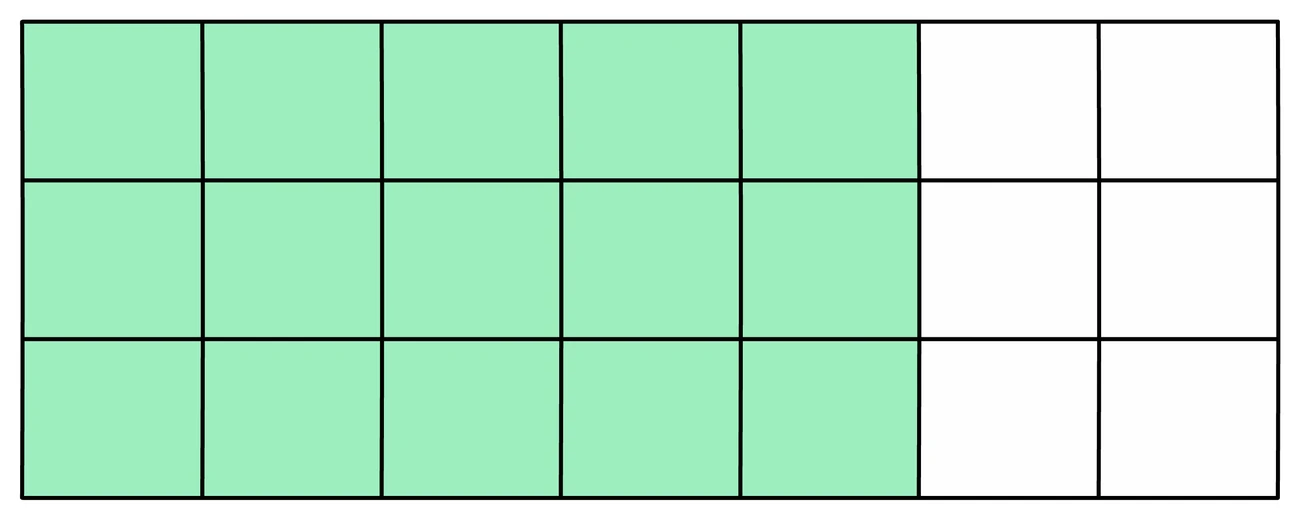
- Equivalence is easiest to see by regrouping: 21 small squares arranged as 7 columns of 3 means shading 15 squares shades exactly 5 whole columns, so 15/21 and 5/7 cover the same area
Simplifying
- Dividing numerator and denominator by a common factor produces a smaller equivalent fraction, a process also called cancelling
- A fraction is in its simplest form when the only common factor left is 1
- Dividing by the highest common factor reaches simplest form in one step
- 24/36 has highest common factor 12, so 24/36 = 2/3
- 30/48 has highest common factor 6, so 30/48 = 5/8
- Repeated cancelling by smaller factors reaches the same place, only more slowly
Exam tip
Write the fraction, then cancel fully
When a question asks for a fraction of a shape, a group or a total in its simplest form, a correct uncancelled fraction such as 18/42 earns one mark on a two-mark question. The final mark, and the only mark on a one-mark question, needs it fully cancelled, here to 3/7. So write the uncancelled fraction down first, then keep dividing until the only common factor is 1.
Worked example
Simplifying a fraction fully
Write 84/126 in its simplest form.
Solution:
- Look for a common factor of the numerator and the denominator
- Both are even, so divide each by 2: 84/126 = 42/63
- Both digit sums are multiples of 3 (4 + 2 = 6 and 6 + 3 = 9), so divide by 3: 42/63 = 14/21
- Both are multiples of 7: 14/21 = 2/3
- Check nothing is left: 2 and 3 share no factor above 1, so this is fully simplified
- Dividing by the highest common factor of 42 in one step gives the same answer, and either route earns the mark
3. Mixed numbers and improper fractions
Recognising each form
- A mixed number is written as a whole number beside a proper fraction
- 4 2/9 means four wholes together with two ninths
- Any value above 1 can be written either as a mixed number or as an equivalent improper fraction
Converting a mixed number to an improper fraction
- Multiply the whole number by the denominator, then add the numerator
- Write the result over the original denominator
- For 4 2/9: 4 × 9 = 36, and 36 + 2 = 38, giving 38/9
Converting an improper fraction to a mixed number
- Work out how many whole denominators fit inside the numerator
- That count becomes the whole part, and whatever is left over sits above the original denominator
- For 29/6: 29 ÷ 6 = 4 remainder 5, giving 4 5/6
Worked example
Converting both ways
Write 4 3/5 as an improper fraction, and write 47/6 as a mixed number.
Solution:
- For the mixed number, multiply the whole part by the denominator and add the numerator
- 4 × 5 = 20, then 20 + 3 = 23
- The denominator does not change, so 4 3/5 = 23/5
- For the improper fraction, divide the numerator by the denominator
- 47 ÷ 6 = 7 remainder 5
- The whole part is the 7 and the remainder becomes the new numerator, so 47/6 = 7 5/6
- Check by reversing: 7 × 6 = 42, and 42 + 5 = 47