Fractions, Decimals and Percentages
Mathematics (Core) revision notes · Cambridge (CIE) · 0580 · Core
1. Percentages and decimals
Percentage to decimal
- A percentage counts hundredths, so dividing by 100 recovers the decimal
- Dividing by 100 shifts every digit two columns to the right
- 8% becomes 0.08
- 65% becomes 0.65
- 240% becomes 2.4
- 0.5% becomes 0.005
- A percentage above 100 always gives a decimal above 1
Decimal to percentage
- Multiplying by 100 reverses the process and shifts every digit two columns left
- 0.47 becomes 47%
- 2.06 becomes 206%
- 0.009 becomes 0.9%
- The per cent sign must be written, since 47 and 47% are different quantities
2. Decimals and fractions
Decimal to fraction
- The number of decimal places fixes the denominator: one place gives tenths, two gives hundredths, and n places gives 10ⁿ
- 0.9 is 9/10
- 0.23 is 23/100
- 0.041 is 41/1000
- Write the digits after the point as the numerator, then simplify
- 0.44 is 44/100, which cancels to 11/25
- A whole number is written as a fraction by placing it over 1
Percentage to fraction
- Every percentage is already a number of hundredths, so it goes straight over 100 and is then cancelled
- 44% is 44/100, which cancels to 11/25
Fraction to decimal
- Where the denominator divides into a power of ten, scale up to that power and read the decimal straight off
- 25 goes into 100 four times, so 7/25 becomes 28/100, or 0.28
- Otherwise divide the numerator by the denominator
- Denominators that are powers of 2 can be reached by repeated halving
- 3/8: halving 3 gives 1.5, then 0.75, then 0.375
- Some conversions are worth knowing on sight: 1/2 = 0.5, 1/4 = 0.25, 3/4 = 0.75, 1/5 = 0.2 and 1/10 = 0.1
- 1/3 = 0.333… and 2/3 = 0.666…, where the digit repeats for ever
- Any other fraction is a short division with zeros written after the point: 5/8 is 5.000 ÷ 8 = 0.625
Fraction to percentage
- Convert to a decimal first, then multiply by 100
- 9/20 scales to 45/100, which is 0.45, and therefore 45%
Worked example
The four conversions
Write 0.36 as a fraction in its simplest form, and write 3/8 as a decimal and as a percentage.
Solution:
- 0.36 has two decimal places, so it is 36 hundredths: 0.36 = 36/100
- Cancel by 4: 36/100 = 9/25
- For 3/8, divide the numerator by the denominator: 3 ÷ 8 = 0.375
- To reach a percentage, multiply the decimal by 100: 0.375 × 100 = 37.5%
- Check the other way round: 37.5 ÷ 100 = 0.375, and 0.375 × 8 = 3
3. Ordering fractions, decimals and percentages
Ordering fractions only
- Rewrite every fraction over the lowest common denominator, then compare numerators
- For 2/3, 5/8, 7/12 and 3/4 the lowest common denominator is 24
- These become 16/24, 15/24, 14/24 and 18/24
- Ascending order is therefore 7/12, 5/8, 2/3, 3/4
- Give the answer in the form the values were originally written in
Ordering a mixed list
- Convert every value to a decimal, since decimals are the one form that can be compared column by column
- To order 0.31, 2/3, √0.09, 32% and 3⁻¹: 0.31 is already a decimal, 2/3 = 0.666…, √0.09 = 0.3, 32% = 0.32 and 3⁻¹ = 1/3 = 0.333…
- Pad the decimals to a common number of places before comparing
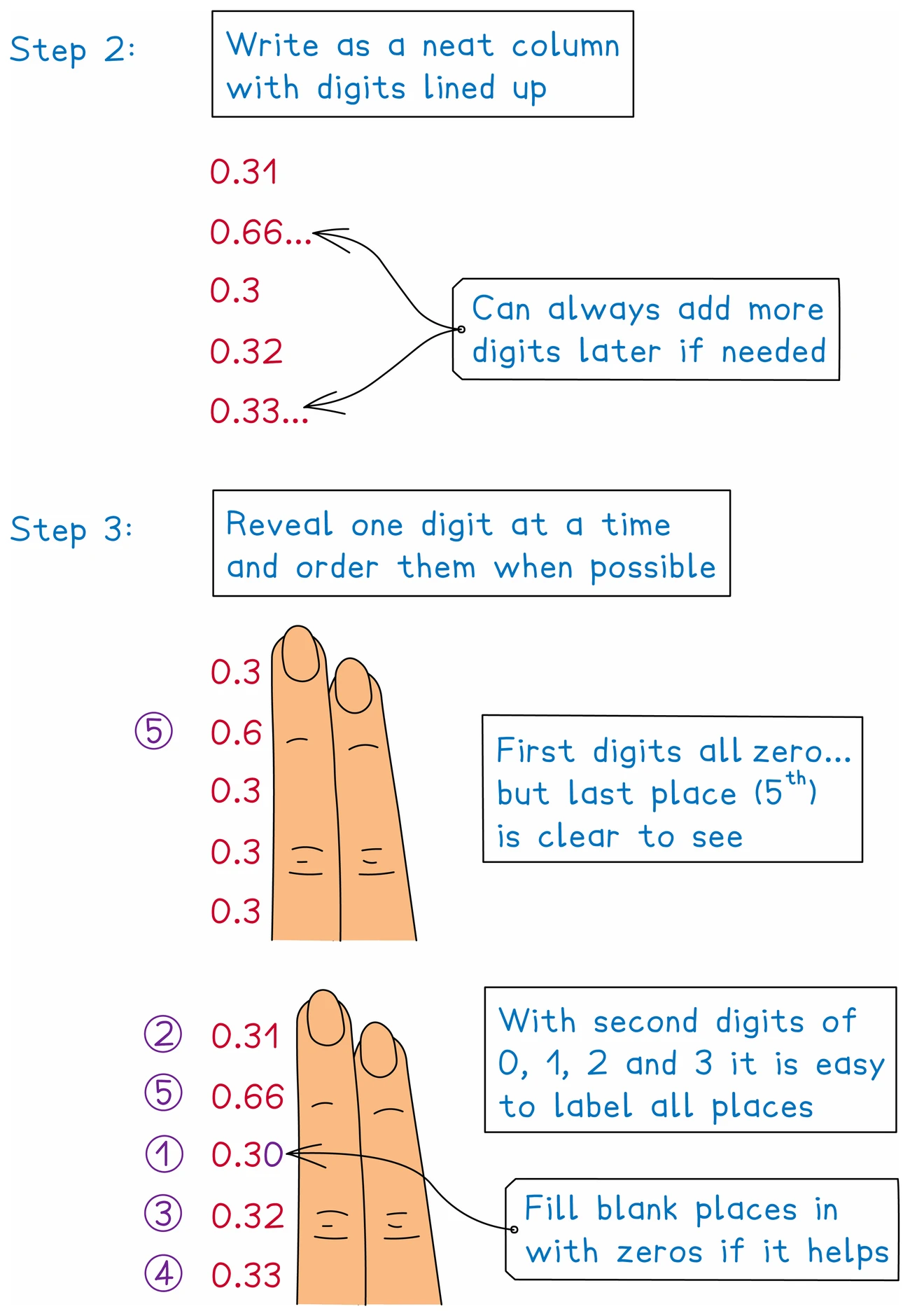
- Order the decimals, then rewrite each in its original form
Comparison symbols
- A chain of values can be joined with the inequality symbols rather than listed
- 1/5 < 1/4 < 1/3
- Recall that > is greater than, < is less than, ⩾ is greater than or equal to, and ⩽ is less than or equal to
Exam tip
Write every decimal, to enough places
Writing every value in the list as a decimal, or every one as a percentage, earns one of the two marks even if the final order slips. The decimals must be precise enough to tell apart, and on Paper 3 some of the values usually agree to two places: 6/7 = 0.8571… only beats 0.857 at the fourth place. Write each to three or four places, then order them.
Worked example
Ordering a mixed list without a calculator
Write these values in ascending order: 0.62, 5/8, 63%, 3/5
Solution:
- Convert each to a decimal
- 0.62 is already a decimal
- 5/8 by repeated halving: 5, 2.5, 1.25, 0.625
- 63% divided by 100 gives 0.63
- 3/5 is equivalent to 60/100, so 0.6
- Pad to three places: 0.620, 0.625, 0.630, 0.600
- Ascending order of the decimals: 0.600, 0.620, 0.625, 0.630
- Rewritten in their original forms: 3/5, 0.62, 5/8, 63%