Congruence and Similarity
Mathematics (Core) revision notes · Cambridge (CIE) · 0580 · Core
1. Congruent shapes
Same shape, same size
- Two shapes are congruent when neither their form nor their measurements differ in any way
- Turning one round, flipping it over or sliding it somewhere else leaves it congruent, since a rotation, a reflection and a translation all move a shape without resizing it
- An enlargement changes a shape's size unless its scale factor is 1, so any other enlargement gives an image that is not congruent to the original
- To decide whether two shapes are congruent, match up the sides and check that corresponding lengths are equal, then do the same for the angles
- The two shapes need not face the same way, so match corresponding parts rather than comparing them where they sit
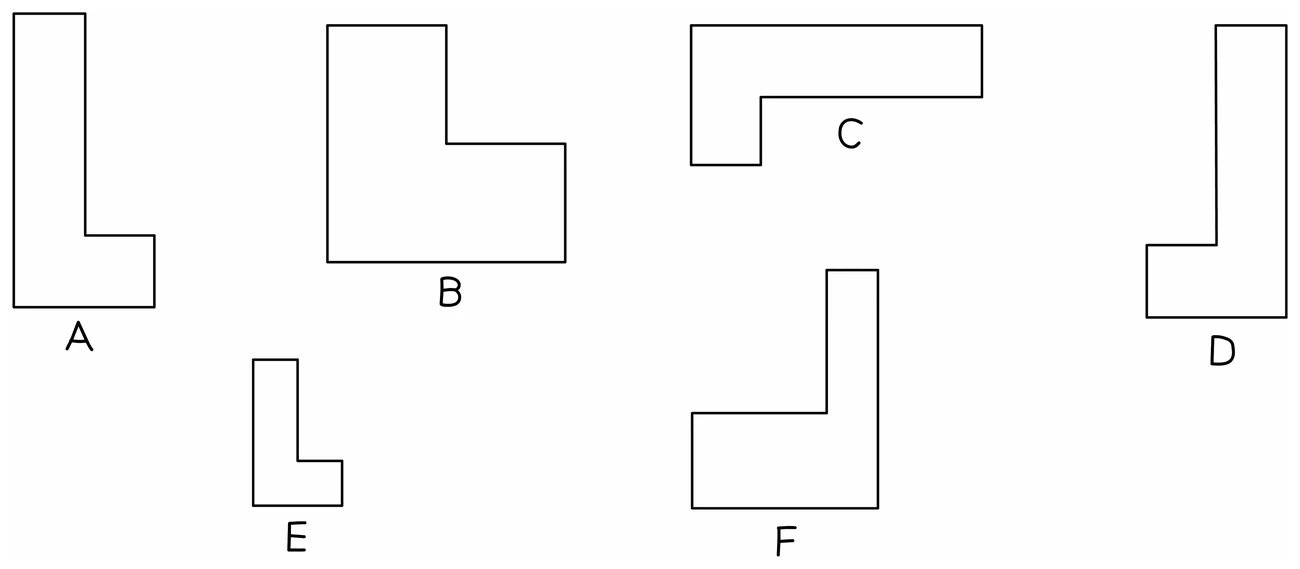
- Tracing paper settles it quickly on a diagram drawn to scale
2. Similar shapes
Same shape, different size
- Two shapes are similar when one is an enlargement of the other, turned or flipped over if need be, which means their angles match and every pair of corresponding sides shares the same ratio
- Papers usually say "mathematically similar", occasionally just "similar", and either phrasing is the signal to look for a scale factor
- Congruence is the special case of similarity where the scale factor is 1, so congruent shapes are similar but similar shapes are usually not congruent
3. Similar lengths
Finding a missing length
- Pick a pair of sides whose lengths are both known, one from each shape, and divide one by the other to get the scale factor
- Multiply to move towards the larger shape and divide to move towards the smaller one
- Choosing the direction that goes small to large keeps the scale factor above 1, which many find easier to check
- Pair the sides correctly before dividing: corresponding sides sit between the same pair of equal angles
- Sanity check the answer, since a length on the larger shape must come out larger
Exam tip
Write the matching sides as two fractions
On a two-mark similar-shapes question, the first mark is for the matching sides written as an equation of two fractions with the lengths in place, such as x/6 = 7/4 for the example below, and it is earned even if solving the equation goes wrong. When the shapes are named, the letter order shows which sides match: if triangle ABC is similar to triangle PQR, AB matches PQ, BC matches QR and AC matches PR.
Worked example
A missing length on a similar shape
Two triangles are mathematically similar. A side of 4 cm on the smaller corresponds to 7 cm on the larger. Another side of the smaller is 6 cm. Find the corresponding side, x cm, on the larger.
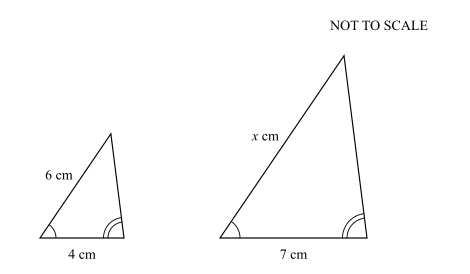
Solution:
- Take the scale factor from the pair of sides that are both known
- Scale factor = 7 ÷ 4 = 1.75
- The missing side is on the larger shape, so multiply
- x = 6 × 1.75 = 10.5, so the side is 10.5 cm
- Check: 10.5 ÷ 6 = 1.75, matching the scale factor from the first pair