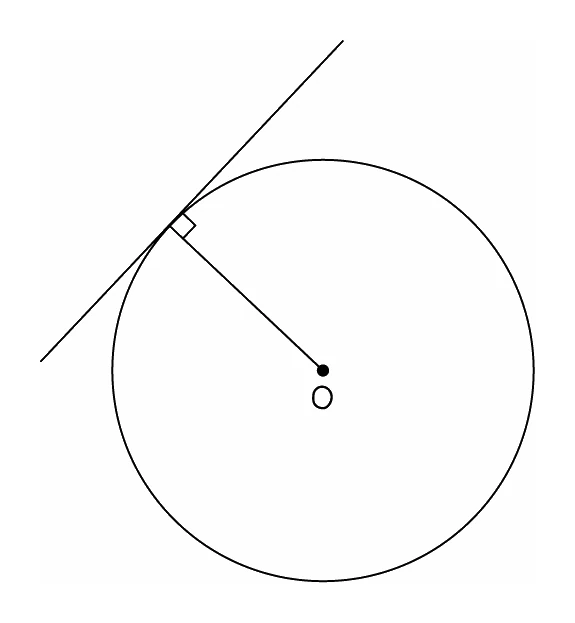
1. How circle questions work
Reasons carry the marks
- Many circle questions ask for an angle and the theorem that justifies it, with a mark for each
- On some questions the reason is a whole part on its own, so the wording has to be right
- Where the answer takes two steps, two reasons are expected: give one for each step, not just the last one
- The ordinary angle facts stay available throughout: angles in a triangle, angles on a line, angles at a point, isosceles triangles and angles in a quadrilateral
- Mark the radii on a diagram first, since any two of them make an isosceles triangle and that is often the missing step
- Diagrams are not to scale, so never measure
The theorems you need
- Two angle theorems are examined: the angle in a semicircle is 90°, and the angle between a tangent and a radius is 90°
- The ordinary angle facts above do the rest of the work, so a question is usually a short chain of those with one circle theorem in the middle
2. The two right-angle theorems
The angle in a semicircle is 90°
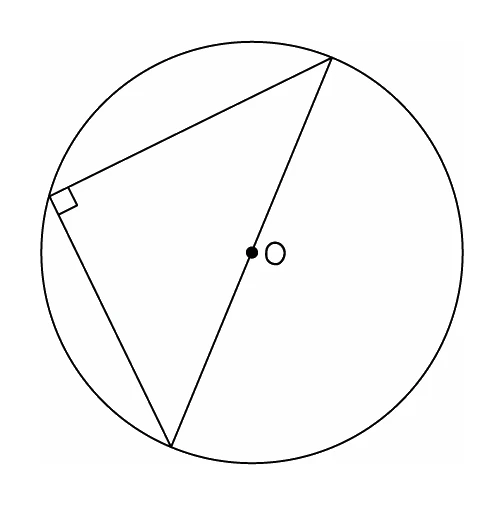
- Where a triangle has the diameter as one side and its third corner on the circumference, the angle at that corner is a right angle
- To spot it, check that one side runs through the centre and that every corner lies on the circumference
- Whichever corner faces the diameter is the one holding the right angle
Worked example
Using the semicircle and the triangle
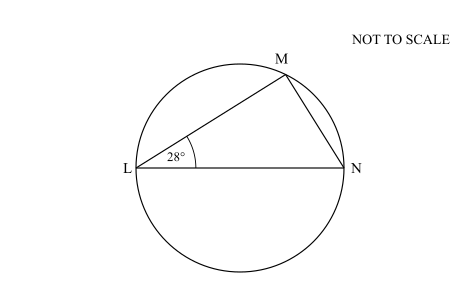
The diameter LN is drawn in a circle, and M is a third point on the circumference. Angle MLN is 28°. Find angle MNL, giving reasons.
Solution:
- LN is a diameter and M lies on the circumference, so angle LMN = 90°
- The reason is that the angle in a semicircle is 90°
- The three angles of triangle LMN add to 180°
- Angle MNL = 180 − 90 − 28 = 62°
- The second reason is that the angles in a triangle add to 180°
A tangent meets a radius at 90°
- A tangent touches the circle at exactly one point, and the radius drawn to that point is perpendicular to it
- Draw the radius in yourself whenever a tangent appears, because the right angle is usually what unlocks the question
- A mark scheme has accepted "tangent and radius are perpendicular" as well as the ninety-degree form, and allowed diameter in place of radius