Bearings, Constructions and Scale Drawings
Mathematics (Core) revision notes · Cambridge (CIE) · 0580 · Core
1. Measuring and drawing accurately
Equipment and expectations
- This topic is marked on accuracy, so a sharp pencil, a ruler, a protractor and a pair of compasses are all needed
- Every straight edge must be drawn with a ruler, which the syllabus states explicitly
- Lengths are normally accepted within a small tolerance either side of the exact value, so a carefully drawn line scores where a rough one does not
- Write each point's letter beside it when the question names the point, so it is clear which point is which
- Constructing perpendicular bisectors and angle bisectors is not required on this specification, so the compasses are needed only for triangles
2. Scale drawings
What a scale means
- A scale links a length on the drawing to the matching length in real life, and it is a ratio
- It appears in two forms
- As words, such as "1 cm represents 4 km", which is the form most scale drawings on these papers use
- As a ratio with no units, such as 1 : 25 000, meaning one unit on the drawing is 25 000 of the same units in reality
- A unitless ratio works for any unit, so 1 : 25 000 means 1 cm stands for 25 000 cm, which is 250 m or 0.25 km
- Converting the ratio into "1 cm represents … km" before doing anything else avoids most of the errors here
Working both ways
- To find a real distance, measure the drawing in centimetres and multiply by what one centimetre represents
- To find a drawing length, divide the real distance by what one centimetre represents
- Give the answer in the units the question asks for, converting at the end rather than mid-calculation
- Measure between the centres of the marked points, and to the nearest millimetre
Exam tip
Write the measured length down
When a question asks for a real distance from a scale drawing, write the length you measure, in centimetres, on its own line before using the scale. That measurement earns one of the two marks by itself, and if it is slightly out, multiplying it by the scale still earns the method mark. So for a line of 5.8 cm at 1 cm to 25 km, write 5.8 cm, then 5.8 × 25 = 145 km.
Worked example
Reading a distance off a map
On a map the scale is 1 cm represents 4 km. Two towns are 6.5 cm apart on the map. Find the actual distance between them, and the map distance for a third town 18 km away.
Solution:
- Each centimetre on the map stands for 4 km
- Real distance = 6.5 × 4 = 26 km
- For the second part, divide instead of multiplying
- Map distance = 18 ÷ 4 = 4.5 cm
- Check: 4.5 × 4 = 18
Worked example
Converting a ratio scale
A plan is drawn to a scale of 1 : 25 000. A path measures 8 cm on the plan. Find its real length in kilometres.
Solution:
- The ratio has no units, so 1 cm on the plan stands for 25 000 cm in reality
- Real length = 8 × 25 000 = 200 000 cm
- Convert to metres by dividing by 100: 200 000 ÷ 100 = 2000 m
- Convert to kilometres by dividing by 1000: 2000 ÷ 1000 = 2
- The path is 2 km long
3. Bearings
The three rules
- A bearing describes a direction, and it follows three rules without exception
- Measured from north
- Measured clockwise
- Written with three figures, so 59° is recorded as 059°
- Bearings therefore run from 000° round to 360°
- The compass directions have fixed bearings: north 000°, east 090°, south 180°, west 270°, with north-east 045°, south-east 135°, south-west 225° and north-west 315°
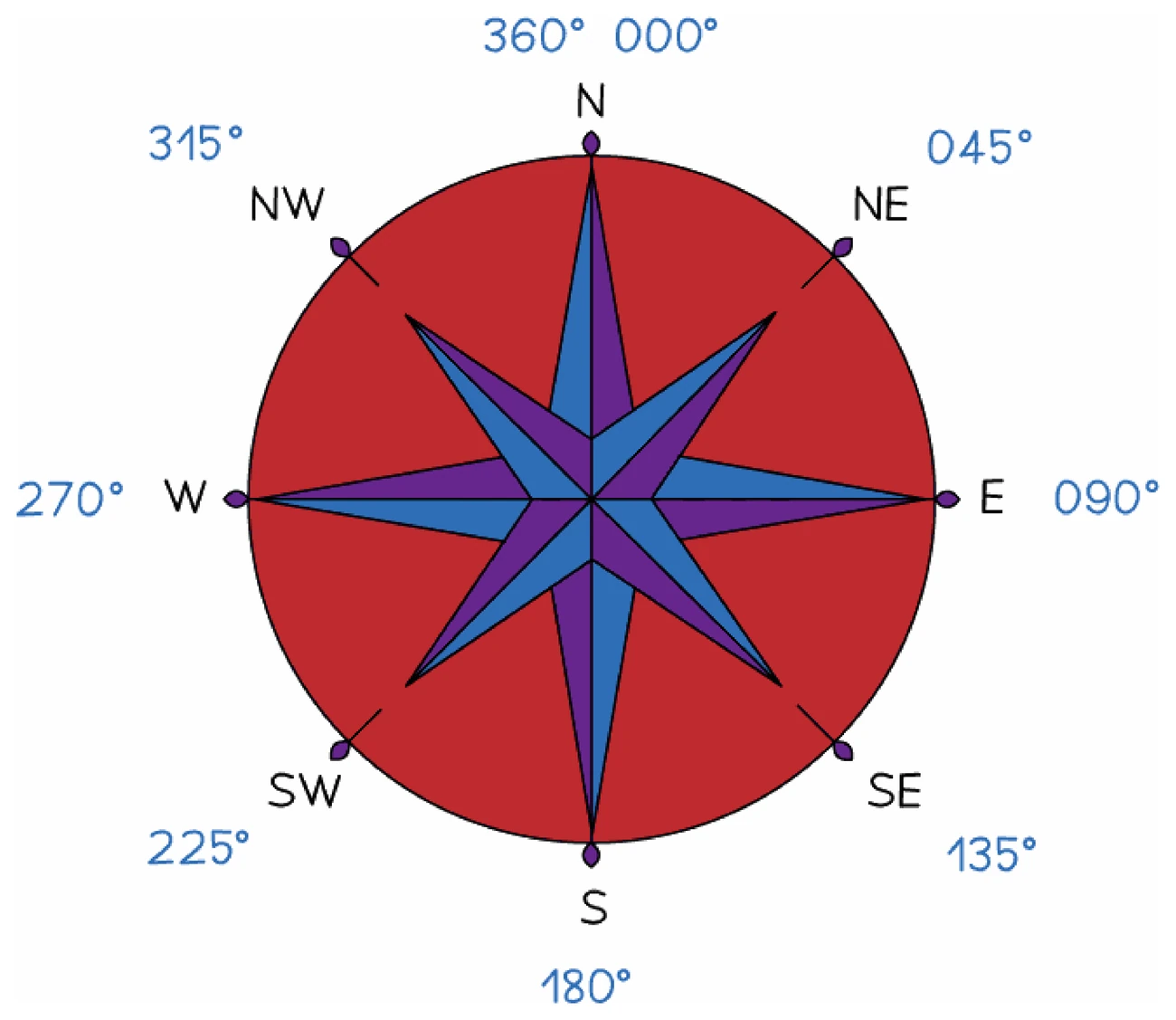
- "Due east" means exactly 090°, and the word "due" signals an exact compass direction
Which point to start from
- "The bearing of B from A" means stand at A and look towards B, so the north line is drawn at A
- The point after "from" is where the north line goes, and getting this the wrong way round reverses the answer
- To measure one, start by drawing north at wherever you are standing, join the two points, and take the clockwise angle with a protractor
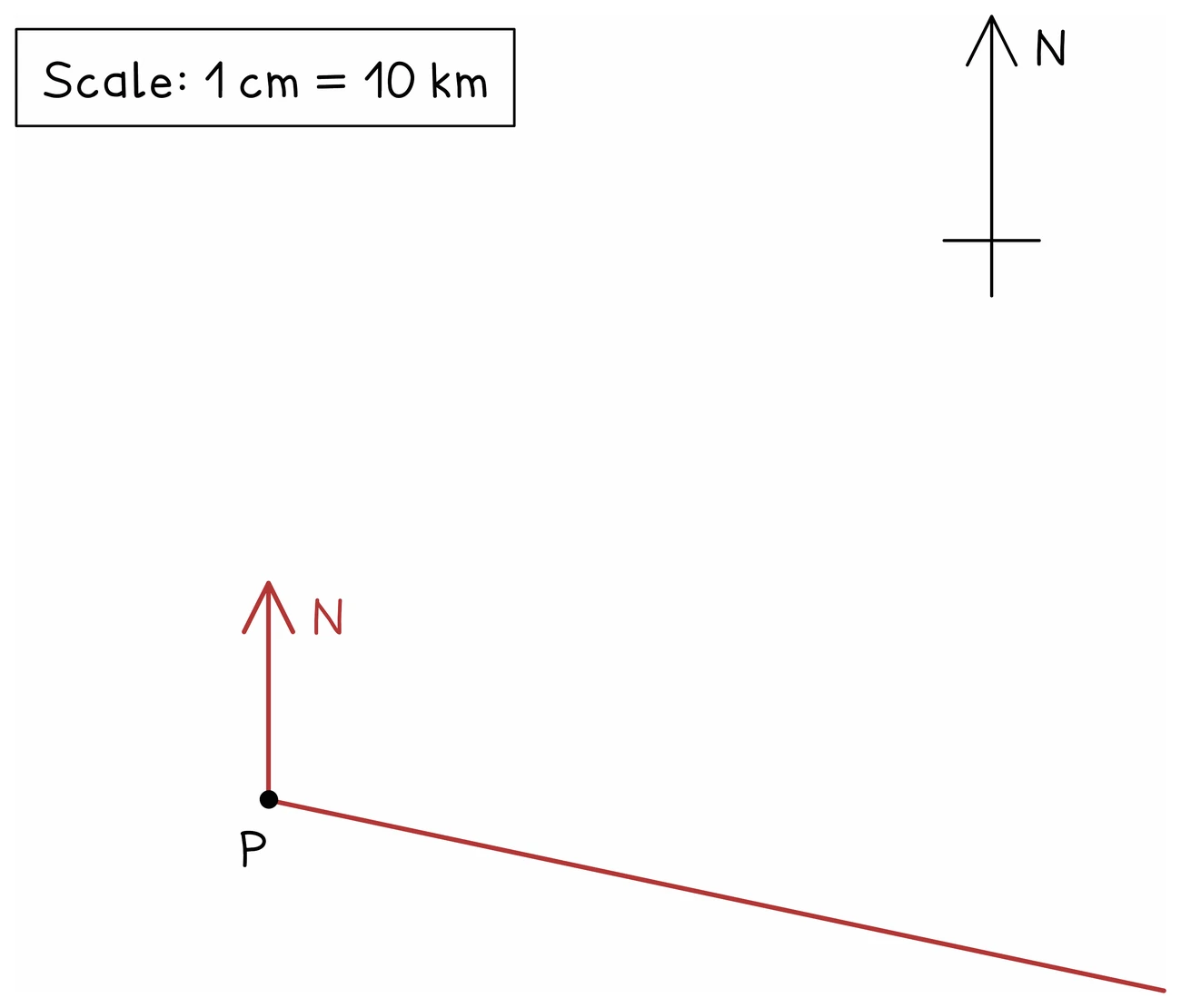
- To plot one, draw the north line, measure the angle clockwise, rule a long line, then mark the distance along it using the scale
Worked example
Measuring and plotting a bearing
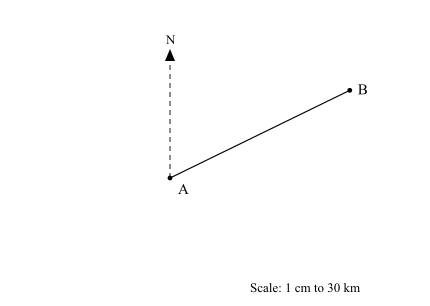
The scale drawing shows two ports, A and B, with a north line drawn at A. The scale is 1 cm to 30 km. Measure the bearing of B from A. A lighthouse, L, is 120 km from A on a bearing of 235°. Mark the position of L on the drawing.
Solution:
- The bearing of B from A is measured at A, so use the north line drawn there
- Put the centre of the protractor on A with 0° on the north line, and read the angle clockwise round to the line AB: 64°
- Bearings are written with three figures, so the bearing of B from A is 064°
- For L, change the real distance into a length on the drawing first: 120 ÷ 30 = 4 cm
- 235° is more than 180°, so extend the north line down through A to point south, and measure 235 − 180 = 55° clockwise from south (or 360 − 235 = 125° anticlockwise from north)
- Rule a line from A at that angle and mark the point 4 cm from A along it: that point is L
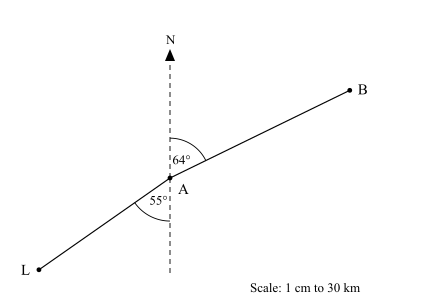
- Check: a bearing between 180° and 270° points south-west, and L lies below and to the left of A
Back bearings
- The bearing of A from B and the bearing of B from A always differ by exactly 180°
- Reverse a bearing below 180° by adding on a further 180°
- Reverse one above 180° by taking 180° away instead, which keeps the answer inside the 000° to 360° range
- The rule follows from the two north lines being parallel: the angle at A between north and AB and the angle at B between north and BA are co-interior, so they add up to 180°, and that puts the two bearings exactly 180° apart
Worked example
Reversing a bearing both ways
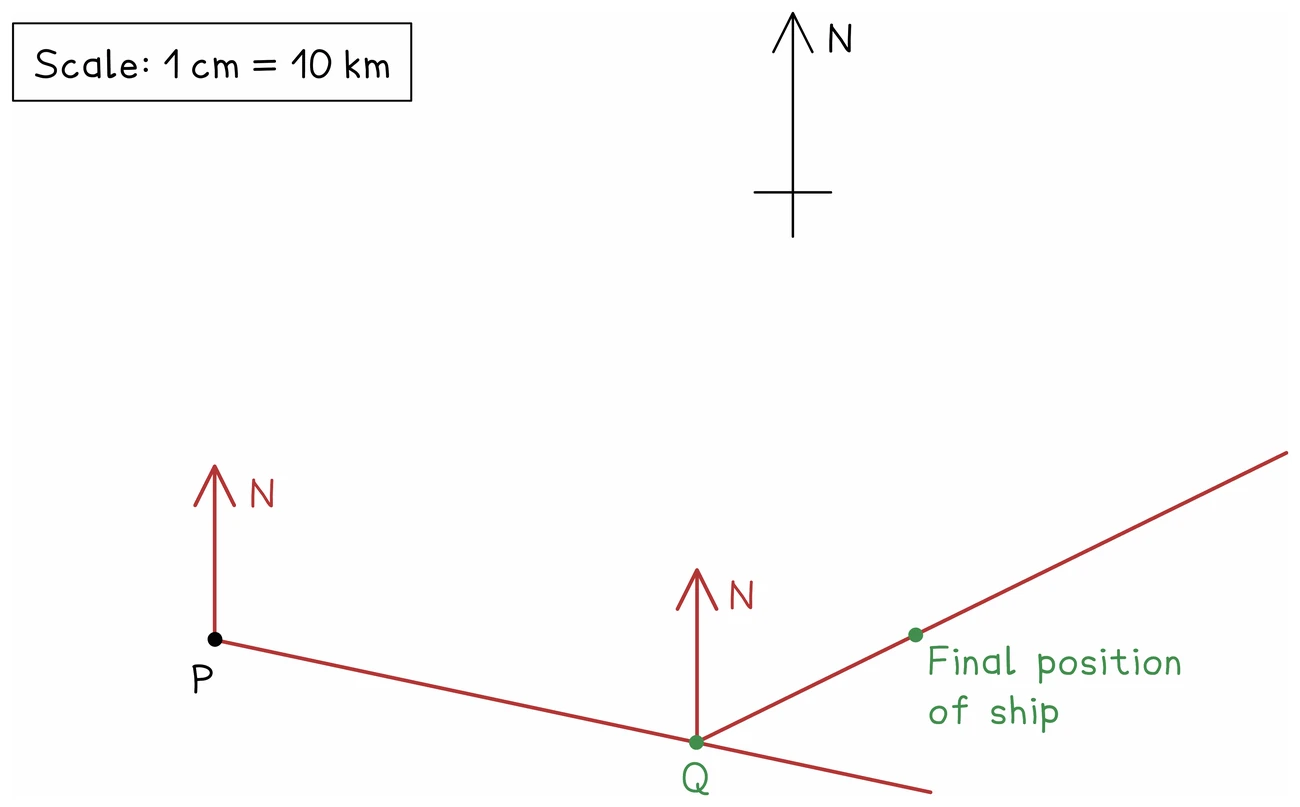
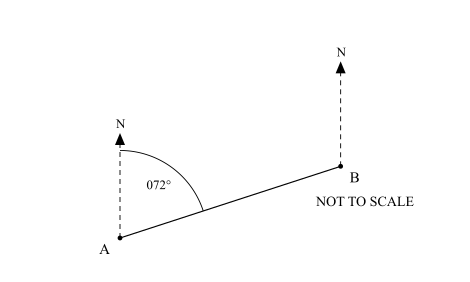
The bearing of B from A is 072°. The bearing of Q from P is 295°. Find the bearing of A from B, and the bearing of P from Q.
Solution:
- For the first, 072° is less than 180°, so add 180°
- 72 + 180 = 252, so the bearing of A from B is 252°
- For the second, 295° is more than 180°, so subtract 180°
- 295 − 180 = 115, so the bearing of P from Q is 115°
- Both answers are written with three figures and lie between 000° and 360°
- A question may give one bearing as an expression and the other as a number, which turns the same rule into an equation to solve
- Harder bearings questions combine this with Pythagoras or trigonometry, so draw and label a clear diagram before calculating
Worked example
A bearing from angles on a diagram
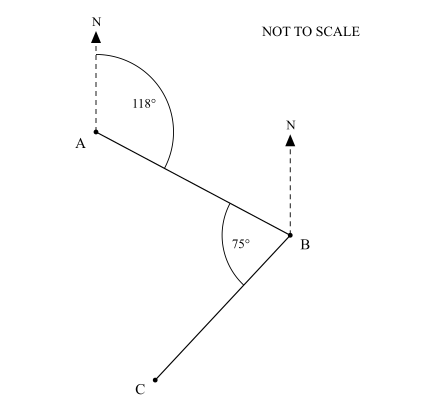
Points A, B and C are shown in the diagram. B is on a bearing of 118° from A, and angle ABC = 75°. Find the bearing of C from B.
Solution:
- The bearing is measured from B, so work with the north line at B
- The north lines at A and B are parallel, so the bearing of A from B is the reverse of 118°: 118 + 180 = 298°
- Seen from B, the line to C is a further 75° anticlockwise from the line to A, so subtract: 298 − 75 = 223
- The bearing of C from B is 223°
- Check another way: the angle between north at B and BA is co-interior with the 118° at A, so it is 180 − 118 = 62°, and the clockwise angle from north round to BC is 360 − 62 − 75 = 223°
- C lies to the south and west of B, so its bearing must be between 180° and 270°, and 223° lies in that range
4. Constructing a triangle
Three sides, ruler and compasses
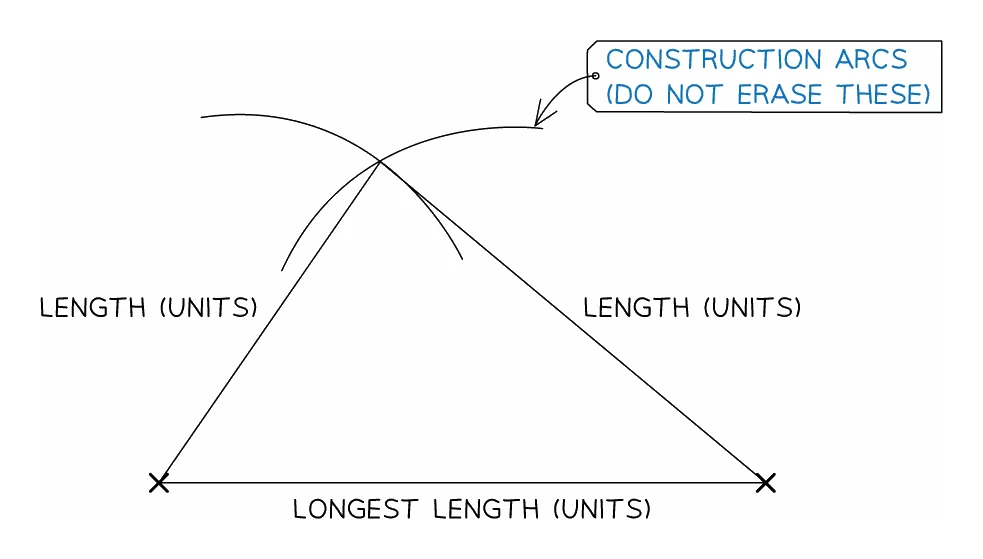
- The one construction required is a triangle from its three side lengths, using a ruler and compasses only
- Work through it in the same order every time
- Draw the longest side as a horizontal base, measured exactly, and write its length underneath
- Set the compasses to the second side's length, rest the sharp point at one end of the base, and sweep an arc above it
- Reset them to the third side's length, rest the point at the opposite end, and sweep a second arc across the first
- Join both ends of the base to wherever those two arcs meet, using a ruler
- Measure the two new sides to check them against the question before labelling
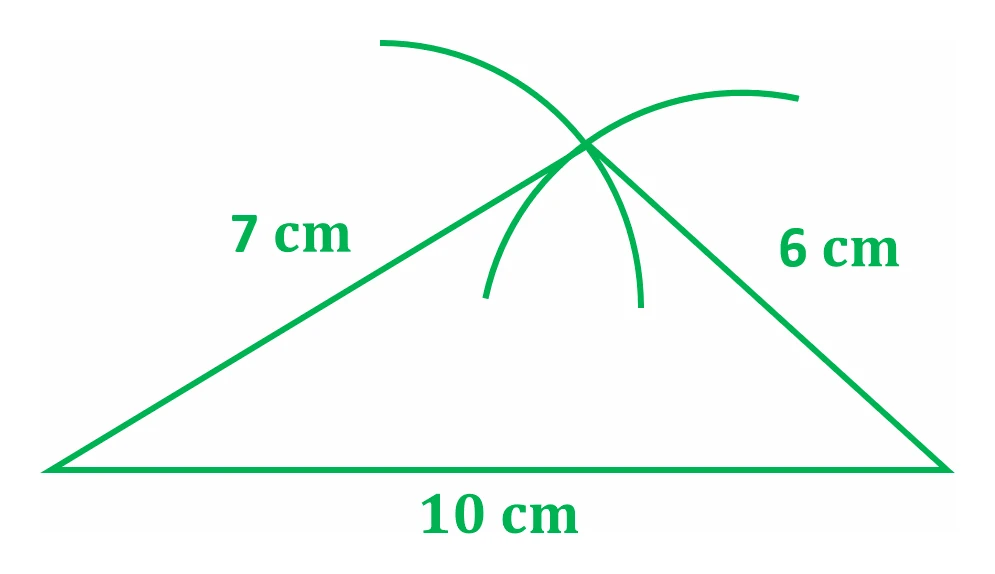
- Leave the arcs on the page. They are the evidence that compasses were used, and a mark depends on them
- Where the triangle is named, such as triangle ABC, label each corner with the right letter
- The same method builds other shapes, since a rhombus is two triangles sharing a side
Exam tip
Swing each arc from the end its length names
When the triangle is named, each length belongs at a particular end of the base. For triangle ABC with AB drawn, AC = 8 cm and BC = 6 cm, the 8 cm arc is swung from A and the 6 cm arc from B. Swapping them draws a mirror-image triangle with the two sides interchanged, which earns only a special-case mark. Check each side's letters before setting the compasses.
Worked example
An SSS construction
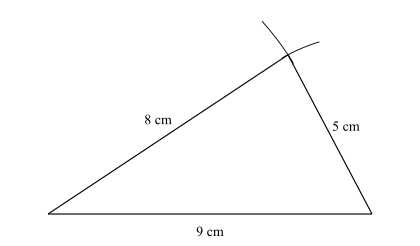
Using a ruler and a pair of compasses only, construct a triangle with sides of 5 cm, 8 cm and 9 cm.
Solution:
- Draw the longest side, 9 cm, as a horizontal base and label it
- Set the compasses to 8 cm, rest them at the left end of the base and sweep an arc above it
- Reset to 5 cm, rest them at the right end and sweep a second arc across the first
- Rule a line from each end of the base to wherever the arcs meet
- Measure the two lines to confirm they are 8 cm and 5 cm, then label them
- Leave both arcs visible: the answer is the ruled triangle with both construction arcs showing
- The three lengths do form a triangle, since the two shorter sides together, 5 + 8 = 13 cm, exceed the longest side of 9 cm