1. What unemployment is
Employment is the situation in which people of working age are in paid work, either working for an employer or self-employed.
Unemployment is the situation in which people of working age who are willing and able to work cannot find a job. The measures how widespread this is in the labour force.
Both parts of the unemployment definition have to hold.
- Willing to work. The person actively wants a job and is searching for one.
- Able to work. The person has the physical and legal capacity to take a job (right age, not full-time student, no condition preventing work).
People not in either group are not counted as unemployed. A retired person is not "unemployed". A student in full-time education is not "unemployed". A "discouraged worker" who has given up looking is technically counted as , not unemployed.
Full employment is the situation in which everyone of working age who is willing and able to work at the going wage rate has a job. It does not mean 0% unemployment: some frictional and seasonal unemployment always remains, so a small amount of unemployment persists even at full employment.
Common exam question
Who counts as unemployed
Question: Choose who is classed as unemployed, the conditions a worker must meet, or what full employment is taken to mean (1 mark, multiple choice).
Set in 3 of the 13 multiple-choice papers. An unemployed person has no paid job, is willing and able to work and is actively looking for one. The wrong options can be people outside the labour force, such as a student, a retired person or an adult staying at home to look after children: none of them is seeking work, so none is unemployed. When the conditions come as a yes/no grid, pick the row where every condition holds, including being ready to work at the current wage rate.
Full employment does not mean that nobody is out of work. It is taken to mean no cyclical unemployment, so an option that rules out frictional or seasonal unemployment is wrong: people between jobs or out of season are still counted.
Why governments target low unemployment
This was covered in topic 12 (macroeconomic aims), but the highlights:
- Reduces poverty and raises living standards.
- Raises tax revenue and cuts welfare spending.
- Uses the economy's productive capacity efficiently rather than letting it sit idle.
- Improves social wellbeing (long-term unemployment is linked to poor mental and physical health).
Most developed countries therefore aim for full employment rather than for zero unemployment, which is neither possible nor desirable because some frictional unemployment is normal as people move between jobs.
2. The four types of unemployment
A 4-mark "explain two types of unemployment" question gives one mark for naming each type and one for explaining it. The syllabus names four.
Cyclical (demand-deficient) unemployment
Cyclical unemployment is caused by a fall in aggregate demand during a recession. When firms cannot sell as much output, they need fewer workers and lay people off.
The mechanism: a recession → AD falls → firms cut output → firms hire fewer workers / make existing workers redundant. As the economy recovers, AD rises again and cyclical unemployment falls.
This is also called demand-deficient because the underlying cause is too little demand for goods and services.
Structural unemployment
Structural unemployment is caused by the long-term decline of an industry, or a mismatch between the skills of unemployed workers and the skills required by the new jobs available.
Two distinct sources:
- Industry decline. Coal mining, shipbuilding, manual telephone-exchange operating and high-street retail have all shrunk dramatically over recent decades. The workers in those industries cannot all be redeployed in the new growing sectors.
- Skills mismatch. Even when total demand for labour is fine, individual workers may lack the specific skills the open jobs require. A former coal miner without IT skills cannot easily take a software-engineering job.
Structural unemployment is long-term. It does not go away when the economy recovers, because the underlying problem is not weak demand. The solution is retraining, education and regional policy.
Frictional unemployment
Frictional unemployment is the short-term unemployment that arises when workers are moving between jobs: leaving one position and looking for the next.
This kind of unemployment is voluntary and temporary. A worker who has resigned from one job to look for a better one is frictionally unemployed for the days, weeks or months until they find the new position. Almost every healthy labour market has some frictional unemployment, simply because matching workers to jobs takes time.
Better information about available jobs (online job portals, job centres) reduces frictional unemployment by shortening the search.
Seasonal unemployment
Seasonal unemployment is caused by demand for labour varying with the seasons in particular industries.
Examples:
- Ski resort workers are out of work in summer.
- Fruit pickers are needed only during the harvest months.
- Construction workers in cold climates face winter slowdowns.
- Tourism workers in coastal resorts may have very low demand in off-season months.
Seasonal unemployment is predictable; workers in seasonal industries often have second jobs or move between industries with opposite seasons.
The four types at a glance
| Type | Cause | Time horizon | Main policy response |
|---|---|---|---|
| Cyclical | Fall in aggregate demand (recession) | Short to medium term | Expansionary fiscal / monetary policy |
| Structural | Industry decline / skills mismatch | Long term | Retraining, education, regional aid |
| Frictional | Workers between jobs (voluntary) | Very short term | Better job information |
| Seasonal | Seasonal variation in demand | Recurring annually | Income support; encourage off-season work |
Common exam question
Explaining and spotting the type of unemployment
Question: Explain two types of unemployment, or the main type an economy in the source is suffering from (2–4 marks).
Asked in 2 of the 11 structured papers. Each type earns one mark for its name and one for its cause: frictional, workers between jobs; structural, mismatched skills, a declining industry or immobile labour; cyclical, too little total demand in a recession. For a source showing falling total demand, write cyclical and say "total demand": "a fall in demand" alone was not enough. The 2027 syllabus adds seasonal: demand for labour falls out of season, as in tourism or farming.
The same idea is set in 5 of the 13 multiple-choice papers. A temporary fall in the demand for labour in a recession is cyclical. A shift in what the economy produces is structural: if factory jobs vanish as service jobs grow, the answer is structural even if total employment rose. Frictional is the least serious type.
3. Measuring unemployment
The unemployment rate is the percentage of the that is unemployed.
The labour force = people in work + people actively seeking work. Children, retirees, full-time students and discouraged non-seekers are not part of it. So:
Worked example
Calculating the unemployment rate
A country has a population of 48 million. Of these, 22.8 million people are in paid work and 1.2 million are unemployed. Calculate the unemployment rate. A year later the labour force is 25 million and the unemployment rate is 4%: how many people are unemployed?
Solution:
- The labour force is the employed plus the unemployed: 22.8 + 1.2 = 24 million
- Unemployment rate = number unemployed ÷ labour force × 100 = 1.2 ÷ 24 × 100 = 5%
- A year later, rearrange: number unemployed = rate × labour force = 0.04 × 25 million = 1 million
Divide by the labour force, not the population. Using the population gives 1.2 ÷ 48 × 100 = 2.5%, which is wrong because the population includes children, retired people and others outside the labour force. A data table may print the population next to the labour force, so check which row you divide by.
Unemployment is measured using the .
The Labour Force Survey (LFS)
The Labour Force Survey is a sample survey of households that asks people directly whether they are working, looking for work, or neither.
Strengths:
- Accurate measure of true unemployment because it asks people directly, picking up those who are looking for work but not registered with any benefit office.
- Internationally comparable because countries use the same survey definitions (ILO standards), so unemployment rates can be compared across borders.
- Captures details that administrative records cannot, such as demographic breakdowns and how long people have been out of work.
Weaknesses:
- Expensive to run, because it involves surveying a large sample of households regularly.
- Sample-based, so subject to a margin of error: the figure is an estimate, not a complete count.
- Available with a lag, because the survey results take time to collect and process.
Exam tip
Name the survey, then say what it asks
To explain how unemployment is measured, name the Labour Force Survey for the first mark and say what it does for the second: it asks a sample of households whether people are out of work and looking for a job. If a multiple-choice item asks what the survey measures, the answer is the unemployed population. The wrong options are other labour-market figures, such as the number paid the minimum wage, the share of women in the labour force or trade union membership.
4. Effects of unemployment
Unemployment harms more than just the unemployed person. The syllabus lists its consequences for the individual, firms, the government and the economy.
Effects on the unemployed individual
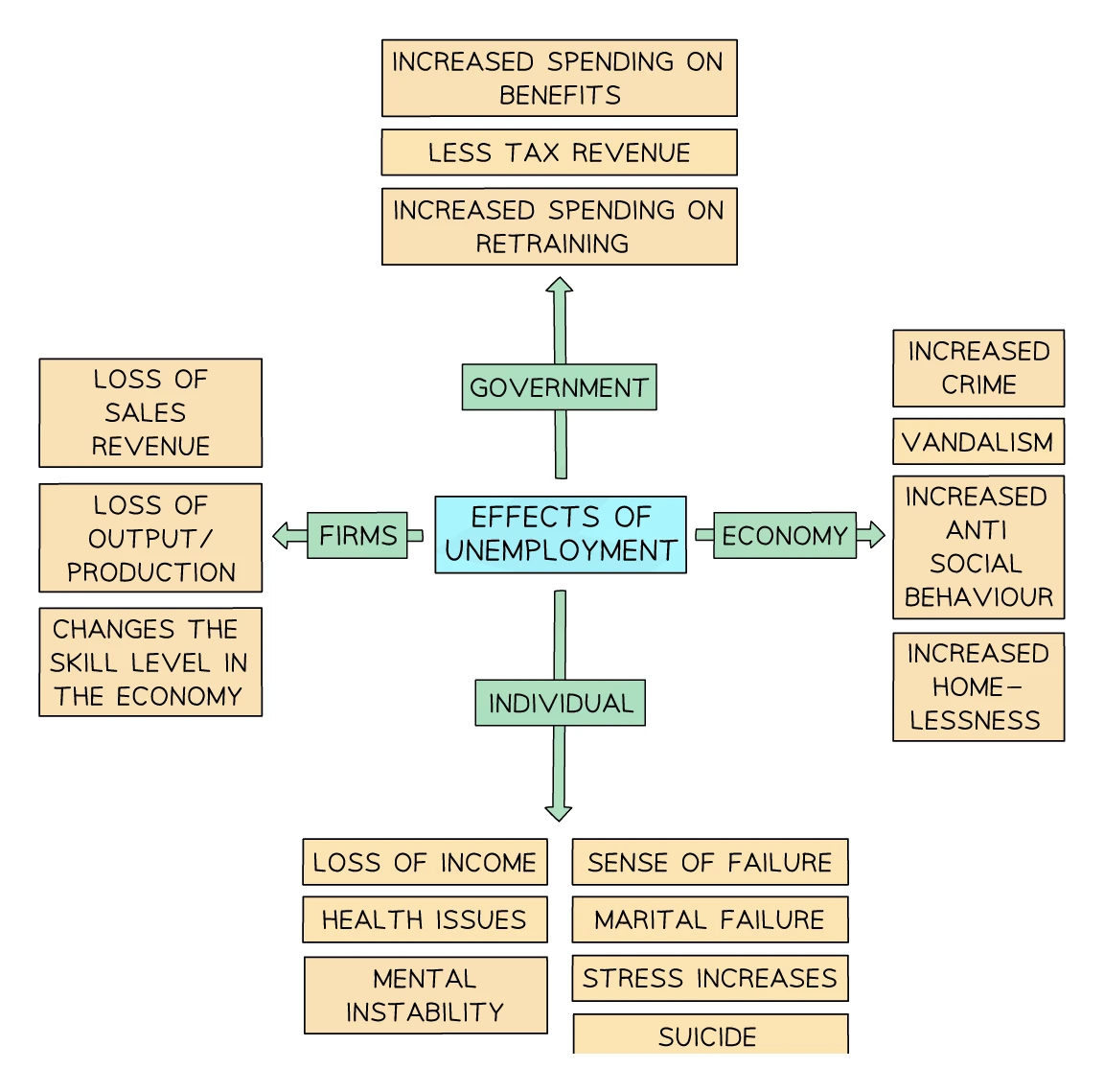
- Loss of income. The most immediate effect. Living standards fall.
- Deskilling. Skills decay during long periods without work. The longer someone is unemployed, the harder it becomes to find a new job (a "scarring" effect).
- Mental and physical health. Long-term unemployment is associated with depression, anxiety, and poorer physical health.
- Social stigma. Unemployed people may face discrimination from employers and judgement from peers.
Common exam question
Why some workers stay unemployed for a long time
Question: Analyse why someone unemployed for over a year may not find work, or discuss whether people who lose their jobs stay unemployed for long (6–8 marks).
Asked in 2 of the 11 structured papers. In the 6-mark Analyse each step of a reason earns a mark. Skills and qualifications go out of date, so the worker needs costly retraining and looks less attractive to employers. Confidence falls, and with it the effort put into searching. The worker may be occupationally or geographically immobile, a recession leaves few vacancies, benefits may rival low wages, and employers may discriminate, for example by age.
The 8-mark Discuss needs the other side: government training, workers willing to move or retrain, a gap between benefits and wages that pushes people to seek work, a growing economy creating jobs, and people leaving the labour force by retiring or emigrating. Cyclical and structural unemployment are more likely to last than frictional; seasonal spells are short.
Effects on the government
- Higher welfare spending. Unemployment benefits, housing support and free school meals all rise when unemployment rises.
- Lower tax revenue. Less income tax (fewer wage-earners), less VAT (people on benefits spend less), less corporation tax (firms earn less).
- Larger budget deficit. Both directions push the government's books into deficit.
- More pressure for action. Voters dislike high unemployment, and political pressure for stimulus rises.
Effects on the wider economy
- Output below potential. Some of the economy's productive capacity sits idle. Real GDP is below what it could be.
- Lower aggregate demand. Unemployed people spend less, which feeds back into lower demand for firms' products.
- Lost productive capacity. Long-term unemployment causes permanent skill loss; the economy's future capacity is reduced.
- Higher inequality. Unemployment is concentrated among already-vulnerable groups (low-skilled workers, certain regions, ethnic minorities).
Effects on firms
Firms see a mix of harm and benefit:
- Harm: lower sales. Unemployed customers spend less, so firms in consumer-facing industries lose revenue.
- Benefit: cheaper labour. With more job seekers per vacancy, firms can hire at lower wages and put less effort into retention.
- Benefit: less wage pressure. Existing workers are less likely to demand pay rises because the threat of unemployment is real.
On balance the harm usually outweighs the benefit, which is why business groups generally support job-creation policies despite the cheap-labour upside.
The effects spread out across every stakeholder group at once, as this summary shows.
Common exam question
Consequences of a rise or fall in unemployment
Question: Choose the likely result of falling unemployment, what explains a budget sliding into deficit, or which aim most improves the budget (1 mark, multiple choice).
Set in 3 of the 13 multiple-choice papers. Each turns on the government's budget: falling unemployment raises income tax revenue and cuts benefit payments, so full employment is the aim most likely to enlarge a surplus, while rising cyclical unemployment pushes spending up and tax revenue down. Wrong options can reverse a direction: lower unemployment raises wages and cuts benefits and poverty.
Asked in 1 of the 11 structured papers, as an 8-mark Discuss on stopping unemployment rising. For: more output and growth, more tax revenue, less benefit spending, less poverty. Against: unemployment may already be low; cutting it may bring inflation or a current account deficit; some unemployment keeps the labour market flexible; policies have an opportunity cost. The specimen mark scheme adds firms: more revenue, but higher wages and harder recruitment.
The downward-spiral pattern
In a serious recession, the effects feed back into each other:
- AD falls → firms cut output → workers lose jobs.
- Unemployed workers spend less → AD falls further.
- Firms cut output again → more workers lose jobs.
The spiral is what makes a deep recession so hard to escape without policy intervention.
5. Policies to reduce unemployment
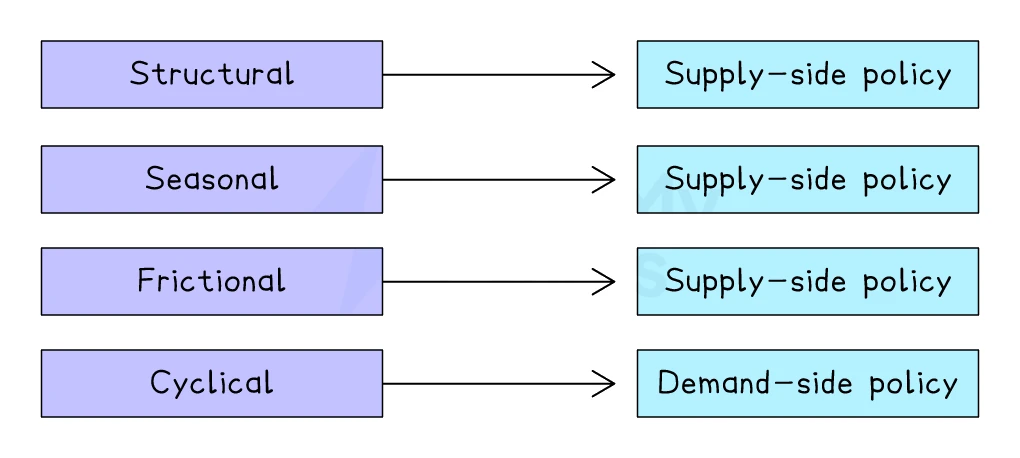
The right policy depends on the type of unemployment. Broadly, cyclical unemployment calls for a demand-side response while the other three types call for supply-side labour-market policies.
Common exam question
Matching a policy to the type of unemployment
Question: Explain two ways a government tried to cut frictional unemployment, or discuss whether people should be fined for being out of work (4–6 marks).
Asked in 2 of the 11 structured papers. Say which type a measure targets. Frictional unemployment falls when better job information helps workers and employers find each other, cutting search time, and when benefits lose value against prices, strengthening the incentive to work: one mark for each measure, one for how it works.
A fine may shorten the search if the unemployment is frictional. If it is structural or cyclical, training or higher total demand would work better, and fining people on low incomes deepens poverty and can push them into the informal economy. Each side of that Discuss earns up to 4 of its 6 marks. Set in 1 of the 13 multiple-choice papers: the fiscal change that cuts cyclical unemployment is a bigger budget deficit; more money supply is monetary policy.
Cyclical unemployment: expansionary AD policy
Cyclical unemployment is a problem of too little demand. The response is to raise aggregate demand.
- Expansionary fiscal policy. Cut taxes and/or raise government spending. Both increase AD: households have more to spend, government injects money directly. Firms hire more workers to meet the higher demand.
- Expansionary monetary policy. Cut interest rates. Borrowing becomes cheaper, households spend more on credit-purchased goods (cars, homes), firms invest more. AD rises.
Both work over months to a year. The trade-off is that excessive stimulus can trigger inflation (topic 12's growth–inflation conflict).
Structural unemployment: supply-side policy
Structural unemployment is a problem of mismatched skills or declining industries. The response is to change the supply side of the labour market.
Main tools:
- Retraining programmes. Government-funded courses to teach unemployed workers new skills for growing industries.
- Subsidised apprenticeships. Firms get money to take on and train new workers, especially the previously unemployed.
- Education reform. Schools and colleges adjust the curriculum to match labour-market needs (more vocational pathways, more STEM).
- Regional aid. Tax incentives or grants for firms to set up in high-unemployment regions, or subsidies for workers to relocate to where the jobs are.
- Encouraging geographic mobility. Housing support, transport investment, easier credentials transfer between regions.
These policies take years to bear fruit; structural unemployment is not solved overnight.
Frictional unemployment: search-and-information policies
Frictional unemployment is a problem of job search taking time. The response is to speed up matching.
- Better job-information services. Online job portals, well-funded job centres, employer-matching services.
- Tighter benefit eligibility. Some governments shorten the period during which unemployment benefit can be claimed, to incentivise faster job search. (This has obvious downsides for vulnerable workers.)
- Job-search support. CV-writing classes, interview practice, career guidance.
Frictional unemployment can never be fully eliminated, but it can be kept very low with good information and incentives.
Seasonal unemployment: income smoothing
Seasonal unemployment is predictable and recurring. The response is usually to smooth incomes across seasons rather than to eliminate the unemployment.
- Income support during off-seasons.
- Encouraging off-season work for seasonal workers (e.g. ski instructors who work as climbing guides in summer).
- Subsidising employers to keep workers on the books year-round.