1. What PED measures
Price elasticity of demand (PED) is the responsiveness of the quantity demanded to a change in the price of the good.
The law of demand (topic 4) says that when price goes up, quantity demanded goes down. PED asks the next question: by how much? A small price rise might wipe out half the demand for a luxury item; the same rise might barely dent the demand for an essential medicine. PED puts a single number on that responsiveness.
A definition that just says "how demand changes when price changes" is too vague. Say what responds (the quantity demanded), to what (a change in the good's own price), and compare the two changes as percentages.
Exam tip
Define PED using percentage changes
Define PED as the responsiveness of quantity demanded to a change in the good's own price, measured as the percentage change in quantity demanded divided by the percentage change in price. The only elasticity definition the schemes mark, elastic supply, gives 2 marks for comparing the percentage changes and 1 for comparing the changes without them. The PED schemes word it the same way: demand is inelastic when quantity demanded changes by a smaller percentage than price, or less than proportionately.
2. The PED formula
That is, PED is the percentage change in quantity demanded divided by the percentage change in price. Both numbers are percentages, not raw unit changes.
To work out either percentage change:
A short illustration before the full template. The price of a takeaway pizza rises from £8 to £10, and quantity demanded falls from 200 to 150 per evening.
%ΔP = (10 − 8) ÷ 8 × 100 = +25 %%ΔQd = (150 − 200) ÷ 200 × 100 = −25 %PED = −25 ÷ 25 = −1
The PED value is negative for a downward-sloping demand curve (price and quantity move in opposite directions). The papers print PED both with and without the minus sign, and a mark scheme has accepted a calculated PED either way, so this set of notes classifies PED by its absolute value.
Worked example
Calculating price elasticity of demand (PED)
When the price of a good rises from $4 to $5, the quantity demanded falls from 200 to 180 units. Calculate the PED and state whether demand is elastic or inelastic.
Solution:
- Percentage change in quantity: %ΔQd = (180 − 200) ÷ 200 × 100 = −10%
- Percentage change in price: %ΔP = (5 − 4) ÷ 4 × 100 = +25%
- PED = %ΔQd ÷ %ΔP = −10 ÷ 25 = −0.4
- |PED| = 0.4, which is less than 1, so demand is inelastic.
Always use percentage changes, never the absolute changes: dividing the absolute fall in quantity (20) by the absolute rise in price (1) gives 20, which is wrong.
3. The five categories of PED
Demand can be sorted into five categories based on |PED|. All five are named in the 2027-2029 syllabus (2.6.2), so you need to be able to interpret a PED value in each category and draw the matching demand curve. The two extremes are limiting cases rather than everyday examples, but they are examinable.
| Category | Value of |PED| | What it means | Typical example |
|---|---|---|---|
| Perfectly inelastic | 0 | Qd does not change at all when price changes | A life-saving heart transplant (a limiting case: demand is close to perfectly inelastic) |
| Relatively inelastic | 0 < |PED| < 1 | %ΔQd is smaller than %ΔP | Essential medicines, basic food, addictive products |
| Unitary (unit) elastic | |PED| = 1 | %ΔQd equals %ΔP | Knife-edge case; total revenue does not change |
| Relatively elastic | |PED| > 1 | %ΔQd is larger than %ΔP | Luxury goods, branded products with many substitutes |
| Perfectly elastic | ∞ | Any price rise wipes out demand entirely | One seller of an identical product in a highly competitive market (a limiting case) |
Each category can be drawn as a demand curve; the steeper the curve, the more inelastic demand is.
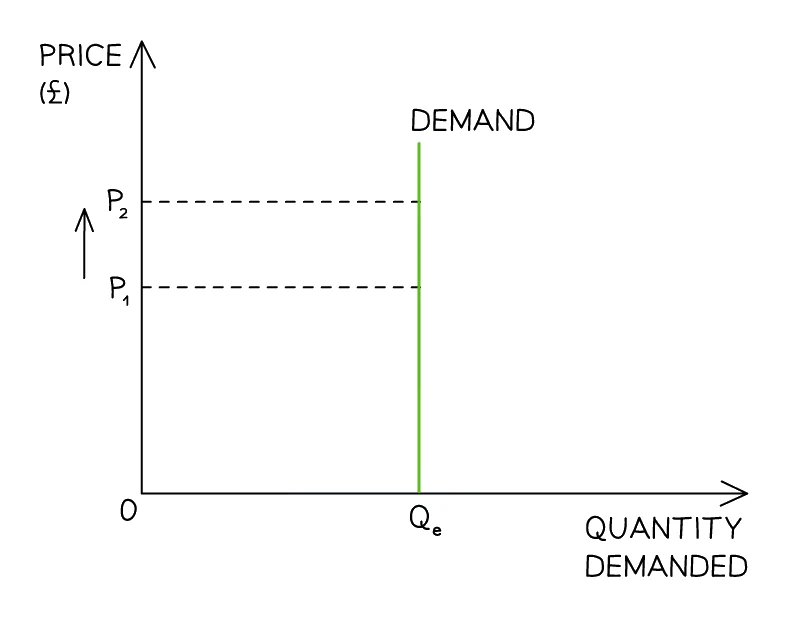
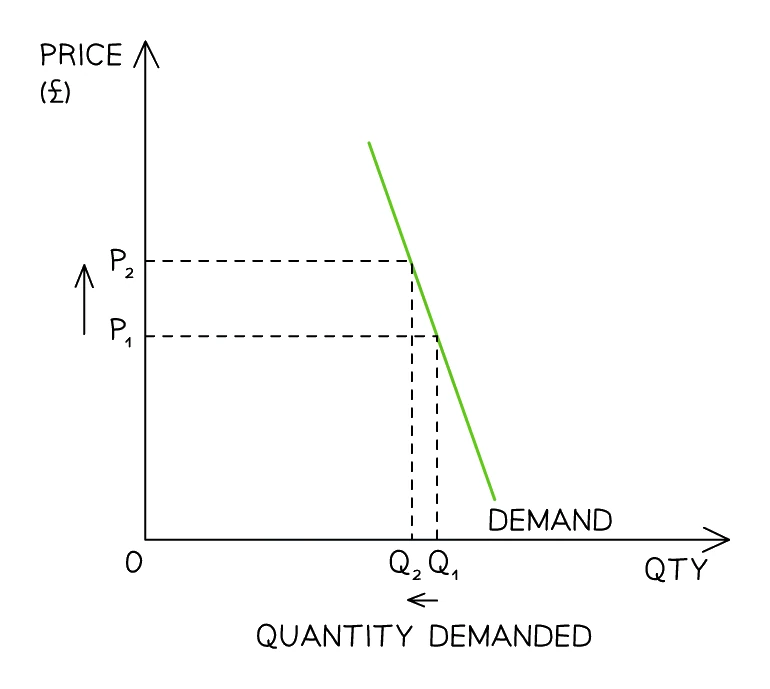
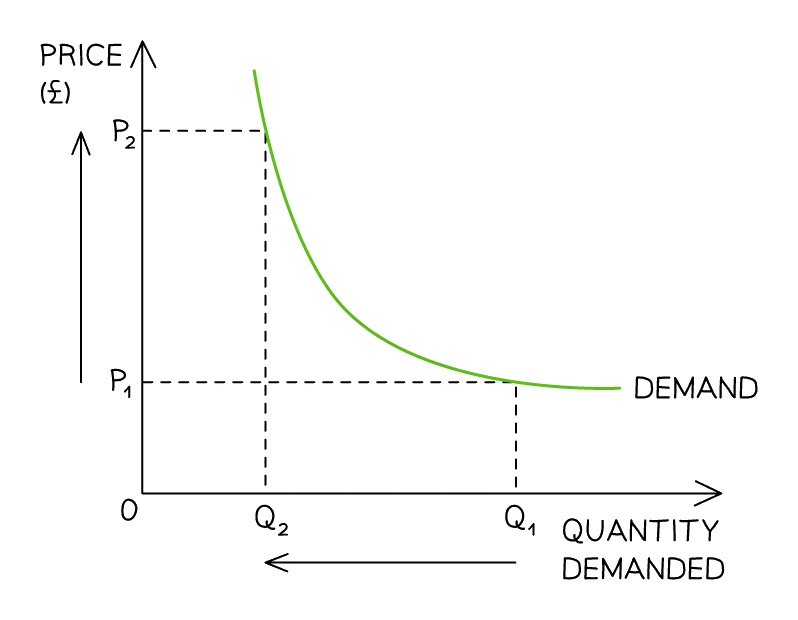
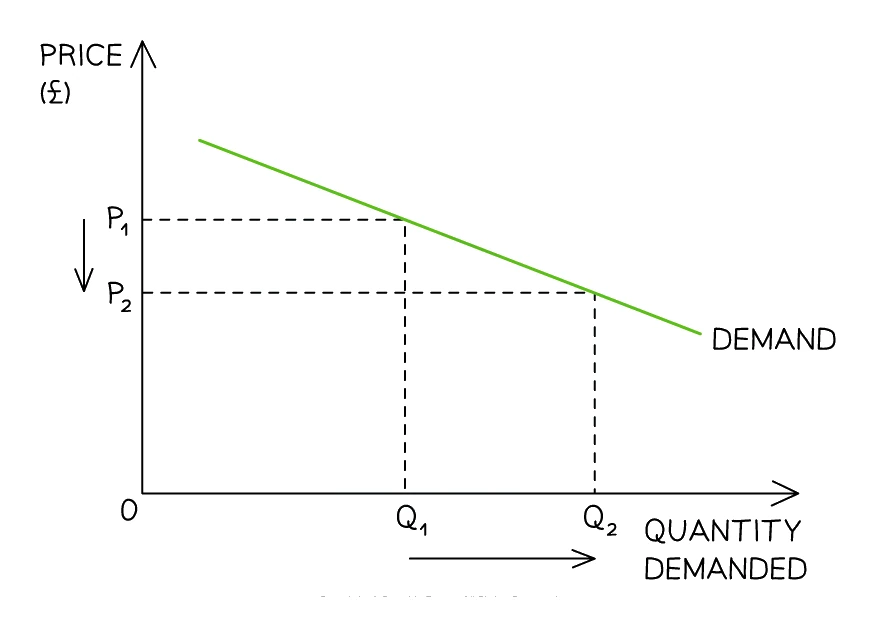
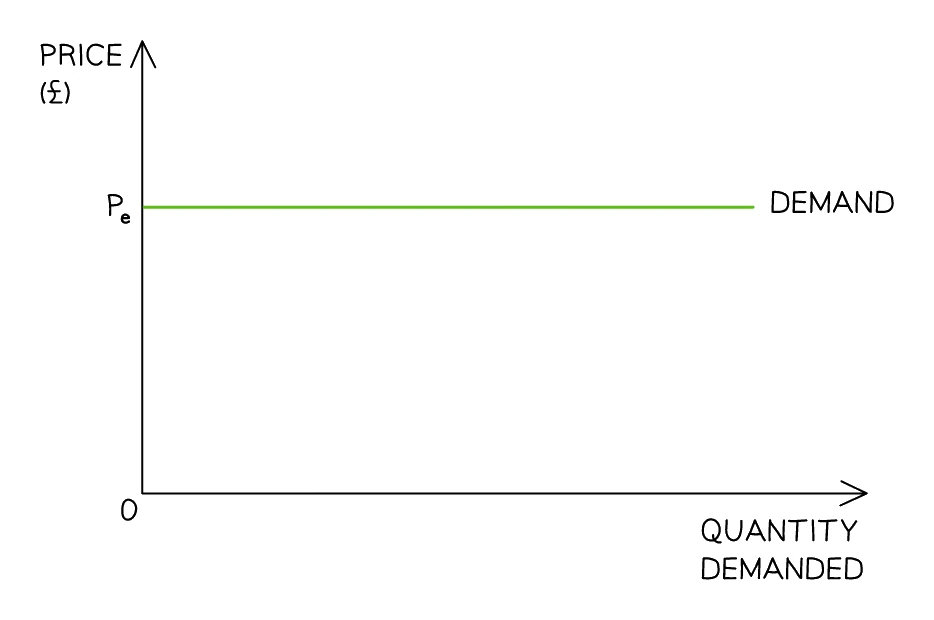
The full interpretation ladder, which is what a question means when it asks what a PED value tells you:
|PED| = 0: perfectly inelastic, drawn as a vertical demand curve.0 < |PED| < 1: inelastic, so quantity demanded responds less than proportionately to the price change.|PED| = 1: unitary elastic, so total revenue is unchanged when price changes.|PED| > 1: elastic, so quantity demanded responds more than proportionately.|PED| = ∞: perfectly elastic, drawn as a horizontal demand curve.
Most calculation questions land in the inelastic and elastic bands, so the quickest check is whether the value is below or above 1, but you are expected to recognise and use all five.
Exam tip
Classify PED by its size, not its sign
PED is negative for a normal demand curve, and the papers print it both with and without the minus sign, so classify it by its size: below 1 is inelastic and above 1 elastic, which makes −2 more elastic than −0.5. The syllabus now names three more categories, and the papers already use them: a PED of exactly 1 is unitary elastic; a PED of 0 is perfectly inelastic, a vertical demand curve, and one scheme accepts answers that assume it; perfectly elastic demand is a horizontal curve, offered as an option beside the relative terms.
4. Calculating PED step by step
On the papers a PED calculation is a one-mark item scored on the answer alone, so follow these steps in order: the wrong options come from skipping or swapping them.
Step 1. Calculate the percentage change in quantity demanded.
Step 2. Calculate the percentage change in price.
Step 3. Divide: PED = %ΔQd ÷ %ΔP.
Step 4. Interpret the result: say whether demand is elastic (
|PED| > 1) or inelastic (|PED| < 1), and what that means for total revenue.
Common exam question
Calculating PED or the quantity change it predicts
Question: Calculate PED from given changes in price and quantity, or use a given PED and price change to find the new quantity demanded (1 mark).
Set in 5 of the 13 multiple-choice papers. Work out both percentage changes from the original values, then divide the quantity change by the price change. Wrong options divide the other way round or divide the raw changes (a fall of 30 units after a $2 rise is not a PED of 15).
Given a PED, multiply: % change in quantity demanded = PED × % change in price. Options that divide instead, or move quantity the same way as price, are wrong. For a new quantity, find that percentage of the old quantity and take it off (or add it on); the change alone is a wrong option.
Asked in 1 of the 11 structured papers, as a one-mark data part; its scheme accepts the value with or without the minus sign.
Worked example
Using a PED value to find the new quantity
A cinema sells 2,400 tickets a week at $12 each. The PED for its tickets is −0.6. It raises the price to $15. Calculate the new number of tickets sold each week and the change in the cinema's total revenue.
Solution:
- Percentage change in price: (15 − 12) ÷ 12 × 100 = +25%
- Rearrange the formula: %ΔQd = PED × %ΔP = −0.6 × 25 = −15%
- New quantity: 2,400 × (1 − 0.15) = 2,400 × 0.85 = 2,040 tickets a week
- Total revenue before: $12 × 2,400 = $28,800; after: $15 × 2,040 = $30,600
- Total revenue rises by $1,800 a week. Demand is inelastic (|PED| = 0.6, below 1), so the price rise raises revenue.
Multiply PED by the percentage change in price: dividing (25 ÷ 0.6) would give a 42% fall, which is wrong. Apply the 15% to the original 2,400 tickets, and remember that a price rise lowers the quantity demanded.
5. The determinants of PED: SPLAT
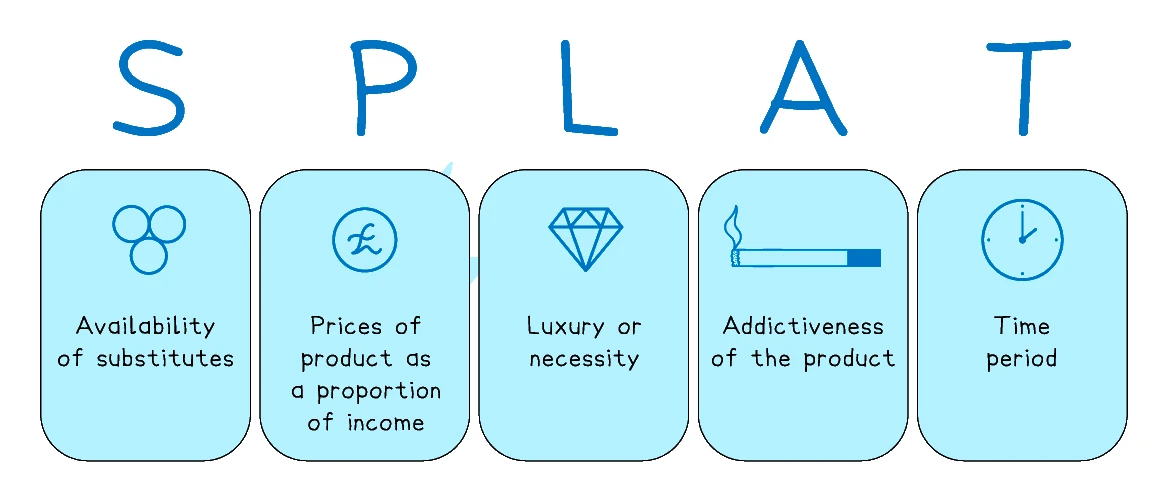
The PED of a good depends on several non-price factors. The mnemonic SPLAT groups the five main ones and is the one most commonly used.
| Letter | Stands for | Effect on PED |
|---|---|---|
| S | Substitutes (number and closeness) | More (and closer) substitutes → demand is more elastic (consumers can switch easily). Fewer substitutes → more inelastic. |
| P | Proportion of income spent on the good | A good that takes a large share of consumer income → more elastic (consumers notice the price rise). A small share → more inelastic. |
| L | Luxury or necessity | Luxuries (designer bags, holidays, expensive electronics) → more elastic (consumers can do without). Necessities (basic food, medicine) → more inelastic. |
| A | Addictiveness / habit / brand loyalty | Addictive or habit-forming products (cigarettes, caffeine, gambling) → more inelastic (consumers keep buying despite price rises). Strong brand loyalty has a similar effect. |
| T | Time period | Short run: more inelastic (consumers cannot change habits or find substitutes quickly). Long run: more elastic (alternatives are found, habits change). |
Two similar-sounding ideas to keep apart:
- A change in the price of substitutes shifts the demand curve (topic 4). What determines PED is the number and closeness of substitutes, although rivals becoming cheaper or better does make them closer substitutes, so demand becomes more elastic.
- A change in income shifts the demand curve. What determines PED is the proportion of income the good takes, although a fall in income raises that proportion and so can make demand more elastic.
Common exam question
The determinants of PED
Question: Identify two influences on a good's PED, or explain two causes of a rise in it (2–4 marks).
Asked in 1 of the 11 structured papers, as a 2-mark identify; the specimen mark scheme sets a 4-mark explain, a mark per cause and per explanation. Credited determinants include substitutes, luxury or necessity, the proportion of income, habit-forming goods, the time period and brand loyalty; only your first three count.
For a rise in PED, give a change that makes demand more elastic and why: closer substitutes as rivals get cheaper or better, more time to find alternatives, the good seen less as a necessity, or a fall in income, so it takes a larger share of income.
Set in 2 of the 13 multiple-choice papers: a close substitute is the keyed cause of a PED above 1, and the degree of necessity the keyed determinant, not a change in income, stocks of the product (a supply factor) or monopoly.
6. PED, consumer expenditure and firms' revenue: the central application
Total revenue (TR) = Price × Quantity.
The same Price × Quantity figure can be read from two directions. To the firm it is (the money it takes in); to consumers it is their total expenditure (the money they spend on the good). The two are always equal, so everything that follows about a firm's revenue applies in mirror image to consumer spending: when a price change raises a firm's revenue, it raises consumer expenditure by exactly the same amount.
When a firm changes its price, two things happen at once:
- Price goes up (or down): that pushes TR up (or down).
- Quantity demanded goes down (or up): that pulls TR in the opposite direction.
Whether total revenue ends up higher or lower depends on which of the two effects is bigger, and that is exactly what PED measures.
The PED-TR rule
| If demand is... | A price rise does what to TR? | A price fall does what to TR? |
|---|---|---|
Inelastic (|PED| < 1) | TR rises (Qd falls only a little) | TR falls (Qd rises only a little) |
Unitary elastic (|PED| = 1) | TR unchanged | TR unchanged |
Elastic (|PED| > 1) | TR falls (Qd falls a lot) | TR rises (Qd rises a lot) |
The rule can also be shown as a calculation, which is how a question usually asks for it. Take a chocolate bar selling 1,000 bars a day at $2.00 each. The price rises to $2.20 and daily sales fall to 950.
- Before: TR = $2.00 × 1,000 = $2,000 a day
- After: TR = $2.20 × 950 = $2,090 a day
- PED = −5% ÷ +10% = −0.5, so demand is inelastic and total revenue rises by $90. Consumers now spend $2,090 a day instead of $2,000, which is the same $2,090 the firm receives as total revenue.
Now take a designer handbag selling 1,500 units a month at $200. The price rises to $240 and monthly sales fall to 900.
- Before: TR = $200 × 1,500 = $300,000 a month
- After: TR = $240 × 900 = $216,000 a month
- PED = −40% ÷ +20% = −2.0, so demand is elastic and total revenue falls by $84,000. Consumers spend $84,000 a month less on handbags, which is exactly the revenue the firm has lost.
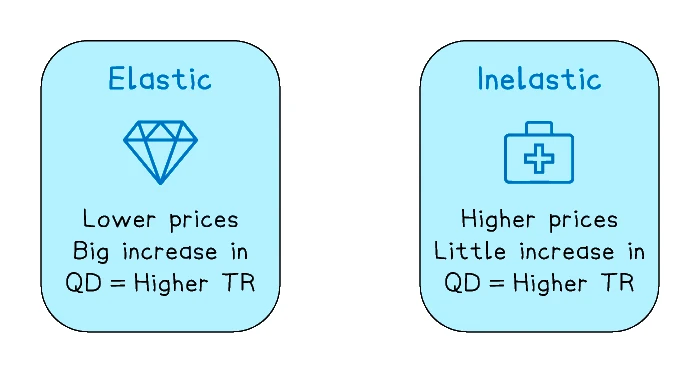
The simplest way to memorise it: price and TR move in the same direction when demand is inelastic; in opposite directions when demand is elastic.
Common exam question
How a price change affects total revenue
Question: Explain an advantage and a disadvantage to a producer of price-inelastic demand, or analyse how a price rise affects producers' revenue (4–6 marks).
Asked in 2 of the 11 structured papers. With inelastic demand a price rise cuts quantity demanded less than proportionately, so revenue rises (the advantage); a price cut raises it less than proportionately, so revenue falls (the disadvantage). Each effect earns a mark and its explanation another. For the 6-mark analysis, say demand contracts and revenue depends on PED, then take both cases; producers of a substitute gain revenue as buyers switch.
Set in 4 of the 13 multiple-choice papers. A price rise with PED between 0 and 1 raises revenue; a PED of 1 leaves it unchanged. If the price doubles, a PED of 0 gains most: sales do not fall, so revenue doubles. Options pairing a price fall with inelastic demand, or a rise with elastic demand, cut revenue.
What firms should do
A firm that knows its PED can pick its pricing strategy.
- Selling an inelastic good? Raise the price. The fall in quantity sold is smaller than the rise in price, so TR rises.
- Selling an elastic good? Cut the price. The rise in quantity sold is larger than the fall in price, so TR rises.
The same rule explains why some firms charge different customer groups different prices for a similar service. A train operator can charge more at peak times, when commuters have few alternatives and demand is inelastic, and less off-peak, when demand is elastic and a lower fare attracts many extra passengers. In each case the firm is applying the PED-revenue rule to the group in front of it.
7. The significance of PED: who it matters for
PED is not only a firm's tool. It shapes the decisions of four groups: consumers, workers, producers and the government.
Consumers
PED describes consumers' own responsiveness, so it decides which price rises a household absorbs and which it reacts to. For a necessity with no close substitute, demand is inelastic: the household keeps buying much the same quantity, its total expenditure on that good rises, and less of the budget is left for everything else. For an elastic good, the consumer has real choices: switch to a rival brand, postpone the purchase until prices fall, or go without. Knowing which of your purchases are elastic tells you where cutting back actually protects your budget.
Workers
Demand for labour is derived from demand for the product, so the PED of what a worker helps produce affects that worker's job. Where the product has price-inelastic demand, a price rise barely dents sales, so output and revenue are stable, employment is more secure, and workers are in a stronger position when bargaining for higher pay because the firm can pass the extra cost on to customers. Where the product is price-elastic, sales and output swing sharply with price, so hiring and hours are volatile and pay demands are more likely to be resisted or met with job losses, since the firm cannot raise its price without losing customers.
Producers and firms
Beyond setting the price (the rule above), PED tells a firm how much risk any price change carries. If demand is inelastic the firm can pass a cost increase or a new tax on to its customers with little loss of sales; if demand is elastic it has to absorb most of that cost itself. A firm whose products all have elastic demand also faces far less predictable revenue, so it will be more cautious about committing to extra capacity.
Government
The government uses PED when deciding what to tax and what to subsidise.
- Taxes on inelastic goods raise large tax revenue with a small fall in quantity sold. This is why "sin taxes" on cigarettes, alcohol and fuel are so common: these goods are inelastic, so the tax raises revenue without wiping out the market.
- Taxes on elastic goods raise less revenue and shrink the market a lot. A high tax on a luxury good would push consumers to substitutes, and tax revenue would fall.
- Subsidies on elastic goods produce a large rise in quantity demanded for each pound of subsidy spent. This is why subsidies for renewable-energy products like solar panels are designed to be substantial: demand responds strongly.
Common exam question
How PED decides the effect of a tax
Question: Pick the tax type and the PED that let producers pass most of a tax on, or say from a diagram who bears a tax (1 mark, multiple choice).
Set in 2 of the 13 multiple-choice papers. A tax on a good is an indirect tax, and producers can pass most of it on when demand is price-inelastic, as for a necessity, because buyers keep buying at the higher price. With a vertical (perfectly inelastic) demand curve the whole tax falls on consumers.
The same idea decides whether a tax cuts consumption. One structured scheme on taxing a product to reduce external costs lists both sides: with elastic demand the price rise cuts quantity demanded sharply, while with inelastic demand, as for addictive products, it hardly changes. Where demand is inelastic, sales hold up, so the tax also raises more revenue.
Be careful: for an inelastic good, quantity demanded does fall when its price rises, just by a smaller percentage than the price rise; only perfectly inelastic demand (PED = 0) does not fall at all. When cigarette duty rises, smoking really does fall a little, but by less than the price has risen.