1. What poverty means
Poverty is a lack of the income and resources needed to enjoy an acceptable standard of living. Economists distinguish two kinds, and the syllabus asks you to know the difference between them.
Absolute poverty
Absolute poverty is a situation in which people cannot afford the minimum essentials needed to stay alive and healthy, such as food, clean drinking water, shelter, basic clothing and access to healthcare.
The level of income needed to buy these essentials is roughly the same everywhere, so absolute poverty is measured against a fixed line. The World Bank's widely cited line is about $3.00 a day (at 2021 purchasing-power-parity prices), a figure it revises from time to time. Anyone living below it is in absolute poverty. Absolute poverty is far more common in developing countries, where a large share of the population may live below the line.
Relative poverty
Relative poverty is when a household's income is below a chosen proportion of the average (usually the median) income in its own country.
A common threshold is less than 60% of median household income. Because the threshold rises as a country gets richer, relative poverty measures inequality rather than survival: a household counted as relatively poor in a high-income country might still be above the global absolute-poverty line. Relative poverty is the main measure used in developed countries, where almost no one is in absolute poverty but income gaps still cause hardship.
Common exam question
Telling absolute from relative poverty
Question: Pick what describes relative poverty, or which kind of poverty a change raises or lowers (1 mark, multiple choice).
Set in 4 of the 13 multiple-choice papers. Absolute poverty is judged against survival: being unable to afford necessities such as food and shelter, or an income below a fixed minimum line. Relative poverty is judged against the rest of society: a living standard below what that society regards as the acceptable minimum. Lacking necessities, or never seeing a doctor, is absolute poverty.
For a change, ask whether people can still afford necessities (absolute) and whether the poor fall further behind (relative): a recession leaving the jobless unable to pay rent or buy food raises both. Pensions rising more slowly than prices raise relative poverty; more investment in education lifts low earners' pay and reduces it. Wrong options reverse this: higher benefits or a higher minimum wage reduce poverty, and a lower minimum wage or contractionary fiscal policy will not.
2. Causes of poverty
People fall into poverty for several distinct reasons. The syllabus names five.
- Unemployment. Someone without a job has no wage income and must rely on benefits, which are usually well below average earnings. Long-term or structural unemployment is a leading cause of poverty.
- Low wages. Being in work does not guarantee escaping poverty. Workers in low-skilled, low-productivity or insecure jobs may earn too little to cover basic needs, especially where there is no minimum wage.
- Illness. Poor health stops people working, reduces the hours they can do and adds medical costs. Illness can push a household into poverty and then keep it there.
- Age. The very young depend on others, and the elderly may live on small or no pensions once they stop earning. Both groups are over-represented among the poor.
- Environmental factors. Drought, floods, poor soil or natural disasters can destroy crops, livelihoods and homes, and the resulting fall in output and incomes pushes households into poverty.
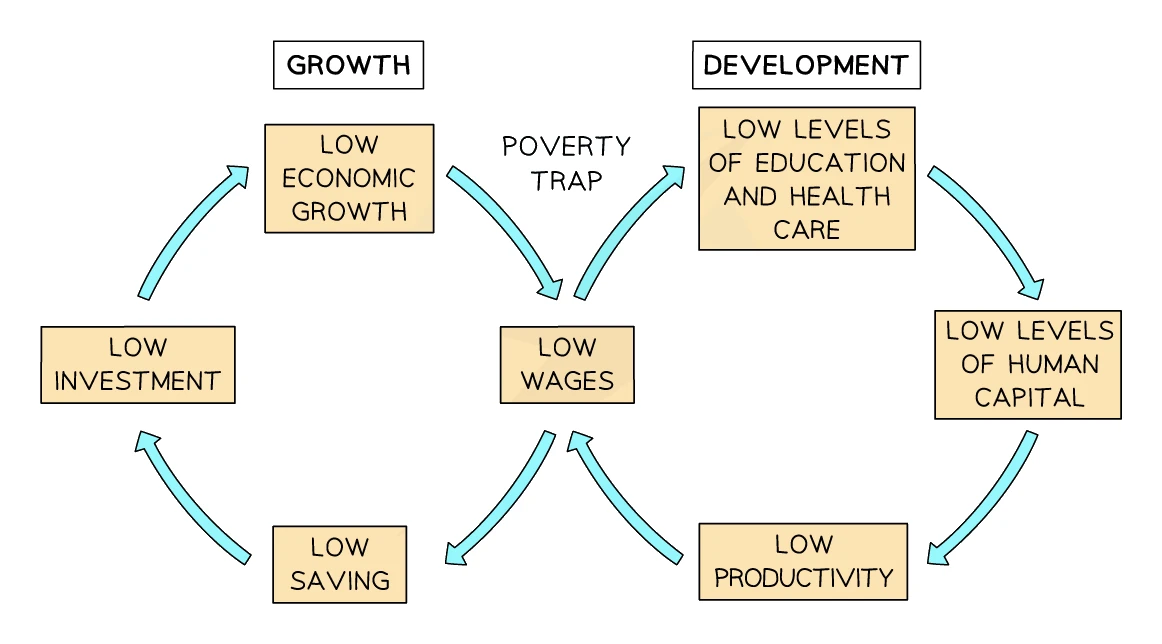
Behind several of these sits a self-reinforcing poverty trap centred on low wages. On the growth side, low wages mean low saving and low investment, which holds back economic growth; on the development side, low wages leave no money to spend on education or healthcare, so human capital and productivity stay low. Both loops feed back into low wages, keeping incomes down. A high dependency ratio (many children or elderly per worker) makes the trap harder to break.
Common exam question
Linking poverty with ill health
Question: Choose the most likely cause of rising poverty in developing economies, or the change that would not show poverty falling (1 mark, multiple choice).
Set in 2 of the 13 multiple-choice papers. Poor nutrition and ill health cause poverty: sick people work less or not at all, and face medical bills. The wrong options would raise incomes: more education provision, more tourism or stronger trade unions. Falling poverty shows up as more people in work, longer lives and higher adult literacy, so a rise in infant mortality does not show progress.
Asked in 1 of the 11 structured papers, as an Analyse of a table of poverty and life expectancy (4–5 marks). Call the relationship inverse (more poverty, shorter lives), support it with the countries at each end of the table, explain it (the poor get less healthcare, food, housing, sanitation and education), then pick out a country that breaks the pattern and give a reason, such as war.
Exam tip
Chain each step from the change to poverty
In the specimen mark scheme, the 6-mark Analyse on how a fall in investment could increase poverty gives one mark for showing what investment is, one for poverty, and the rest for the links between them, so write every step. Less spending on capital goods cuts output, unemployment rises, incomes fall and people cannot afford necessities: absolute poverty rises. Less investment in education, training or healthcare lowers some workers' skills and pay, widening the gap between rich and poor: relative poverty rises. A full chain can earn all six marks without separate definitions.
3. Policies to alleviate poverty and redistribute income
Governments use a mix of policies. Some raise the incomes of the poor directly; others raise their long-run earning power; others transfer income from the better-off. The syllabus names six.
Promoting economic growth
Higher output raises the demand for labour, creating jobs and raising wages, which lifts incomes at the bottom. Growth also raises tax revenue, giving the government more to spend on services for the poor. The catch is that growth helps only if its benefits reach low-income households rather than concentrating at the top.
Improved education
Better schooling and training raise workers' skills and productivity, so they can move into higher-paid, more secure jobs. This attacks the poverty cycle at its root, but the gains are long-term because it takes years for education to feed through into earnings.
Improved healthcare provision
Better healthcare keeps people well enough to work consistently and for more years, and removes the medical costs that can push a household into poverty. A healthier workforce is also more productive, raising wages over time. Like education, healthcare provision builds human capital and works mainly in the long run.
More generous state benefits
Unemployment benefit, pensions and other welfare payments give income to those who cannot earn enough themselves, letting them afford food, housing and other essentials. Benefits act fast and directly, but they are costly to fund and, if set too high relative to wages, can weaken the incentive to take low-paid work.
Exam tip
Benefits ease absolute poverty more than relative
Asked whether higher unemployment benefit would reduce poverty (8 marks), develop both sides. For: it raises the incomes of people with little or none, so they can buy more necessities, easing absolute poverty, and their spending adds to total demand, which can cut unemployment. Against: it may blunt the incentive to find work, it misses the retired and the sick, some never claim it, a small rise may lag behind inflation, it may leave relative poverty unchanged, and the money might do more spent on education. A one-sided answer cannot rise above Level 2 (5 marks).
Progressive taxation
A progressive tax takes a larger percentage of income from high earners than from low earners. It narrows the income gap directly and raises revenue that can fund benefits and public services for the poor. Set too high, though, it may discourage effort, enterprise and investment.
National minimum wage (NMW)
A sets a legal floor on hourly pay, directly raising the earnings of the lowest-paid workers so they can afford more necessities. The risk is that, if set above what some firms can afford, it may lead them to cut jobs or hours, which would harm the very workers it is meant to help.
No single policy is enough on its own. Direct transfers (benefits, the minimum wage) relieve poverty now, while growth, education and healthcare reduce it for the long run, so governments usually combine several.
Common exam question
Explaining policies that reduce poverty
Question: Explain two measures that could reduce poverty or redistribute income, or how a better-educated workforce reduces poverty (4 marks).
Asked in 3 of the 11 structured papers. Each of two measures earns a mark for naming it and one for how it helps the poor: a minimum wage raises low pay; state benefits let people without work buy necessities; a progressive income tax takes more from high incomes to help low earners; education, training or healthcare raises earning power. Name the tax and the benefit separately: in the redistribution version, "tax the rich, give to the poor" earns one mark. When it names education, each link earns a mark: more skills and productivity, higher wages, necessities affordable.
Also set in 2 of the 13 multiple-choice papers: low earners paying no income tax but using state healthcare is redistribution of income, not regressive taxation; a higher progressive tax spent on hospitals makes the distribution more even and raises living standards.