1. What money is
Before money existed, people traded by barter: swapping one good directly for another. Barter only works when there is a double coincidence of wants, meaning each person has exactly what the other wants and wants exactly what the other has. That is rare, so barter is slow and clumsy. Money solves the problem by acting as something everyone is willing to accept in exchange.
Money is anything that is widely accepted as a means of payment for goods and services and in settlement of debts.
2. The functions of money
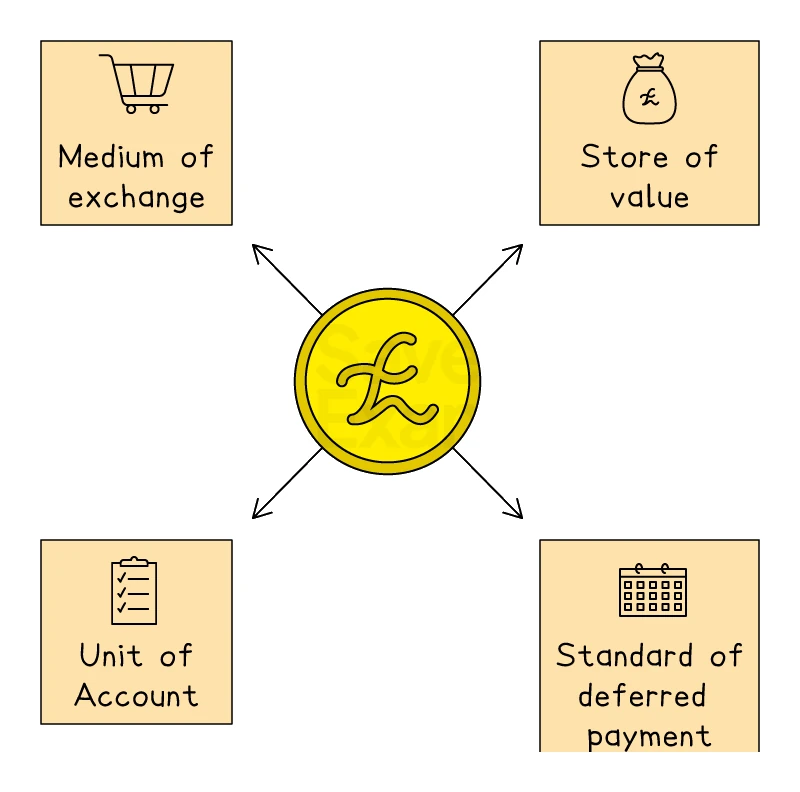
The syllabus expects you to know the four functions of money.
| Function | What it means |
|---|---|
| Medium of exchange | Money is accepted in return for goods and services, so people no longer need a double coincidence of wants. It is used to buy, sell and trade. |
| Store of value | Money keeps its value over time, so people can save now and spend later (this only holds well when inflation is low). |
| Unit of account (measure of value) | Money provides a common measure in which the price of every good can be expressed and compared. |
| Standard of deferred payment | Money lets people buy now and pay later, so debts, loans and contracts can be set in money terms. |
Common exam question
Identifying and explaining the functions of money
Question: Identify two functions of money, or explain two of them (2–4 marks).
Asked in 3 of the 11 structured papers. For Identify, any two of the four score: unit of account, store of value, medium of exchange and standard of deferred payment. A description without the term ("used to buy and sell things") still scores; a characteristic such as durability scores nothing. For Explain, name each function (1) and say what it does (1): compare what products are worth, save, buy and sell, or borrow and lend.
The same idea is set in 5 of the 13 multiple-choice papers, as a situation to match to its function. A measure of value is the unit of account (comparing what goods are worth); wrong options describe buying, saving or borrowing. Saving for old age uses money as a store of value, which inflation weakens: savers lose, and in rapid inflation cash holds its value worse than gold, property or shares.
3. The characteristics of money
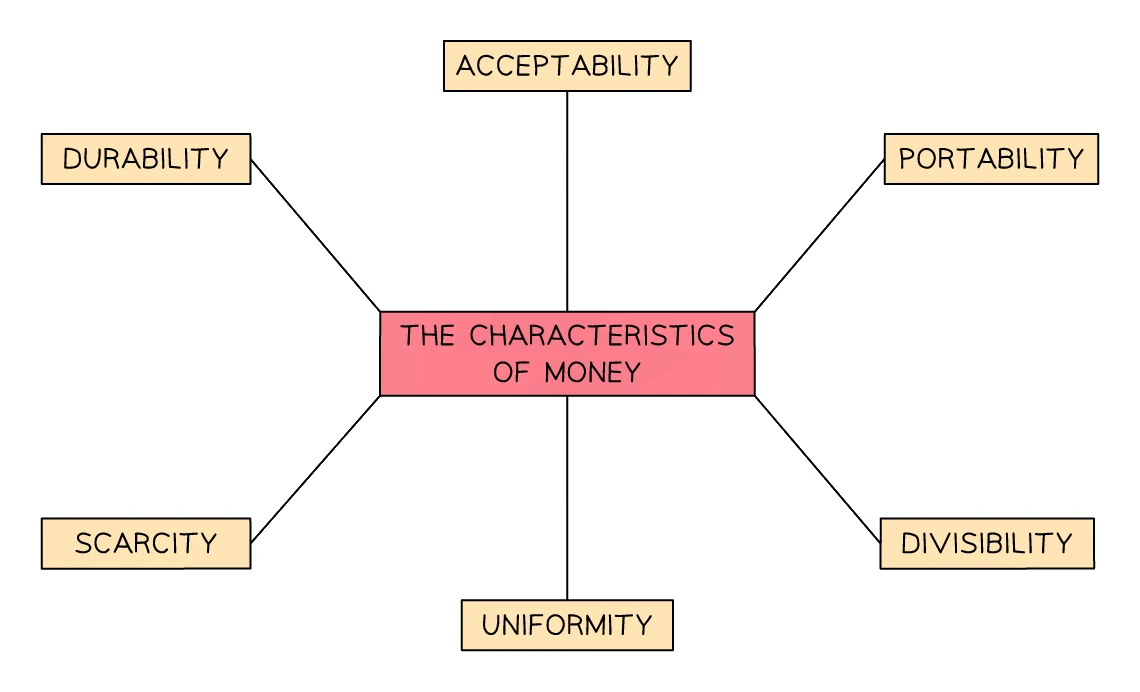
For something to work well as money it needs certain physical and practical qualities.
| Characteristic | Why it matters |
|---|---|
| Acceptability | Everyone must be willing to take it in exchange, or it cannot act as a medium of exchange. |
| Durability | It must last and not wear out or decay quickly, so it can act as a store of value. |
| Portability | It must be easy to carry so it can be used in everyday transactions. |
| Divisibility | It must split into smaller units so it can pay for cheap as well as expensive goods. |
| Scarcity (limited supply) | It must be hard to copy or produce freely, otherwise it loses value. |
| Uniformity | Each unit must be the same as every other of the same value, so prices are clear. |
This is why modern economies use notes, coins and bank deposits rather than, say, perishable goods: a basket of fruit fails durability and divisibility, so it is poor money.
Common exam question
Telling a characteristic of money from a function
Question: Choose the option that pairs a characteristic of money with a function, or the item that is not a function (1 mark, multiple choice); or explain two characteristics of money (4 marks).
Set in 2 of the 13 multiple-choice papers. Asked in 1 of the 11 structured papers. A function is a job money does; a characteristic is a quality that lets it do the job (acceptable, durable, portable, divisible, limited in supply, uniform). The options mix the two lists, plus forms of money such as cash or a bank deposit, so label each option first: portability is a quality, not a function.
For the 4-mark question, name each characteristic (1) and say why it matters (1): acceptable, so people take it in payment; durable, so it lasts and can be saved; limited in supply, so it keeps its value; divisible, so there are units of different value. Recognisable was credited too, and "breakable" was accepted for divisible.
4. Forms of money
Money is no longer only cash. The main forms are:
- Cash: notes and coins, the most acceptable and portable form.
- Bank deposits: money held in current accounts, spent directly using debit cards, cheques, direct transfers and mobile payments. Most money in a modern economy is in this form.
- Near : assets that cannot be spent directly but can be quickly turned into cash, such as money in a savings (deposit) account, which must first be withdrawn or transferred into a current account before it can be spent.
The growth of digital and contactless payments means that the share of cash is falling, but the underlying functions of money are unchanged.
5. The central bank
A central bank is the bank, usually owned by the government, that issues the currency and operates monetary policy (for example, setting the main interest rate) and acts as banker to the government and to the . There is normally only one in each country.
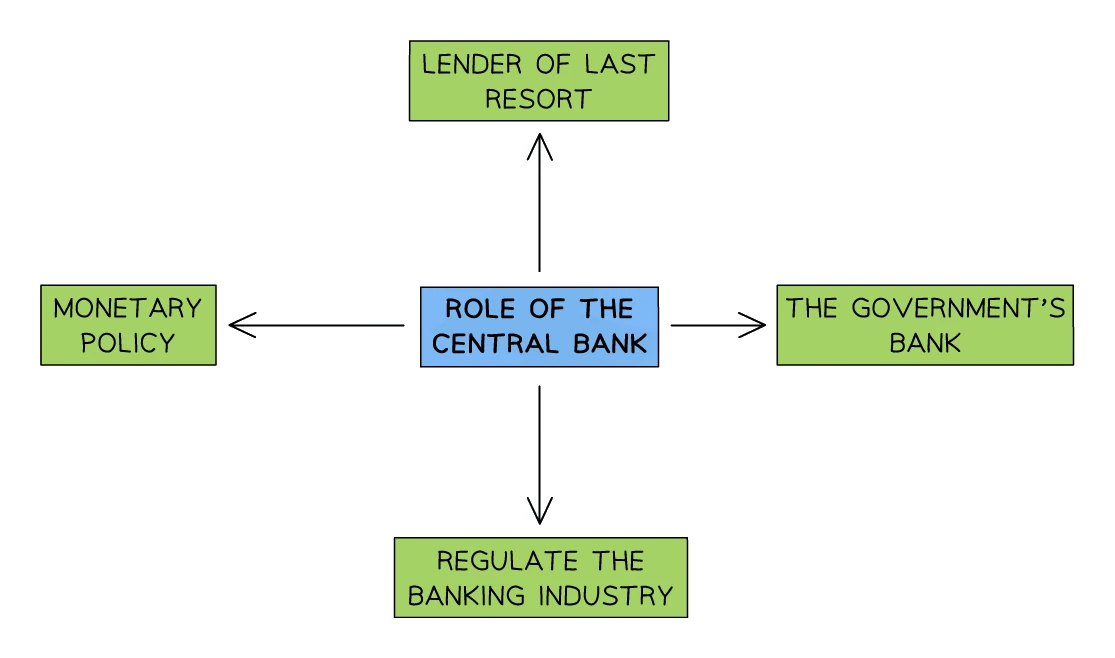
The central bank carries out roles that no commercial bank performs.
| Role | What the central bank does |
|---|---|
| Issuing currency | It is responsible for printing notes and minting coins, controlling the money supply. |
| Operating monetary policy | It sets the country's main interest rate to influence borrowing, spending and inflation. |
| Banker to the government | It holds the government's accounts and helps manage government borrowing. |
| Banker to the commercial banks | It holds banks' reserves and acts as lender of last resort, lending to banks in difficulty to keep the financial system stable. |
| Regulating the banking industry | It supervises commercial banks and sets the rules they must follow, protecting depositors and keeping the financial system sound. |
| Managing the exchange rate and reserves | It holds the country's foreign-currency reserves and may buy or sell currency. |
Common exam question
Telling a central bank's role from a commercial bank's
Question: Choose the function or role that belongs to a central bank, or to a commercial bank, from options that mix the two (1 mark, multiple choice); or define a central bank (2 marks).
Set in 7 of the 13 multiple-choice papers. Asked in 1 of the 11 structured papers. Sort each option by whom the bank serves. The central bank is the government's bank and the banks' bank: it issues notes and coins, runs monetary policy aiming at stable prices, controls the banking system and is lender of last resort to a bank facing a liquidity crisis (short of cash, not merely unprofitable). A commercial bank is owned by shareholders and serves households and firms: deposits, savings accounts, loans, mortgages, credit cards. Setting the government's budget is neither bank's job.
For the definition, any two of three ideas score: government-owned; operates monetary policy (setting interest rates, managing the exchange rate); banker to the government or to the commercial banks.
6. Commercial banks
A commercial bank is a bank that accepts deposits from the public and lends to households and firms, aiming to make a profit.
Their main functions are:
- Accepting deposits. Keeping customers' money safe in current and savings accounts.
- Lending. Providing loans, overdrafts and mortgages to households and firms, charging interest. This is their main source of profit: they pay savers a lower interest rate than they charge borrowers, and keep the difference.
- Providing a means of payment. Debit and credit cards, cheques, direct debits and online and mobile transfers.
- Other services. Foreign-currency exchange, financial advice and safe storage.
Commercial banks matter for the wider economy because their lending lets households spend beyond current income and lets firms invest. More commercial banks usually means more competition, giving customers more choice, a wider range of services, lower charges, lower interest rates on loans and higher interest rates on savings.
Common exam question
Why customers choose one commercial bank over another
Question: Identify influences on a customer's choice of bank, or explain two ways a bank could win customers or two benefits consumers gain from more banks (2–4 marks).
Asked in 3 of the 11 structured papers. The schemes credit overlapping ways banks compete for customers: lower interest charged on loans and higher interest paid on savings; a wider range or better quality of services, and lower charges; easier loans, such as lending to people on lower incomes or allowing longer to repay; convenience, such as more branches, online banking or a person to speak to; and advertising.
In the 4-mark versions, one mark is for each idea and one for its development: easier loans (1) let households buy more products (1). When the question is about more banks, link better interest rates to the extra competition between them. For the 2-mark version, online facilities, bank size, safety and relationships with staff count too, but brand loyalty was not accepted.