1. What market failure is
Market failure occurs when the free market (operating through the price mechanism on its own) fails to allocate scarce resources efficiently from society's standpoint. Either too much or too little of a good is produced compared with what would be best for society as a whole.
The price mechanism (topic 6) usually does a good job of allocating resources. But it focuses only on the private costs and benefits seen by buyers and sellers; it ignores any cost or benefit that spills over onto other people. Where those spillovers are large, the resulting allocation is socially inefficient. That is market failure.
The causes of market failure:
- (negative externalities — over-production of harmful goods).
- External benefits (positive externalities — under-production of beneficial goods).
- (non-provision because of the free-rider problem).
- Merit and (information failures cause mis-consumption).
- Abuse of power (a single firm restricts supply and raises price).
Sections 2–8 below cover each one and the policies the government can use to correct it.
Common exam question
Analysing the consequences of market failure
Question: Analyse the consequences of market failure, or analyse why a government might choose to intervene in a market (6 marks).
Asked in 2 of the 11 structured papers. Start with what market failure is: the market leaves resources inefficiently allocated, a point both schemes credit. Then take each cause through to its result, because the schemes credit every link of the chain:
- demerit goods and goods with external costs are over-consumed, so resources are misallocated (cigarettes, fossil fuels)
- merit goods and goods with external benefits are under-consumed (education, healthcare, vaccinations)
- public goods are not supplied at all: being non-rival and non-excludable, they invite free riders, so no private firm can profit from them (defence)
- a firm with monopoly power restricts supply and charges higher prices, cutting affordability, choice and quality
One scheme allows at most 3 marks for naming reasons without analysing them, so develop a few chains fully rather than listing every cause.
2. Private, social and external costs and benefits
Before tackling externalities, fix three pairs of definitions.
. The cost paid by the producer or consumer in the transaction itself. Example: a factory's wage bill and electricity bill; a smoker's £12 packet of cigarettes.
. The cost imposed on third parties outside the transaction. Example: smoke pollution affecting neighbours; passive-smoking harm to bystanders.
. The total cost to society. Social cost = private cost + external cost.
The same three definitions exist on the benefit side.
Private benefit. The benefit gained by the producer or consumer of the good.
External benefit. The benefit enjoyed by third parties outside the transaction.
. Social benefit = private benefit + external benefit.
Two patterns that examiners test repeatedly:
- When social cost > private cost, the gap is an external cost (negative externality). The market over-produces.
- When social benefit > private benefit, the gap is an external benefit (positive externality). The market under-produces.
3. Externalities
An externality is a cost or benefit experienced by a third party that is not factored into the price paid by the buyer or received by the seller. Each externality is either positive or negative, and arises either from production or from consumption. That gives four combinations.
Negative externality of production
A cost imposed on third parties as a by-product of making the good. Social cost > private cost.
Examples:
- A chemical plant discharges waste into a river; nearby residents and farms suffer.
- A cement factory creates noise and dust pollution for the surrounding neighbourhood.
- An electricity-generation plant burning coal raises CO₂ emissions and contributes to climate damage.
Because the producer ignores the third-party cost, the market over-produces these goods at a socially inefficient level.
Negative externality of consumption
A cost imposed on third parties when consumers use the good. Social cost > private cost at the consumption stage.
Examples:
- Passive smoking from cigarettes.
- Drink-driving from alcohol consumption.
- Litter from fast-food packaging.
- Noise pollution from loud parties.
Because the consumer ignores the third-party cost, the market over-consumes these goods.
Positive externality of production
A benefit enjoyed by third parties as a by-product of producing the good. Social benefit > private benefit.
Examples:
- A bee-keeper produces honey; bees also pollinate neighbouring orchards (the orchard owners benefit free of charge).
- A pharmaceutical firm's research generates knowledge that other firms can use.
- A managed forest produces timber for sale but also absorbs CO₂ and provides habitat.
Because the producer cannot capture the third-party benefit in revenue, the market under-produces these goods.
Positive externality of consumption
A benefit enjoyed by third parties when others consume the good.
Examples:
- A person who is vaccinated against measles protects others by reducing transmission.
- A student who completes a university degree contributes higher tax payments and innovation to society.
- A neighbour who maintains an attractive garden raises the value of nearby houses.
Because consumers cannot capture the third-party benefit themselves, the market under-consumes these goods.
Why externalities mean market failure
The price mechanism only looks at private costs and benefits. Externalities are, by definition, outside that calculation. When they are present:
| Type of externality | Market outcome |
|---|---|
| Negative (production or consumption) | Over-production / over-consumption of the good |
| Positive (production or consumption) | Under-production / under-consumption of the good |
Either way, the free-market quantity is wrong from society's standpoint, and resources are misallocated.
Common exam question
Explaining an external cost or benefit
Question: Identify or explain two external costs or benefits, or explain how a private benefit differs from an external one (2–4 marks).
Asked in 3 of the 11 structured papers. Name the effect, then say which third party gains or loses and how: oil drilling pollutes nearby residents' air and its noise disturbs their sleep; vaccination cuts others' risk of infection, and a healthier workforce produces more. One scheme marks each cost named and its explanation separately. A private benefit goes to the consumer (better health) or the provider (revenue). Social cost, also asked in the specimen mark scheme, is private plus external cost.
The same idea is set in 5 of the 13 multiple-choice papers. Wrong options include the buyer's or seller's own costs and benefits: the cost to the smoker, the cigarette tax, graduates' higher pay, builders' wages. External benefit is social benefit minus private benefit, and the market misallocates because buyers weigh only private costs and benefits.
4. How the government corrects negative externalities
Questions on correcting an external cost ask you to judge one policy at a time, such as whether a tax on a product will cut it (see the box below).
Indirect taxation (Pigouvian tax)
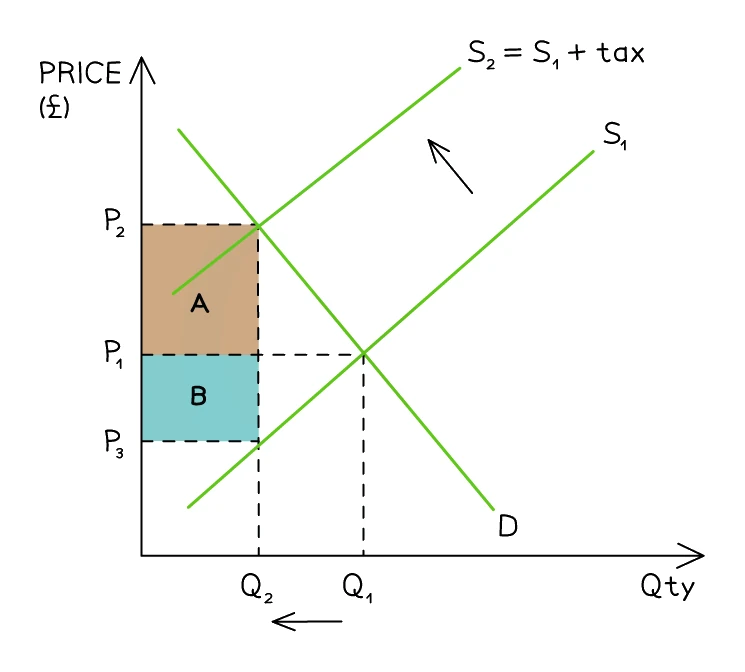
The government levies an indirect tax on the producer or consumer of the good. If the tax is set equal to the per unit, it forces the producer or consumer to internalise the externality: their private cost now matches the social cost.
On a diagram, the tax shifts the supply curve to the left (from S₁ to S₂ = S₁ + tax). The equilibrium price rises from P₁ to P₂ and the equilibrium quantity falls from Q₁ to Q₂, bringing output back toward the socially optimal level. The two shaded areas split the tax by incidence: area A is the part passed on to consumers as a higher price and area B the part absorbed by producers.
The tax also raises government revenue, which can be used to fund the clean-up or to compensate affected third parties.
Common exam question
Discussing a tax on a product
Question: Discuss whether taxing a product will cut the external costs it causes, or whether a government should tax a particular good (6–8 marks).
Asked in 2 of the 11 structured papers, marked by levels: Level 3 (6–8 marks) needs both sides developed, so a one-sided answer stays in Level 2 (3–5) at best. For: the tax raises the price, so quantity demanded falls, by more if demand is price elastic; it raises firms' costs, so supply falls; its revenue can fund cleaner alternatives. Against: with inelastic demand, as for addictive goods, consumption hardly changes; the tax may be small next to the price; people may dodge it through unofficial markets. If society wants more of the good, as with sports equipment, add that the tax deters a merit good, hitting low incomes hardest. The specimen mark scheme sets a 6-mark carbon tax version, up to 4 marks a side, adding lost competitiveness abroad and a regressive burden.
A complication that is also tested: the incidence of the tax (who actually pays it) depends on price elasticity of demand. For an inelastic good (cigarettes, petrol), most of the tax is passed on to the consumer as higher prices, because demand barely falls. For an elastic good, most of the tax is absorbed by the producer (the firm has to swallow the cost or risk losing too many sales).
Regulation, bans, and standards
The government can use laws to restrict the harmful activity directly. Examples:
- Emission caps for industrial plants.
- Bans on the sale of certain pesticides.
- A minimum legal age for buying alcohol or tobacco.
- Smoke-free zones in public buildings.
Regulation works by setting a maximum quantity or by removing the activity altogether, rather than relying on price. It is most effective when the external cost is severe or when monitoring individual emissions is expensive.
Minimum prices
The government can set a minimum price above the free-market price to discourage consumption of a demerit good (e.g. minimum unit pricing for alcohol). The higher legal price reduces quantity demanded.
5. How the government corrects positive externalities
Positive externalities require the opposite policy mix: encourage more production and consumption.
Producer subsidies
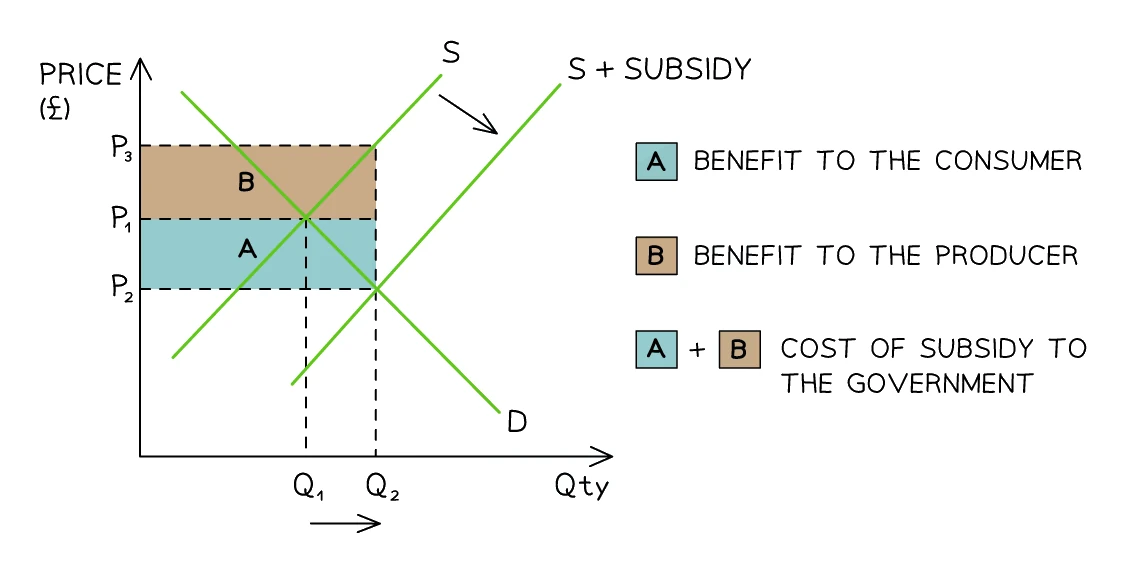
A subsidy is a payment from the government to the producer per unit of output. The subsidy lowers the producer's effective cost, shifts the supply curve to the right, lowers the market price and raises the quantity sold. This boosts the production of goods that generate positive externalities (e.g. solar panels, electric vehicles).
Like a tax, a subsidy is shared between producer and consumer. The split depends on price elasticity of demand: an inelastic good's subsidy mostly reaches consumers as a lower retail price; an elastic good's subsidy is mostly retained by producers.
Common exam question
Arguing for and against a subsidy
Question: Explain two reasons why a government may subsidise a product, or discuss whether it should keep subsidising one (4–8 marks).
Asked in 2 of the 11 structured papers. Run the case for through the market: the subsidy lowers producers' costs, supply increases and the price falls, so the good becomes more affordable. In the one 6-mark Discuss set, each of those links earned a mark, up to 4 on each side. Then say why it matters: more output of a necessity, better nutrition and health, higher farm incomes and jobs, fewer imports, or less pollution if it backs clean energy. Against: firms may come to rely on it and grow inefficient, may not pass it on as a lower price, and the money has an opportunity cost or may mean a budget deficit or higher taxes. The specimen mark scheme sets an 8-mark, levels-marked version on a merit good (toothpaste), adding that the good could end up over-consumed.
State provision
The government can simply provide the good itself, free at the point of use, funded through taxation. This is common for education and basic healthcare. State provision guarantees that everyone can access the good regardless of ability to pay, which raises its consumption towards the level that is best for society.
Common exam question
Choosing a tax or a subsidy for the problem
Question: Pick the policy, or pair of policies, a government would use to cut pollution or change how much of a good people consume (1 mark, multiple choice).
Set in 5 of the 13 multiple-choice papers. Decide first whether the good is over- or under-consumed. A subsidy lowers costs and the price, so it raises consumption: a merit good, fruit, or bus travel to take cars off the road. A tax raises the price, so it goes on the over-consumed good: sugar, or private motoring. With a pair, follow each policy separately: subsidised bus fares lower the private cost for passengers, and a tax on motoring raises it for drivers. Several wrong options turn the logic round (a subsidy to boost a demerit good, a tax on fruit, lower taxes on making private cars). A government paying bus firms so that fares can fall is running a subsidy, not regulation or a price control.
6. Public goods
Some goods are unusual because of two properties the market cannot price. These are .
A public good has two key features:
Non-rival. One person's consumption does not reduce the amount available to others. Walking past a street light does not stop anyone else from using it.
Non-excludable. Once provided, it is impossible (or too costly) to prevent non-payers from using it. A lighthouse warns every passing ship regardless of which shipping company has paid.
Classic examples: national defence, street lighting, lighthouses, public flood defences, clean air, public parks (in many cases).
Both properties are required. A good that has only one of them is not a public good.
Why public goods are under-provided in the free market
The combination of non-rival and non-excludable creates the free-rider problem: a private firm trying to sell a public good cannot stop people who refuse to pay from consuming it. Rational consumers therefore wait for someone else to pay and then use the good for free. Knowing this, the firm cannot collect enough revenue to cover costs, so it does not produce the good at all.
The free market either massively under-provides public goods or fails to provide them entirely. The non-provision of public goods is one of the consequences of market failure the syllabus names directly: socially valuable goods like defence and street lighting would simply not exist if left to private firms. This outcome is called a missing market.
Government provision of public goods
The standard solution: the government provides public goods directly, funded through general taxation. Everyone pays through tax, and the free-rider problem is solved because no one can opt out of the tax.
This solution has its own trade-off: providing the good requires tax revenue, which has an opportunity cost (the tax money could have funded a hospital, a road, or a tax cut for households).
7. Merit and demerit goods
Merit and demerit goods are a different kind of market failure, arising from or misjudged personal benefits, often combined with externalities.
Merit goods
A merit good is under-consumed in a free market because consumers underestimate the benefits of consuming it (or because it generates positive externalities).
Examples: education, healthcare, vaccinations, fresh fruit and vegetables, pension contributions.
Two reasons the free market under-provides them:
- Information failure. Consumers do not fully realise how much they will gain from the good. Many young adults underestimate the value of higher education; many people skip flu vaccinations because they underestimate the personal protection it offers.
- Positive externalities. Education and vaccination produce benefits for other people (a better-educated workforce, herd immunity), and these are not captured by the price the consumer pays.
Government response: subsidies, free or subsidised state provision, compulsory consumption (e.g. compulsory schooling), and information campaigns.
Exam tip
Policies for a merit good must raise its consumption
When you analyse how a government could encourage people to consume a merit good, use measures that act on the merit good itself and follow each one through: a subsidy or a cut in indirect tax lowers its price and makes it affordable; information campaigns correct people's underestimate of its benefits; regulation can make it compulsory, as with school attendance; the state can provide it free; a maximum price makes it cheaper but risks a shortage. Taxing or banning a demerit good earns credit only when you tie it to people switching to a merit good.
Demerit goods
A demerit good is over-consumed in a free market because consumers underestimate the harm of consuming it (or because it generates negative externalities).
Examples: cigarettes, alcohol, recreational drugs, junk food, sugary drinks, gambling.
Two reasons the free market over-provides them:
- . Consumers do not fully realise the future health damage, addiction risk, or social harm.
- Negative externalities. Consumption affects others: passive smoking, drink-driving, healthcare costs paid by the state.
Government response: indirect taxes (sin taxes), regulations (minimum legal age, advertising bans, packaging warnings), outright bans on the worst products, and education campaigns.
Common exam question
Telling public, merit and demerit goods apart
Question: Pick the public, merit or demerit good, or say why the state provides some goods (1 mark, multiple choice).
Set in 6 of the 13 multiple-choice papers. A public good is non-rival and non-excludable, so firms cannot charge users and will not supply it: the keyed reason for state provision. A demerit good is more harmful to its consumers than they realise, so it is over-consumed; a merit good is under-consumed because people underestimate its benefits.
Wrong options swap labels: education, healthcare or railways as public goods (users can be charged; defence is keyed); merit, free or economic goods as what markets cannot provide; a demerit good defined by private costs above social costs, or by external benefits; defence or unemployment benefit as merit goods; providing demerit goods as a government role.
Asked in 1 of the 11 structured papers, as 4 marks on merit versus public goods: a feature and example of each (education; defence or street lighting).
A merit / demerit good is not the same as a . Merit goods are usually rival (one person's healthcare appointment uses up a doctor's time) and excludable (a school can refuse to enrol non-payers). The two failures sometimes overlap but are conceptually distinct.
The labels "merit" and "demerit" are descriptive, not moral judgements. The terms describe under- or over-consumption, not whether the good is good or bad in any absolute sense.
8. Monopoly as a cause of market failure
The syllabus lists alongside externalities and public goods as a term associated with market failure, and names the abuse of monopoly power as one of its causes.
A monopoly is a market dominated by a single firm (or, more loosely, one firm with a very large share of the market). With no close competitor to undercut it, the firm has the power to set its own price rather than accept the market price.
A monopoly causes market failure through one main mechanism the syllabus tests directly: restricted supply causing higher prices.
- To maximise its profit, a monopolist restricts the quantity it supplies below the level a competitive market would produce.
- With less of the good available, the price rises above the competitive level.
- Consumers therefore pay more and consume less than is socially desirable, so resources are misallocated — the hallmark of market failure.
A monopoly can also harm consumers in other ways: with no competition, there is less incentive to improve quality, less choice, and less pressure to keep costs and prices down, while the firm earns high (supernormal) profit. (A monopoly is not always harmful — a large single firm may achieve economies of scale and fund research — but the abuse of monopoly power is what makes it a market-failure concern.)
Governments respond to the abuse of monopoly power through competition policy, price regulation, or measures to encourage new firms to enter and compete.
9. Government intervention: maximum and minimum prices
Two intervention tools that need separate diagrams.
Maximum price (price ceiling)
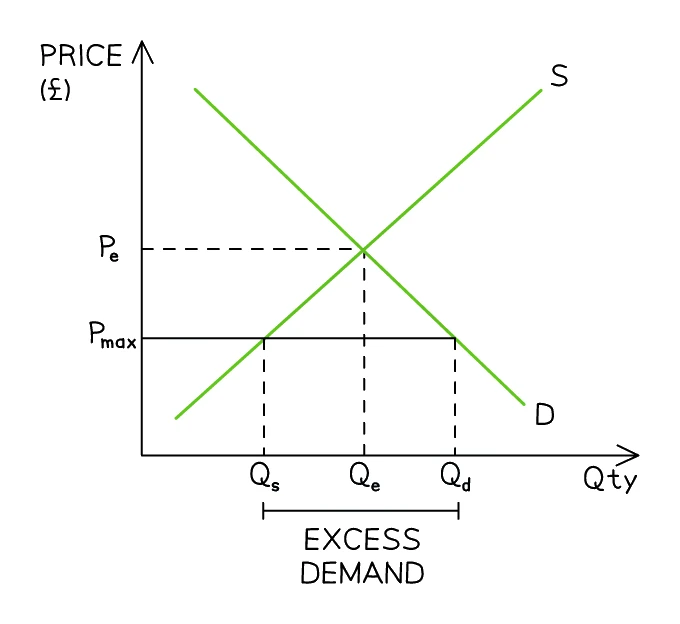
A maximum price is a legal price cap below the free-market equilibrium. Sellers cannot legally charge more.
- Quantity supplied contracts (less profitable at a lower price).
- Quantity demanded extends (cheaper, so more is wanted).
- The result is a shortage (excess demand) at the legal maximum.
Common exam question
Drawing a maximum or minimum price
Question: Draw a demand and supply diagram with a maximum price set below equilibrium, define a minimum price, or analyse how either control causes disequilibrium (2–6 marks).
Asked in 2 of the 11 structured papers. The drawing earns four marks: price and quantity axes, labelled demand and supply curves, a price line below the equilibrium, and quantity demanded shown greater than quantity supplied (a correctly marked shortage is also accepted). A minimum price is defined as a price set by the government (one mark) above the equilibrium price (the second). The specimen mark scheme's 6-mark Analyse gives a mark for placing each price, then credits the chains: price falls, demand extends, supply contracts, shortage; price rises, demand contracts, supply extends, surplus.
Set in 2 of the 13 multiple-choice papers. A maximum price cuts the quantity traded as well as the price, because firms supply less; it counts as regulation, not fiscal, monetary or supply-side policy.
Used to protect consumers in essential markets: rent controls in a housing crisis, price caps on essential medicines, fuel price caps during shortages.
| Advantages | Disadvantages |
|---|---|
| Lower prices protect low-income consumers | Shortages mean some buyers go without |
| Stabilises markets during emergencies | Black markets may emerge (illegal resale at higher prices) |
| Limits exploitation in rental and essential-goods markets | Reduces producer incentive to invest in supply |
Common exam question
Discussing a maximum price
Question: Explain why a government controls the price of an essential good, or discuss whether it should set a maximum price on a product such as housing (2–8 marks).
Asked in 2 of the 11 structured papers. For: a necessity becomes affordable, which reduces poverty and inequality and leaves households money for other needs; a cap also stops a monopoly using its power to push the price up. Against: set below the equilibrium it creates a shortage, because firms supply less and may cut quality to protect their profits; informal markets spring up at higher prices; and a cap set above the equilibrium price changes nothing. The 8-mark version is marked by levels, so develop both sides.
Minimum price (price floor)
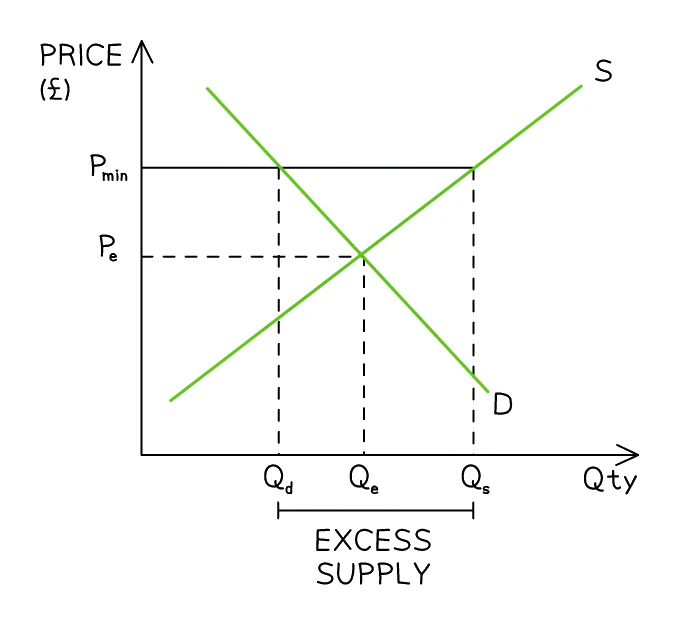
A minimum price is set above the free-market equilibrium. Sellers cannot legally charge less.
- Quantity supplied extends (more profitable at a higher price).
- Quantity demanded contracts (more expensive, so less is bought).
- The result is a surplus (excess supply) at the legal minimum.
Used to support producers (agricultural floor prices) or to discourage consumption of a demerit good (minimum unit pricing for alcohol). The national minimum wage is a minimum price in the labour market designed to protect workers from low pay.
| Advantages | Disadvantages |
|---|---|
| Producers receive a guaranteed income | Surplus output may need to be bought up by the government |
| Reduces consumption of demerit goods | Encourages over-production and waste |
| Minimum wage raises pay of the lowest paid | Higher costs may lead firms to lay off workers |