1. The labour market
The labour market is the market in which workers (the suppliers of labour) meet firms (the buyers of labour). The "price" in this market is the ; the "quantity" is the number of workers employed (or hours worked).
Like every other market on the syllabus, the labour market has demand and supply curves. Where they cross sets the at which the quantity of labour demanded equals the quantity supplied.
Two features make the labour market different from a product market:
- Demand for labour is . Firms do not want workers for their own sake; they want the products workers help to make. When demand for a firm's product rises, its demand for labour rises with it.
- The supply of labour is the number of workers willing and able to work at each wage. It tends to rise as the wage rises, because higher pay attracts more workers and persuades some to work extra hours.
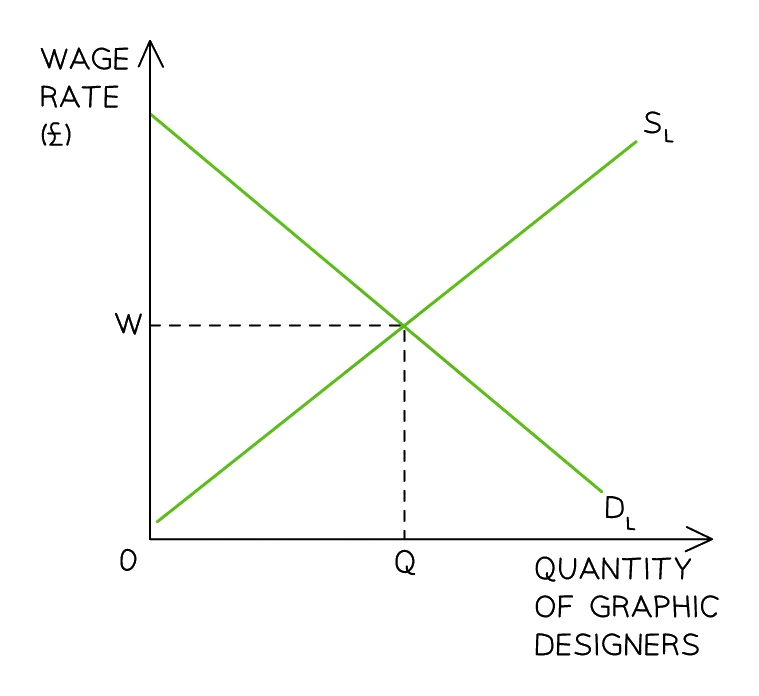
A standard labour-market diagram has the wage rate on the vertical axis, the quantity of labour on the horizontal axis, a downward-sloping DL (demand for labour) curve and an upward-sloping SL (supply of labour) curve. They cross at the equilibrium wage W and quantity Q.
2. Choosing an occupation: wage and non-wage factors
Workers do not pick jobs on pay alone. The syllabus splits the influences on an individual's choice of occupation into wage factors and non-wage factors.
| Type of factor | Examples |
|---|---|
| Wage factors | Basic pay, overtime rates, bonuses, commission, pay rises linked to inflation |
| Non-wage factors | Holiday entitlement, pension, healthcare and other fringe benefits, job security, working hours, training and promotion prospects, location, prestige and status, the working environment |
A job with a lower wage but generous non-wage benefits (long holidays, flexible hours, a good pension) can still attract many applicants. A high-paying job with long hours, dangerous conditions or a remote location may struggle to fill posts, which is why such jobs often pay a , extra pay to make up for the unattractive features.
Exam tip
Develop each reason for choosing a job
A question on why people choose an occupation, or why fewer now do, gives one mark for each of two reasons and the rest for developing them, so pair every factor with its effect. High pay raises living standards and often reflects scarce skills; job security, a good pension, pleasant working conditions, status and job satisfaction are the non-wage reasons. The specimen mark scheme sets the reverse case for 6 marks, why fewer people become teachers, crediting pay that has fallen behind other jobs, poor conditions (long hours, large classes, paperwork) and longer or costlier training.
3. Wage determination
A question on what determines wages rewards distinct, well-explained reasons. They fall into demand-side, supply-side and institutional groups.
Demand-side and supply-side factors
Demand for labour depends on the demand for the product the worker helps to make (derived demand) and on the worker's productivity. A worker who produces more output per hour, or output the firm can sell for more, is worth more, so firms demand such workers more strongly and pay them more.
Supply of labour depends on how many workers have the relevant skills and are willing and able to do the job. The fewer the qualified workers available, the higher the wage employers must offer to attract them.
- Skills and qualifications. Jobs that need long training (surgeon, airline pilot, engineer) have a small pool of qualified candidates, so pay is high. Jobs almost anyone can do (cleaner, fast-food worker) have a large pool, so pay is low.
- Demand for the product. Demand for software engineers has risen with demand for software; demand for typists has fallen with the rise of personal computers.
- Productivity. A worker who generates more revenue per hour is worth more to the firm, which is willing to pay more to recruit and keep them.
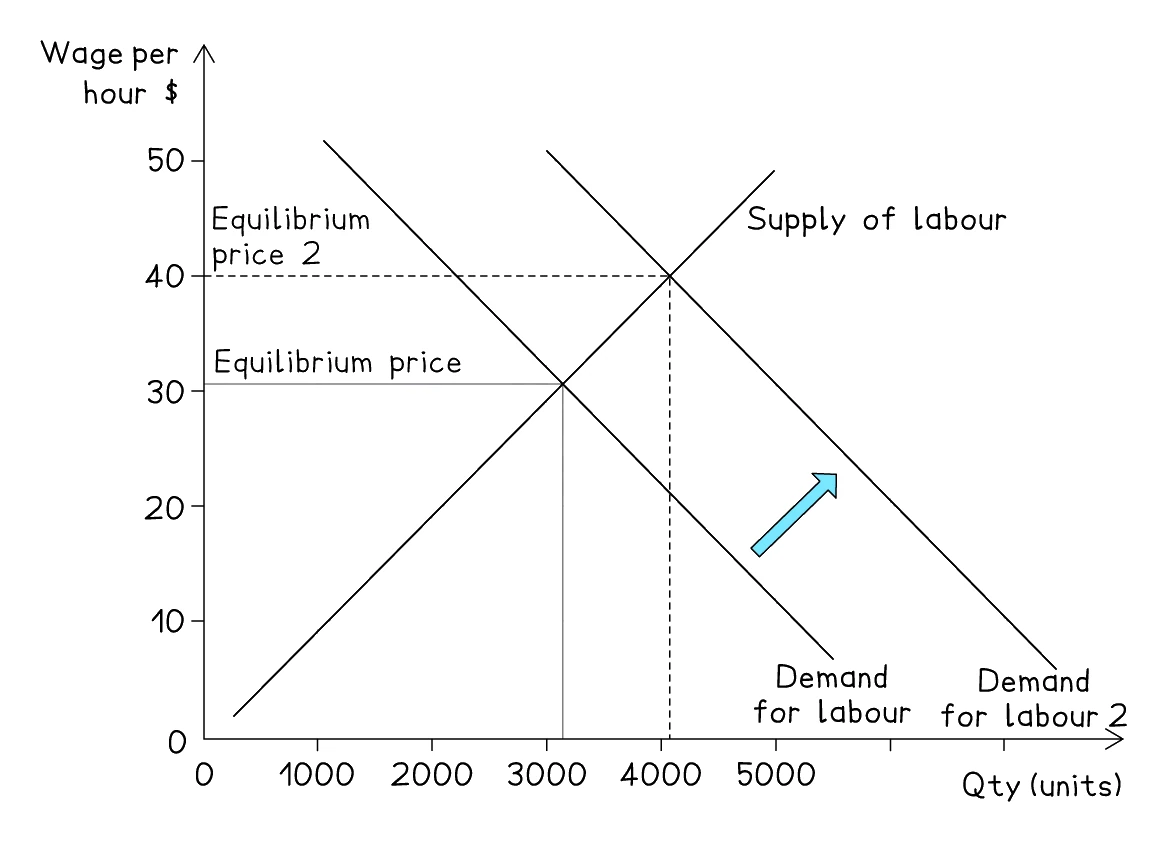
Because demand for labour is derived, a rise in demand for the product shifts the demand for labour to the right. The demand curve moves from Demand for labour to Demand for labour 2, and along the unchanged supply curve the wage is bid up (here from the original equilibrium price to the higher equilibrium price 2) while the quantity of workers employed rises.
A shift in supply works the same way on the other curve. If fewer workers hold the necessary qualifications, if workers emigrate, or if a professional body lengthens the training needed to enter the job, the supply of labour falls and the SL curve shifts left to SL2. Reading off the unchanged DL curve, the equilibrium wage rises and the equilibrium quantity of labour falls: employers have to offer more to attract the smaller pool of available workers, and at that higher wage they take on fewer of them. The mirror case runs in reverse. If immigration, retraining schemes or a large cohort of new entrants increase the supply of labour, SL shifts right, the equilibrium wage falls and the quantity of workers employed rises. When a question asks you to use a diagram, label both curves, show the shifted curve as SL2, and mark the new wage and the new quantity on the axes.
Common exam question
How demand and supply of labour change a wage
Question: Analyse how market forces can raise wages, or what influences a firm's demand for labour (6 marks).
Asked in 2 of the 11 structured papers. Name the change and the market: one scheme gives a mark for an increase in demand and one for making it demand for labour, and likewise for a decrease in supply of labour. Then give the cause. Demand for labour is derived: it rises with demand for the product, with workers' skills and with dearer machines that could replace them, and falls when machinery gets cheaper. Supply falls if the labour force shrinks or fewer hold the skills.
The same idea is set in 4 of the 13 multiple-choice papers. Higher productivity shifts only the demand curve right, to a higher wage and more workers; options that move supply are wrong. More demand for labour raises the wage and extends the quantity supplied. Better working conditions are keyed to raise the supply of nurses.
Institutional factors
Two institutions can lift wages above the level the market alone would set: a can negotiate higher pay for its members through collective bargaining, and a national sets a legal floor below which employers cannot pay.
Common exam question
What gives a trade union bargaining power
Question: Choose the condition that would, or would not, strengthen a trade union's power to push up wages (1 mark, multiple choice).
Set in 2 of the 13 multiple-choice papers. A union is strong when the employer cannot do without its members: it supplies all the labour the firm needs, membership is high, workers are scarce or the economy is growing fast. Laws limiting strike action, rising cyclical unemployment and a move to short-term contracts all weaken it. The trap is the product market: when demand for the firm's product is price-elastic, a wage rise passed on as a higher price costs many sales and jobs, so elastic demand weakens the union rather than strengthening it.
4. The national minimum wage (NMW)
A national minimum wage is a legally imposed floor on wages: the lowest hourly rate at which an employer can lawfully pay a worker.
How it works on a labour-market diagram
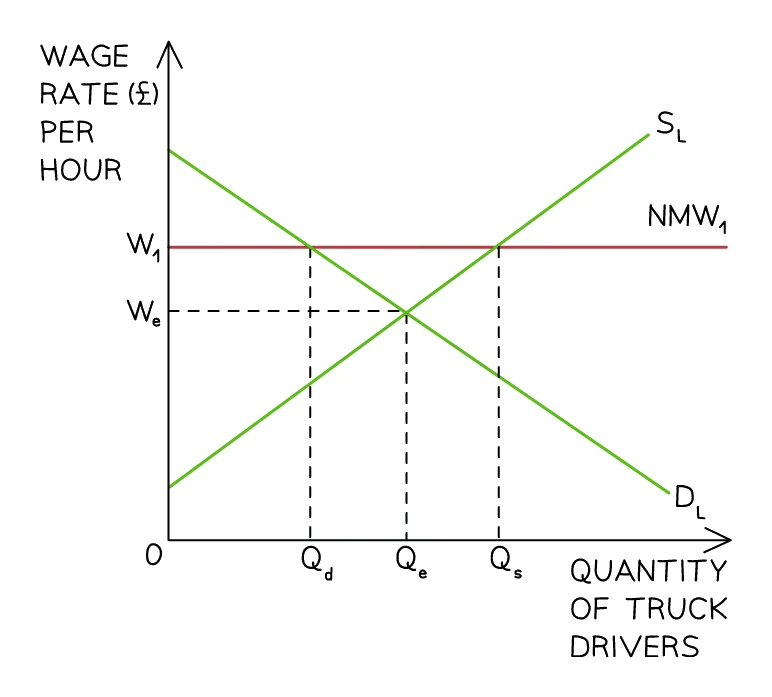
If the NMW is set above the free-market equilibrium We, two things happen:
- Quantity of labour supplied rises (more workers want the higher-paid jobs), a movement up the SL curve.
- Quantity of labour demanded falls (firms hire fewer workers because labour is more expensive), a movement up the DL curve.
The result is an excess supply of labour at the NMW: more workers want to work at this wage than firms want to hire. The gap is unemployment caused by the minimum wage. If the NMW is set at or below the equilibrium, it is non-binding and has no effect on employment.
Advantages and disadvantages
| Advantages | Disadvantages |
|---|---|
| Raises pay of the lowest-paid workers, reducing in-work poverty | If set above equilibrium, can cause unemployment among low-skilled workers |
| Reduces wage exploitation in vulnerable industries | Raises firms' production costs, which may be passed on as higher consumer prices |
| Reduces wage discrimination (everyone gets at least the minimum) | Small firms may struggle to absorb higher wage costs and may close |
| Higher incomes for low-paid workers can boost consumer spending and total demand | May encourage firms to substitute capital (machines) for labour |
Common exam question
A minimum wage and unemployment
Question: Analyse how a minimum wage could affect unemployment, or identify why one is set (2–6 marks).
Asked in 2 of the 11 structured papers. Credited aims: higher low pay, less poverty or inequality, no exploitation, more job seeking. For the effect, define it as a legal wage floor and argue both ways. Above the equilibrium it creates a labour surplus (a diagram can show it), and firms facing higher costs may cut output or automate; higher pay can lift productivity and total demand, so firms hire more. Stating the outcome earns one mark in total; the chain earns the rest, as does noting that a floor below equilibrium does nothing.
The same idea is set in 3 of the 13 multiple-choice papers: a floor below a group's wage changes nothing, while at a floor above it, set by law or won by a union, unemployment is the whole gap between labour supplied and demanded, not just the jobs lost.
5. Reasons for differences in wages
A wage differential is the difference in pay between workers in different jobs, or between workers with different characteristics in similar jobs.
Different occupations earn different wages, and different workers in the same occupation are paid differently, for several reasons.
1. Demand for and supply of labour
Jobs with long training periods have a small supply of qualified workers; if demand for that labour is also strong, the equilibrium wage is high. A doctor needs roughly a decade of training, a checkout assistant a few days, so the doctor's labour supply is small and the wage high.
2. Relative bargaining strength
Workers represented by a strong trade union or professional body can negotiate pay above the free-market level. Doctors, airline pilots and lawyers earn more partly because their professional bodies restrict the supply of new entrants. Workers with no collective representation have weaker bargaining power and accept lower pay.
3. Compensating differentials
Dangerous, unpleasant, anti-social or remote jobs must pay extra to attract anyone at all (offshore oil-rig workers, night-shift nurses, deep-sea trawler crews). The extra pay is the .
4. Discrimination and government policy
Wage differences are not always economically justified. Discrimination on the basis of gender, age, ethnicity or disability can produce pay gaps unrelated to productivity. Government policy, such as a national minimum wage or equal-pay legislation, also shapes wages, especially for the lowest-paid.
5. Economic sector and public or private sector
Economic sector. The sector a worker is in affects pay through the skills that sector needs and the value of what each worker produces. Much primary-sector work (subsistence farming, basic agriculture) needs few formal qualifications, so the supply of workers able to do it is large, and output per worker is often low in value, so pay is low. Secondary-sector wages vary with capital intensity: a worker operating expensive machinery produces far more saleable output per hour than one doing simple assembly by hand, so is in stronger demand and is paid more. The tertiary sector spans the widest range of all, from professional services such as law, medicine and finance, where long training keeps the supply of qualified labour small and pay high, to retail and catering, where little training is needed, supply is large and pay is low. In an answer, say that the sector changes the skill requirement and the value of output per worker, and that it is those two things that move the demand for and supply of that labour. Naming the sector is only a start: link it to skills and the value of output to develop the point.
Public or private sector. Public-sector pay is set by government out of tax revenue, usually on national pay scales negotiated with trade unions, so it is more standardised across the country and it is capped by the government's budget rather than by what the worker earns for an employer. Private-sector pay follows the demand for and supply of each kind of labour, and demand for the firm's product feeds that demand, so it can rise well above the public-sector equivalent where the skills are scarce or the product sells well, and fall below it where they are not. A firm's profit alone does not explain a worker's pay: a cleaner at a profitable bank can earn less than a waiter. Public-sector jobs also tend to carry stronger non-wage benefits such as pensions and job security, which act as a compensating differential in reverse: workers accept a somewhat lower wage in exchange for them, the point made in section 2.
Common exam question
Why some workers earn more than others
Question: Explain or analyse why a group such as top sportspeople, cleaners, women or the less educated earns more or less than others (4–6 marks).
Asked in 5 of the 11 structured papers. Root every reason in the demand for or supply of that labour: long training and scarce skills or talent mean few, hard-to-replace workers; high productivity means strong demand. Add bargaining power (a union or professional body), discrimination (against women, older workers or migrants), experience, part-time hours, and responsibility or danger. Either side of the comparison is accepted.
Two answers score nothing alone: that the employer, a bank say, is more profitable, and low demand for cleaners unless set against their high supply.
The same idea is set in 3 of the 13 multiple-choice papers. Bargaining power, discrimination and government policy explain pay gaps, inflation does not; paying by age is discrimination, paying by education, productivity or experience is not; city allowances cover high living and transport costs.
6. Mobility of labour
Occupational mobility is the ease with which a worker can move from one type of job to another. Geographical mobility is the ease with which a worker can move from one location to another to take a job.
Several things make labour more or less mobile.
| What raises mobility | What lowers mobility | |
|---|---|---|
| Occupational | Transferable skills, retraining and education, similar work in other industries | Highly specialised skills, long training requirements, lack of retraining |
| Geographical | Affordable housing, good transport, available information on vacancies | High housing costs, family and social ties, language or cultural barriers |
Common exam question
What affects labour mobility
Question: Define labour mobility, or identify or explain what makes workers more or less able to change job or area (2–4 marks).
Asked in 3 of the 11 structured papers. A definition earns its two marks from the ability of workers to move, between occupations or between areas, to take another job. For influences, one scheme accepts age, skills or training, qualifications, the price or availability of housing, the cost of living, family ties, information on vacancies, disability, transport, distance to work and discrimination, but marks only the first three you give. To explain one, say which mobility it changes: better education or internet access builds skills and knowledge of vacancies, raising occupational mobility; better or cheaper transport lets people work further away, raising geographical mobility.
The same idea is set in 1 of the 13 multiple-choice papers: more low-cost housing raises geographical mobility, while spending on apprenticeships and training raises occupational mobility instead.
Consequences matter for the whole economy. When labour is mobile, workers move quickly from declining industries and regions to growing ones, which keeps structural unemployment low and helps firms fill vacancies. When labour is immobile, workers stay stuck in shrinking industries or depressed regions, structural unemployment rises, and firms in growing areas face shortages that push wages up. Governments improve mobility through education and training (occupational) and through transport and housing policy or job-vacancy information (geographical).
7. Division of labour
Division of labour (worker specialisation) is breaking down the production process into separate tasks, with each worker concentrating on a particular task rather than making the whole product alone.
Exam tip
Define division of labour in two halves
The specimen mark scheme gives one mark for each half of the definition: production split into separate tasks, and each worker concentrating on one of them. An answer that says only that workers specialise has the second half alone, so it earns one mark. When division of labour comes with mechanised production, keep the two costs apart: output per worker rises, so average cost falls, even though total cost rises with the larger output, while repetitive work tends to lower motivation.
Splitting a job into specialised tasks has clear gains, but also costs.
| Advantages | Disadvantages |
|---|---|
| Workers become skilled and faster at their single task, raising output and productivity | Repeating one task can become boring, lowering motivation and increasing mistakes |
| Less time wasted moving between tasks or tools | If one specialist worker is absent, the whole production line can be held up |
| Easier and cheaper to train a worker for one task than for the whole job | Workers have narrow skills, which can make them occupationally immobile if the job disappears |
| Allows the use of specialised machinery for each task | Standardised output gives less variety and less personal pride in the finished product |