1. Why countries trade
International trade is the exchange of goods and services between countries. Almost every modern economy buys some things from abroad and sells some things abroad. Even very large, near self-sufficient economies such as the United States and China import and export trillions of dollars each year.
Common exam question
Defining international trade and free trade
Question: Define international trade (2 marks).
The specimen mark scheme for the 2027 papers gives one mark for an exchange of goods (services may be added) and the second for between countries, so an answer that never mentions other countries earns only one.
The 2027 syllabus also adds definitions of free trade and specialisation by country, which the specimen does not set. Give each both of its parts. Free trade is international trade with no government barriers such as tariffs or quotas. Specialisation by country is a country concentrating on the goods and services it produces most efficiently and trading for the rest.
Countries trade for three broad reasons.
- Different resources. Saudi Arabia has oil; New Zealand has grazing land for sheep; Brazil has the climate for coffee. Each can produce some goods that others cannot, or cannot produce as cheaply.
- Different costs. Even when two countries can make the same product, one is usually cheaper at it. Concentrating on the goods each makes most cheaply, and trading for the rest, raises total output.
- Different tastes. Consumers want variety. Even a country that can make every good itself may still want German cars, French wine, Italian fashion or Japanese electronics.
The first two of these are the basis for .
2. Specialisation by country
Specialisation by country is when a country concentrates on producing the goods and services it can make most efficiently, and trades for the rest rather than trying to produce everything itself.
This is the same idea as the division of labour, applied to whole economies instead of individual workers. A country specialises where it has an advantage, exports the surplus, and uses the foreign currency it earns to import the goods it has chosen not to make.
The basis for specialisation
A country specialises in a good for one of two reasons, and often both at once.
- Best use of resources (resource allocation). A country directs its land, labour, capital and enterprise toward the goods its resources are best suited to. Land with a tropical climate goes into coffee or cocoa; a workforce with strong technical education goes into electronics or finance. Resources end up where they are most productive.
- Low-cost production. A country specialises in goods it can produce at a lower cost than other countries can. Producing on a large scale for the world market also lets firms spread fixed costs and gain economies of scale, pushing average cost down further.
When each country does this, world resources are used more efficiently and total world output rises, so there is more for every country to share through trade.
Common exam question
What makes countries specialise
Question: Choose what is most likely to encourage countries to specialise and trade (1 mark, multiple choice).
Set in 5 of the 13 multiple-choice papers. Specialisation rests on differences: different resources, or making a product more cheaply than other countries (a cost advantage beats a newly found resource). Similar climates or similar natural resources are wrong. When a grid pairs two conditions, pick different resources and resources easy to move between industries.
A country specialises only if it can sell its surplus abroad, so free trade or abolishing tariffs encourages it. Tariffs, quotas, high transport costs, unstable exchange rates, a foreign currency shortage, labour immobility, inefficiency and diseconomies of scale are wrong.
Asked in 1 of the 11 structured papers, turned round: explain two reasons a country changes its specialisation (4 marks), a mark per reason and per explanation. Resources change (a discovery, new technology), costs change (a higher minimum wage, cheaper technology), demand changes, or rivals become more competitive.
Advantages of specialisation
- Higher output and incomes. Concentrating on what a country does best raises productivity, so total output is higher than if the country spread its resources across everything.
- Lower average costs. Producing more units of fewer goods lets firms exploit economies of scale, cutting unit costs.
- Better quality and reputation. A country that focuses on a few industries builds skill, expertise and a reputation for quality, which raises demand for its exports.
- Wider consumption. Export earnings pay for imports, so a country can consume goods it does not produce itself and enjoy a greater variety than its own resources allow.
Disadvantages of specialisation
- Vulnerability to price swings. A country that exports mainly one product is exposed when the world price of that product falls.
- Loss of self-sufficiency. A country that imports all of an essential good (food, fuel, medicine) has no fallback if war, disease or a natural disaster disrupts trade.
- Risk of resource depletion. Specialising in a non-renewable resource can exhaust it, leaving the economy with no replacement industry.
- Structural unemployment. Workers in industries that a country chooses not to develop, or that decline, may struggle to find new jobs if their skills do not transfer.
Because of these risks, most countries specialise partially: they keep a diversified base while still concentrating on their strongest industries.
Common exam question
Advantages and disadvantages of specialising
Question: Choose the advantage of specialisation at a national level for consumers or for a firm (1 mark, multiple choice).
Set in 3 of the 13 multiple-choice papers. Check the group: consumers gain lower prices and better quality, a firm lower average costs from economies of scale; higher productivity is the firm's gain. Wrong options pair a benefit with a cost (more choice with high transport costs), name a drawback (reliance on foreign supplies, overseas competition, depleted resources) or reverse an effect: specialising makes a country more dependent on trade.
Asked in 2 of the 11 structured papers. Explaining one advantage from the source (2 marks): skills raise productivity or quality, a good reputation raises demand; the explanation mark counts without the identification. Discussing more resources for a main export (6 marks, up to 4 per side): for, rising world demand, exports, revenue, jobs, economies of scale; against, rival producers, weather, exhausted land, opportunity cost, unpredictable demand, dependence on imports.
3. Free trade
Free trade is international trade between countries with no government-imposed barriers to the flow of goods and services: no tariffs, no quotas and no restrictive subsidies.
Free trade is what specialisation points toward if a country follows the logic to its conclusion: produce what you are best at, and buy everything else from wherever it is cheapest. In practice almost no country has completely free trade with every partner; most combine low barriers with some protected sectors.
Advantages of free trade
The benefits fall on different groups, so a discussion of free trade can draw distinct points from each.
For consumers:
- Lower prices. Imports add competition, so domestic firms must keep prices down to compete.
- Wider choice. Consumers can buy goods that could not be produced at home, such as tropical fruit in cold countries or advanced electronics in countries without those industries.
- Better quality. Foreign competition pushes domestic firms to raise their standards.
For firms:
- Larger markets. Exporters can sell to the whole world, not just their domestic population, allowing them to expand output and gain economies of scale.
- Cheaper inputs. Firms can import the cheapest raw materials, machinery and components from anywhere, lowering their costs of production.
For the economy as a whole:
- Faster economic growth. Export earnings finance imports of capital goods, and competition raises productivity, both of which lift GDP.
- More efficient use of resources. Resources flow toward the industries where the country is most productive.
- Transfer of ideas and technology. Contact with foreign firms spreads new techniques and designs.
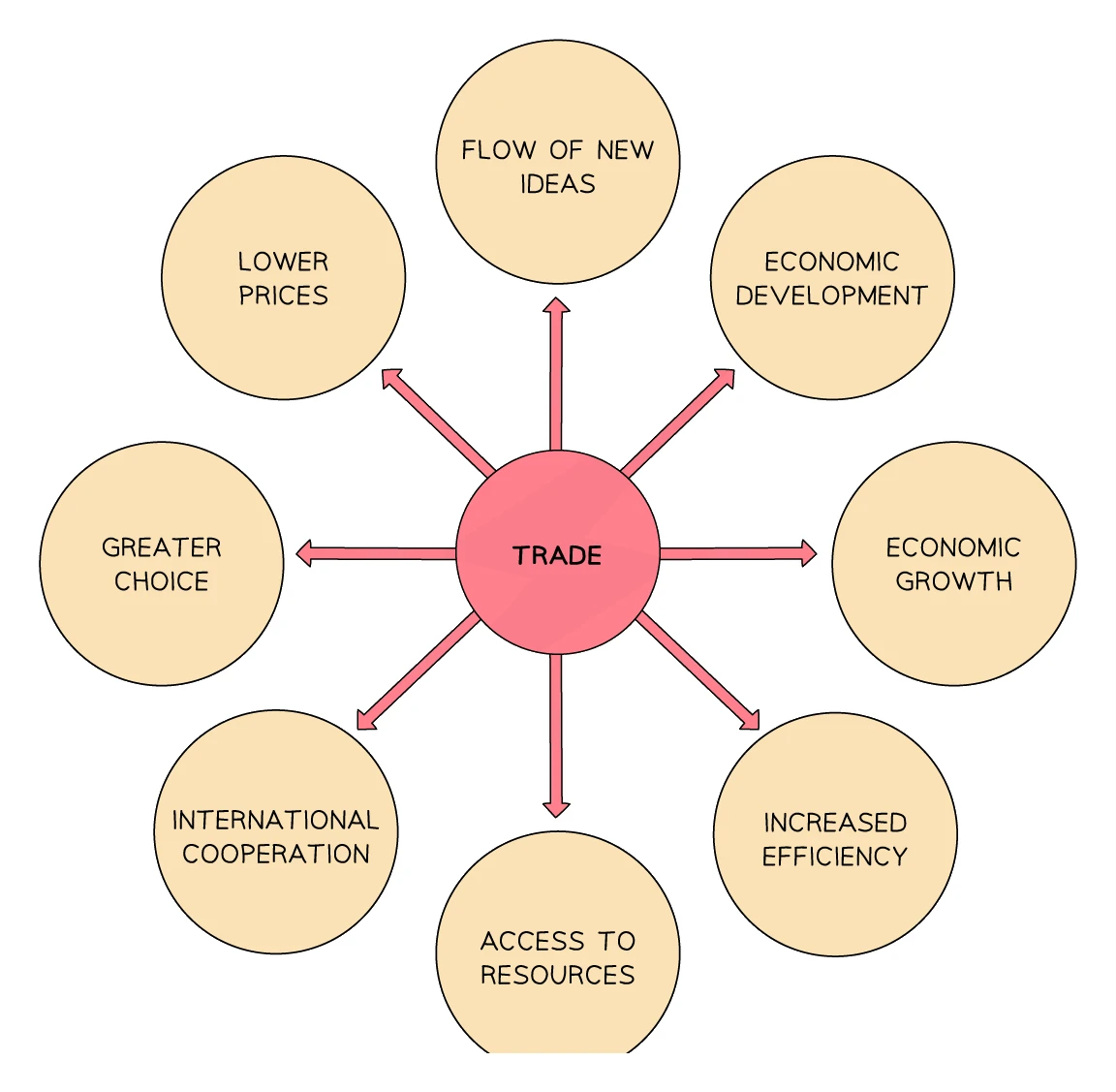
Taken together, these gains spread across consumers, firms and the wider economy, as the diagram summarises.
Disadvantages of free trade
Free trade is not costless, and honest "discuss" answers acknowledge the drawbacks.
- Structural unemployment in domestic industries that cannot compete with imports.
- Over-dependence on foreign suppliers for essential goods.
- Harm to infant industries. New industries may be wiped out by established foreign rivals before they have a chance to grow.
- Loss of strategic industries, such as the ability to produce food, energy or defence equipment.
- Wider inequality, as the gains may flow disproportionately to skilled workers and to firms in the country's strongest industries.
- Environmental costs from long transport chains and from production in countries with weaker regulation.
The standard view is that free trade raises total welfare but creates winners and losers, so it works best alongside policies that help those who lose out to adjust.
Common exam question
Discussing whether free trade benefits an economy
Question: Discuss whether or not free trade increases economic growth or benefits a country or city (6–8 marks).
Asked in 3 of the 11 structured papers. For: countries specialise in what they do best; competition raises productivity and cuts costs; firms buy raw materials and capital goods more cheaply and reach larger markets, gaining economies of scale; exports, jobs and choice grow. Against: infant industries cannot grow; declining industries close sooner; imports replace domestic output; tax revenue may fall; monopoly power or dumping; shocks abroad hit exporters; gains are uneven; extra transport harms the environment.
Develop every point. In the 8-mark version a one-sided answer stays in Level 2 (at most 5): Level 3 needs both sides developed. In the 6-mark version each side earns up to 4 marks, and reversing an earlier point scores nothing. Set in 1 of the 13 multiple-choice papers: a free trade agreement aims at more efficient resource allocation, not more tariff revenue.