1. Two demand-side toolkits
Governments and central banks have two main demand-side toolkits for managing the economy. Each is set by different people and works through different mechanisms, but both ultimately act on (total spending in the economy).
| Policy family | Who controls it | Main tools | Acts on |
|---|---|---|---|
| Fiscal policy | The government (treasury / finance ministry) | Taxes and government spending | Aggregate demand |
| Monetary policy | The central bank | Interest rate, money supply and the foreign exchange rate | Aggregate demand |
Both are demand-side policies: they try to lift or lower aggregate demand to pursue the macroeconomic aims of topic 12. The third toolkit, supply-side policy, raises the economy's productive capacity instead and is covered in its own topic.
This topic walks through each family, the tools each uses, and the limitations to be aware of.
2. Fiscal policy
Fiscal policy is the government's use of its budget (its decisions on taxes and public spending) to influence the economy.
The government budget
The government budget is a plan of the government's revenue (mostly from taxes) and its spending over a period, usually a year.
The budget has two sides:
- Government revenue (mostly tax): income tax, corporation tax, VAT, excise duty, national insurance, capital gains tax, and so on.
- Government spending: public services (health, education), welfare (pensions, benefits), capital projects (roads, hospitals), and debt interest.
Comparing the two gives the budget position:
A budget surplus is when government revenue is greater than spending. A budget deficit is when government spending is greater than revenue, so the government has to borrow to fund the gap.
The size of a deficit or surplus is simply the gap between the two figures: budget balance = total revenue − total spending. A positive answer is a surplus; a negative answer is a deficit. Most governments run a small persistent deficit.
Common exam question
What changes tax revenue and the budget balance
Question: Identify or analyse why a government's tax revenue rises or falls, or discuss whether a budget deficit is likely (2–6 marks).
Asked in 2 of the 11 structured papers. Link each tax to what it is levied on, one mark per step: more jobs and incomes bring in more income tax, more spending more indirect tax, higher profits more corporation tax and more imports more tariff revenue, so a recession cuts them all. For a deficit, weigh both sides: rising unemployment (more benefits, less income tax), a growing population (pensions, healthcare, education) and debt interest from past deficits make one likely; a growing labour force and rising GDP (more taxpayers, fewer benefit claims) make it less likely.
The same idea is set in 1 of the 13 multiple-choice papers. Take revenue minus spending each year: spending of 72bn to 18bn to $9bn, not a surplus.
Reasons for government spending
Governments spend on several broad areas, each with its own purpose:
- Public services such as healthcare and education, to provide merit goods that would be under-provided by the market.
- Welfare and benefits such as pensions and unemployment benefit, to redistribute income and reduce poverty.
- Infrastructure such as roads, railways and ports, to lower firms' costs and support long-run growth.
- Defence, law and order, to provide public goods that markets will not supply.
- Debt interest, the unavoidable cost of past borrowing.
The way the government splits its spending across these areas affects growth, inequality and the other macroeconomic aims.
Common exam question
Should the government spend more on one area
Question: Discuss whether a government should spend more (or less) on an area such as healthcare, housing, renewable energy or pensions, or analyse what that spending could achieve (6–8 marks).
Asked in 6 of the 11 structured papers. Give the area's own case (healthcare is a merit good the poor may not afford; renewable energy cuts external costs), then the wider one: more total demand, output and jobs. Against: the opportunity cost, higher taxes or borrowing and a budget deficit, inflation near full employment, and a private sector that might do it better. For a cut, such as smaller state pensions, the sides swap: a smaller deficit against lower living standards, more poverty and less total demand.
The 6-mark data-response version credits up to 4 marks a side; the 8-mark version is levels-marked, and its top level needs both sides developed. An Analyse answer built on one area is capped at 4 marks, so develop two.
Expansionary fiscal policy
Expansionary lifts aggregate demand by raising government spending or cutting taxes (or both).
The mechanism: higher spending puts money directly into the economy (more infrastructure projects, higher welfare payments). Lower taxes leave households and firms with more disposable income, which they spend. Both channels raise aggregate demand (AD), which lifts real GDP and reduces unemployment.
Expansionary policy is used when the economy is in a recession or growing too slowly. The trade-off: if used too aggressively, it can trigger demand-pull inflation (topic 13).
Contractionary fiscal policy
Contractionary fiscal policy lowers aggregate demand by cutting government spending or raising taxes (or both).
The mechanism is the mirror image: higher taxes reduce disposable income; lower spending withdraws money from the economy. AD falls, which slows inflation but also slows growth and may raise unemployment.
Contractionary policy is used when inflation is too high or when the government deficit has become unsustainably large.
Limitations of fiscal policy
Fiscal policy has four main limitations:
- Time lags. Tax changes and new spending take months to years to feed through. Recognising the problem, passing the law, and waiting for the effect can leave fiscal policy acting after the economy has already moved on.
- Political constraints. Tax rises and spending cuts are unpopular with voters. Governments often avoid them even when they are economically right.
- The cost of funding it. A deficit has to be paid for by borrowing, and borrowing adds to debt interest, one of the main areas of government spending. Money that goes on servicing past debt is money that cannot be spent on other priorities in future budgets.
- Imperfect information. The government does not always know exactly where the economy is in the cycle, so its fiscal response may arrive late or be the wrong size.
Common exam question
Whether fiscal policy can achieve an aim
Question: Discuss whether fiscal policy can achieve an aim such as full employment or less poverty, or analyse how government spending and unemployment are related (5–8 marks).
Asked in 3 of the 11 structured papers. For: more spending or lower taxes raise total demand, so firms hire and cyclical unemployment falls; spending on education, training and job information makes workers more skilled and mobile; benefits, and spending paid for by progressive taxes, reduce poverty. Against: the change may be too small, weak confidence can stop spending, tax cuts can be inflationary and benefits can weaken the incentive to work. Turning a "might" point round earns nothing on the other side. With data, state the relationship, quote figures showing it and explain the exception.
The same idea is set in 4 of the 13 multiple-choice papers. Both halves of a paired option must push total demand the same way, and a cut in direct taxes raises demand and supply together.
3. Monetary policy
The money supply is the total amount of money in circulation in an economy: cash held by the public plus the deposits held in bank accounts.
Monetary policy is the central bank's use of interest rates, the money supply and the foreign exchange rate to influence the economy.
The central bank is independent of the elected government in most modern economies (e.g. the Bank of England, the European Central Bank, the US Federal Reserve). Independence is meant to keep monetary decisions away from short-term political pressure.
The main tool is the the central bank charges on its loans to commercial banks. Changes in the base rate flow through to all other interest rates in the economy: mortgages, business loans, savings accounts, credit cards.
Higher interest rates: contractionary monetary policy
When the central bank raises interest rates, borrowing becomes more expensive and saving becomes more attractive. Households and firms spend less and save more, so falls.
What follows:
- Mortgage payments rise → households have less disposable income.
- Business loans are more expensive → firms invest less.
- Saving is more attractive → households save more, spend less.
- The currency often strengthens (foreign investors want higher-yielding assets in this country) → imports become cheaper, exports more expensive.
The combined effect is lower aggregate demand, which slows demand-pull inflation. Higher rates are the central bank's main weapon against inflation.
Lower interest rates: expansionary monetary policy
When the central bank cuts interest rates, borrowing becomes cheap and saving becomes unattractive. Households and firms spend and invest more, so aggregate demand rises.
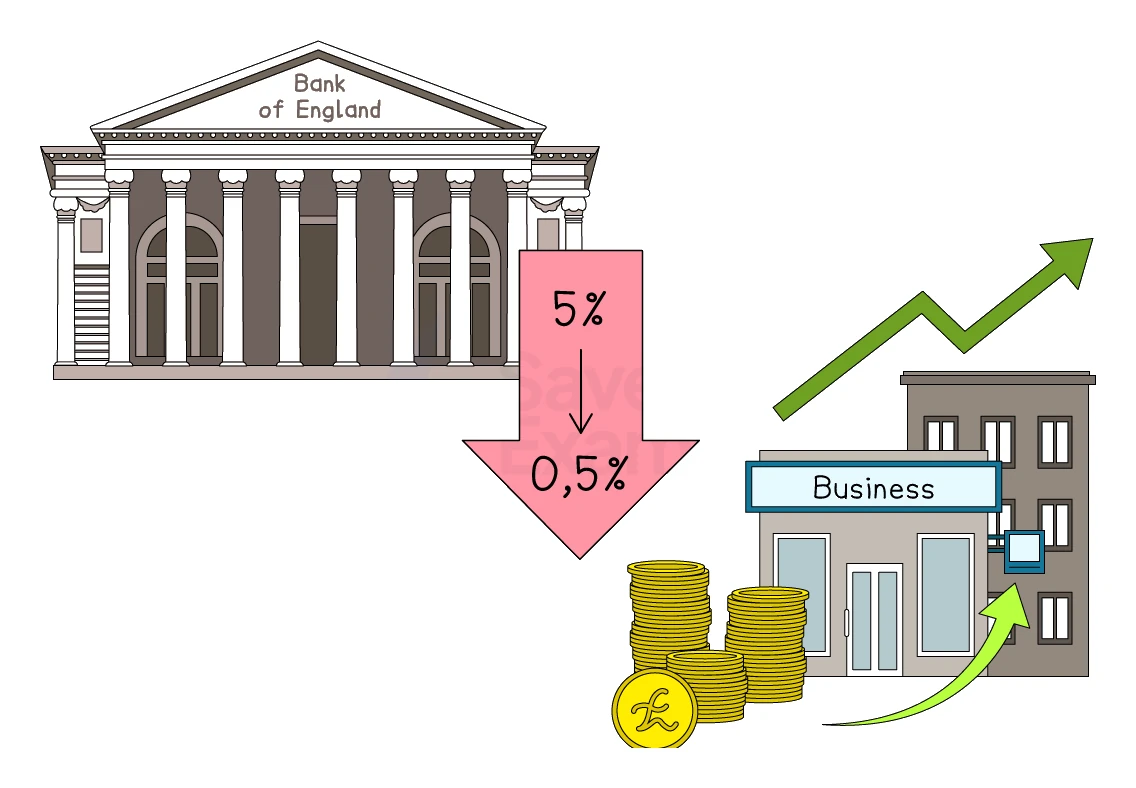
What follows:
- Mortgage payments fall → households have more disposable income.
- Business loans are cheaper → firms invest more.
- Saving is less attractive → households spend more.
- The currency often weakens → exports cheaper abroad.
The combined effect is higher aggregate demand, which lifts growth and reduces unemployment. Lower rates are the central bank's main weapon in a recession.
Common exam question
Whether an interest-rate change will curb inflation
Question: Discuss whether a cut in the interest rate will reduce inflation, or whether a central bank should have raised its rate (6–8 marks).
Asked in 2 of the 11 structured papers. A rise makes borrowing dearer and saving more rewarding, so spending falls, total demand falls and demand-pull inflation eases. Against it: investment, growth and jobs suffer, government debt costs more, and a higher exchange rate hurts exports and the current account. For a cut, the "will not" side is that chain reversed (more borrowing, less saving, more demand-pull inflation); the "will" side takes another route: cheaper loans cut firms' costs and raise investment, easing cost-push inflation.
The same idea is set in 5 of the 13 multiple-choice papers, whose wrong options reverse a direction. A higher rate discourages investment and rewards savers, so a cut leaves savers worse off; the monetary cure for inflation is a rate rise, not more money or a weaker currency.
Other monetary tools
- (QE). The central bank creates new money to buy government bonds (and sometimes corporate bonds), pushing more cash into the financial system. Used when interest rates are already near zero.
- Money-supply changes. Some central banks directly control the amount of money in circulation, though this is less common in advanced economies.
- Changes in the foreign exchange rate. The central bank can act on the exchange rate deliberately, not just as a side effect of an interest-rate decision. Buying its own currency using its foreign-currency reserves raises demand for that currency and pushes the rate up; selling its own currency to buy foreign currency raises the supply of it and pushes the rate down. A lower rate makes exports cheaper abroad and imports dearer at home, which raises total demand and so supports growth and employment, although the dearer imports add to cost-push inflation. A higher rate does the reverse: cheaper imports help hold inflation down, but export sales and jobs in exporting industries suffer. (Topic 20 develops these consequences.)
Common exam question
Naming monetary policy measures
Question: Identify two monetary policy measures (2 marks).
Asked in 1 of the 11 structured papers. Any two of changes in interest rates, the money supply and the foreign exchange rate score, one mark each. Quantitative easing is accepted for the money supply but not expected, and only the first three measures you write are read. Taxes and government spending are fiscal measures, not monetary ones.
The same idea is set in 3 of the 13 multiple-choice papers, where the monetary measure sits beside fiscal ones (a tax cut, more government spending), supply-side ones (education, infrastructure) and rules or price controls in single markets. When an option pairs two measures, check both halves: an exchange-rate change paired with education spending is only half monetary.
Limitations of monetary policy
- Time lags. It takes 6–18 months for a rate change to feed fully through to spending and inflation. The central bank has to act on its forecast, not on what is happening today.
- Confidence matters. If households and firms are pessimistic, cheap loans alone may not persuade them to spend. (The "you can lead a horse to water…" problem.)
- Limited room to cut. When rates are already very low, the central bank has little scope to cut them further, so monetary policy loses traction. This was the position of many central banks for most of the 2010s.
- Effects on the housing market. Rate changes have large and sometimes unintended effects on house prices, which complicates social policy.
4. Comparing fiscal and monetary policy
| Fiscal policy | Monetary policy | |
|---|---|---|
| Decision-maker | Government / treasury | Central bank (independent) |
| Main tools | Tax rates, public spending | Interest rates, money supply, foreign exchange rate |
| Targeted directly at | Specific groups (e.g. low-income tax cuts, NHS spending) | Whole economy (all borrowers and savers) |
| Speed | Slow to legislate; faster to take effect once passed | Fast to decide; slow to feed through |
| Political pressure | High (visible tax-and-spend decisions) | Lower (central bank insulated) |
| Main constraint | A deficit must be funded by borrowing, which adds to debt interest | Little room to cut when rates are already very low |
Most countries use both together: monetary policy as the first response to inflation; fiscal policy as the first response to a recession (especially a deep one).
5. Taxation
Tax is the main source of government revenue, and the way a government taxes shapes every macroeconomic aim. This section covers why governments tax and the main classifications of tax.
Reasons for taxation
Governments do not tax only to raise money. The main reasons are:
- Raising revenue to pay for public services, welfare and infrastructure.
- Discouraging consumption of demerit goods such as tobacco, alcohol and sugary drinks, by adding tax that raises their price.
- Reducing imports by placing tariffs on foreign goods, which protects domestic producers and the current account.
- Redistributing income, by taxing higher earners more heavily and using the revenue to fund benefits and services for those on low incomes.
- Influencing total (aggregate) demand, since raising taxes withdraws spending power from households and firms while cutting them adds it back.
- Encouraging environmental sustainability, by taxing pollution or carbon emissions so that firms have an incentive to pollute less.
Common exam question
Matching a tax change to its purpose
Question: A government raises one kind of tax, or changes its income tax rates; pick the most likely reason (1 mark, multiple choice).
Set in 3 of the 13 multiple-choice papers. Ask what the tax falls on. Most tax rises are about revenue: higher direct taxes on all incomes and profits pay for public and merit goods, and raising indirect taxes while leaving direct ones alone cuts a budget deficit. A broad tax targets no single product or polluter, and a higher tax on profits discourages investment. A rise in indirect taxes lifts prices and falls hardest on poorer households, so it is an unlikely way to cut inflation and does not shift income towards the poor. Cutting the rates on low incomes while raising them on high incomes makes the tax more progressive, so the aim is less income inequality.
Direct vs indirect taxes
A direct tax is levied on income or wealth and is paid by the person or firm on whom it is levied, who cannot pass it on to anyone else.
Common examples:
- Income tax (paid on wages and salaries).
- Corporation tax (paid on company profits).
- National insurance (paid on wages, funds social security).
- Capital gains tax (paid on gains from selling assets).
- Inheritance tax (paid on large estates).
An indirect tax is levied on goods and services and paid via the seller, who passes the cost on to the consumer.
Common examples:
- VAT (Value Added Tax): a percentage charged on most goods and services.
- Excise duty: extra tax on specific goods (alcohol, tobacco, fuel).
- Sales tax: similar to VAT in countries that use a single-stage tax.
- Tariffs: tax on imports.
The distinction is who bears the tax. Income tax comes out of the worker's own pay and cannot be passed on, even where the employer deducts it from wages and sends it to the tax authority for the worker. With VAT the customer pays the shop, and the shop pays the tax authority.
Progressive, regressive, and proportional taxes
This second distinction is about how the tax rate changes with income.
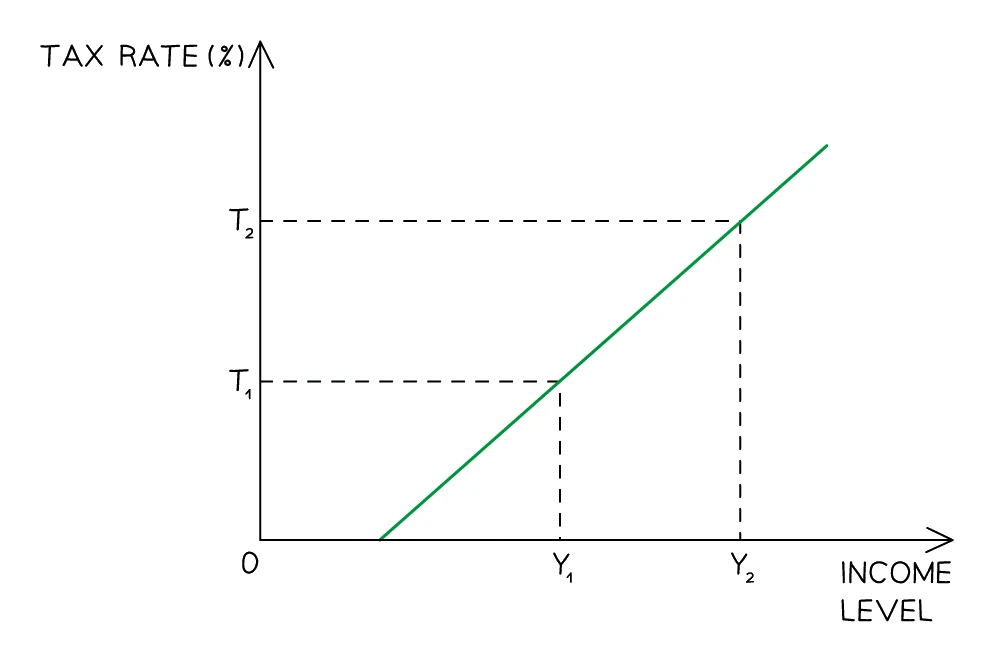
A takes a higher percentage of income from the rich than from the poor. Income tax with rising bands is the classic example.
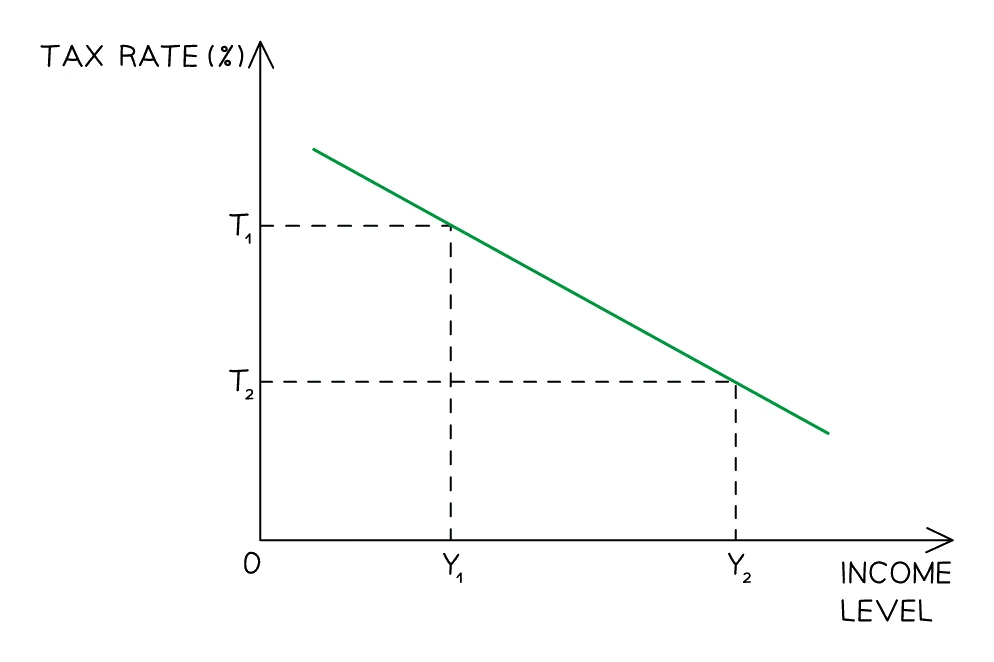
A takes a higher percentage of income from the poor than from the rich. VAT is regressive in practice because poor households spend a higher share of their income on taxed goods.
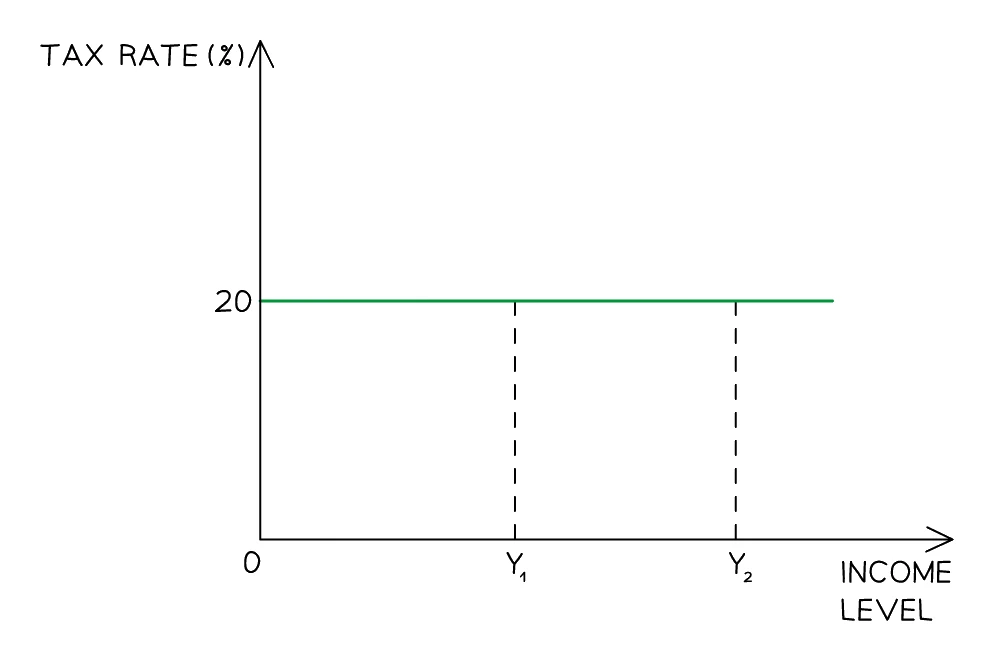
A takes the same percentage of income regardless of income level. A "flat tax" on all earnings would be proportional.
Direct vs indirect: strengths and trade-offs
| Direct tax | Indirect tax | |
|---|---|---|
| Usually progressive? | Yes (income tax with bands) | No (often regressive) |
| Visible to the taxpayer? | Very (shown on the payslip) | Less (built into prices) |
| Distorts consumer choice? | Less | Yes (consumers shift away from taxed goods, useful for demerit goods but problematic otherwise) |
| Can be avoided? | Hard (employer deducts at source) | Easier (the informal economy escapes VAT) |
| Stable revenue? | Yes (predictable from wages) | Yes overall, but falls in a recession when spending falls |
Most countries use a mix of direct and indirect taxes to fund the public sector.
Common exam question
Classifying a tax
Question: Identify two types of tax (2 marks).
Asked in 1 of the 11 structured papers. Any two of direct, indirect, progressive, proportional and regressive score, one mark each. Named taxes such as income tax or a tariff are accepted too, and specific and ad valorem taxes are accepted though not expected.
The same idea is set in 2 of the 13 multiple-choice papers, from a table of incomes and tax paid or a change to an income tax. Turn each into a percentage of income: 6 000 is 10% and 10 000 is 20%, so the share rises with income and the tax is progressive. Cutting the tax-free allowance adds the same taxable slice to every income, which weighs most on a small one, so that change is regressive; raising the allowance or the top rate does the opposite. Income tax is direct, never indirect.
Impact of taxation
Tax changes ripple through the whole economy:
- Consumers pay more for taxed goods (indirect tax) or keep less of their income (direct tax), so their purchasing power falls. Higher taxes on demerit goods are meant to cut consumption of those goods.
- Workers may have less incentive to work or work overtime if income tax rises sharply, though most still work because they need the income.
- Producers and firms face lower after-tax profits from corporation tax, which can reduce investment; indirect taxes raise their selling prices and may cut sales.
- The government gains revenue to fund spending, but very high tax rates can encourage avoidance and evasion, which reduces the revenue actually collected.
- The economy as a whole sees aggregate demand fall when taxes rise and rise when taxes are cut, which is exactly how fiscal policy works.