1. Demand for factors of production
To produce, a firm must hire the four factors of production: land, labour, capital and enterprise. A firm's demand for any factor is a derived demand: the firm does not want the factor for its own sake, but for the output it helps to produce. Several influences decide how much of a factor a firm demands.
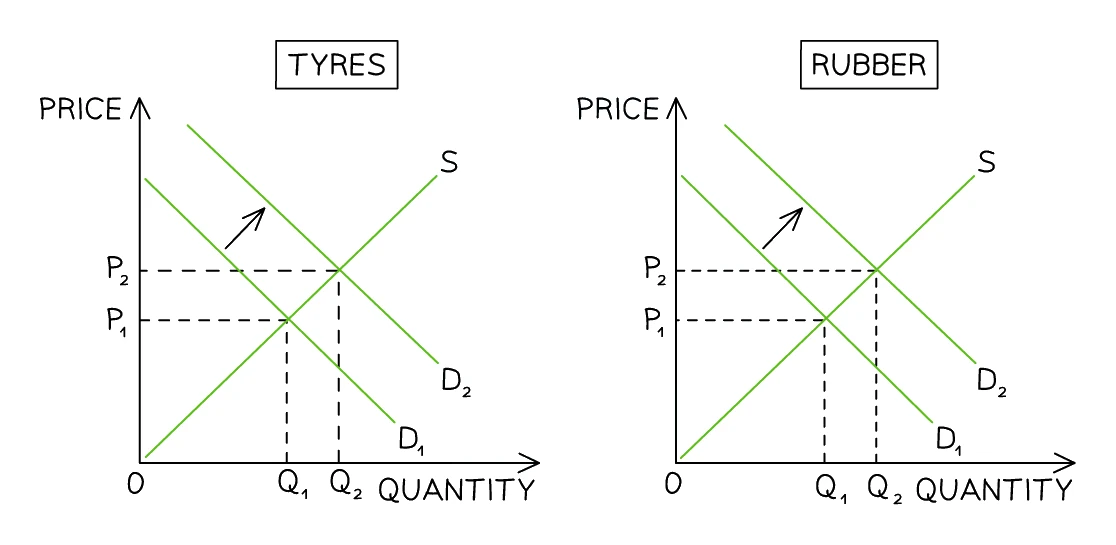
Because demand is derived, a rise in demand for a final product feeds straight through to the inputs used to make it. When demand for tyres rises (from D₁ to D₂), the price and quantity of tyres both rise; and because tyres are made from rubber, demand for rubber shifts out in the same way, raising its price and quantity too.
| Influence | How it affects demand for the factor |
|---|---|
| Demand for the product | A rise in demand for the product (higher total demand / economic activity) raises demand for the factors used to make it. |
| Price of the factor | A lower price of a factor tends to raise the quantity of it demanded; a higher price reduces it and may push the firm towards a cheaper substitute factor. |
| Price of other factors | If capital becomes cheaper than labour, firms switch towards capital, lowering demand for labour, and the reverse. |
| Availability of the factor | If a factor is scarce or hard to obtain, firms may have to demand alternatives. |
| Productivity of the factor | A more productive factor (better-trained workers, more advanced machines) is worth more to the firm, so demand for it rises. |
Exam tip
Give each influence on factor demand its direction
Each influence on demand for factors of production earns one mark for naming it and one for the direction of its effect. Strong pairs: demand for the product (more demand for the good raises demand for the factors that make it, because factor demand is derived), the factor's own price (cheaper means more is demanded) and its productivity (more productive means more is demanded). For another factor, name its price: dearer capital can raise demand for labour as a substitute, and cheaper capital used alongside workers can raise it as a complement. The bare word "substitute" is not enough.
2. Labour-intensive and capital-intensive production
A firm chooses how to produce, not just what. The choice turns on the balance between people and machines.
uses a high proportion of labour relative to capital. The firm's main cost is wages. Examples: hand-stitched clothing, a restaurant kitchen, private tutoring.
uses a high proportion of capital (machinery and technology) relative to labour. The firm's main cost is machinery and the energy to run it. Examples: a car-assembly plant, an oil refinery, a large mechanised farm.
The choice depends on the relative price of labour and capital, the scale of output (large-scale standard goods suit capital-intensive methods) and the type of product (bespoke or personal services suit labour-intensive methods).
| Labour-intensive | Capital-intensive | |
|---|---|---|
| Best suited to | Bespoke, varied or personal output | Large-scale, standardised output |
| Output volume | Limited by worker numbers | Very high (machines can run continuously) |
| Flexibility | Workers adapt easily to new tasks | Machines need re-tooling for new products |
| Set-up cost | Low | High (large initial investment) |
| Main running cost | Wages | Maintenance and energy |
The advantages of capital-intensive production include lower costs of production when output is large, higher productivity and faster output, and more consistent quality. Its disadvantages include the high initial cost of the machinery and the risk of structural unemployment when machines replace workers. Labour-intensive production can be cheaper where labour is plentiful and low-paid and where output must be customised, but it can mean lower productivity and less consistent quality.
Common exam question
Advantages of labour- and capital-intensive production
Question: Explain two advantages of capital-intensive production, or two reasons a firm may adopt labour-intensive production (4 marks); or discuss whether labour-intensive production harms an economy (8 marks).
Asked in 3 of the 11 structured papers. In the 4-mark versions each point earns one mark for the advantage or reason and one for developing it. Capital-intensive production can bring lower costs of production on a large scale (lower prices or higher profits), higher productivity, more consistent quality, and machines that work long hours without strikes. Say lower costs overall: one scheme gives nothing for "lower labour costs". A firm may choose labour-intensive production because labour is cheap or plentiful, it sells a personal service, or its workers lack the skills for advanced machinery.
The Discuss reaches the top level only with both sides developed: labour may cost more, be less productive and less reliable, yet it keeps employment high, saves on unemployment benefits and adapts to customers better than machines.
Common exam question
Machines versus workers in multiple choice
Question: Pick the likely result of a firm replacing workers with machinery, or the situation that favours one method of production (1 mark, multiple choice).
Set in 6 of the 13 multiple-choice papers. Reason from what machinery changes. Equipment is a fixed cost, so after a switch variable costs fall as a share of total cost; wrong options beside it include a falling share of fixed costs and falling output per worker. Output per worker rises, so farms can be highly productive with few workers, and a firm adding machines while cutting staff can raise productivity and total production. A mechanised line using division of labour can raise total costs yet cut average total cost, while worker motivation falls.
For which method fits: cheap labour, or a population of mostly subsistence farmers, makes capital-intensive production unlikely, while outside money for equipment, such as aid grants, encourages it. Skilled staff preparing each item individually let a firm offer variety.
3. Production and productivity
These two terms are easily confused, and exams test the difference directly.
Production is the total output of goods and services a firm or economy makes.
Productivity is output per unit of a factor of in a given time, most often output per worker (or per worker-hour). It measures efficiency, not just total quantity.
A firm can raise production simply by using more inputs (hiring more workers, running more machines). Raising productivity means getting more output from each input, which lowers average costs.
Influences on production and productivity include:
- the quantity and quality of factors available (more or better land, labour, capital);
- education and training, which raise workers' skills;
- technology and capital equipment, which let workers produce more per hour;
- worker motivation, since better-motivated workers produce more;
- specialisation (division of labour), which raises output per worker.
Exam tip
Name a definite cause of higher productivity
Asked for causes of a rise in labour productivity, give a definite cause: better education, training or skills, better healthcare, better capital equipment or newer technology, more experience, specialisation, or higher pay and better working conditions. One scheme gives nothing for workers simply being "more motivated", as too vague, while the specimen mark scheme credits a rise in wages that motivates workers: say what motivates them. When the question says explain, add the link to output per worker, for example education raises skills, or new technology gives each worker better equipment.
4. The effects of investment on productivity
Investment is spending by firms on capital goods, such as machinery, equipment, buildings and technology.
Investment is one of the most powerful ways to raise productivity. When a firm invests in better capital equipment, IT systems or software, its workers can produce more output per hour and to a higher quality, so productivity rises. Higher productivity lowers the average cost of each unit, which can let the firm cut prices, raise profits or do both.
The link runs the other way too. A fall in can leave a firm using older, less efficient equipment, which raises its average costs of production, pushes up prices and can reduce workers' productivity and skills over time. Investment in training alongside new machinery matters, because workers need the skills to use the new capital effectively.
Common exam question
Whether investment in new capital is beneficial
Question: Discuss whether or not investment in new capital benefits consumers or the economy (8 marks).
Asked in 2 of the 11 structured papers. The case for runs through productivity: new capital brings newer technology, so output per worker rises and costs fall, giving consumers lower prices, better quality and new products. For the economy, add jobs, higher total demand and growth. When the question names consumers, keep to consumers, not workers.
Against: prices may rise at first to pay for the equipment, and quality can dip while workers learn it; for the economy, add short-run inflation, fewer consumer goods for now and job losses where machines replace workers. For a fall in investment, the specimen mark scheme credits older equipment raising average costs and prices.