1. What the factors of production are
The factors of production are the inputs an economy uses to make every good and every service. There are exactly four: , , and . Every good or service draws on some combination of all four.
Two quick definitions used throughout this topic.
- A good is a physical, tangible product (a phone, a loaf of bread, a chair).
- A service is an action one person performs for another (a haircut, a doctor's appointment, a delivery).
Both goods and services are produced by combining the four factors.
2. The four factors in detail
Land
Land covers all natural resources (the "gifts of nature") that are used in production. This includes the physical ground itself, plus everything in or on it: minerals, forests, rivers, oil, fish stocks, fertile soil, sunlight for crops.
Key features:
- Land is non-man-made. It exists without human intervention.
- A country's natural endowment of land determines what it can specialise in. Saudi Arabia has oil, Iceland has geothermal energy, New Zealand has grazing land for sheep, the Democratic Republic of the Congo has cobalt.
- Some types of land are renewable (forests, fish, sunlight) and some are non-renewable (oil, coal, metal ores). Non-renewable land becomes scarcer over time as it is used up.
Reward for the owner of land: rent.
Labour
Labour is the human effort (physical and mental) supplied by people who work in the production process. This includes factory workers, designers, teachers, doctors, software engineers, farmers and every other paid role.
Key features:
- Labour can be skilled or unskilled. A surgeon and a supermarket cashier are both supplying labour, but the skill levels differ.
- The quality of labour can be raised by education and training. A worker with more training is usually more productive (produces more output per hour worked).
- Labour is the only factor that can refuse to work, demand better conditions, or join a union.
Reward for the supplier of labour: wages (or salary).
Capital
Capital is the man-made resources used to produce other goods and services. This includes machinery, tools, vehicles, factory buildings, computers, robotic arms, conveyor belts and shop fittings.
Two crucial points about capital.
- Capital is physical, not financial. A factory machine is capital; a £100,000 bank loan is not. The loan is finance that may be used to buy capital, but the money itself is not a factor of production.
- Capital is anything man-made that is used in production. It splits into fixed capital, which is durable and lasts many production cycles (machinery, vehicles, factory buildings), and working capital, which is used up within a single cycle (rolled steel, components, fertiliser, packaging). The test that separates capital from land is man-made versus natural: iron ore, crude oil, sand and standing timber are land, but once people have processed or manufactured them they count as capital.
Reward for the owner of capital: interest.
Enterprise
Enterprise (or entrepreneurship) is the human factor that organises land, labour and capital into a business and bears the financial risk of the venture. The person who supplies enterprise is called an entrepreneur.
The entrepreneur makes two distinctive contributions:
- Organising. Deciding what to produce, how to produce it, where to locate, who to hire, and how to combine the other three factors.
- Bearing risk. Investing time and money up front, with no guarantee that customers will buy or that the business will survive.
Examples of enterprise: founding a tech start-up, opening a corner shop, setting up a freight company, starting a private clinic.
Reward for enterprise: profit (the residual left over after rent, wages and interest have been paid).
3. The four rewards at a glance
Memorise this table in both directions: given a factor, name the reward; given a reward, name the factor.
| Factor | Reward |
|---|---|
| Land | Rent |
| Labour | Wages (or salaries) |
| Capital | Interest |
| Enterprise | Profit |
The four rewards are sometimes collectively called factor incomes. In a market economy, households own the factors and receive these incomes when firms hire the factors in factor markets.
Exam tip
Matching rewards to factors, and why profit is different
Learn the pairs both ways: land earns rent, labour wages, capital interest and enterprise profit. Rent, wages and interest are agreed before production starts (a lease, a pay rate, a loan rate); profit is only known once the output is sold and the others are paid, and it can be a loss. One multiple-choice item turned on this: of land and enterprise, only the reward to land can be fixed in advance.
When a source-based question asks for rewards to factors, take them from the passage: one scheme credited only wages and profits, the two the passage mentioned.
4. All four factors in one product
It helps to see all four factors at work simultaneously. Take the production of a single loaf of bread sold by a high-street bakery.
| Factor | Example for a loaf of bread |
|---|---|
| Land | The wheat field where the grain was grown; water used in the dough; the natural gas burned in the oven |
| Labour | The farmer harvesting the wheat; the miller; the baker mixing and shaping the dough; the shop assistant selling the loaf |
| Capital | The combine harvester, the milling machinery, the kneading mixer, the industrial oven, the bakery's display shelves and till |
| Enterprise | The bakery owner who decided to open the shop, hired the staff, sourced the equipment and bears the risk of slow trading days |
Every produced good and service can be broken down the same way. A car is another clear example: its inputs are iron ore, natural rubber, oil, sand and the cattle whose hides become leather; its capital is the robotic arms, conveyor belt, rolled steel, computers, seats, dashboards and mirrors; its labour is the car designer, production director, production line staff and supply chain staff; and its enterprise is the CEO who organises the venture and bears the risk.
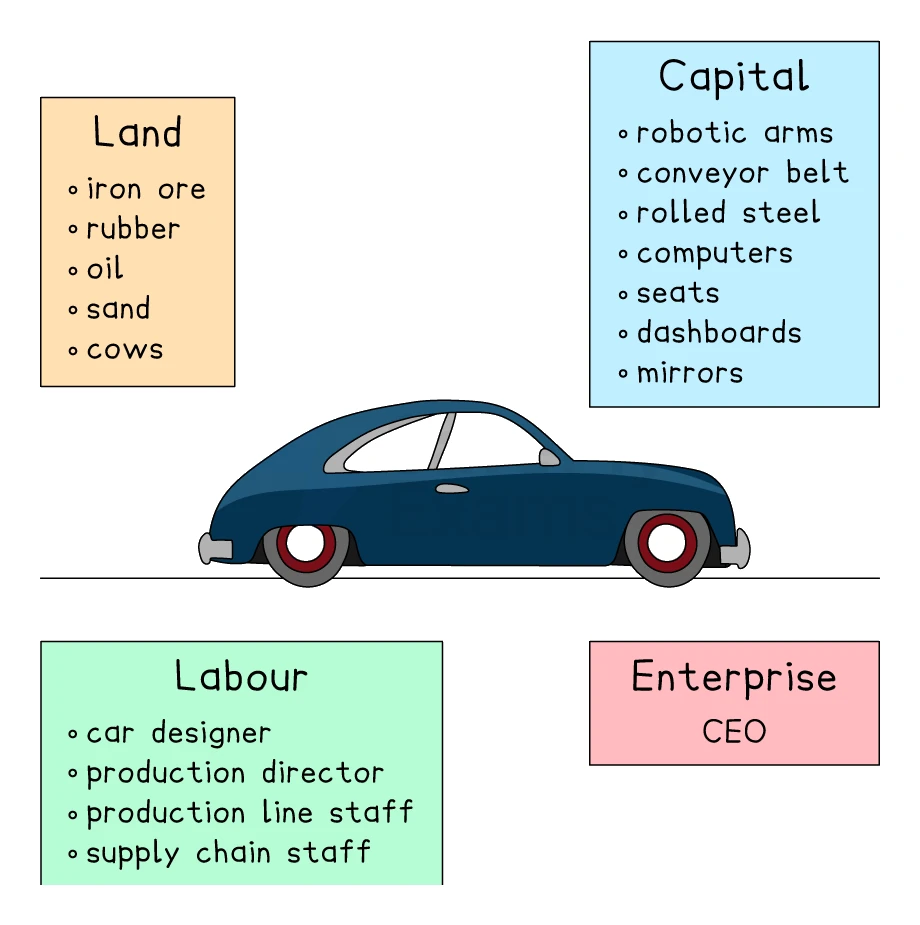
Apply the man-made test to inputs that look natural. Fertiliser is because it is man-made, even though it ends up on a field with wheat.
5. Capital vs money
Do not call money "capital". In economics they are not the same.
Capital is the physical productive asset used to make goods and services. Money is a medium of exchange: a means of paying for things. Money is not a factor of production.
A loan, a bank account balance and a pile of cash are all finance, not capital. The money may be used to buy capital, but the money itself is not a factor of production. There are only four factors: land, labour, capital and enterprise. Money is not a fifth factor.
Common exam question
Identifying a factor of production, and what capital is
Question: Match items to factors of production, or say what capital is (1 mark, multiple choice); or define a capital good with an example (2 marks).
Set in 3 of the 13 multiple-choice papers. Asked in 1 of the 11 structured papers. Land is what nature provides, including a crop such as wheat. Capital is anything people have made that is used to produce other goods or services, so a factory or a railway track is capital even though it stands on land. A finished product such as bread is not a factor at all. The wrong options beside capital have included the money invested in a firm (finance) and the ability to organise production (enterprise).
For the definition, one mark is for the meaning (a man-made good used to make other products) and one for an example such as a machine. The specimen mark scheme also wants capital goods picked out of a source, one mark each.
6. Changes in the quantity and quality of factors
The total productive capacity of an economy depends on how much of each factor exists (quantity) and how good that factor is (quality). Either can rise or fall over time. A rise in quantity or quality is economic growth of productive potential; a fall is the opposite.
Causes of changes in factors:
| Influence | Typical effect |
|---|---|
| Technological advances | Improve the quality of capital (faster machines, more accurate tools) and sometimes the quality of labour (better training tools) |
| Changes in costs of inputs | Persistently high running costs (fuel, energy) make older machinery uneconomic to operate, so firms scrap or mothball it, reducing the quantity of usable capital |
| Investment | Buying automated machinery to replace labour-intensive methods adds to the quantity of capital and raises its quality, so output per worker rises |
| Education and training | Raise the quality of labour, often the most important long-term lever |
| Government regulation | Easing regulations can release more land or capital into use (e.g. permitting new mineral extraction); tightening regulations can withdraw factors from use |
| Demographic change | A rising birth rate or net inward migration raises the quantity of labour; an ageing population reduces it |
Common exam question
Causes of a change in a factor's quantity or quality
Question: Explain why the quantity or quality of a factor, such as land or labour, may increase, or identify causes in the source (2–4 marks).
Asked in 3 of the 11 structured papers. Explaining a cause earns one mark for naming it and one for showing how it changes that factor. More land comes from reclamation, new discoveries such as oil, or fish stocks recovering; better land from fertilisers, less pollution or better technology. The labour force grows through immigration, a later retirement age, an earlier school-leaving age, more women working or, in time, a higher birth rate. From a source, take its causes: one scheme credited land reclamation and a bigger labour force, not the low interest rates beside them.
Set in 3 of the 13 multiple-choice papers, as an item matching a change to its factor: a bigger working-age population adds labour, new aircraft and retrained pilots improve capital and labour, and lighter regulation of firms encourages enterprise.
These influences also drive shifts in the production possibility curve (covered in topic 3). A rise in any factor's quantity or quality shifts the PPC outward; a fall shifts it inward.