1. What an economic system is
An economic system is the way a country organises the use of its scarce resources to answer the three basic economic questions: what to produce, how to produce it, and for whom to produce it.
Every country faces the same basic economic problem (limited resources, unlimited wants), but different countries answer the three questions in different ways. The syllabus studies two systems: the and the . The fully planned (command) economy is not part of this syllabus, so you do not need to study or evaluate it. Real economies sit on a spectrum, from more planned to more market-led, with mixed economies in between.
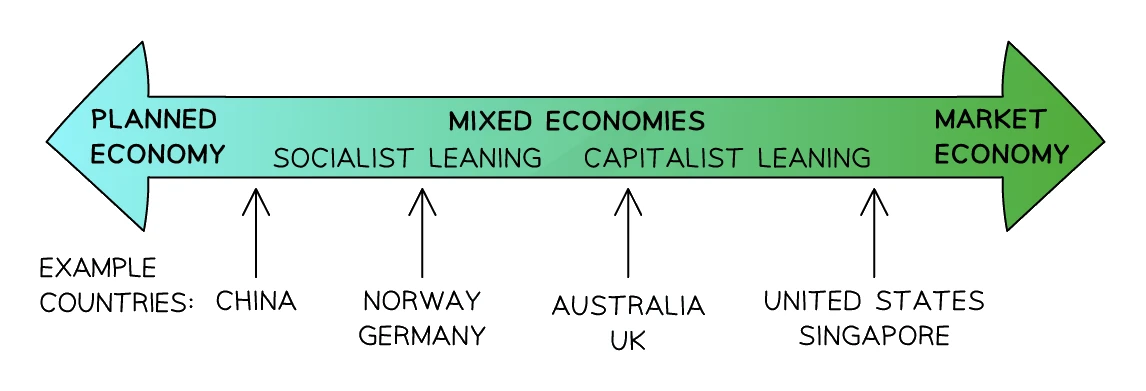
The systems differ in one central question: who allocates the resources. In a market system, private firms and consumers allocate resources through the price mechanism. In a mixed system, the private sector and the public sector (government) share that job.
2. The market economic system
A market economic system is one in which resources are allocated by the , through the free interaction of demand and supply, with little or no . Firms are privately owned and produce whatever is profitable; consumers spend their own incomes as they choose.
In a pure market system the government plays almost no role in production. The three questions are answered automatically by prices (topic 6):
- What to produce? Whatever consumers are willing to pay for. High prices signal high demand, so firms produce it.
- How to produce? In the cheapest way, because firms compete and the lowest-cost producer earns the most profit.
- For whom to produce? For those willing and able to pay the market price.
The driving forces are private ownership, the profit motive, and competition between firms.
Common exam question
Recognising a market economy in multiple choice
Question: Pick the feature that defines a market economy, something that could or could not happen in one, or one of its advantages or disadvantages (1 mark, multiple choice).
Set in 5 of the 13 multiple-choice papers. A market economy means private ownership of the factors of production and resources allocated through demand and supply, with no government allocation. So an option in which the government acts (a minimum wage, public ownership, more nationalisation, "state intervention") cannot describe it, while a monopoly, heavy pollution and private firms making defence equipment can all occur in one.
Limited resources with unlimited wants is scarcity, true of every economy, and having both a private and a public sector is a mixed economy. The credited advantage is lower costs of production; less inequality and more public goods come from government. The credited disadvantage is too few merit goods; competition and choice are market features, not things it lacks.
Arguments for the market economic system
- Efficiency. Competition forces firms to keep costs and prices low; inefficient firms lose customers and leave the market.
- Responsiveness to consumers. Prices act as signals, so resources flow quickly to the goods consumers most want. This is sometimes called consumer sovereignty.
- Incentives and choice. The profit motive rewards firms that innovate and work hard, and consumers enjoy a wide variety of goods produced by competing firms.
- Economic growth. The pursuit of profit encourages investment and the development of new products, which can raise output over time.
Arguments against the market economic system
- Market failure. A pure market over-produces goods with external costs (pollution) and under-provides merit goods and public goods (the free market may not provide defence or street lighting at all).
- Income inequality and poverty. Resources go only to those who can pay. People on low incomes, the unemployed and those unable to work may be left without essentials, and there are no automatic welfare benefits.
- Monopoly. Successful firms can grow until they dominate a market, then restrict supply and raise prices at the expense of consumers.
- Instability. Markets can swing between booms and recessions with no one to smooth them out.
Common exam question
Discussing how well a market economy works
Question: Discuss whether or not a market economy gives the best possible allocation of resources, or whether a high level of poverty is likely in a market economic system (8 marks).
Asked in 2 of the 11 structured papers. For the market: prices follow demand and supply, moving resources towards the goods people want more; the profit incentive makes firms produce what consumers want (consumer sovereignty); competition brings efficiency and lower prices; and wage changes draw workers to the jobs most needed. For poverty, add high wages and jobs from efficiency, growth from responding to demand, and relative poverty coexisting with little absolute poverty.
Against: merit goods such as healthcare and education are under-consumed, demerit goods over-consumed, public goods not provided, external costs and benefits ignored, and monopolies can restrict output and raise prices. For poverty, add unemployment, no welfare benefits and income inequality. Level 3 (6–8 marks) needs both sides developed; one-sided answers fit Level 2 (3–5 marks).
3. The mixed economic system
A mixed economic system is one in which both the private sector and the public sector (government) allocate resources. Most goods and services are left to the market, but the government intervenes where the market on its own would fail.
The mixed economy is the most common real-world system; almost every country is a mixed economy of some kind. The balance varies: some governments intervene heavily, others lightly.
In a mixed economy:
- The private sector / private firms produce most goods and services through the price mechanism, motivated by profit.
- The public sector / government provides goods the market under-supplies (public goods, merit goods), redistributes income through taxes and benefits, and regulates the harmful side-effects of private activity.
Common exam question
Identifying what makes an economy mixed
Question: Identify who allocates resources in a mixed economy, or give two reasons why a country in the source counts as a mixed economy (2 marks).
Asked in 2 of the 11 structured papers. The marks go one to each sector, so name both: the private sector (private firms, or firms and producers) and the public sector (the government, or state-owned and nationalised firms). With a source, use it: public-sector jobs, output from state-owned firms or a government intervention it describes all earn the public-sector mark, and you still need the separate point that a private sector exists.
The same idea is set in 1 of the 13 multiple-choice papers, which asks for the pair of services the private sector would most likely provide. Choose services firms can sell at a profit, such as banking and insurance; courts, prisons, tax collection and defence are provided by the government.
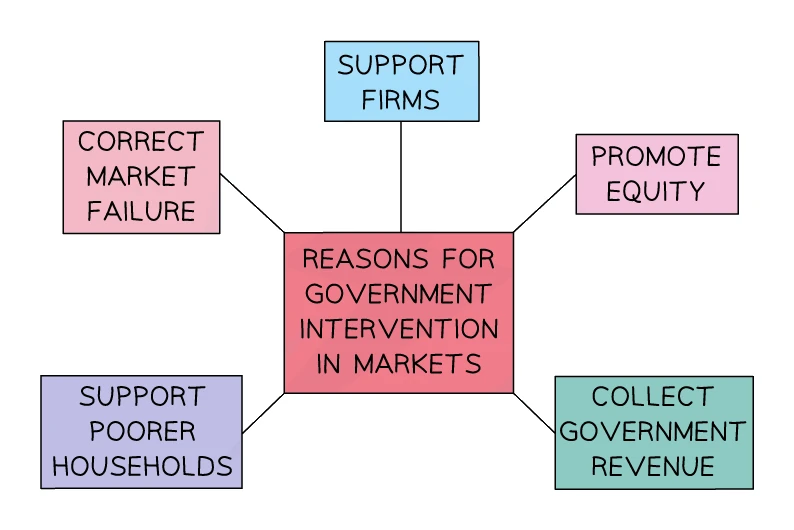
The government intervenes for several reasons: to correct market failure, to support firms, to promote equity, to support poorer households, and to collect government revenue.
Arguments for the mixed economic system
- Keeps the strengths of the market. Competition, choice, the profit incentive and efficiency are retained for most goods.
- Corrects market failure. The government provides public goods and merit goods, taxes goods with external costs, and subsidises goods with external benefits.
- Reduces poverty and inequality. Taxation and welfare benefits redistribute income; state healthcare and education give the poor access to essential services.
- Greater stability. The government can use policy to smooth booms and recessions.
Arguments against the mixed economic system
- Higher taxes. Government spending must be funded, so taxes reduce the incentive to work and invest.
- Inefficiency in the public sector. State-run organisations face no competition and may have weaker incentives to keep costs down.
- Risk of government failure. Intervention can be poorly designed; the cost of correcting a market failure can end up larger than the failure itself.
- Bureaucracy. Regulation and administration can slow firms down and add to their costs.
Common exam question
Discussing whether government intervention works
Question: Discuss whether or not intervention by the government can overcome the weaknesses of a market economy, or whether it benefits firms (8 marks).
Asked in 2 of the 11 structured papers. For intervention: the government can provide merit goods and public goods, restrict demerit goods, regulate monopolies or block mergers, tackle external costs such as pollution, and help people on low incomes. A regulation can ban a product, limit purchases or set an age limit, cutting harmful consumption and external costs. Firms gain from subsidies and tax cuts that lower costs.
Against: government failure, as governments can lack accurate information, decide slowly, weaken incentives or suffer corruption. Regulations, taxes and a minimum wage can raise firms' costs and cut profits. A ban can be hard to police and may create illegal markets, policing has an opportunity cost, and jobs, output and tax revenue from the industry can fall. Level 3 (6–8 marks) needs both sides developed.
4. Government intervention to address market failure
In a mixed economy the government uses a toolkit of measures to correct market failure. Each has advantages and disadvantages, and the best choice depends on the type of failure.
Price controls
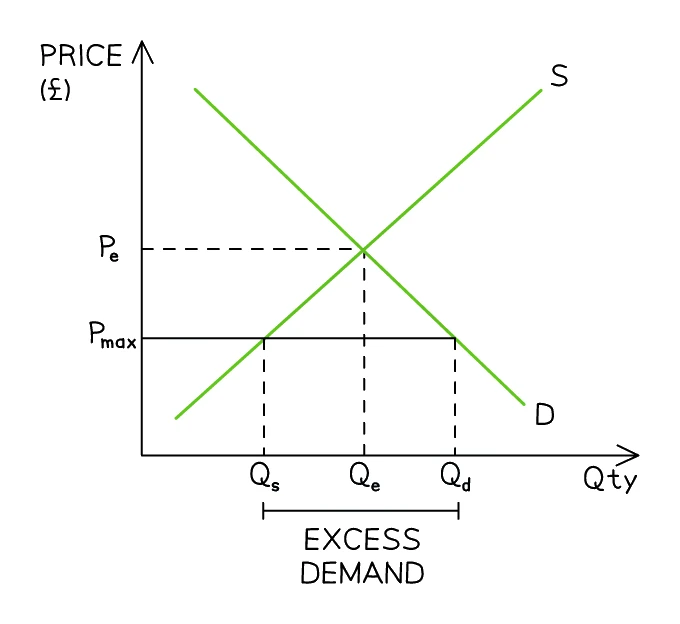
A maximum price is a legal cap set below the equilibrium, used to keep an essential good affordable. It causes a shortage (quantity demanded exceeds quantity supplied).
A minimum price is a legal floor set above the equilibrium, used to support producers or to discourage a demerit good. It causes a surplus (quantity supplied exceeds quantity demanded).
A maximum price set below the equilibrium price Pe holds the price down at Pmax. At that price the quantity demanded (Qd) exceeds the quantity supplied (Qs), so there is excess demand, that is, a shortage.
Indirect taxation
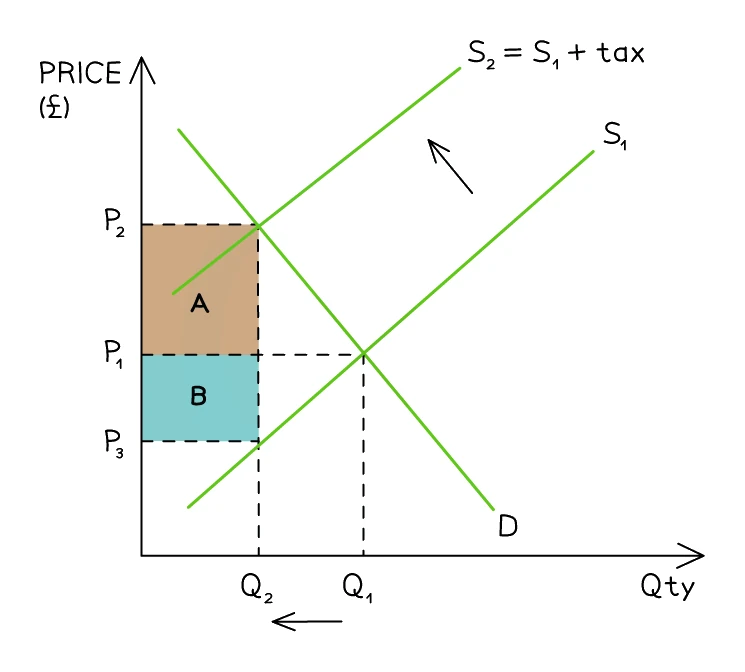
An indirect tax on goods with external costs (cigarettes, fuel, sugary drinks) raises their price and reduces the quantity consumed, helping the polluter or consumer to internalise the external cost. It also raises government revenue. The drawback is that for inelastic goods, demand barely falls, so the harmful activity continues.
Subsidies
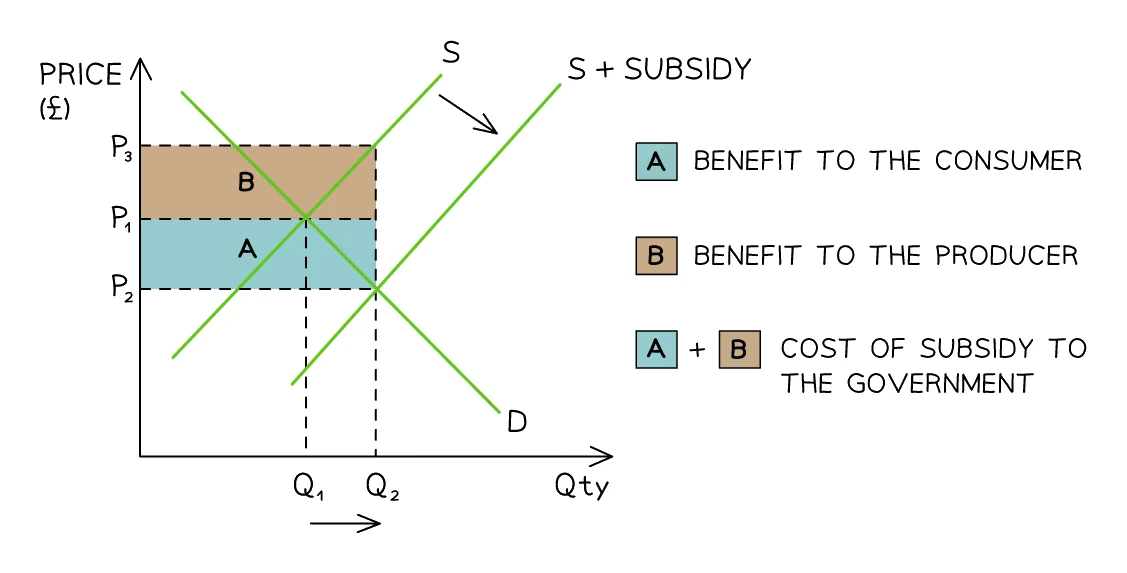
A subsidy is a payment to producers of goods with external benefits (solar panels, public transport, vaccination). It lowers the price and raises the quantity consumed. The drawback is the opportunity cost of the tax money used to fund it, and the risk that firms become dependent on the subsidy.
Regulation
Laws and standards restrict harmful activity directly: emission limits, minimum ages for buying alcohol, bans on dangerous products. Regulation is effective when the harm is severe, but it can be costly to monitor and enforce, and over-tight rules can raise firms' costs.
Privatisation and nationalisation
Privatisation is the transfer of a business or industry from public (government) ownership to private ownership. The aim is to raise efficiency through competition and the profit motive.
Nationalisation is the opposite: bringing a private industry into government ownership, often to secure the supply of an essential service or to control a natural monopoly.
Privatisation works when the industry is opened up to real competition: rival firms have to hold costs and prices down and offer consumers more choice, and the sale itself brings in revenue for the government. The risks are that the industry becomes a private monopoly that raises prices instead, that social objectives such as running loss-making rural services are abandoned once profit is the target, and that cost-cutting leads to job losses.
Nationalisation can guarantee that an essential service keeps running, stop a natural monopoly exploiting consumers, and let the government take social costs and benefits into account rather than private profit alone. Against that, without the profit motive there may be less incentive to keep costs under control, buying the industry and covering any later losses has an opportunity cost for taxpayers, and decisions can be driven by political rather than economic considerations.
Exam tip
Define privatisation by naming both sectors
When you are asked to define privatisation (2 marks), say what moves and in which direction: it is the sale or transfer of assets (a state-owned firm or industry) from the public sector to the private sector. The one scheme that sets it credits three separate ideas for the two marks: the sale or transfer of assets, the public sector it leaves, and the private sector it joins. Naming both sectors therefore earned both marks there, even without the word "assets". Nationalisation is the same move in reverse, from the private sector into government ownership.
Direct provision
The government can provide goods and services itself, free or subsidised at the point of use, funded by taxation. This is the usual solution for public goods (defence, street lighting) and major merit goods (state education and healthcare), because it guarantees access regardless of ability to pay. The drawbacks are that the tax revenue used to fund it has an opportunity cost, that a service which is free at the point of use can be over-used or wasted, and that with no competing suppliers there is weaker pressure to keep quality high and costs down.
Quotas
A quota sets a legal limit on quantity — for example, a cap on the volume of a natural resource that may be extracted. Quotas can protect resources from over-exploitation, but they can be hard to police and may push activity into illegal markets.