Differences in Development between Countries
Economics revision notes · Cambridge (CIE) · 0455
1. The development gap
Countries differ enormously in how developed they are. A child born today in Switzerland can expect to reach 83, attend school for around 16 years, and live in a country with a GNI per capita above $90,000. A child born the same day in Sierra Leone can expect to reach 60, attend school for around 10 years, and live in a country with a GNI per capita below $2,000.
This topic explains why those gaps exist, what developed and developing countries look like, and what strategies developing countries can use to close the gap.
2. Characteristics of developed and developing countries
The distinction is not just "rich" vs "poor". Each category has a recognisable set of features.
Developed countries
Developed countries have high GDP per capita, advanced industry and services, high HDI (topic 16), and an ageing population structure with low birth and death rates.
Typical characteristics:
- High GDP per capita: usually above $25,000 in PPP terms.
- Services-dominated economy. A large share of output and employment is in tertiary activities (finance, retail, healthcare, education, technology). Primary-sector employment is often under 5%.
- High HDI: usually above 0.85.
- Long life expectancy at birth, often above 80.
- Low birth and death rates: births often near or below the replacement level.
- High capital stock per worker: modern factories, infrastructure, transport networks.
- Advanced technology and high innovation rates.
- High urbanisation: typically 75%+ of the population live in cities.
- Strong institutions: rule of law, well-functioning courts, low corruption, stable democracy.
Examples: Germany, Japan, the United States, the United Kingdom, South Korea, Australia.
Developing countries
Developing countries have lower GDP per capita, a much larger primary sector, lower HDI, and a younger population structure with higher birth rates and higher infant mortality.
Typical characteristics:
- Lower GDP per capita: usually well below $15,000 in PPP terms.
- Larger primary sector. Agriculture, mining, fishing and forestry account for a much higher share of employment, sometimes 40% or more.
- Lower HDI: usually below 0.75.
- Shorter life expectancy, often 65–75 years.
- Higher birth rates and infant mortality: births remain well above those of developed countries. Overall death rates have fallen quickly, and with so many young people they can even be lower than in an ageing developed country.
- Lower capital stock per worker: fewer machines, less developed infrastructure.
- Lower technology levels and slower innovation.
- Lower urbanisation, with a large rural population.
- Weaker institutions, with higher corruption and more political instability in many cases.
Examples: India, Nigeria, Bangladesh, Kenya, Vietnam, Bolivia.
Both categories cover a wide range. "Developing" includes both least-developed countries (very low income, weak institutions) and emerging-market economies (middle income, fast-growing) like India, Brazil and Vietnam. A single label hides huge variation.
Common exam question
Spotting the features of a more developed economy
Question: Choose the feature, or the change in an economy, that goes with a country being more or less developed (1 mark, multiple choice).
Set in 4 of the 13 multiple-choice papers. As a country develops, work moves from countryside to towns and from farming to manufacturing and then services, while GDP per head, the HDI, education and living standards rise. So a high-income economy has a high GDP per head, a high HDI and a large tertiary share of jobs.
Wrong options turn a change round (services back into manufacturing, skilled work back into farming) or pair a right feature with a wrong one, such as a high HDI beside a small service sector. Others offer things that say nothing about development: a budget deficit, a current account deficit or a large population. When the item asks for the unlikely change, the reversed one (more subsistence farming, fewer financial services) is the answer.
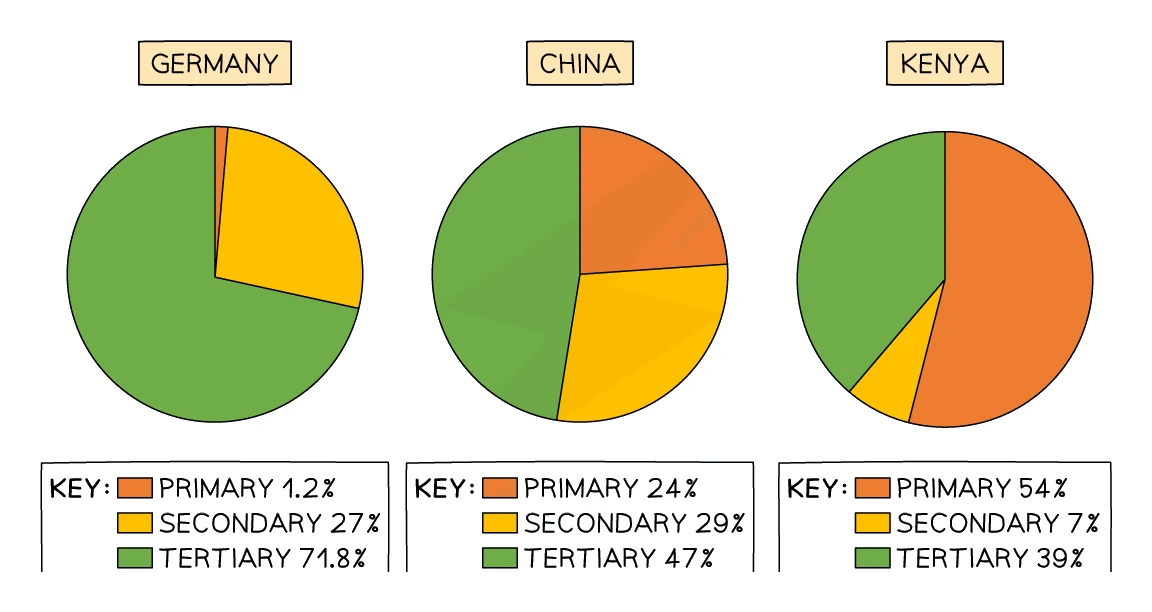
The contrast shows up clearly in the sector composition of employment. A developed economy like Germany has a tiny primary sector and a services-dominated economy; an emerging economy like China has a larger secondary and primary share; a lower-income economy like Kenya still has most of its workforce in the primary sector.
Worked example
A sector's share of employment and output
The table gives data for one country. Everyone in its labour force works in one of the three sectors.
| Indicator | Value |
|---|---|
| Labour force | 40 million |
| Employed in the primary sector | 11.2 million |
| Employed in the tertiary sector | 21.6 million |
| GDP | $180 billion |
| Secondary sector's share of GDP | 24% |
Using the table, find what share of the labour force works in the secondary sector, and the value of that sector's output.
Solution:
- Primary share: 11.2 ÷ 40 × 100 = 28%
- Tertiary share: 21.6 ÷ 40 × 100 = 54%
- Secondary share: 100 − 28 − 54 = 18% (check: 40 − 11.2 − 21.6 = 7.2 million, and 7.2 ÷ 40 × 100 = 18%)
- Secondary output: 24 ÷ 100 × $180 billion = $43.2 billion
Show the multiplication, not just the answer: the specimen mark scheme gives one of its two marks for the right method (GDP × the sector's share) even when the final figure is wrong.
Structural change as countries develop
As countries grow richer, the structure of their economy changes in a consistent pattern.
| Sector | Share of output and employment |
|---|---|
| Primary (agriculture, mining) | High in early development, falls steadily |
| Secondary (manufacturing, construction) | Rises in mid-development, peaks, then declines |
| Tertiary (services) | Low in early development, dominates in advanced economies |
The progression is primary → secondary → tertiary as a country develops. Alongside this, urbanisation rises and birth and death rates fall (topic 17).
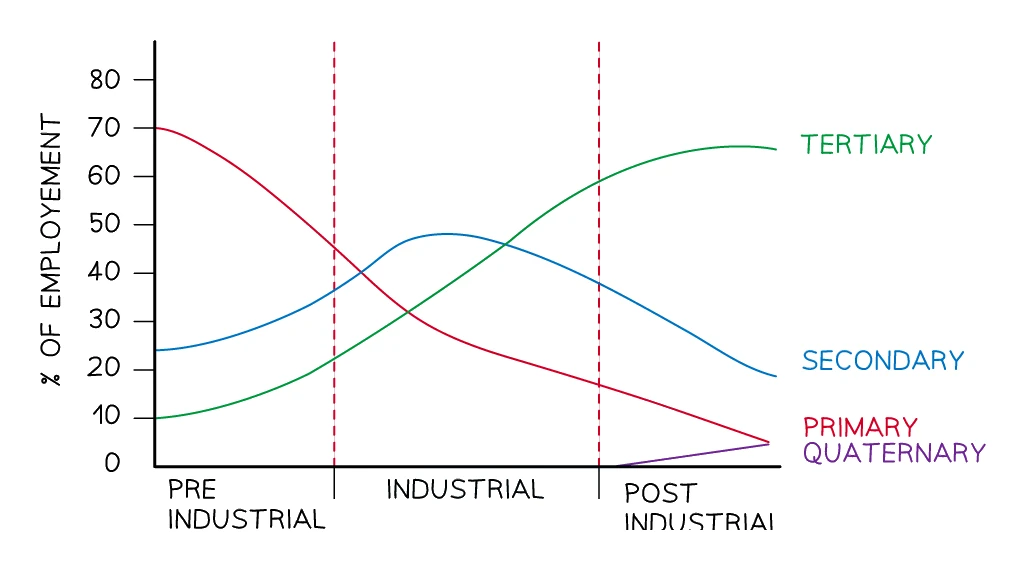
As the graph shows, the primary sector's share of employment falls steadily, the secondary sector rises to a peak in the industrial stage and then declines, and the tertiary sector grows to dominate the most developed (post-industrial) economies.
Common exam question
Growth of services or manufacturing and living standards
Question: Analyse how growth of services raises living standards or what a country gains by making manufactured goods instead of primary products, or discuss whether services have brought development (6 marks).
Asked in 3 of the 11 structured papers. Each link in a chain earns a mark, so carry every benefit through to living standards. Service and factory jobs can be more productive and better paid, so workers afford more goods, education and healthcare. Manufactured goods add more value than raw products and depend less on the weather, so earnings are higher and steadier. Growing education and health services raise skills, life expectancy and the HDI; less physical work means fewer accidents. Both can raise tax revenue for schools, hospitals and infrastructure.
The Discuss allows up to 4 marks a side, so add the risks: pollution, a wide gap between high and low earners, demand for luxuries that falls with incomes, and workers without the skills for the new jobs.
3. Reasons living standards differ between countries
Topic 16 introduced some of these. The gap between developed and developing countries usually involves several reinforcing factors at once.
Common exam question
Linking GDP per head to a development factor in a table
Question: Analyse how GDP per head is related to a factor such as internet access, farm employment or university degrees, using a table of countries (4–5 marks).
Asked in 3 of the 11 structured papers. Give the expected relationship, evidence for it, an exception, and analysis of each. GDP per head rises with internet access and with degrees (positive) but falls as the share of workers in farming rises (inverse). Back it by comparing countries, for example the richest country per head also having the most internet access; copying out one country's figures earns nothing.
Explain the link with a cause of development: degrees bring skills, higher productivity and higher pay; farm work pays less and adds less value than manufacturing or services; richer households and governments afford internet access, which raises productivity. Then name a country that breaks the pattern and another influence that explains it, such as school quality or a large banking sector.
Differences in physical capital
Developed countries have more machinery, factories, infrastructure, transport networks and communication systems per worker. A worker with better tools produces more output per hour. The accumulated capital stock is the result of decades of investment, and investment requires saving, which is harder in low-income countries where most income is spent on immediate needs.
Differences in human capital
Developed countries have higher levels of education, training and healthcare. A more educated workforce is more productive; a healthier workforce works more hours and learns faster. Most developing countries have made huge progress in human capital over recent decades, but gaps remain in tertiary education and specialised skills.
Differences in technology and innovation
Developed countries are usually the source of new technologies (R&D investment, patents, world-class research universities). Developing countries can adopt technology from elsewhere, but the adoption is rarely as fast or as complete as making it in-house.
Natural resources (with the resource-curse caveat)
Natural resources can support development (Norway's oil wealth, Australia's mineral exports, Saudi Arabia's hydrocarbons). But they do not guarantee it. The resource curse describes how some resource-rich countries actually grow slower than resource-poor ones:
- Commodity-price volatility. A country heavily dependent on one resource swings between booms and busts.
- . A strong export of one commodity raises the exchange rate, making other industries (manufacturing, services) less competitive.
- Corruption and rent-seeking. Resource wealth concentrates in the hands of those who control the resource, which can fuel corruption.
- Failure to diversify. Countries that focus on one commodity may neglect the institutions, education and infrastructure needed for broader growth.
Resource-rich countries that diversify, save resource revenues sensibly, and maintain strong institutions (Norway) escape the curse. Those that do not (some African oil exporters) stay poor despite the wealth.
Common exam question
Whether a natural resource benefits a country
Question: Discuss whether or not a country gains from a natural resource, such as finding oil, expanding coal production or mining diamonds (6–8 marks).
Asked in 3 of the 11 structured papers. For: more exports and a better current account, faster growth and higher incomes that cut poverty, more jobs, and more tax revenue to spend on education and healthcare. Against: pollution that harms health and can deter tourists, dangerous work, a foreign MNC that sends its profits home or brings its own workers, reserves that run out, and dependence on one product whose demand or price can fall. Conserving it can pay if its price may rise.
The 6-mark version allows up to 4 marks a side; a reason that just reverses one already given (more jobs, then fewer jobs) scores nothing, but a different reason for the opposite outcome scores. The 8-mark version is marked by levels, and the top level needs both sides developed.
Political stability, governance and institutions
- Political stability encourages investment because firms need predictability before committing capital.
- Rule of law protects property and contracts. Without it, firms cannot trust their investments will pay off.
- Low corruption ensures public spending reaches public services.
- Stable democracy (or stable governance more generally) avoids policy reversals and conflict.
Countries with weak institutions struggle to develop even when they have other advantages.
Trade patterns and dependence
Many developing countries are trade-dependent on a narrow range of primary exports. This creates two risks:
- Volatile export earnings, as commodity prices swing widely.
- Slow-growing world demand: as global incomes rise, extra spending goes mostly to manufactured goods and services rather than basic commodities, so demand for primary exports grows only slowly and the country's relative income stagnates.
Countries that diversify into manufacturing and services tend to grow faster than those stuck in primary exports.
Demographic structure
A country with a young dependency-heavy population (many children per worker) has less to invest in capital and infrastructure. A country with a (a large working-age share with few dependants) can grow rapidly. Most developing countries are somewhere in transition between these states.
Common exam question
Causes of differences in development between countries
Question: Analyse why levels of economic development differ between countries, or explain why countries with good transport often have a high GDP (4–6 marks).
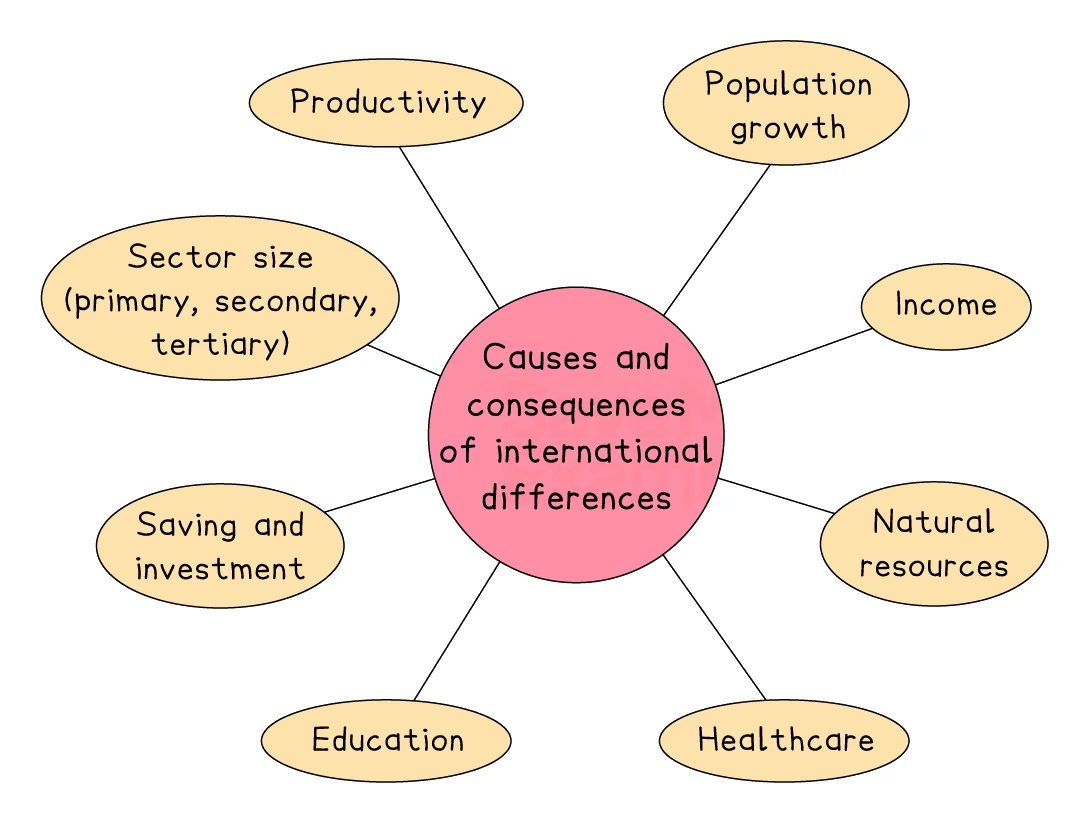
Asked in 2 of the 11 structured papers. Carry each cause through to development: higher income buys more goods and services; education raises skills, productivity and pay; healthcare lengthens lives and cuts days off work; population growth changes the workforce and the dependency ratio; a large primary sector means lower value added; investment in transport, schools and hospitals cuts costs and creates jobs. The 4-mark version gives one mark per reason and one per explanation. Treating economic growth as development earns nothing.
The same causes are set in 3 of the 13 multiple-choice papers: the faster-developing country spends more on education, and higher productivity means higher pay and living standards. Wrong options pin a helpful cause on the slower country or give a result of high pay, such as paying more income tax, as its cause.
4. Trade and FDI as tools for development
The two main external resources a developing country can use to support its growth.
Trade
Trade is the exchange of goods and services between countries. Export-led development uses trade as the main engine of growth.
Benefits:
- Earns foreign currency that can be used to import capital goods and technology.
- Expands market size beyond the domestic market, allowing economies of scale.
- Specialisation in the industries a country is best suited to (topic 19) raises productivity.
- Exposure to international competition forces firms to become more efficient.
Drawbacks for developing countries:
- Dependence on primary commodities with volatile prices.
- Falling relative export prices: commodity exports tend to get cheaper over time while imported manufactured goods get more expensive, so a given volume of exports buys fewer imports.
- Protectionism in rich countries sometimes blocks developing-country exports from the markets where they would sell best (especially agricultural products).
- Initial heavy reliance on one or two trading partners can leave the country exposed if those partners go into recession.
Trade is generally seen as the most powerful long-term engine of development if countries can diversify away from a narrow commodity base.
Foreign Direct Investment (FDI)
Foreign Direct Investment (FDI) is when a firm or individual in one country builds or acquires productive assets in another country (a factory, an office, a mine). It is direct ownership, not just buying shares.
Benefits:
- Brings in capital that the country could not raise itself.
- Brings in technology and know-how, often transferred to local workers and suppliers.
- Creates jobs directly and through the supply chain.
- Builds infrastructure (a multinational often improves the roads, power and telecoms it needs).
- Provides training that raises local human capital.
Drawbacks:
- Profit repatriation. Multinationals typically send most profits back to their home country.
- Environmental concerns. Multinationals may exploit weaker regulations in developing countries.
- Low wages and poor working conditions in some sectors.
- Cultural and political tensions with local communities or governments.
- Exit risk. A multinational can pull out if conditions change, leaving the host country with idle infrastructure.
FDI is generally seen as valuable but in need of careful regulation to ensure benefits flow to the host country.
Choosing between trade and FDI
Most developing countries use a mix.
- Trade for sustainable long-run growth, especially once the country has diversified beyond primary commodities.
- FDI for capital, technology and jobs, especially in manufacturing and services.
The two reinforce each other: FDI often builds the productive capacity a country then exports from, and open export markets are part of what attracts multinationals in the first place.
5. Development strategies
A developing country can use several internal strategies to raise its living standards. These complement trade and FDI.
Investment in human capital
The single most reliable long-term strategy. Spending on:
- Schooling: primary, secondary, vocational, tertiary.
- Healthcare: primary care, vaccination programmes, sanitation.
- Skills training for the existing workforce.
The returns take decades to fully appear, but the effect on long-run productivity is large.
Investment in infrastructure
Roads, ports, airports, electricity, water, sanitation, broadband. Better infrastructure:
- Lowers firms' costs of doing business.
- Connects rural producers to urban markets.
- Makes the country more attractive to foreign investors.
- Improves quality of life directly (clean water, reliable electricity).
Funded through government revenue, borrowing or FDI.
Diversification away from primary products
A country that depends on coffee, copper or oil for most of its exports is vulnerable to commodity-price swings. Active policy to diversify into manufacturing and services:
- Reduces volatility of export earnings.
- Builds higher-value industries whose demand grows faster as world incomes rise.
- Creates more skilled jobs.
Examples: South Korea moved from primary exports in the 1960s to manufacturing in the 1970s–80s to high-tech in the 2000s. Most of East Asia's success stories follow a similar trajectory.
Trade liberalisation and export promotion
Lowering tariffs, removing import quotas, encouraging firms to enter export markets. The argument: exposure to world competition forces domestic firms to become more productive, and gives them access to the much larger world market. Combined with a competitive exchange rate (often slightly undervalued), this is the basis of the export-led growth model.
The counter-argument: developing-country firms may need protection in their early years (the "infant industry" argument) before they can compete with established foreign competitors. The right approach is often a mix of protection for emerging industries and openness in others.
Microfinance
Small loans to people too poor to access regular banks. Allows them to start small businesses, buy productive assets (sewing machines, farm equipment), and become self-sustaining. Effective for poverty reduction; less effective as a country-wide growth strategy.
Population policy
Already covered in topic 17. Falling birth rates (through education and family planning) reduce the dependency ratio over a generation and give the country a to support growth.
Reform of institutions
Long-term institutional reform (tackling corruption, strengthening property rights, reforming the legal system, professionalising the civil service) has large but slow-acting effects on development. It is the foundation that lets other strategies work.
6. The development "ladder"
Not every country follows the same path, but the historical pattern of successful development looks roughly like this:
- Stage 1. Primary-sector dominated, low income, high birth rates, low capital and education.
- Stage 2. Investment in basic education, healthcare and infrastructure. Growth begins. Manufacturing starts.
- Stage 3. Industrialisation accelerates. Exports of manufactured goods rise. Urbanisation moves quickly. Birth rates begin to fall.
- Stage 4. Services start to overtake manufacturing. Income approaches middle-income levels. Human capital rises.
- Stage 5. High-income, services-dominated, advanced manufacturing, with low birth and death rates.
Countries that have climbed this ladder fast in recent decades (South Korea, Singapore, Taiwan, China, Ireland) typically combined trade openness, FDI inflows, heavy investment in human capital, strong institutions and a stable macroeconomic environment. Countries stuck in early stages usually have weakness in at least one of these areas.
Convergence between developed and developing countries has been uneven: some developing countries are catching up rapidly while others continue to lag behind. The development gap is not closing automatically.