1. What digital currency is
Digital currency is money that exists only in digital form. There are no physical coins or banknotes; balances and transactions live entirely on computer systems.
Key features of digital currency:
- Stored in digital wallets or in online accounts rather than as cash in a pocket.
- Transferred over a network (typically the internet) to pay for goods, pay other people, or move money between countries.
- Recorded electronically: every payment is a database entry rather than the physical movement of notes or coins.
- Often very fast: a payment can move from one side of the world to the other in seconds.
Some digital currencies are centralised (one trusted authority, such as a bank or a payment company, runs the whole system). Others are (no single authority; many computers around the world keep copies of the ledger and agree on it together).
Common exam question
Features of digital currency
Question: Give two features of digital currency, or complete a description of it using terms from a word box (1–2 marks).
Asked in 2 of the 17 papers. The feature credited every time is that a digital currency only exists electronically: it has no physical form, so it is held and spent through computer systems rather than as notes and coins. The other credited features are that it can be centralised or decentralised and that it is usually encrypted. Read the stem before answering: one paper states that digital currencies are tracked using digital ledgers and then asks for two other features, and the ledger is not on its credited list.
In the gap-fill the wanted word is "physically" (a digital currency does not exist physically), with "virtually" in the word box as a distractor. The specimen paper's one-mark definition wants the same idea: a currency that exists in electronic form only.
Cryptocurrency
Cryptocurrency is a type of that uses cryptography to secure transactions and that runs on a network rather than under any single authority.
Common examples: Bitcoin, Ethereum, Litecoin.
Cryptocurrency features:
- Cryptographic security: each transaction is signed with the sender's private key, so only the legitimate owner of the funds can spend them.
- Public ledger: every transaction is recorded openly on the (covered in section 3), so anyone can verify the history of every coin.
- Decentralised: many computers ("nodes") around the world hold copies of the ledger; no single bank, government or company controls it.
- Pseudonymous: identities are represented by wallet addresses (long random-looking strings), not real names; the addresses are public, but real-world identities behind them often are not.
Exam note: the papers only ever say "digital currency" and never use the word "cryptocurrency". In real life cryptocurrency is just one kind of digital currency (centralised bank-issued digital currencies also exist), but this distinction is not tested.
Volatility
Cryptocurrencies are famously volatile: their value in dollars or pounds can rise or fall sharply over short periods. A coin worth £100 one week may be worth £150 or £60 the next. This makes them risky to hold as an investment and tricky to use for everyday pricing.
2. Cryptocurrency vs traditional currency
A side-by-side comparison covers the main differences.
| Feature | Traditional currency (e.g. pound, euro, dollar) | Cryptocurrency (e.g. Bitcoin) |
|---|---|---|
| Physical form? | Cash exists as banknotes and coins; balances also held in bank accounts | No physical form: exists only as digital records |
| Who controls it? | A central bank or government | Decentralised: a network of computers around the world |
| Where transactions are recorded | In private bank databases | On a public blockchain that anyone can inspect |
| Authority for issuance | A government / central bank prints or mints new money | Mined or issued by the protocol according to fixed rules (no human decides to "print more") |
| Identity of payer/receiver | Bank accounts are linked to real names and addresses | Pseudonymous wallet addresses; harder to link to a real person |
| Speed of international transfers | Slow (hours to days through traditional banking) | Fast (minutes, sometimes seconds) |
| Transaction fees | Set by banks and payment networks | Set by the network; can be very high when network is busy |
| Reversibility | Banks can reverse fraudulent or mistaken payments | Irreversible once confirmed on the blockchain |
| Volatility (against everyday goods) | Stable in the short term (small annual inflation) | Often highly volatile |
| Legal status | Legal tender everywhere it is issued | Varies by country (legal in some, banned in others, taxed in many) |
| Backed by | Trust in the issuing government | Mathematical security of the protocol and the network of participants |
Trade-offs in a single line
- Traditional currency is stable, regulated and reversible, but centralised and slow internationally.
- Cryptocurrency is decentralised, fast and (often) cheap to send globally, but volatile, irreversible, and less protected if something goes wrong.
3. Blockchain: the technology behind cryptocurrency
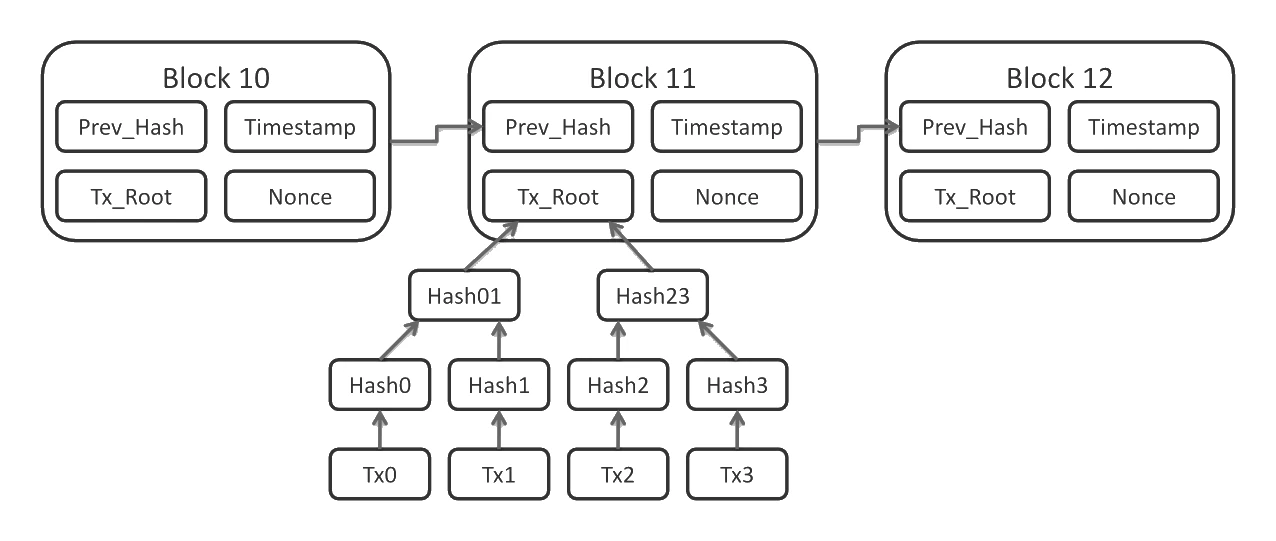
A blockchain is a digital ledger of every transaction in a currency, organised as a chain of blocks linked by cryptographic hashes, with copies stored across many computers in a decentralised network.
Three big ideas in that definition:
- A ledger: a record of who owns what and who sent what to whom.
- A chain of blocks: transactions are grouped into "blocks" and each block links to the previous one through a hash, so the whole history is connected in order.
- Distributed across many computers: no single computer holds "the" blockchain; many computers (nodes) keep copies and agree on the same version.
What is inside a block?
Each block typically contains five things:
| Field | What it holds |
|---|---|
| Block number | The position of this block in the chain (the first block is block 0, the genesis block) |
| Transactions | A list of new transactions being recorded in this block (who sent how much to whom, when) |
| Timestamp | The exact time the block was added |
| Hash of the previous block | The cryptographic fingerprint of the block before this one, linking the chain backwards in time |
| This block's own hash | A cryptographic fingerprint summarising all the data in this block |
What a hash is
A hash is the fixed-length cryptographic fingerprint of some data, produced by a one-way function. Even a tiny change in the data produces a completely different hash.
Two important properties of a hash:
- Deterministic: the same input always produces the same hash.
- Sensitive to change: changing even one character in the input produces an utterly different output. This is what makes hashes useful for spotting tampering.
How blocks form a chain
Each block stores the of the previous block in its own header. This is the "link" in the chain:
Block 0          Block 1          Block 2          Block 3
[ hash: H0 ]     [ hash: H1 ]     [ hash: H2 ]     [ hash: H3 ]
                 [ prev: H0 ]     [ prev: H1 ]     [ prev: H2 ]
[ data ]         [ data ]         [ data ]         [ data ]
The first block (block 0) is special and is called the genesis block; it has no previous block, so its prev field is zero or empty.
When a new block is added, the network calculates the hash of the latest block and stores it as the new block's prev. The chain grows one block at a time.
Common exam question
How blockchain tracks digital currency transactions
Question: Name the process that tracks digital currency in a digital ledger, complete a description of it, or draw and annotate a payment diagram (1–4 marks).
Asked in 3 of the 17 papers (a name, a gap-fill and a diagram); the specimen paper also asks for a two-mark description. The name is blockchain: a digital ledger recording each transaction with a time-stamp, linked to the record before it. Old records cannot be altered, only added to, so every transaction can be traced. In the gap-fill, "datachains" and "transaction-chains" were the near-miss options, so read each term back into its sentence.
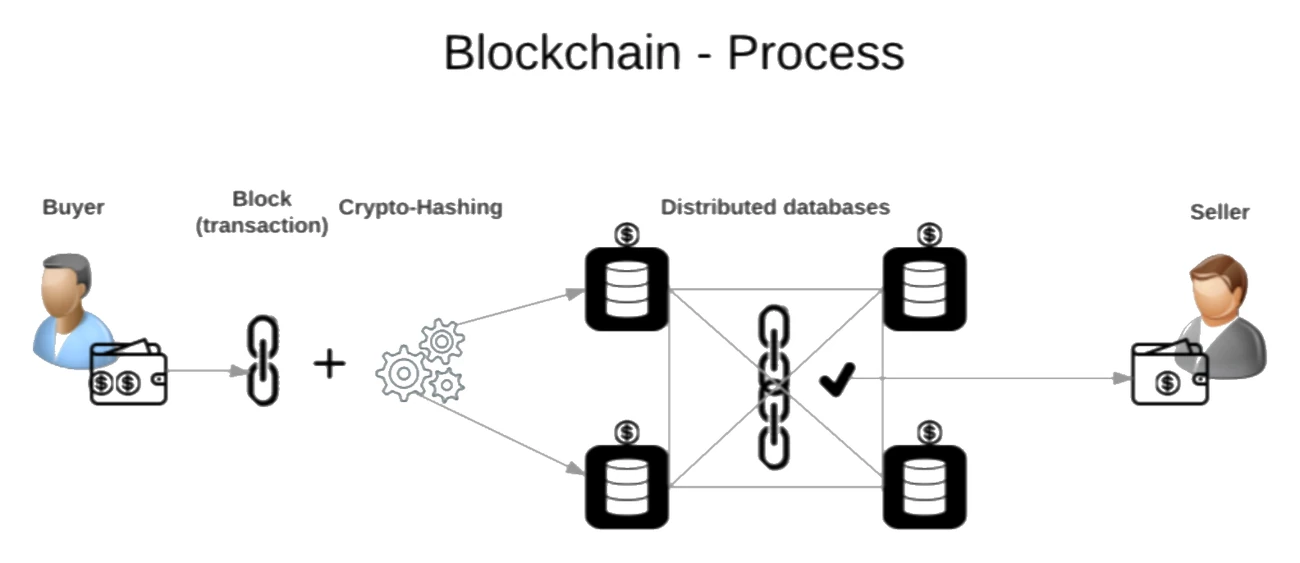
The diagram earns a mark per correct stage labelled: the customer's device encrypts the payment data and sends it to a digital ledger; it is recorded there with a digital signature and a time-stamp; it is stored in a block that carries its own hash; and the block is added to the blockchain on every device.
4. How blockchain resists tampering
The clever property of a blockchain is that an attacker cannot simply change an old transaction and get away with it. Several mechanisms work together to make tampering nearly impossible.
Mechanism 1: Hash linking propagates changes
If an attacker modifies a transaction inside an old block:
- That block's contents change.
- So the block's changes.
- But the next block still stores the old hash as its
prevvalue. - So the chain is broken: the next block's
prevno longer matches the previous block's actual hash. - The attacker would also need to re-calculate the next block's hash to fix the link, and then the one after that, all the way to the current end of the chain.
This means a tampered block forces the attacker to rewrite every block after it, not just one. The longer ago the block was, the more work this is.
Mechanism 2: Proof-of-work makes rewriting blocks expensive
Adding a new block (mining) is computationally expensive on purpose. The network requires the new block's hash to meet a specific mathematical condition (e.g. starting with a certain number of zeros). To find a hash that meets the condition, a miner must try many random small adjustments (called the nonce) until one works.
For the Bitcoin network in particular, finding a valid block hash takes the entire global mining network roughly 10 minutes. To rewrite the last 6 blocks, an attacker would need to redo 60 minutes of the world's combined mining work, while also keeping up with honest miners who keep extending the legitimate chain. This is practically impossible for anyone short of a state-level adversary.
Mechanism 3: Distributed copies make local tampering useless
Many computers hold a copy of the blockchain. Even if one attacker quietly rewrites their own local copy, they still have to convince the rest of the network to accept it. The rule of consensus is that nodes accept the longest valid chain. An attacker's tampered chain will be shorter than the honest one (because the honest network is mining ahead), so the network simply ignores it.
To beat the honest network, an attacker would need to control more than half of the entire network's power (the "51% attack"). For large blockchains like Bitcoin, this would cost billions of pounds in hardware and electricity.
Mechanism 4: Every transaction is signed
Each transaction is digitally signed by the sender using their private key. Anyone in the network can use the sender's public key to verify that the signature is valid (asymmetric encryption, topic 6). Without the private key, no one can forge a transaction from someone else's wallet.
Why these four mechanisms together make tampering impractical
A blockchain is tamper-resistant because:
- A change to an old block breaks the hash chain, which everyone can detect.
- Re-doing the work to repair the chain requires more computing power than the rest of the world combined.
- Many copies of the ledger across the network mean local tampering is ignored.
- Digital signatures stop anyone from forging a transaction from someone else's wallet.
Putting the whole payment flow together: a buyer creates a transaction, the transaction is distributed and validated across the network using cryptographic hashing, the block holding it is then committed to the blockchain held by many distributed copies, and the seller receives the payment.
5. Advantages and disadvantages of cryptocurrency
These are the main pros and cons of moving from traditional money to cryptocurrency.
Advantages
- Decentralised: no single bank or government can freeze accounts, devalue the currency by printing more, or block specific transactions.
- Fast international transfers: cross-border payments settle in minutes, not days.
- Low fees (in periods of low congestion) compared to international wire transfers.
- Open ledger: anyone can audit the chain to confirm that the supply rules are being followed.
- Pseudonymous: users do not have to reveal their real identity to send or receive funds.
- Programmable: smart-contract blockchains (Ethereum and others) let people build automated financial agreements, marketplaces and games on top of the same chain.
Disadvantages
- Highly volatile prices make cryptocurrency awkward for everyday spending and risky as a savings instrument.
- Irreversible transactions: if you send money to the wrong address (or to a scammer), there is no central authority that can refund you.
- No consumer protection: no equivalent of a chargeback when goods are not delivered or services not provided.
- Environmental cost: proof-of-work mining (especially Bitcoin) consumes huge amounts of electricity, often from non-renewable sources.
- Used for illegal activity: anonymity has made cryptocurrencies popular with ransomware, fraud, dark-web marketplaces and money laundering.
- Technical literacy required: managing wallets, private keys and addresses is unforgiving. A lost private key means lost money, permanently.
- Regulation varies and is changing: some countries ban or restrict crypto; tax treatment is complicated and inconsistent.
- Scaling limits: most blockchains can only process a small number of transactions per second compared to traditional payment networks (Visa handles thousands per second; Bitcoin handles a handful).
When cryptocurrency makes sense and when it does not
| Use case | Better choice |
|---|---|
| International remittances (sending money home from abroad) | Cryptocurrency can be fast and cheap |
| Paying for a coffee | Traditional currency (volatility and slow settlement make crypto awkward) |
| Long-term savings | Traditional savings account or stable investment (crypto is volatile) |
| Avoiding a failing local currency in hyperinflation | Cryptocurrency or a stablecoin can be a useful hedge |
| A reversible payment to a new online seller | Traditional currency, because of chargeback protection |
| Tipping a content creator anywhere in the world | Cryptocurrency works well for tiny, instant, cross-border payments |