1. What artificial intelligence is
Artificial intelligence (AI) is the area of computer science focused on building machines whose behaviour mimics human intelligence.
An AI system is one that can do three things:
| Capability | What it means |
|---|---|
| Learn | Take in new information and update its behaviour based on what it has seen |
| Decide | Analyse a situation and choose between alternative actions |
| Act autonomously | Carry out chosen actions without needing a human to step in for each one |
A system that does all three (gathers information, makes its own decisions, and acts on them) qualifies as AI. A pocket calculator does not qualify: it cannot learn, and every "decision" follows a fixed rule the user typed in. A modern chess engine does qualify: it analyses positions, weighs alternatives, learns from training games, and plays its own moves.
Mark-scheme phrasing: these three verbs describe what an AI system does, but the mark scheme for a characteristic credits the syllabus wording in section 2: data and the rules for using it, the ability to reason, the ability to learn and adapt. Vague phrases like "AI is a clever computer" name none of them.
Narrow AI vs general AI
AI is usually split into two big categories:
| Narrow AI (also called weak AI) | General AI (also called strong AI or AGI) | |
|---|---|---|
| Scope | Built to handle a single defined task (or a tight group of related tasks) | Built to perform any intellectual task a human can do |
| Does it exist today? | Yes, in many products | No; it remains a research goal |
| Examples | Chess engines, voice assistants, image recognisers, recommendation systems, self-driving cars | Hypothetical: a machine with full human-level intelligence across every domain |
Every AI system you can interact with today is narrow. Even very impressive systems (chat assistants, image generators, AlphaGo) are highly specialised, just on a wider task than older AIs.
2. The three characteristics of an AI system
The syllabus describes AI through these main characteristics. The first two are present in every AI system; the third is included in many of them:
| Characteristic | What it means |
|---|---|
| Collection of data | An AI system needs large amounts of data to work, together with the rules for using that data |
| Ability to reason | The system can draw conclusions and make decisions from the data and rules available to it |
| Ability to learn and adapt | The system can change its own rules and data in response to new information, improving its behaviour over time. This characteristic is included in many AI systems but is not present in every one |
A useful way to remember them: data (and rules) + reasoning + learning and adapting. Keep reasoning and learning distinct: reasoning is using what the system already has to reach a decision, while learning and adapting is changing what it has for next time.
Common slip: writing "AI is just a robot" or "AI is just a computer program". Neither phrase earns marks. The exam wants the three characteristics named precisely.
Exam tip
Stating a characteristic of an AI system
A one-mark question can ask for a main characteristic of an AI system. Any one of these earns it: the system collects data and holds rules for using that data; it can reason, which the scheme also phrases as problem solving or making predictions; it can learn and adapt, also credited as having machine learning abilities. Simulating intelligent or human behaviour and analysing patterns are credited as well. Every credited answer names a specific ability, so a description such as "it is a clever computer" names none of them.
3. Machine learning
Machine learning (ML) is a method used to build AI systems in which the machine learns from data rather than being told every rule explicitly.
The relationship between AI and machine learning matters in exam answers:
- AI is the broader goal: building machines that behave intelligently.
- Machine learning is one technique for achieving AI, where the machine improves with more data instead of being hand-programmed.
So is part of AI, not a separate thing. Be careful with this distinction: one mark scheme credits describing machine learning as a form of AI.
How machine learning works
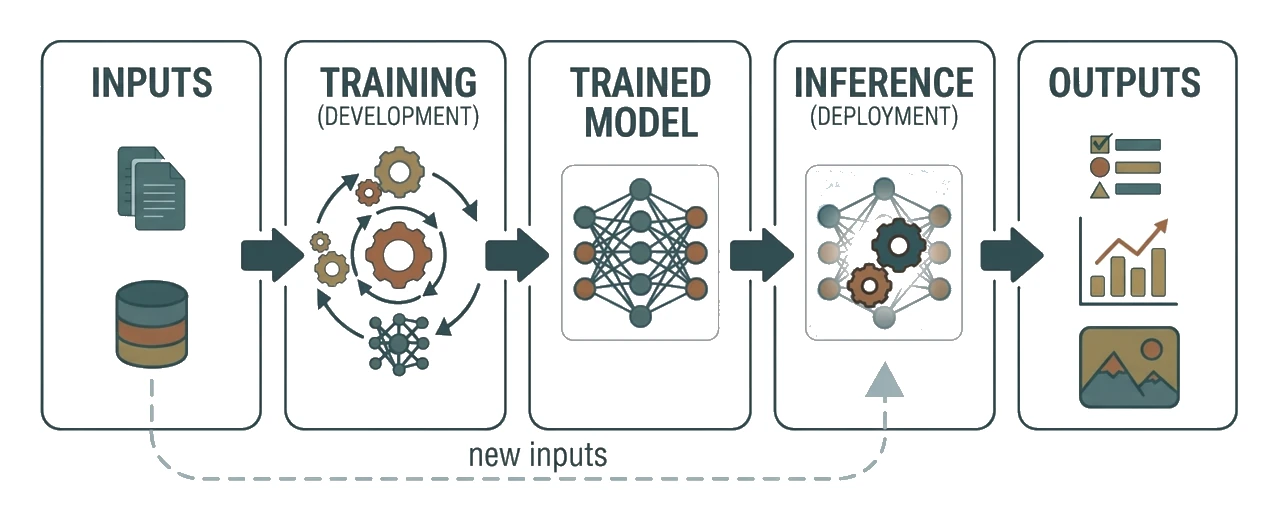
The process at the conceptual level the exam expects:
- The system is given training data: a large collection of examples, often labelled (e.g. thousands of photos tagged "cat" or "dog").
- An algorithm examines the data and looks for patterns or relationships that connect the inputs to the labels.
- The algorithm builds a that captures what it has found.
- The model can then be given new, unseen data and make a prediction about it.
- As more data is processed, the system continues to improve its accuracy.
Common exam question
Explaining how a device uses machine learning
Question: Explain how a device (a robot vacuum cleaner, an automated plough) makes use of machine learning or AI, or describe what machine learning capabilities means (3–4 marks).
Asked in 3 of the 17 papers. Answer as a chain, one point per link: the device gathers data while it works; it uses that data to change its own processes; so next time it performs better, making fewer mistakes, mapping the area, taking the most efficient route or avoiding known problems. Each example of data gathered (obstacles, field dimensions, dirtier areas) is a separate point, so give two or three.
Machine learning capabilities means a form of AI in which the system changes its own processes and data; it can be trained, with or without human interaction (supervised or unsupervised); it analyses patterns and keeps its results to guide future decisions. Asked to name the ability of a system that automatically adapts its own processes and data, write machine learning.
Common applications of machine learning:
- Image recognition (face unlock, photo tagging, medical scan analysis)
- Speech recognition (voice assistants, automatic captions)
- (translation, chatbots, summarisation)
- Recommendation systems (Netflix, Spotify, YouTube suggestions)
- Spam filters
- Fraud detection in banking
- Self-driving cars
Advantages of machine learning
| Advantage | Why it matters |
|---|---|
| Saves time and effort | Reduces the need for manual rule-writing, since the system learns the rules itself from data |
| Detects patterns humans miss | Can spot subtle correlations in huge datasets that no human could read through |
| Improves with more data | Performance continues to get better as more examples are seen, without needing to rewrite the program |
| Handles huge scale | Can process millions of inputs per second, far beyond human capability |
Disadvantages of machine learning
| Disadvantage | Why it matters |
|---|---|
| Needs very large amounts of high-quality data | Without enough data, or with biased or noisy data, the model performs poorly |
| Requires high processing power | Training a modern model can use vast computing resources and electricity |
| "Black box" decisions | It can be hard to explain why a learned model made a particular decision, which matters in medicine, law and finance |
| Bias from training data | If the training data reflects existing human biases, the model will reproduce them, sometimes in an amplified form |
| Vulnerable to adversarial inputs | Specially crafted inputs can trick a model into the wrong answer with high confidence |
4. Expert systems
An expert system is an AI program that imitates the decision-making of a human expert in a specific field, by combining a body of expert knowledge with logical rules.
Examples of expert systems:
- Medical diagnosis systems that suggest possible conditions from a patient's symptoms.
- Equipment troubleshooting systems that walk a technician through finding faults.
- Technical support chatbots that diagnose customer problems.
- Tax advice software that asks questions and recommends actions.
- Geological prospecting systems that suggest where to drill for oil or minerals.
The four components of an expert system
A standard expert system has four parts working together. Exam questions often ask you to name and describe each.
| Component | What it holds / does |
|---|---|
| Knowledge base | A store of facts in the chosen field, gathered from real human experts. For a medical system: lists of diseases, symptoms and test results |
| Rule base | A set of rules (typically IF-THEN statements) that link facts together: "IF cough AND fever AND chest-pain THEN suspect pneumonia" |
| Inference engine | The program that applies the rules to the facts and derives conclusions. It is the "reasoning" component |
| User interface | The way the user interacts with the system: typically a series of questions and a final answer or recommendation |
A typical session: the user enters information through the user interface; the queries the rule base and the to work out what the user is dealing with; the system asks follow-up questions or presents conclusions back through the interface.
Common exam question
Naming the components of an expert system
Question: Identify three of the four components of an expert system, or the others when one or two are named for you, or circle the components in a list of terms (2–3 marks).
Asked in 4 of the 17 papers, one mark per component. The four are the knowledge base, the rule base, the inference engine and the interface; when the stem already names one or two, the marks are for the others. Term lists, here and in the gap-fill descriptions of how the system operates, mix real components with plausible distractors: mechanical engine, question base, output device and machine learning in one paper, operating system, firewall, server, printer, actuator and encryption in another. Machine learning is an ability an expert system may have, not one of its components. The circling version listed only three of the four, so circle exactly the number asked for.
Common exam question
Describing how an expert system operates
Question: Explain how an expert system operates, or describe the role of one component such as the inference engine or the rule base (2 marks for one component, 5–7 for all four).
Asked in 5 of the 17 papers, sometimes as a gap-fill. Take the data through the components, one point each: input at the interface; facts in the knowledge base; rules in the rule base that link those facts, for the inference engine to use; the inference engine applies the rules to the facts to reach a diagnosis or decision and picks the next question from the data entered; output at the interface. For six marks, naming each component earns a mark; the rest come from what they do.
For the role of one component, two of these points about it earn the marks. In a gap-fill a term can be needed twice, and where the description says one base is applied to the other, either order is credited.
Advantages of expert systems
| Advantage | Why it matters |
|---|---|
| Consistent results | Every query is treated the same way, with no fatigue or mood changes |
| Faster responses | Far quicker than waiting for a human expert |
| Stores huge knowledge bases | Can hold more facts than any single human could remember |
| Available 24/7 | No waiting lists, no shift hours |
| Unbiased (when designed well) | Does not have personal preferences, although it may carry biases from its source data |
| Used as a training tool | Junior staff can learn from the system's explanations and recommendations |
Disadvantages of expert systems
| Disadvantage | Why it matters |
|---|---|
| Only as good as the knowledge entered | If the knowledge base is incomplete or out of date, the recommendations will be wrong |
| Lacks human empathy and judgement | A medical expert system cannot reassure a frightened patient or notice non-verbal cues |
| Requires training to use correctly | Users must enter information accurately; mistakes lead to misleading answers |
| Building it is expensive | Capturing expert knowledge in formal rules takes time and a real expert's involvement |
| Cannot easily handle unusual cases | Outside the situations the rules cover, the system may give a confidently wrong answer |
| Maintenance burden | New medical research, new equipment fault types or new tax rules all require the knowledge base and rule base to be updated |
5. Advantages and disadvantages of AI overall
Across all AI systems, similar trade-offs apply.
Advantages of AI
| Advantage | Why it matters |
|---|---|
| Increased efficiency | Tasks are completed faster than humans can manage |
| Increased accuracy | Well-trained AI systems are often more reliable than humans at narrow tasks (medical imaging, defect detection) |
| Scalability | One trained model can serve millions of users simultaneously, around the clock |
| Works 24/7 | No breaks, no holidays, no fatigue |
| Handles dangerous or boring tasks | Frees humans from work that is unsafe or repetitive |
| Personalisation | Adapts to each user's preferences and history |
Disadvantages of AI
| Disadvantage | Why it matters |
|---|---|
| Job losses | Tasks that AI can do may not need human workers, leading to unemployment in some sectors |
| Bias in decision-making | AI trained on biased data may make unfair decisions (hiring, lending, policing) |
| Loss of human skill | If AI takes over a task, humans may lose the skill to do it manually |
| Ethical concerns | Concerns about privacy, surveillance, autonomous weapons, deepfakes and manipulation |
| High setup and energy cost | Training large AI models is expensive and uses huge amounts of electricity |
| Lack of accountability | If an AI system causes harm, working out who is legally responsible can be very difficult |
| Dependence | As more decisions are delegated to AI, organisations and societies become reliant on systems they may not fully understand |
Ethical and legal concerns about AI
Three specific issues stand out:
- Algorithmic bias: AI trained on data that reflects historical bias can reproduce or amplify it. A hiring AI trained on past data may unfairly favour the demographics historically hired.
- Privacy: AI systems often rely on huge amounts of personal data. How that data is collected, stored and shared raises real concerns.
- Accountability: when an autonomous AI system causes harm, who is responsible: the developer, the operator, the company, or the user? Legal frameworks are still catching up.
These questions do not have single right answers.