1. Addition polymers
What a polymer is
- A polymer is a very long molecule built by joining together a large number of small repeating units
- The small repeating starting molecules are called ; each monomer becomes one in the polymer chain
- Polymerisation reactions join hundreds to thousands of monomers end-to-end through covalent bonds, giving a single chain molecule of high relative molecular mass
- Synthetic polymers are manufactured by industry (plastics, nylon, polyester fabrics, polystyrene cups); natural polymers occur in living things (starch, cellulose, proteins, DNA)
Addition polymerisation
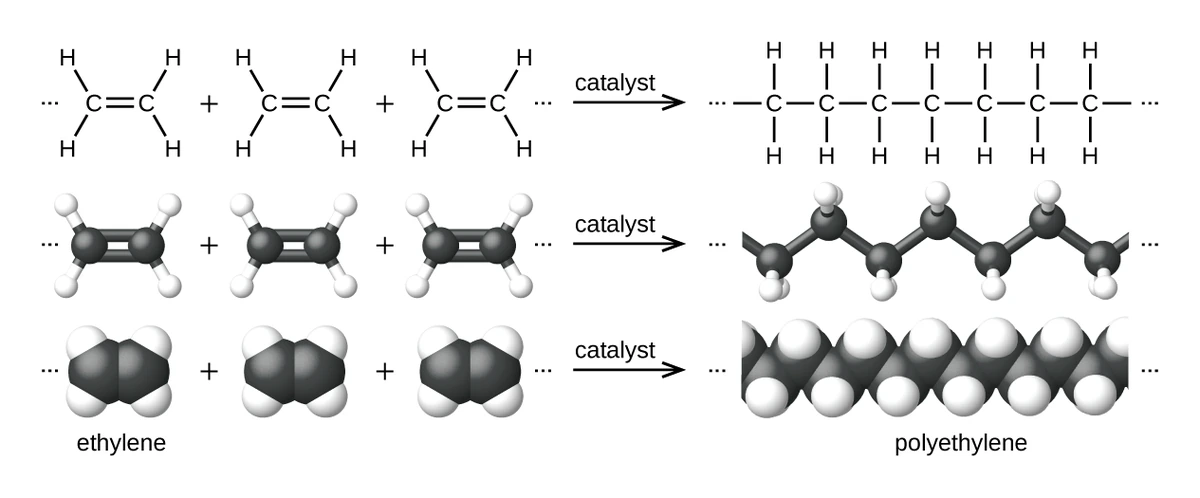
- joins monomer molecules that each have a C=C double bond
- One of the two bonds in the C=C of each monomer opens up; the spare bonds from neighbouring monomers link together to form a long single-bond chain
- No other product is made — the polymer is the only outcome (compare with condensation polymerisation in section 3)
- The molecular formula of the polymer is just n times the molecular formula of the monomer
- General equation:
n CH2=CHR → −(CH2−CHR)−n
- where R is whatever atom or group is attached to the second carbon of the monomer
Exam tip
The monomer is the molecule with the C=C
Whenever a question asks you to pick out or name a monomer, look for the C=C double bond: a two-carbon molecule with one chlorine and a double bond is chloroethene, not chloroethane, and from a box of substances the one that can form a polymer is the alkene, ethene. Asked to describe the differences between ethene and poly(ethene), give three separate points, one mark each: the polymer has a far longer carbon chain, it has only single bonds (ethene is unsaturated, the polymer saturated), and ethene is a gas whereas the polymer is a solid.
Exam tip
Counting the monomers in one polymer molecule
Addition polymerisation loses nothing, so the relative molecular mass of a polymer molecule is the number of monomers multiplied by the monomer's Mr. A show-that question giving a polymer molecule an Mr of a few million wants two steps, one mark each: the Mr of the monomer first (62.5 for chloroethene, 42 for propene), then the polymer's Mr divided by it. Write down the unrounded result of the division before rounding it to the approximate figure the question quotes.
The four named addition polymers
| Monomer | Polymer | Repeat unit | Typical use |
|---|---|---|---|
| Ethene, CH2=CH2 | Poly(ethene) | −(CH2−CH2)−n | Plastic bags, bottles, food wrap |
| Propene, CH2=CHCH3 | Poly(propene) | −(CH2−CH(CH3))−n | Crates, ropes, food containers |
| Chloroethene, CH2=CHCl (vinyl chloride) | Poly(chloroethene) — PVC | −(CH2−CHCl)−n | Drainpipes, window frames, electrical cable insulation |
| Tetrafluoroethene, CF2=CF2 | Poly(tetrafluoroethene) — PTFE / Teflon | −(CF2−CF2)−n | Non-stick coatings, plumber's tape, low-friction bearings |
Drawing a polymer's repeat unit from its monomer
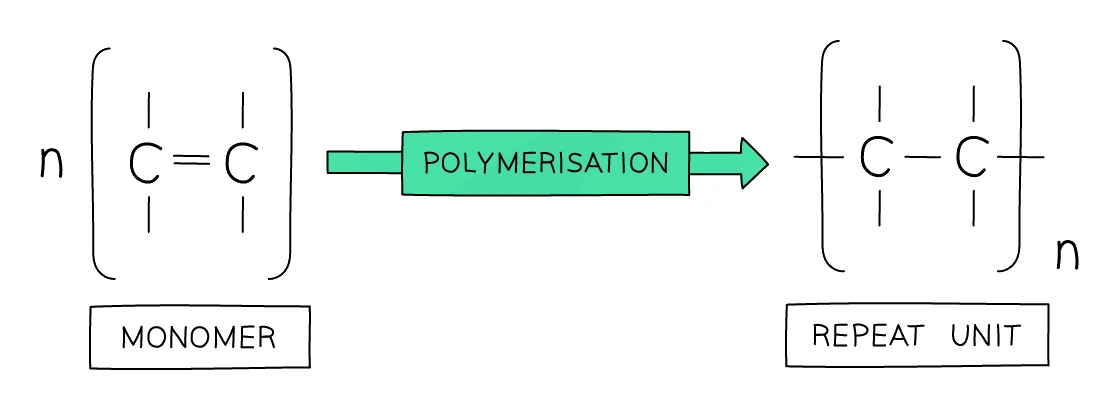
- A four-step recipe:
- Write out the displayed formula of the monomer
- Change the C=C double bond to a single C−C bond
- Add a "stub" bond going outward from each carbon, sticking out of the brackets to show where the chain continues
- Enclose the unit in brackets and write a subscript n outside the bracket
- Worked example: poly(chloroethene) from chloroethene
- Monomer: CH2=CHCl
- Open the double bond to a single bond and add extension bonds: −(CH2−CHCl)−
- Add the subscript: −(CH2−CHCl)−n
Common exam question
Drawing the repeat unit of an addition polymer
Question: Draw the repeat unit of the polymer formed from a given alkene, or complete its polymerisation equation (1–2 marks).
Asked in 6 of the 23 papers, all on Paper 1, for poly(propene) or poly(chloroethene). The first mark is the structure: the two carbons joined by a single bond, each hydrogen, chlorine or CH₃ still on its own carbon. In the two-mark version the second mark is for the two extension bonds, the brackets and the n together, and only if the structure is right; extension bonds need not pass through the brackets and n may sit anywhere after them.
In the one-mark version brackets and n are ignored, but one scheme rejects a unit drawn without extension bonds, so always draw them. A variant prints four carbons in a row and asks for the section of poly(propene) made from two molecules: one mark is for two of the carbons each carrying two H, the other for the other two each carrying one H and one CH₃, with nothing on any of the joining bonds, including the open ends. The two marks are independent.
Reading the monomer from a polymer's repeat unit
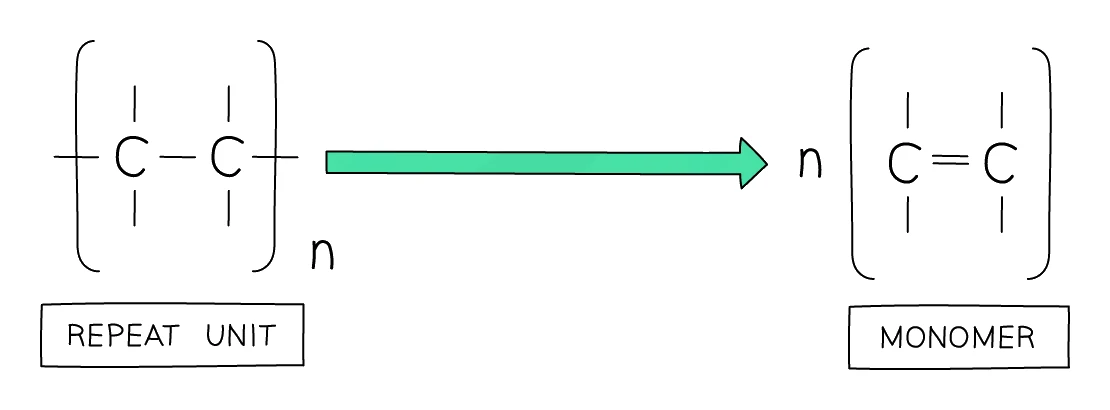
- Reverse the recipe: take the repeat unit, remove the extension bonds and the subscript n, and turn the C−C single bond between the two carbons back into a C=C double bond
- Worked example: poly(propene) repeat unit −(CH2−CH(CH3))−n
- Remove the brackets and the subscript: CH2−CH(CH3)
- Put the double bond back: CH2=CH(CH3) — propene
- This skill is exam-mark assessable in both directions: monomer → polymer and polymer → monomer
2. Disposal of addition polymers
Why polymers are difficult to dispose of
- The chains in an addition polymer are held together by strong C−C single bonds and they contain no chemically reactive functional groups
- This makes the polymers and non-biodegradable: bacteria and other decomposers in soil cannot break the chains down
- Once thrown away, the polymer persists in the environment for centuries — a serious downside of one of the chemistry industry's most useful product families
Landfill
- Most household plastic waste ends up in sites
- Landfill takes up large amounts of land and the polymer waste does not degrade, so each site fills up quickly and a new one has to be excavated
- Plastic in landfill can leach additives (plasticisers, pigments) into groundwater over time
Incineration
- Burning waste polymers in an incinerator is an alternative, and it can recover energy for heating or power
- Drawbacks:
- Burning hydrocarbons releases large amounts of carbon dioxide, a greenhouse gas, contributing to climate change
- Burning polymers that contain chlorine (PVC) releases toxic hydrogen chloride (HCl) gas, which is corrosive and contributes to acid rain
- Incomplete combustion in a poorly run incinerator releases carbon monoxide, the toxic gas that cuts the blood's ability to transport oxygen around the body (see topic 22 section 2)
Common exam question
Problems caused by disposing of addition polymers
Question: State, explain or discuss the environmental problems caused by disposing of addition polymers in landfill or by burning them (1–4 marks).
Asked in 5 of the 23 papers, all on Paper 1. Keep the two methods apart. Landfill is worth two linked points: the polymer stays there for a very long time, so sites fill up or space runs out, because it is inert and non-biodegradable (it does not decompose, or only very slowly). For burning, the credited points are that it produces toxic gases, carbon monoxide from incomplete combustion or hydrogen chloride from a chlorine-containing polymer such as PVC, and that it releases carbon dioxide, a greenhouse gas.
For burning, name the gas: in the short questions "global warming" on its own is ignored, and climate change earns a mark only as a further point in the four-mark discussion, where any mention of the ozone layer caps the score at three, so leave that out.
Recycling
- Many addition polymers can be sorted, melted and re-moulded into new products — the most environmentally friendly disposal route for those polymers that can be recycled
- Drawbacks: sorting different plastics is labour-intensive; mixed-polymer waste reduces the quality of the recycled product; thermosetting polymers cannot be melted and re-formed
3. Condensation polymers
What a condensation polymer is
- joins two different monomers, each carrying a functional group on each of its two ends
- For every link that forms between the monomers, a small molecule (usually water, sometimes HCl) is split out
- This is the key contrast with addition polymerisation:
- Addition → polymer only (no by-product)
- Condensation → polymer + a small molecule (e.g. water) per link
Common exam question
Naming the type of polymerisation that forms a polyester
Question: Give or explain the name of the type of polymerisation in which a diol and a dicarboxylic acid form a polyester, and name the other product (1–2 marks).
Asked in 3 of the 23 papers, all on Paper 2. The answer is condensation polymerisation; every scheme writes polymerisation in brackets, so the word that scores is condensation. When the question says explain, the second mark is the reason for the name: a small molecule, water, is also produced (or eliminated) each time a link forms. Where the other product is asked for on its own, water or H₂O is the one-mark answer.
One paper went on to ask what a biopolyester is: one mark for a polyester that is biodegradable, and saying it can be broken down by bacteria, or decomposed, is accepted.
Polyesters
- The example to know is a polyester — a polymer built from many ester linkages (the −COO− group seen in topic 27)
- Two monomers are needed:
- A dicarboxylic acid — a molecule with a carboxylic acid (−COOH) group at each end
- A diol — an alcohol that carries one hydroxyl group at each end of its chain (two −OH groups per molecule)
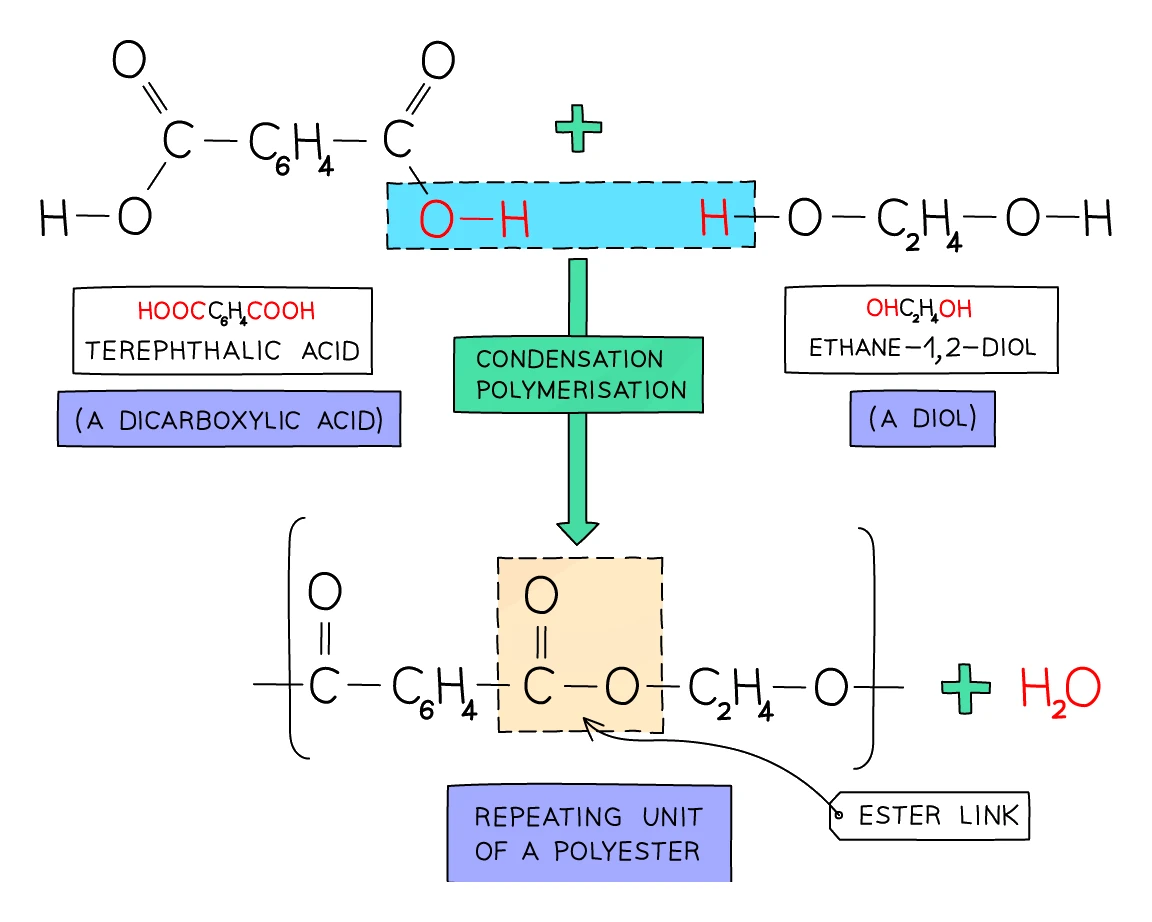
- Each −COOH on one monomer reacts with an −OH on the other monomer, forming an ester linkage and splitting out a water molecule (just like the esterification in topic 27, but happening over and over down the chain)
- The chain alternates: ...diol−ester−diacid−ester−diol−ester−diacid... and so on for thousands of units
A named example: terylene
- Terylene is a polyester — its full chemical name is poly(ethylene terephthalate), often abbreviated to PET, which is the same material that drinks bottles are made from. It is built from:
- Terephthalic acid — a benzene ring with a −COOH on opposite carbons (a dicarboxylic acid)
- Ethane-1,2-diol — a two-carbon molecule with an −OH on each carbon (a diol)
- The two monomers react end-to-end, splitting out one water molecule per ester link, and yield a chain of alternating units suitable for being drawn into fibres or moulded into bottles
Working backward: identifying the diol and diacid from a polyester
- Given the displayed formula of a polyester section, you can find the two monomers by treating the polyester as if it were hydrolysed back into its starting materials
- A step-by-step approach:
- Identify every ester linkage −COO− in the chain
- Break the chain at the single bond between the carbonyl carbon and the next oxygen — the section ending in "−C(=O)−" came from the dicarboxylic acid, and the section ending in "−O−" came from the diol
- Add an −OH to the carbonyl carbon to rebuild the carboxylic acid −COOH
- Add an −H to the oxygen of the diol fragment to rebuild the alcohol −OH
- The two resulting molecules are the diacid and the diol from which the polyester was made
Common exam question
Drawing the repeat unit of a polyester
Question: Draw the displayed formula of the repeat unit of a polyester made from a given dicarboxylic acid and diol (2 marks).
Asked in 4 of the 23 papers, all on Paper 2. The first mark is a correctly drawn ester linkage, its C=O and single-bonded O shown in full; the second is the rest of the unit: the acid's carbons on one side of the linkage, the diol's on the other, with an −OH lost from each acid group and an −H from each alcohol group at the join. In two of the four schemes the second mark depends on the first. Extension bonds are allowed but not required, brackets and n are ignored, and one scheme accepts the unit written in either direction.
The reverse question, giving the two monomers from a printed repeat unit, was set once: one mark per monomer, and structural formulae are accepted, so you need not draw every bond.
Biopolyesters
- Most synthetic polyesters (terylene, PET) are derived from petrochemicals and do not biodegrade quickly
- Biopolyesters are a newer family made from monomers obtained from plant sugars and plant oils, often with the help of microorganisms
- The chains contain ester linkages (and sometimes amide or ether linkages) that bacteria in the soil can attack, so the material gradually breaks down into harmless small molecules
- Biopolyesters are used in compostable packaging, single-use cutlery, and surgical sutures that the body can absorb after a wound heals
| Feature | Addition polymerisation | Condensation polymerisation |
|---|---|---|
| Number of monomer types | One | Two (each with a functional group on each end) |
| Monomer functional group | C=C double bond | −COOH and −OH (for polyesters) |
| Products | Polymer only | Polymer + a small molecule (usually water) per link |
| Example polymer | Poly(ethene), poly(propene), PVC, PTFE | Terylene (polyester), nylon (polyamide) |
| Repeat unit ends in | Single C–C bonds along the backbone | Ester linkages (−COO−) along the backbone |