1. Metals with water and acids
Metals with water
- Metals high in reactivity react with cold water; metals lower down only react with steam (if at all)
- The general reaction with cold water is:
metal + water → metal hydroxide + hydrogen
- The general reaction with steam is:
metal + steam → metal oxide + hydrogen
| Metal | Behaviour with water |
|---|---|
| Potassium | Reacts violently with cold water; ignites the hydrogen with a lilac flame |
| Sodium | Reacts vigorously with cold water; melts to a silvery ball and fizzes |
| Lithium | Reacts steadily with cold water; floats, fizzes, dissolves |
| Calcium | Reacts fairly briskly with cold water; produces a cloudy white suspension of Ca(OH)2 |
| Magnesium | Reacts very slowly with cold water; reacts much faster with steam |
| Zinc | Only reacts with steam, slowly |
| Iron | Only reacts with steam, slowly |
| Copper, silver, gold | No visible reaction with water or steam |
- Calcium example:
Ca(s) + 2 H2O(l) → Ca(OH)2(aq) + H2(g)
Metals with dilute acids
- A metal will react with a dilute acid only if it sits above hydrogen in the
- The general reaction is:
metal + acid → salt + hydrogen
- The more reactive the metal, the more vigorously it reacts; the metals above calcium (potassium, sodium and lithium) are too dangerous to react with acid in a school lab
- The salt formed depends on the acid (chloride from HCl, sulfate from H2SO4, nitrate from HNO3)
Common exam question
Giving the test for hydrogen
Question: Give the test for hydrogen, after a metal has reacted with a dilute acid or with water, or after an electrolysis (1 mark).
Asked in 5 of the 23 papers: three times for hydrogen from a metal reacting with an acid or with water, twice for hydrogen made by electrolysis. The mark needs both halves of the test: a lighted splint is held at the mouth of the tube and the gas burns with a squeaky pop.
An answer that only says it burns with a pop, without the lighted splint, is ignored in two schemes because it never says how the gas was lit, and three schemes reject a glowing splint outright: that is the test for oxygen. When the hydrogen comes from a metal and an acid, the equation before it carries its own mark, and state symbols are ignored there even when they are wrong.
| Metal | Reaction with dilute HCl | Reaction with dilute H2SO4 |
|---|---|---|
| Magnesium | Mg + 2 HCl → MgCl2 + H2 | Mg + H2SO4 → MgSO4 + H2 |
| Zinc | Zn + 2 HCl → ZnCl2 + H2 | Zn + H2SO4 → ZnSO4 + H2 |
| Iron | Fe + 2 HCl → FeCl2 + H2 | Fe + H2SO4 → FeSO4 + H2 |
| Copper | No reaction (Cu is below H) | No reaction |
2. Metal displacement reactions
The displacement principle
- A more reactive metal will displace a less reactive metal from its compound
- This applies to two situations:
- Heating a metal with a solid metal oxide
- Adding a metal to an aqueous solution of a metal salt
- The reactive metal takes the oxygen, or the negative ion, leaving the less reactive metal as the free element
Displacement from metal oxides
- Heat zinc powder with copper(II) oxide:
Zn(s) + CuO(s) → ZnO(s) + Cu(s)
- Zinc takes the oxygen, leaving copper as the brown solid product
- Zinc is the **reducing agent** (it removes oxygen); copper(II) oxide is the **oxidising agent**
- The thermite reaction uses aluminium to extract iron from iron(III) oxide:
2 Al(s) + Fe2O3(s) → 2 Fe(l) + Al2O3(s)
- The reaction releases enough heat to melt the iron, which is why thermite was used to weld railway tracks
- No reaction occurs if the added metal is less reactive than the metal in the oxide (e.g. silver added to lead(II) oxide does nothing)
Displacement from salt solutions
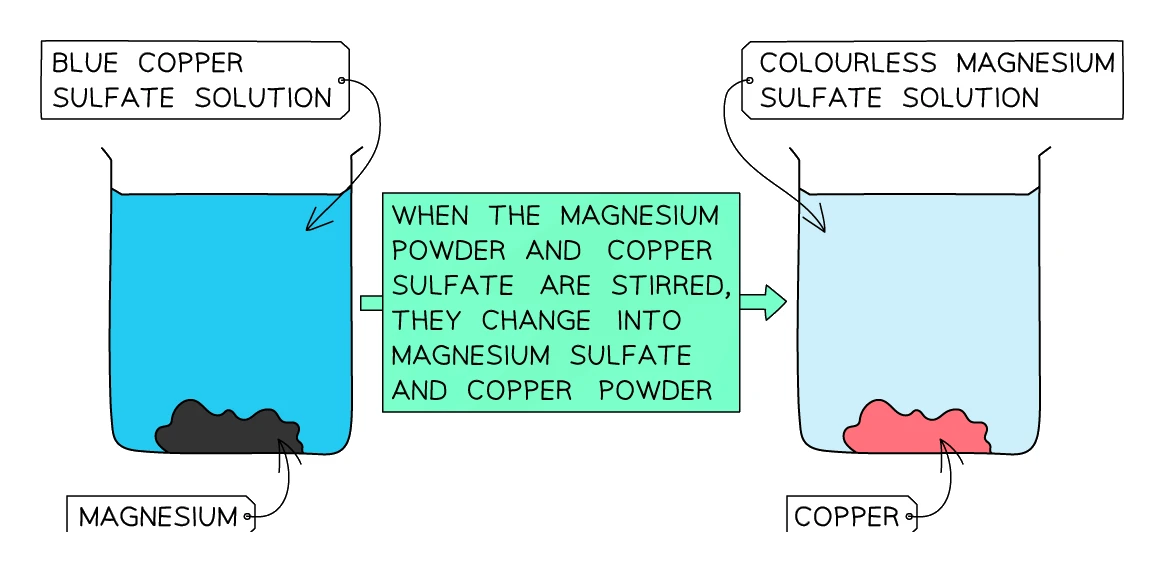
- Add a strip of magnesium to blue copper(II) sulfate solution:
Mg(s) + CuSO4(aq) → MgSO4(aq) + Cu(s)
- The blue colour fades as colourless magnesium sulfate forms
- Pink-brown copper plates onto the magnesium and any loose metal sinks to the base of the beaker
- Add iron filings to copper(II) sulfate solution:
Fe(s) + CuSO4(aq) → FeSO4(aq) + Cu(s)
- Pale-green iron(II) sulfate forms, copper coats the iron
- A metal placed in a salt solution of a more reactive metal gives no reaction (e.g. copper in zinc sulfate does nothing)
Common exam question
Naming what forms when a metal is added to a salt solution
Question: A metal is added to a solution of a less reactive metal's salt, in every case so far copper(II) sulfate: name the type of reaction, name or describe the solid that forms, or complete the word equation (1 mark each).
Set in 3 of the 23 papers. The reaction is displacement; redox, or oxidation and reduction, is accepted instead. The solid is copper, the element: "copper(II)" or Cu²⁺ is rejected as the product in two schemes, because the ion is what was in the solution, not what came out of it.
Asked for its appearance, write pink-brown or brown; orange and orange-brown are also accepted, red-brown is allowed but red on its own is rejected, and writing "copper" scores nothing because the question wants a colour, not a name. In the word equation the products are zinc sulfate and copper, again with no charge on the copper.
3. The reactivity series
Standard order
- Comparing reactions with water, acids, oxygen, and other metals lets chemists rank the metals from most reactive at the top to least reactive at the bottom
| Position | Metal | Reaction with cold water | Reaction with acid | Reaction with oxygen |
|---|---|---|---|---|
| Most reactive | Potassium, K | Violent | (Too dangerous) | Burns easily, lilac flame |
| ↑ | Sodium, Na | Vigorous | (Too dangerous) | Burns, yellow-orange flame |
| ↑ | Lithium, Li | Steady | (Too dangerous) | Burns, red flame |
| ↑ | Calcium, Ca | Brisk | Vigorous | Burns, brick-red flame |
| ↑ | Magnesium, Mg | Very slow; fast with steam | Brisk | Burns with intense white flame |
| ↑ | Aluminium, Al | None (protective oxide layer) | Slow | Forms an oxide film |
| ↑ | Carbon, C | — (non-metal reference) | — | Burns; reduces some metal oxides |
| ↑ | Zinc, Zn | Slow with steam | Moderate | Burns, blue-green flame |
| ↑ | Iron, Fe | Slow with steam | Slow | Rusts in moist air |
| ↑ | Hydrogen, H | — (non-metal reference) | — | Burns to form water |
| ↑ | Copper, Cu | None | None | Surface darkens on strong heating |
| ↑ | Silver, Ag | None | None | None at normal temperatures |
| Least reactive | Gold, Au | None | None | None |
- Carbon and hydrogen are not metals but are placed in the series as reference points
- Carbon's position matters for industry: any metal below carbon (Zn, Fe, Cu, etc.) can be extracted from its oxide by heating with carbon, while metals above carbon (Al, Mg and higher) cannot — they must be extracted by electrolysis
- Hydrogen's position matters for acids: only metals above hydrogen react with dilute acid to release hydrogen gas
Common exam question
Stating why one metal displaces another
Question: State or explain why one metal displaces another (aluminium from iron(III) oxide, zinc from copper(II) sulfate), or why a named pair gives no reaction (1–2 marks).
Asked in 5 of the 23 papers. The mark is a comparison: the displacing metal is more reactive than, or higher in the reactivity series than, the metal in the compound; calling it the better or stronger reducing agent is also accepted, and so is the reverse wording (iron is less reactive than magnesium, so nothing happens).
What is ignored is a statement with no comparison in it: "iron is not reactive enough" on its own scores nothing. For a metal sitting in a solution of its own salt, say it cannot displace itself or does not react with its own ions; "it does not react with itself" is ignored. In the two-mark version the second mark is for what the equation shows, that aluminium displaces iron from its oxide.
Common exam question
Deducing an order of reactivity from a results table
Question: From a table of how lettered metals react with water and acid, or which sulfate solutions they take a coating from, deduce the order of reactivity and say which metal a letter could be (1–2 marks, then 1 mark).
Set in 2 of the 23 papers. Read the table as evidence: a metal that reacts with cold water outranks one that reacts only with acid, one that reacts with neither goes last, and in a displacement grid the metal that takes a coating from the most solutions is the most reactive. One scheme still gave a mark when the two metals in the middle of the order were swapped; writing copper(II) for copper costs one.
Then match behaviour to a metal: no reaction with water or acid means copper, silver or gold; slow with acid and none with water fits zinc or iron; an acid reaction marked "not done" would be explosive or violent, which is the credited reason, "vigorous" alone being ignored.
4. Rusting and its prevention
Conditions for rusting
- Rust is the orange-brown flaky oxide that forms on iron and steel
- Both air (oxygen) and water must be present for iron to rust — neither on its own is enough
- The chemical name for rust is hydrated iron(III) oxide, Fe2O3·xH2O
Common exam question
Recalling the facts of rusting
Question: Name the two substances that must be present for iron to rust, give the chemical name for rust, and state what type of reaction rusting is (1–2 marks each).
Asked in 6 of the 23 papers, usually as the opening parts of a question about iron. The two substances are oxygen (air is accepted) and water (moisture is accepted), one mark each in either order. Rust is hydrated iron(III) oxide: plain "iron oxide" is ignored in two schemes and iron(II) oxide is rejected, while Fe₂O₃ and ferric oxide are allowed.
The type of reaction is oxidation, set twice as a multiple-choice item and once as a written answer, where redox is also accepted. A related one-mark part asks why the iron in an experiment on the air must be wet: because water is needed for iron to rust.
Investigating the conditions
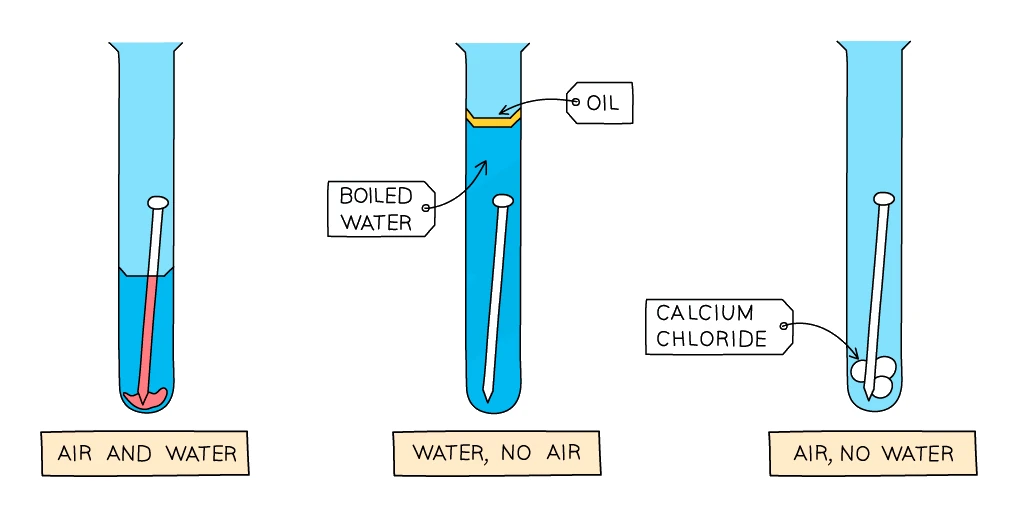
- Set up three test tubes, each containing a clean iron nail:
- Tube A — open to the air, partly filled with tap water (contact with both air and water)
- Tube B — partly filled with water that has been boiled to drive off dissolved oxygen, then sealed with a layer of oil on top (contact with water but not air)
- Tube C — contains a drying agent such as anhydrous calcium chloride, sealed with a stopper (contact with air but not water)
- After several days:
- The nail in tube A is rusty
- The nails in tubes B and C are unchanged
- Conclusion: both oxygen and water are required; removing either prevents rusting
Why rusting is a problem
- Rust is soft and flakes off the metal, exposing a fresh iron surface underneath
- Once started, rusting therefore continues right through the bulk of the iron, weakening structures over time
- This is different from the protective oxide that forms on aluminium, which seals the surface and stops further reaction
Prevention by barrier methods
- Coating iron physically isolates the metal from oxygen and water
- Common barrier coatings: paint, oil, grease, plastic, and an electroplated layer of an unreactive metal (such as tin on tin cans)
- Drawback: if the coating is scratched, the bare iron is exposed and rust begins, often spreading under the coating
Common exam question
Explaining how paint stops iron rusting
Question: Explain how painting prevents iron from rusting (2 marks), or give two other methods of preventing rusting (2 marks).
The explanation was set in 2 of the 23 papers and the list in 1 more. The first mark is that the paint acts as a barrier or layer; one scheme refuses "coating" or "covering" for this mark, so use the word barrier. The second is that it keeps oxygen (or air) and water from reaching the iron.
Naming the coating is not an explanation, and an answer about galvanising earns nothing when the question is about paint. For the list, any two of painting, plastic coating, oiling or greasing, chromium plating and sacrificial protection are credited.
Prevention by sacrificial protection
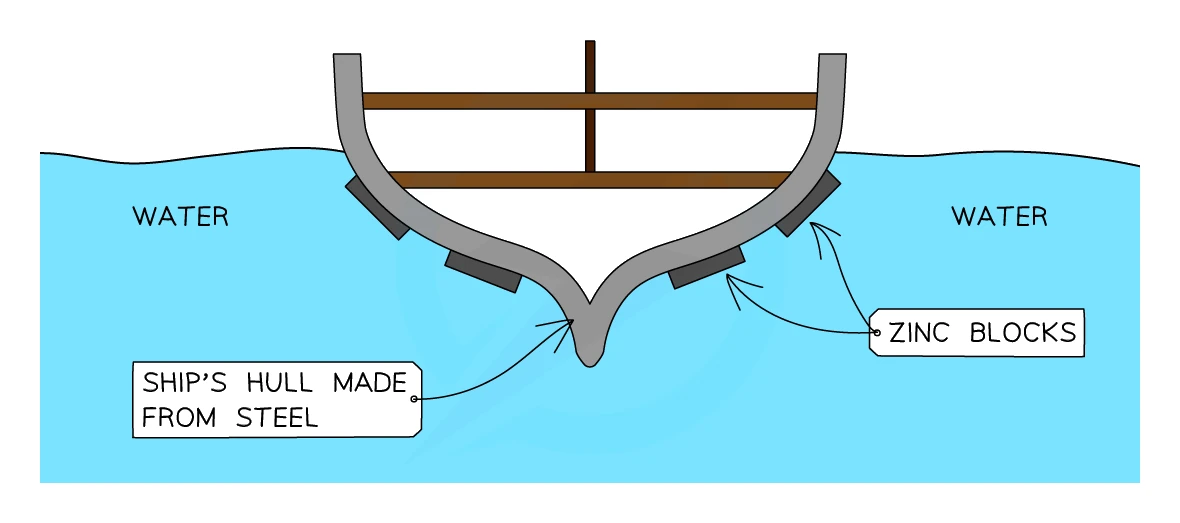
- A more reactive metal is bolted to the iron object
- The more reactive metal corrodes preferentially because it loses electrons more readily, so the iron stays intact
- Zinc blocks attached to the steel hulls of ships are a textbook example: the zinc corrodes away first and is replaced periodically
Galvanising
- coats the iron with a layer of zinc, applied by dipping the iron into molten zinc or by electroplating
- The zinc layer protects in two ways at once:
- As a barrier, it keeps oxygen and water away from the iron underneath
- As , if the coating is scratched the zinc still corrodes preferentially, so the exposed iron is not attacked
Common exam question
Why a scratched zinc coating still protects iron
Question: Explain how galvanising continues to protect iron even when the zinc layer is scratched or damaged (2 marks).
Asked in 3 of the 23 papers, each time straight after a one-mark part asking you to name the method: galvanising. Two of those schemes ignore "sacrificial protection" as the name and one allows it, so galvanising is the safe answer.
The first explanation mark is that zinc is more reactive than iron, or higher in the reactivity series, or loses electrons more readily; "zinc reacts faster" is not accepted. The second is that the zinc therefore oxidises, corrodes or reacts with oxygen instead of the iron. All three schemes reject "zinc rusts": rusting is what iron does, so say the zinc corrodes or is oxidised. One scheme also rejects "zinc reacts with iron".
A note on terminology
- Corrosion is the general term for the slow chemical attack of a metal surface by its environment
- Rusting is specifically the corrosion of iron — every rusting reaction is a corrosion reaction, but not every corrosion reaction is rusting
5. Oxidation and reduction (redox)
In terms of oxygen
- Oxidation is the gain of oxygen by a substance
- Reduction is the loss of oxygen from a substance
- The two always happen together in the same reaction — a redox reaction
- In Zn + CuO → ZnO + Cu:
- Zinc gains oxygen → zinc is oxidised → zinc is the (it caused the reduction of CuO)
- Copper(II) oxide loses oxygen → it is reduced → CuO is the
In terms of electrons
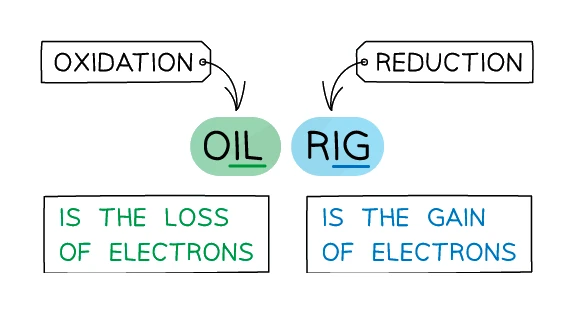
- The more general definitions use electron transfer:
- is loss of electrons
- is gain of electrons
- Mnemonic: OIL RIG (Oxidation Is Loss, Reduction Is Gain)
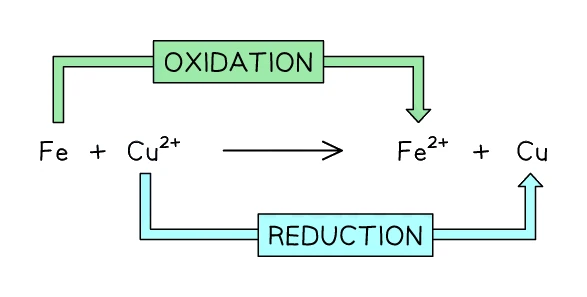
- For the displacement reaction Mg(s) + Cu2+(aq) → Mg2+(aq) + Cu(s):
- Mg → Mg2+ + 2 e− (oxidation — Mg loses electrons)
- Cu2+ + 2 e− → Cu (reduction — Cu2+ gains electrons)
- Mg is the reducing agent (gives away electrons); Cu2+ is the oxidising agent (accepts them)
Common exam question
Explaining why a reaction is redox
Question: Explain why a given reaction (a metal oxide with aluminium, hydrogen or carbon, or a metal with another metal's ions) is a redox reaction, or state what is oxidised and what is reduced (2 marks).
Set in 6 of the 23 papers. The marks are two linked pairs: the species that is oxidised with its reason (it gains oxygen, or loses electrons), and the species that is reduced with its reason (it loses oxygen, or gains electrons). An ionic equation, such as zinc with silver ions, is answered in electrons, and some papers say so.
The second mark is lost by naming the wrong species: it is iron(III) oxide (or the iron ions) that loses oxygen and is reduced, not "iron", and two schemes reject the metal's name. Changes in oxidation number are accepted as reasons. A one-mark version asks why one species is oxidised: it gains oxygen or loses electrons; "reacts with oxygen" is ignored.
Spectator ions and ionic equations
- In the full equation Mg(s) + CuSO4(aq) → MgSO4(aq) + Cu(s), the sulfate ion SO42− appears on both sides unchanged
- An ion that is unchanged in a reaction is a spectator ion — it does not take part in the chemistry
- Leaving out the spectator ions gives the ionic equation, which highlights the actual redox change: Mg(s) + Cu2+(aq) → Mg2+(aq) + Cu(s)
A practice prompt
- In the reaction Cu(s) + 2 AgNO3(aq) → Cu(NO3)2(aq) + 2 Ag(s), Cu loses two electrons to form Cu2+ (oxidation) while each Ag+ gains one electron to form Ag (reduction)
- Copper is therefore the reducing agent here, and silver(I) is the oxidising agent
Common exam question
Identifying the oxidising agent or the reducing agent
Question: Explain which substance in a given equation acts as the oxidising agent or the reducing agent (or what the role of one reactant is), or state what an oxidising agent is (1–2 marks).
Set in 4 of the 23 papers. The first mark names the agent and the second, which depends on it, says what it does to the other substance: name the right agent or the reason cannot score. An oxidising agent gives oxygen to, or takes electrons from, the other substance: with aluminium and iron(III) oxide it is the iron(III) oxide (iron ions are accepted too). A reducing agent gives electrons to, or takes oxygen from, the other substance: carbon heated with a metal compound, or magnesium with aluminium ions.
When the question says "in terms of electrons", the reason must be about electrons: that magnesium "is oxidised" is ignored, and writing "aluminium" for aluminium ions loses the second mark. For the definition, "something that is itself reduced" is also accepted.
6. Practical: investigating metals reacting with acids
Goal of the practical
- Compare how three different metals — magnesium, zinc and iron — react with two different dilute acids (HCl and H2SO4), and use the observations to rank the metals by reactivity
Method
- Wear safety glasses; acids and the hydrogen produced are hazardous
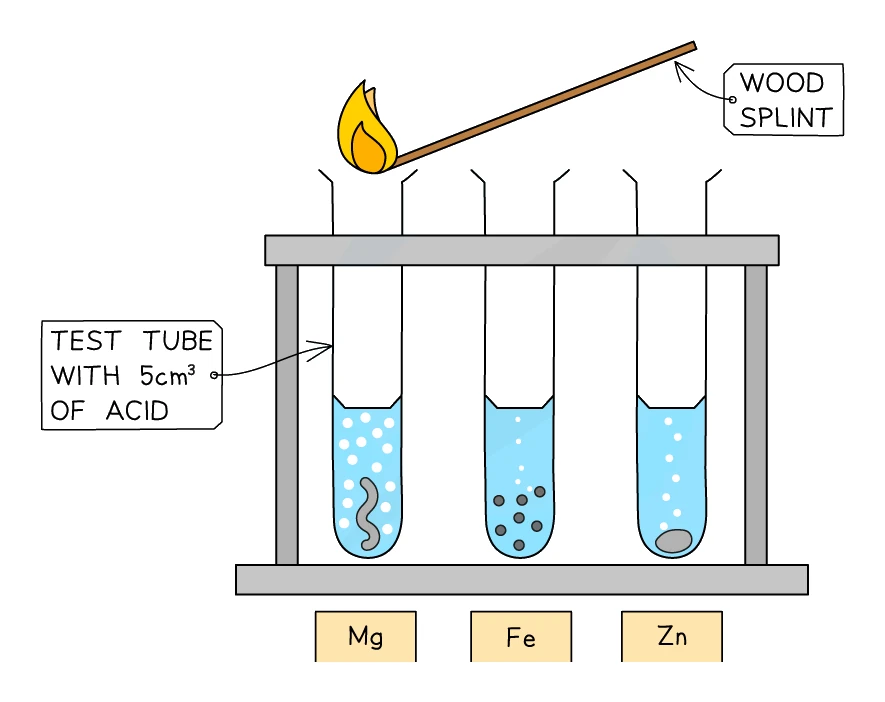
- Set up six labelled test tubes in a rack
- Into each tube, measure 5 cm3 of one of the acids using a small measuring cylinder
- Drop a small, comparable sample of metal into each tube: a 1 cm strip of magnesium ribbon, a few zinc turnings, or a few iron filings
- Watch each tube for bubbling, heat change and any colour change in the solution; time how long it takes for the metal to disappear
- Test any gas given off by holding a lit splint at the mouth of the tube — a hydrogen pop confirms the gas
- Repeat with the second acid and record observations in the same table
Typical observations
| Metal | With dilute HCl | With dilute H2SO4 |
|---|---|---|
| Magnesium | Rapid fizzing, tube warms noticeably, metal disappears within a minute, splint pops | Rapid fizzing, tube warms, metal disappears within a minute, splint pops |
| Zinc | Steady stream of small bubbles, metal dissolves gradually, splint pops | Steady fizzing, metal dissolves more slowly than magnesium, splint pops |
| Iron | Very slow bubbling, metal almost unchanged after several minutes | Slow bubbling, only small bubbles seen |
Conclusion
- Order of reactivity from these observations: Mg > Zn > Fe
- For each metal, the products with hydrochloric acid and with sulfuric acid follow the same general pattern: a soluble salt of the metal plus hydrogen gas
- The order found in this practical matches the order of these metals in the standard reactivity series in section 3