1. Sources of metals
Metals in the Earth's crust
- Almost all metals are found in the Earth's crust combined with other elements as
- An ore is a rock that contains enough of a wanted metal compound to make extraction economically worthwhile
- Many metal ores are metal oxides; some are sulfides or carbonates
- Iron is found mainly as , an iron(III) oxide (Fe2O3)
- Aluminium is found mainly as , a hydrated aluminium oxide ore that is purified to give Al2O3 before extraction
- Copper is found as the sulfide ore chalcopyrite (CuFeS2) and as carbonate ores such as malachite
Native metals
- A few very unreactive metals are found as the free element in the Earth's crust, not as compounds
- These include gold, platinum and (to a lesser extent) silver
- They occur uncombined because they react so slowly with air, water and acids that they survive in their pure form on geological timescales
Exam tip
Naming the metal found uncombined in the Earth
When a list of metals is given and you must explain which of them occurs in the Earth uncombined, as the free element, pick the least reactive metal in the list: gold whenever gold is offered. Silver is ignored and earns nothing. The second mark is the reason, that it is the least reactive (or most unreactive) metal, and it is only available once the right metal is named, so the reason cannot rescue a wrong choice. The same thinking answers the one-mark question asking which listed metal sits lowest in the reactivity series.
Extraction is a reduction
- For an oxide ore, extracting the metal means removing oxygen from the metal compound — by definition, a reaction
- The reactivity series decides how that reduction is carried out (see section 2)
Common exam question
Explaining why an extraction is reduction or redox
Question: State why turning a metal oxide into the metal is a reduction, or explain why a reaction in which carbon, hydrogen or aluminium takes the oxygen from a compound is a redox reaction (1–2 marks).
Answer in terms of oxygen. One mark: the metal oxide loses oxygen. Two marks: the oxide loses oxygen, so it is reduced; the carbon, hydrogen or aluminium gains oxygen, so it is oxidised. Electron versions (metal ions gain electrons) and oxidation numbers are credited too, but "the metal oxide gains electrons" is ignored. Asked in 7 of the 23 papers.
The usual slip is saying the metal loses oxygen: it is the metal oxide that is reduced, and "iron loses oxygen" is rejected. For the oxidising agent, name the oxide: it gives its oxygen to the other reactant. Asked for the role of carbon, call it the reducing agent because it takes the oxygen; a reactivity-series argument earns nothing here.
Common exam question
Keeping air away from the hot metal
Question: Explain why hydrogen is kept flowing until the tube and its contents have cooled, or why argon instead of air fills the reaction vessel (2 marks).
Two linked marks. First, the gas keeps oxygen away from the metal: a stream of hydrogen stops air entering the tube, and argon is used because it is inert. Second, what would otherwise happen: hot metal exposed to oxygen is oxidised, so freshly made metal would turn back into its oxide, and the magnesium used to extract titanium would react with the air instead. Give both halves; naming the gas as inert without saying what oxygen would do is only the first mark. Set in 2 of the 23 papers. A one-mark follow-up asks why escaping hydrogen is burnt off: it is flammable and could cause a fire or an explosion.
2. Extracting metals
Choosing an extraction method from the reactivity series
- Metals above carbon in the reactivity series (K, Na, Li, Ca, Mg, Al) are too reactive to be reduced by carbon
- They must be extracted by electrolysis of their molten compound
- Metals below carbon but above the unreactive group (Zn, Fe, Sn, Pb, Cu) can be reduced by heating their oxide with carbon (or carbon monoxide)
- Metals below hydrogen (Cu, Ag, Au) are unreactive and the least reactive of these are simply mined as the free element
| Metal | Position relative to carbon | Extraction method |
|---|---|---|
| K, Na, Ca, Mg, Al | Above carbon | Electrolysis of the molten compound |
| Zn, Fe, Sn, Pb | Below carbon | Reduction by heating with carbon or carbon monoxide |
| Cu | Below carbon | Reduction by heating with carbon (or roasting copper sulfide) |
| Ag, Au, Pt | Native (unreactive) | Mined directly from the crust as the free element |
Common exam question
Choosing the extraction method from the reactivity series
Question: Explain which method, electrolysis or heating with carbon, suits a named metal, or state why carbon can extract iron but cannot extract aluminium or magnesium from their oxides (1–2 marks).
Asked in 4 of the 23 papers. Everything rests on one comparison with carbon: carbon is more reactive than iron (it sits above iron in the reactivity series), so it can take the oxygen from iron(III) oxide; aluminium and magnesium are more reactive than carbon, so carbon cannot reduce their oxides and electrolysis is needed. Either direction of the comparison is accepted, and for one mark the comparison alone is enough; for the one-mark aluminium version the comparison with carbon is the credited answer, so "aluminium is too reactive" on its own, naming nothing it is more reactive than, does not earn it.
For two marks, add the consequence: carbon can remove the oxygen from (reduce) the oxide. When the question asks which method is suitable, the first mark is the method and the second the reactivity reason, and an answer that chooses electrolysis for iron scores nothing, however good the reasoning that follows.
Extraction of iron in the blast furnace
- Iron is extracted from haematite using a blast furnace — a continuous, high-temperature reactor charged at the top and tapped at the bottom
- Three raw materials are loaded in:
- Iron (haematite, Fe2O3) — the source of iron
- (an impure form of carbon) — the reducing agent and the source of heat
- (calcium carbonate, CaCO3) — to remove acidic impurities from the ore
- Hot air is blasted in near the bottom
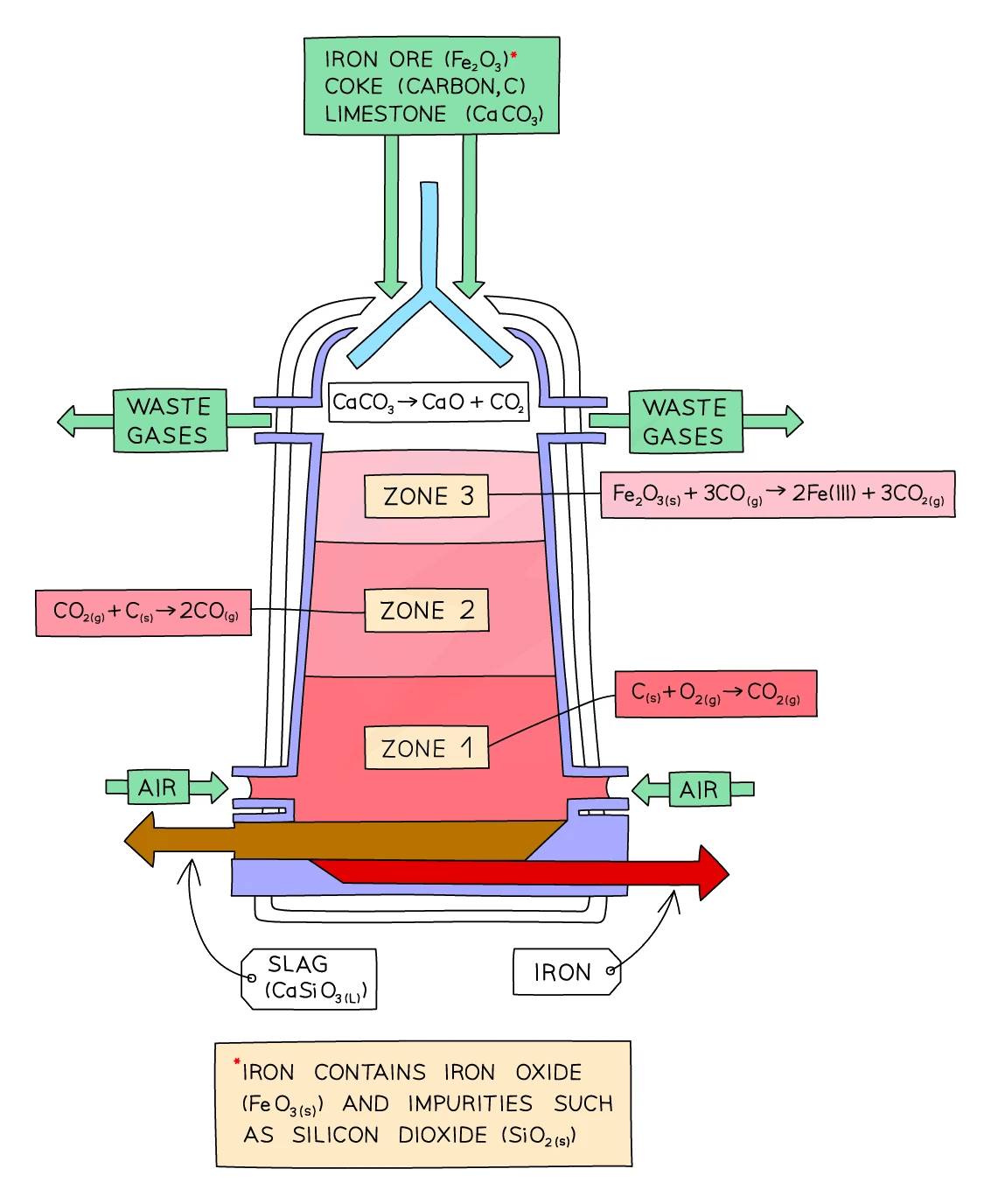
The chemistry inside the furnace
- Combustion zone (hottest, near the air blast) — the coke ignites in the incoming blast of preheated air, supplying the heat that drives the rest of the furnace
- C(s) + O2(g) → CO2(g) (exothermic)
- Carbon-monoxide-forming zone — the very hot carbon dioxide reacts with more coke to make carbon monoxide, the true reducing agent
- CO2(g) + C(s) → 2 CO(g)
- Iron-forming zone — carbon monoxide rises and reacts with iron(III) oxide in the haematite, stripping its oxygen
- Fe2O3(s) + 3 CO(g) → 2 Fe(l) + 3 CO2(g)
- The molten iron drips to the bottom and is tapped off
- Slag formation — limestone removes the sandy SiO2 impurity:
- First, the limestone is thermally decomposed: CaCO3(s) → CaO(s) + CO2(g)
- Then the calcium oxide neutralises the acidic silica: CaO(s) + SiO2(s) → CaSiO3(l)
- Calcium silicate () floats on top of the denser molten iron and is tapped off separately and used for road foundations
Extraction of aluminium by electrolysis
- Aluminium sits above carbon in the reactivity series, so carbon cannot reduce its oxide — electrolysis is needed
- The ore () is purified first to give pure aluminium oxide, Al2O3
- Al2O3 melts at over 2000 °C, far too hot to be practical on its own
- It is therefore dissolved in molten (Na3AlF6)
- The mixture melts around 950 °C, drastically cutting the energy bill, and cryolite is chemically inert so the electrolysis chemistry is unchanged
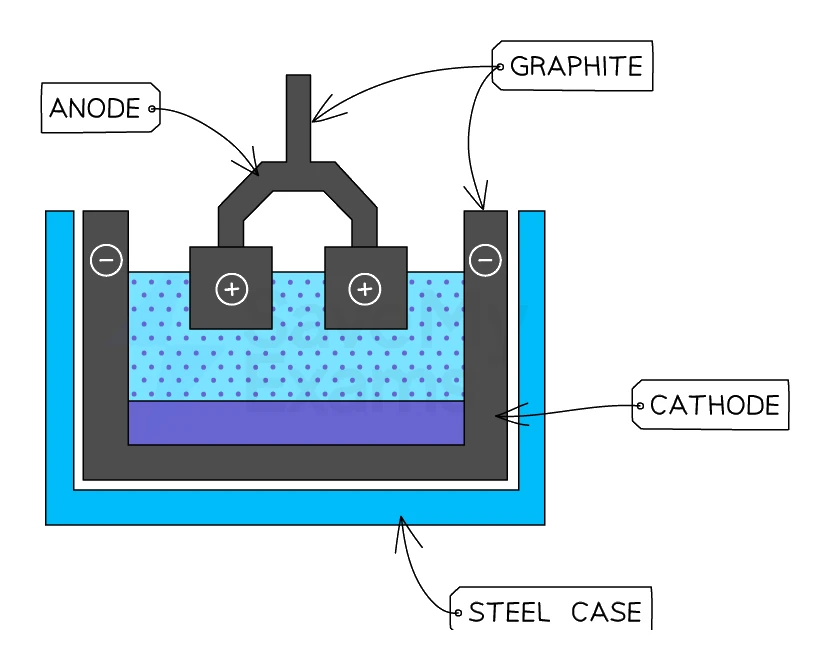
- The cell is a steel tank lined with carbon (graphite). The lining is the cathode; large carbon blocks dipping into the melt from above are the anodes
What happens at each electrode
- At the cathode (the carbon lining): aluminium ions gain electrons and are reduced to liquid aluminium
- Al3+(l) + 3 e− → Al(l)
- Molten aluminium is denser than the electrolyte and sinks to the floor of the tank, from where it is siphoned off
- At the anode (the carbon blocks): oxide ions lose electrons and are oxidised to oxygen
- 2 O2−(l) → O2(g) + 4 e−
- The anodes are made of carbon, so the oxygen produced burns the carbon away:
- C(s) + O2(g) → CO2(g)
- The anodes wear out and have to be replaced regularly, which is a continuing cost
- Aluminium extraction uses a great deal of electricity, which is the main reason it is expensive compared with iron extraction
3. Uses of common metals
Aluminium
| Use | Property that matters |
|---|---|
| Aircraft and high-speed train bodies | Low density; high strength-to-weight ratio |
| Saucepans and cookware | Good thermal conductor; unreactive with most foods |
| Overhead power cables | Good electrical conductor; lighter than copper |
| Drink cans and food containers | Non-toxic; resists corrosion thanks to its surface oxide layer |
Copper
| Use | Property that matters |
|---|---|
| Electrical wiring inside houses and devices | Excellent electrical conductor; ductile (draws into wires) |
| Plumbing pipes and tanks | Unreactive with water; malleable so easy to bend; non-toxic |
| Heat exchangers and base layers of cookware | Excellent thermal conductor |
Common exam question
Explaining a use of a metal from its properties
Question: Explain two uses of aluminium in terms of its properties, or explain the properties that make copper suitable for electrical wiring (4–5 marks).
Set in 2 of the 23 papers, both on Paper 2. The aluminium question is marked in pairs, each pair a use plus the property behind it: drink cans or foil (malleable), aircraft and car bodies (low density), overhead cables (conducts electricity), pans (conducts heat). The property mark depends on the use being right.
For copper wiring, three properties with their causes in the metallic structure make seven credit points, of which any five score: conducts electricity (delocalised electrons can move), ductile (layers of atoms or cations, then those layers sliding over each other, two points), high melting point (strong attraction between the cations and the delocalised electrons). Cost, reactivity, hardness, strength, shininess and a high boiling point are ignored; saying that ions or atoms move loses the conduction reason, and any mention of intermolecular forces or covalent or ionic bonding caps the answer at four of the five.
Iron and steel
- Pure iron is too soft and corrodes too easily for most engineering uses; almost all iron is converted into , an alloy of iron with a controlled amount of carbon and sometimes other metals
- Iron itself is used as a heterogeneous catalyst in the industrial Haber process for ammonia and in some other large-scale reactions
| Type of steel | Composition | Typical use | Why this composition |
|---|---|---|---|
| Mild steel | Iron + about 0.25% carbon | Car body panels, nails, wiring | Soft, malleable, easy to press and shape |
| High-carbon steel | Iron + 0.5–1.4% carbon | Cutting tools, drill bits, chisels | Hard, holds a sharp edge |
| Stainless steel | Iron + about 18% chromium + 8% nickel | Cutlery, sinks, chemical plant | Strong; chromium oxide layer prevents corrosion |
4. Alloys
What an alloy is
- An alloy is a mixture of a metal with one or more other elements, usually another metal or a non-metal such as carbon
- Examples already encountered:
- Steel: iron + carbon (see section 3)
- Brass: about 70% copper + 30% zinc — used for fittings, decorative work and musical instruments
- Bronze: copper + tin — used for statues, bells and bearings
Exam tip
An alloy is a mixture, never a compound
If you are asked what an alloy is (one mark), the word that earns it is mixture: a mixture of metals, or of a metal and another element such as carbon, so steel qualifies. Calling an alloy a compound, or saying the metals have "combined", is rejected. Never write that the metals bond or react together: the atoms of the added element simply sit among the atoms of the main metal.
Why alloys are harder than the pure metal
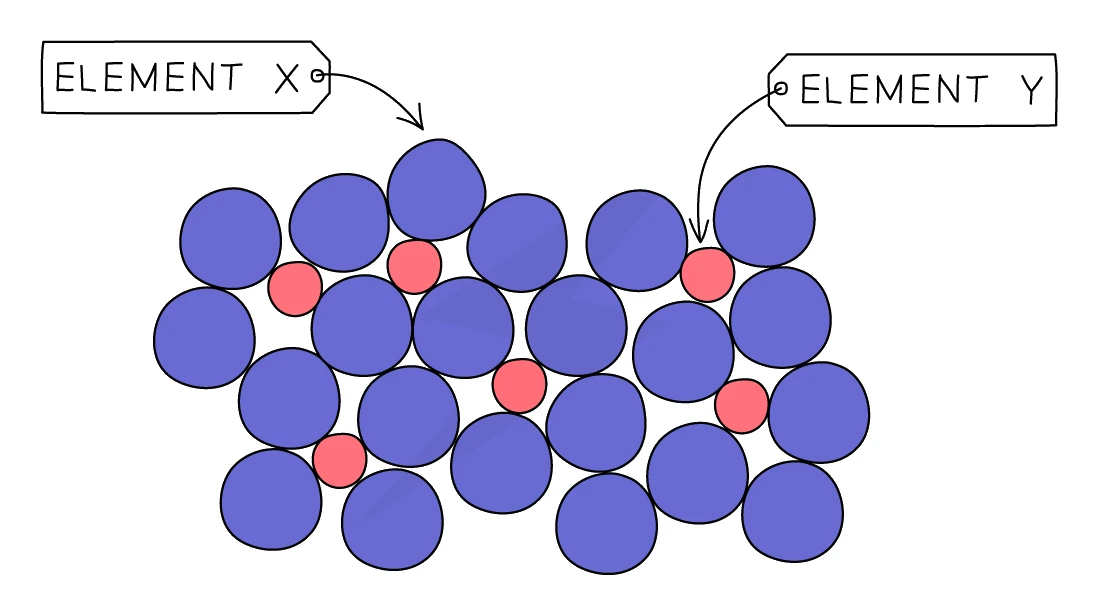
- Pure metals deform easily because layers of identical-size atoms slide cleanly over one another (this was the malleability argument in topic 08)
- In an alloy, the added element has atoms of a different size, which disrupts the regular layered packing
- The disrupted layers can no longer slide smoothly, so the alloy is harder and more rigid
- Many alloys are also chosen because they resist corrosion (stainless steel, bronze) or tolerate higher temperatures (nichrome heating elements)
- The detailed structural picture sits in topic 08 Metallic Bonding, section 3
Common exam question
Why an alloy is harder than the pure metal
Question: Use a diagram of the particle arrangement to explain why an alloy is harder, stronger or less malleable than the pure metal (2–3 marks).
Asked in 3 of the 23 papers, always on Paper 2. Three ideas earn the three marks (the two-mark version wants the last two): in the pure metal the atoms are all the same size, so the layers slide over each other easily; in the alloy the added atoms are a different size, which disrupts (distorts) the regular arrangement; so the layers can no longer slide, and the alloy is harder. Say "layers" (or rows or sheets): one scheme deducts a mark if the word never appears. Labelled diagrams can earn every mark on their own when the question invites them.
Mentioning molecules, intermolecular forces, negative ions, or ionic or covalent bonding costs one mark, however many of them appear, and saying the alloy has stronger metallic bonds earns nothing: the explanation is about the arrangement of the atoms, not the strength of the bonding.