1. Esters and esterification
What an ester is
- An ester is an organic compound formed from the reaction of a with an
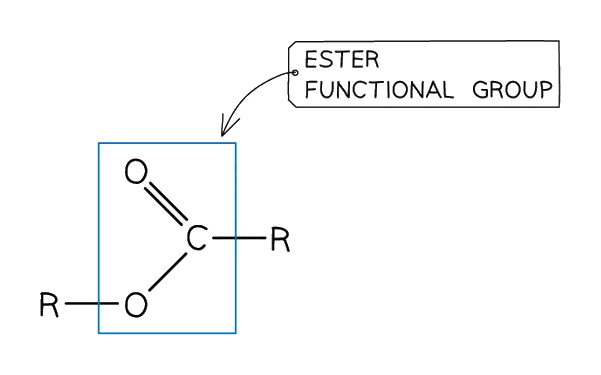
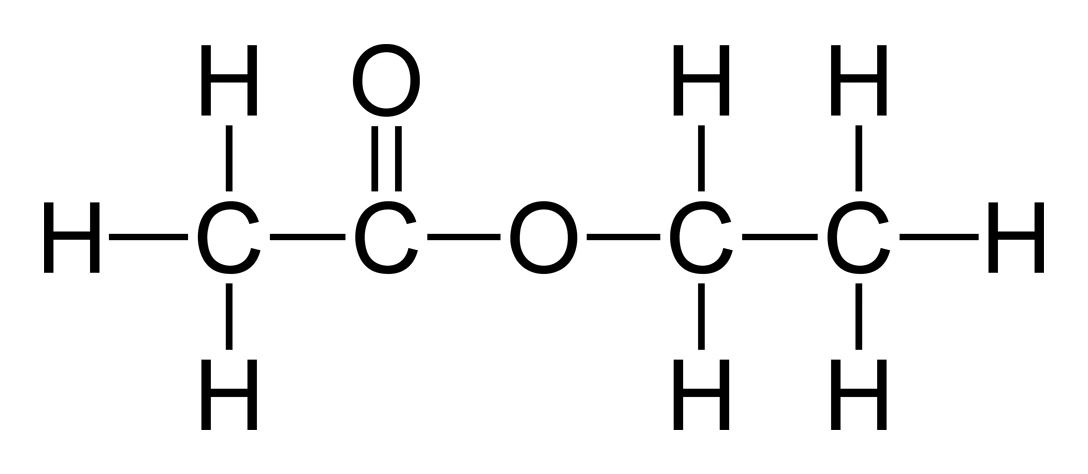
- The functional group is the , written as −COO− and drawn as a carbon with a double bond to one oxygen and a single bond to a separate −O− that continues into the rest of the molecule
- General structure: R–COO–R′, where R is the alkyl group of the carboxylic acid (minus its acidic H) and R′ is the alkyl group of the alcohol (minus its hydroxyl H)
- Physical properties:
- Small esters are colourless, sweet-smelling oily liquids
- They are insoluble or only slightly soluble in water but mix freely with organic solvents
- Many natural fruit aromas are esters: ethyl butanoate (pineapple), 3-methylbutyl ethanoate (banana), octyl ethanoate (orange)
- Esters are widely used as food flavourings and as the scent base of many perfumes
Common exam question
Circling the ester functional group
Question: Circle the functional group of the ester in a displayed formula, or the carboxylic acid group in an equation or molecule that also contains an ester (1 mark).
The ester group is asked in 2 of the 23 papers, and 2 more ask for the carboxylic acid group instead, once in an esterification equation and once in a molecule that carries both groups. For the ester, ring only the −COO− unit: the carbon, its double-bonded oxygen and the single-bonded oxygen that leads on to the alkyl group. One scheme rejects a ring that takes in any other atom, so keep the neighbouring hydrogens and carbons outside it.
For a carboxylic acid, ring the whole −COOH: the carbon, both oxygens and the hydrogen. Ring one group in one molecule only: when the acid is drawn in an equation beside an alcohol, also ringing the alcohol's O−H is rejected, and so is ringing more than one group.
Esterification: making an ester
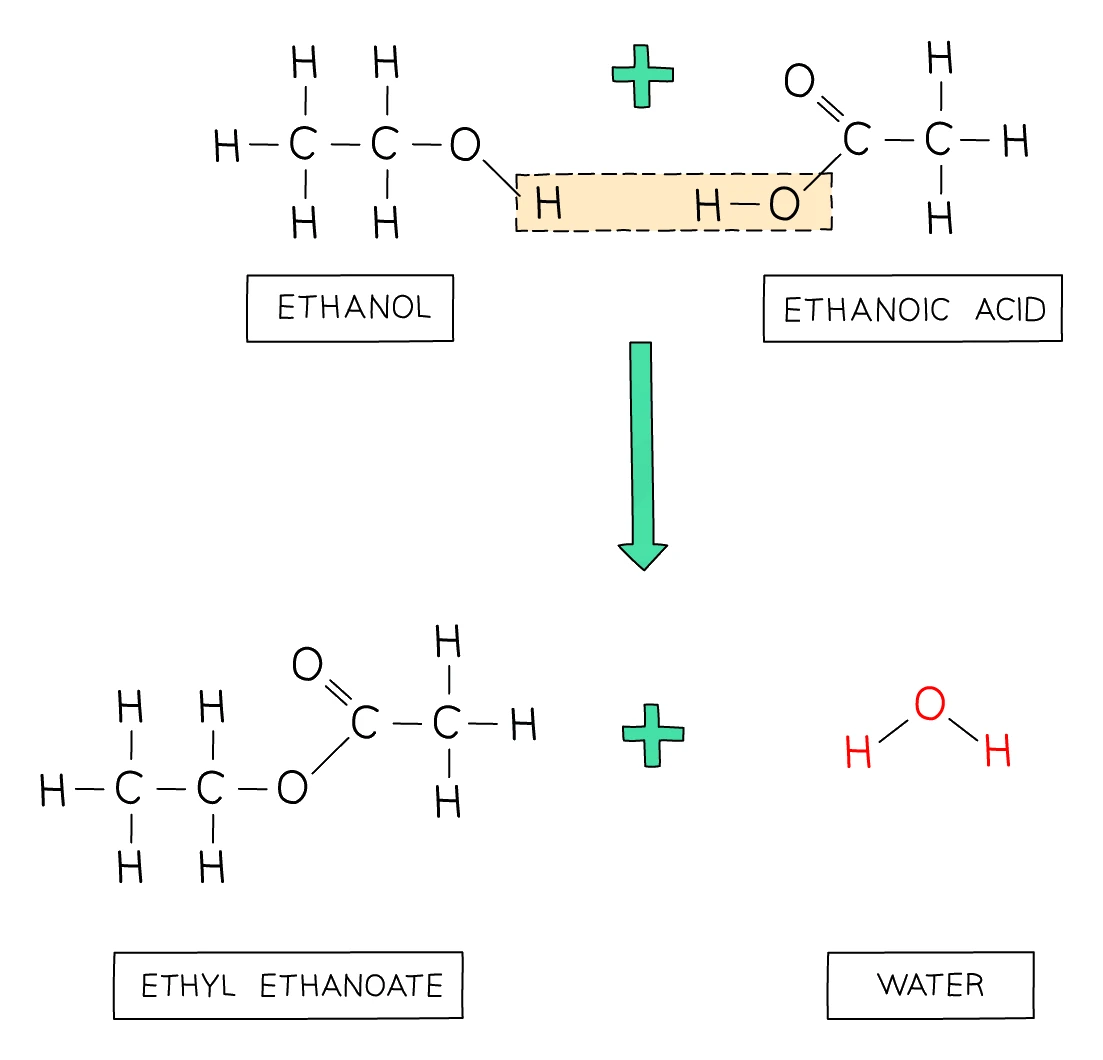
- The reaction between a carboxylic acid and an alcohol, in the presence of a concentrated sulfuric acid catalyst, is called
- Word equation:
carboxylic acid + alcohol → ester + water
- The catalyst is (H2SO4) — it speeds the reaction up and helps drive water out of the mixture
- The −OH of the acid combines with the −H of the alcohol to leave behind a molecule of water; the remaining fragments join through the ester linkage
Common exam question
Naming the catalyst for esterification
Question: Give the name of a suitable catalyst for the reaction between a carboxylic acid and an alcohol (1 mark).
Write concentrated sulfuric acid. Asked in 2 of the 23 papers, and a third asked why the amount of sulfuric acid in the mixture stays the same while the ethanoic acid is used up: it is a catalyst, so it is not consumed. The schemes either bracket the word "concentrated" or leave it out, and one ignores the word "dilute", so plain "sulfuric acid" still scores; one scheme also accepts hydrochloric, nitric or phosphoric acid, and another allows any suitable inorganic acid. Sulfuric acid is the answer that is never in doubt, so give that one.
Common exam question
Bonds broken in esterification and why ΔH is about zero
Question: State which two bonds are broken in the reactants, and explain, in terms of bonds broken and formed, why the enthalpy change for making or hydrolysing an ester is about 0 kJ/mol (2–3 marks).
Set in 2 of the 23 papers, once for the forward reaction and once for hydrolysis. The bonds broken are one C–O (the acid's C–OH) and one O–H (the alcohol's); the bonds formed are the same two, the new C–O of the ester linkage and the O–H of water. The first mark is for saying the same bonds, a C–O and an O–H, are broken and formed; the second for the consequence: the energy taken in to break them equals the energy given out as they form, so the change is zero. One scheme ignores an answer saying only that the same number of bonds break and form, so name them. In hydrolysis the same two bonds swap direction and the same argument scores.
Naming an ester
- An ester's name has two words, one for each parent molecule:
- First word — derived from the that supplied the −OR′ group. Drop the "-ol" ending of the alcohol and replace it with "-yl" (e.g. methanol → methyl, ethanol → ethyl, propan-1-ol → propyl)
- Second word — derived from the that supplied the −COO− group. Drop the "-oic acid" ending of the acid and replace it with "-oate" (e.g. methanoic acid → methanoate, ethanoic acid → ethanoate, propanoic acid → propanoate)
- The first word comes from the alcohol, the second from the acid
| Alcohol | Carboxylic acid | Ester name | Ester formula |
|---|---|---|---|
| Methanol (CH3OH) | Methanoic acid (HCOOH) | Methyl methanoate | HCOOCH3 |
| Ethanol (C2H5OH) | Methanoic acid (HCOOH) | Ethyl methanoate | HCOOC2H5 |
| Ethanol (C2H5OH) | Ethanoic acid (CH3COOH) | Ethyl ethanoate | CH3COOC2H5 |
| Propan-1-ol (C3H7OH) | Ethanoic acid (CH3COOH) | Propyl ethanoate | CH3COOC3H7 |
| Pentan-1-ol (C5H11OH) | Butanoic acid (C3H7COOH) | Pentyl butanoate | C3H7COOC5H11 |
Common exam question
Naming an ester from its structure
Question: Give the name of the ester shown in a displayed or structural formula, or of the ester formed from a named acid and alcohol, or pick its name from four options (1 mark).
Asked in 6 of the 23 papers, all on Paper 2, and ethyl ethanoate is the answer in three of them. Name the alcohol part first, from the alkyl group on the single-bonded oxygen (methyl, ethyl, propyl), then the acid part, from the chain that carries the C=O, counting that carbon (methanoate, ethanoate, propanoate). So CH3CH2COOCH3 is methyl propanoate: its acid chain has three carbons, one of them the C=O. Two schemes note that the spelling must be correct; one scheme allowed ethyl acetate and another propyl formate, but the other three list only the -oate name, so write that. Every multiple-choice version, whether it asks for the name or the formula, lists the swapped ester among the wrong options, so check which fragment came from the alcohol before you answer.
Predicting an ester structure from its name
- Take pentyl butanoate as a worked example:
- "pentyl" → from pentan-1-ol, so the −OR′ side has 5 carbons (C5H11)
- "butanoate" → from butanoic acid, so the −COO− side has 4 carbons in total (including the carboxyl carbon — so 3 in the alkyl part and one in the C=O)
- Combine: butanoate side is C3H7−COO−, pentyl side is −C5H11
- Full formula: C3H7COOC5H11
- The same procedure works in reverse — given an ester's structure, identify the −COO− linkage, split the molecule at the O–C single bond, and read the two parent molecules from each fragment
Common exam question
Writing the ester's formula from its acid and alcohol
Question: Draw the displayed formula of the ester from a named acid and alcohol (2 marks), pick its structural formula from four options, or draw the acid behind a given ester (1 mark).
Set in 5 of the 23 papers, all on Paper 2: twice as a displayed formula, twice as multiple choice and once in reverse. The acid loses the OH of its −COOH and the alcohol the H of its −OH; the acid's chain, still carrying its C=O, joins through a single-bonded oxygen to the alcohol's alkyl group, and the other product is water, which one paper asked for. A displayed formula carries two marks: one for the ester linkage drawn correctly and one for the rest of the molecule with every bond shown; one scheme makes the second depend on the first. To get back to the acid, put OH on the C=O carbon and draw it as O–H: a compressed "−OH" is rejected.
2. Practical: preparation of ethyl ethanoate
Goal of the practical
- Make a small, fragrant sample of by reacting ethanol with ethanoic acid under acid catalysis:
CH3COOH(l) + C2H5OH(l) → CH3COOC2H5(l) + H2O(l)
Apparatus
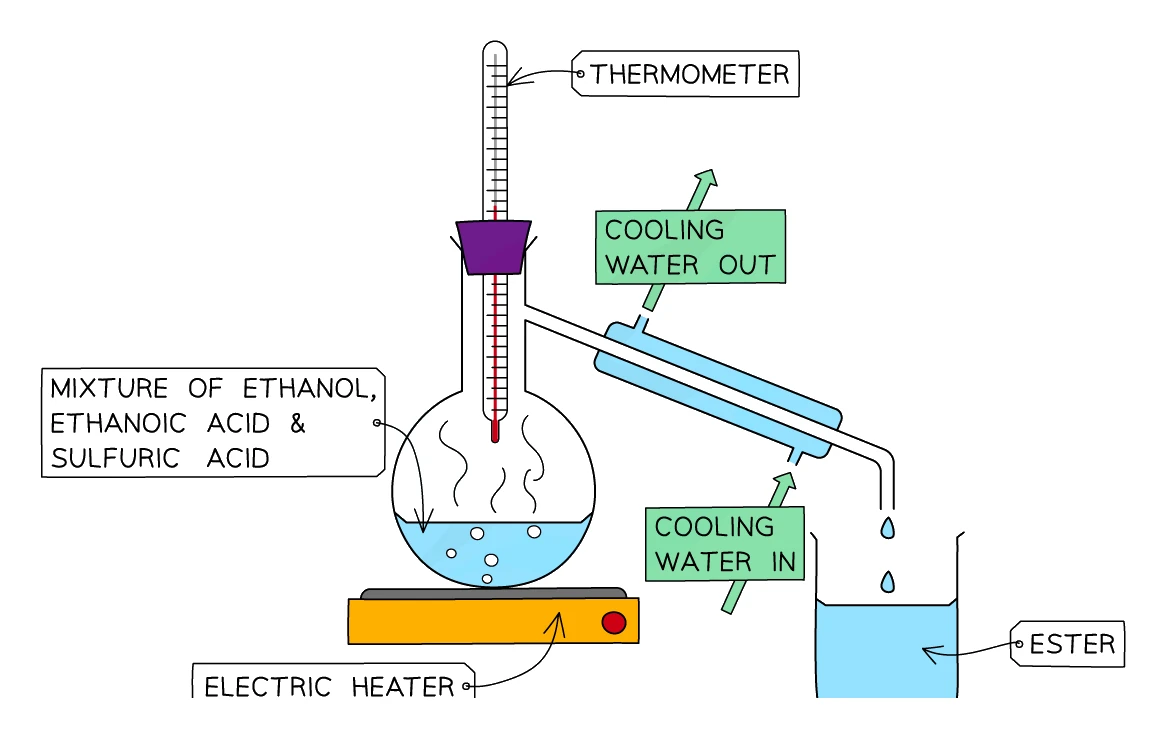
- Pear-shaped or round-bottom flask, fitted with a still-head and a Liebig (water-cooled) condenser
- Collection flask (small conical or round-bottom) for the distillate
- Thermometer
- Heating mantle, electric heater, or water bath — not a Bunsen burner, since ethanol vapour is highly flammable
- Reagents: ethanol, ethanoic acid (glacial), concentrated sulfuric acid (the catalyst), sodium carbonate solution (for the work-up wash)
Exam tip
Why a water bath rather than a Bunsen flame
One paper asked why the acid and alcohol should be heated in a water bath rather than over a Bunsen flame. The mark is for the fire risk: the alcohol (or the ester, or the mixture) is flammable and could catch fire. The scheme also allowed that the alcohol, ester or acid might evaporate, and lists nothing else, so name the flammability rather than writing about gentle or even heating. The same reasoning is why the apparatus above uses an electric heater or a water bath and no naked flame.
Method
- Step-by-step:
- Add about 5 cm3 of ethanol and 5 cm3 of glacial ethanoic acid to the reaction flask
- Carefully add about 2 cm3 of concentrated sulfuric acid (this is corrosive — wear gloves and safety glasses)
- Drop in a few anti-bumping granules (they keep the boiling smooth)
- Fit the still-head, condenser and collection flask
- Heat the mixture gently with the electric heater or in a hot water bath
- As the mixture warms, the ester forms and distils off through the condenser, where it cools back to a liquid and collects in the receiving flask
- The ester has the lowest boiling point in the flask (about 77 °C, against ethanol 78 °C, water 100 °C and ethanoic acid 118 °C), so it is the first substance to come over the condenser
- Because ethyl ethanoate and ethanol boil within about 1 °C of each other, the distillate is a crude mixture; the work-up step below cleans it up
- The distillate has a noticeably sweet, fruity, glue-like smell — this is the diagnostic sign that the ester has been made
Common exam question
Knowing that an ester has formed
Question: State how you would know that an ester has been made, and give one use of esters (1 mark each).
The observation, asked in 2 of the 23 papers, is a sweet, fruity or distinctive smell; one scheme also accepts an oily layer forming on the surface, because the ester does not mix with the water. The use, asked once, is perfumes, food flavourings or solvents, and the scheme accepted any other sensible use such as emulsifiers. "Food colourings" is ignored, so on its own it earns nothing: esters supply flavour and scent, not colour.
Working up the crude distillate
- The crude distillate also contains a small amount of unreacted ethanol, ethanoic acid and a trace of sulfuric acid carried over
- These can be removed before bottling the pure ester:
- Add a small volume of sodium carbonate solution to the distillate; it neutralises any acid carried over, releasing CO2 (visible ) until no more bubbles form
- Anhydrous calcium chloride can then be added to absorb any residual ethanol
- Decant the now-clear ester layer into a clean stoppered bottle
Why the ester is distilled off as it forms
- The esterification reaction is reversible: leaving the ester in the hot flask with water and the acid catalyst would let the reverse reaction (hydrolysis of the ester back to acid + alcohol) take place
- Distilling the ester out of the reaction mixture as soon as it forms removes one of the products and pulls the equilibrium toward more ester — a direct application of Le Chatelier's principle from topic 20
Exam tip
Ester questions go on to dynamic equilibrium
Because esterification is reversible, 3 of the 23 papers follow the ester with what dynamic equilibrium means (1–2 marks) or what the ⇌ symbol means (1 mark). The symbol means a reversible reaction; "equilibrium" alone is ignored. For dynamic equilibrium give both points: the forward and reverse reactions take place at the same rate, and the concentrations (two of the three schemes also allow amounts) of reactants and products stay constant; saying they are equal is rejected. One paper also asked why a catalyst leaves the equilibrium position unchanged: it speeds up the forward and backward reactions equally, and that word earns the second mark.