1. Exothermic and endothermic reactions
Conservation of energy
- Energy cannot be created or destroyed during a chemical reaction — only transferred between the reaction mixture (the system) and its surroundings
- When energy leaves the system, the surroundings warm up by the same amount
- When energy enters the system, the surroundings cool down by the same amount
- A thermometer placed in the reaction mixture is the simplest way to detect this transfer
Exothermic reactions
- An exothermic reaction transfers energy out of the system to the surroundings
- The temperature of the reaction mixture, together with any solvent it sits in, rises
- The chemical energy stored in the products is lower than in the reactants — the difference is what escapes as heat
- The enthalpy change is negative: ΔH < 0
- Reactions that are always exothermic include:
- of fuels
- of an acid by a base
- The reaction of a reactive metal with water or acid
- Many displacement and oxidation reactions
Endothermic reactions
- An endothermic reaction transfers energy into the system from the surroundings
- The temperature of the reaction mixture falls
- The products store more chemical energy than the reactants
- The enthalpy change is positive: ΔH > 0
- Reactions that are commonly endothermic include:
- of metal carbonates
- The reaction between citric acid and sodium hydrogencarbonate
- The dissolving of some ionic salts (e.g. ammonium nitrate) — useful in cold packs
- Photosynthesis (energy supplied by sunlight)
Reading the experimental data
| Reaction | Initial T / °C | Final T / °C | ΔT / °C | Type |
|---|---|---|---|---|
| 20 cm³ HCl + 20 cm³ NaOH | 18.0 | 24.5 | +6.5 | Exothermic (T rose) |
| 5 g KNO₃ stirred into 50 cm³ water | 21.0 | 17.2 | −3.8 | Endothermic (T fell) |
| Zn powder + 30 cm³ CuSO₄(aq) | 20.0 | 28.6 | +8.6 | Exothermic |
| 5 g NH₄NO₃ stirred into 50 cm³ water | 20.0 | 13.4 | −6.6 | Endothermic |
- A rise in temperature = exothermic; a fall = endothermic. Mark schemes credit the direction of the temperature change plus the named conclusion
Common exam question
Defining exothermic and classifying a change from results
Question: State what is meant by the term exothermic, or use the temperature readings from an experiment to explain what type of energy change has taken place (1–2 marks).
The definition is asked in 3 of the 23 papers, and the mark is for heat energy (or thermal energy) being given out to the surroundings. "Energy is given out" on its own is ignored: name heat.
Reading the type from results is set in 2 of the 23 papers. The first mark is for the direction of the change, the temperature of the mixture rose (or fell), and the second for the conclusion, so the reaction is exothermic (or endothermic). For an endothermic change, "the temperature decreased" or "heat energy was taken in" is credited. The direction of the temperature change is a mark of its own, so state it rather than jumping straight to the name.
2. Calorimetry experiments
What calorimetry measures
- uses temperature change to measure heat transfer in a chemical reaction
- Two settings appear:
- Reactions in solution (neutralisation, dissolving, metal displacement) — energy transferred to or from the surrounding solution
- Combustion of fuels — energy transferred to a known mass of water above a spirit burner
Assumptions used to keep the maths tractable
- The solution has the same density as water (1.00 g cm⁻³), so 100 cm³ of solution has a mass of 100 g
- The solution has the same specific heat capacity as water, 4.18 J g⁻¹ °C⁻¹
- No energy escapes from the cup, and the container itself takes up none of the heat
- The reaction goes to completion
Common exam question
Why a polystyrene cup gives a more accurate result
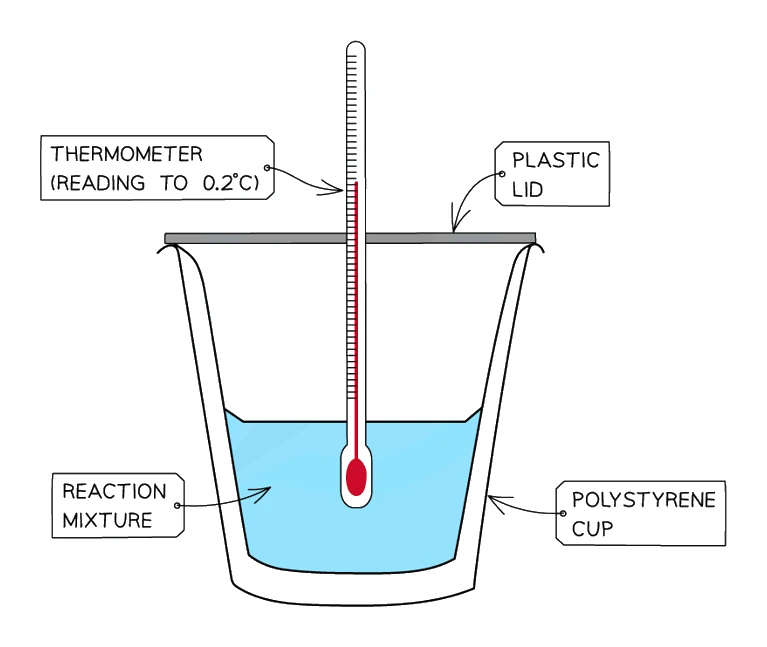
Question: Explain why a polystyrene cup, rather than a glass beaker, makes the measured temperature change more accurate (1–2 marks).
Asked in 5 of the 23 papers, once as part of a six-mark comparison of two methods. The first mark is that polystyrene is an insulator (a poor conductor of heat); the second is what follows, less heat is lost to the surroundings, so the recorded temperature change is nearer the true one. Say "less" or "reduces": "no heat loss" is rejected.
Match the direction to the reaction. For an endothermic reaction the cup's job is to stop heat entering from the surroundings, and "prevents heat loss" is rejected there. The metal can used to burn a fuel is the opposite case: it is chosen because the metal conducts heat better than glass, so the heat passes through it into the water. The mark needs that comparison, and an answer about insulation is rejected.
Calorimeter for reactions in solution
- Method:
- Use a measuring cylinder to add a known volume of one reactant to the cup
- Note the initial temperature with a thermometer once the reading has steadied
- Add an excess of the second reactant in one go, stir continuously, and watch the temperature
- Record the maximum (for exothermic) or minimum (for endothermic) temperature reached
- Why an excess of the second reactant: it ensures the first is the so the full amount of energy is released or absorbed
Common exam question
Why the mixture is stirred
Question: Give a reason, or two reasons, why the student stirs the mixture or the water (1–2 marks).
Asked directly in 2 of the 23 papers, and it is also one of the credited points in a third paper's comparison of two methods. The mark is for an even temperature throughout the liquid, so that the thermometer records the true highest (or lowest) reading. When a solid is added, the second reason is that the solid dissolves more quickly. Say dissolving, not reacting: "to speed up the reaction" earns nothing, and two of the three schemes say to ignore it.
A related one-mark question asks why the spirit burner is weighed immediately after the flame is put out: so that no fuel is lost by evaporation before the mass is read.
Common exam question
Reading the thermometer and completing the temperature table
Question: Read the thermometer diagram and complete the temperature table (start, highest or lowest, and change) to the nearest 0.1 °C (2 marks).
Set in 4 of the 23 papers. Read the scale to one decimal place and write every value that way, including one that lands on a whole number (21.0, not 21): a value not given to 0.1 °C is penalised, though only once. Usually the temperature change is already printed, so you read one temperature and work out the other: add the change for a rise, take it away for a fall (the lowest temperature in an endothermic change). That value carries follow-through from your reading, so a misread thermometer still earns its mark when the arithmetic is right. When the change itself is asked for (one paper), it is the difference between the two readings, written as a positive number. Putting the two readings in each other's rows earns one of the two marks.
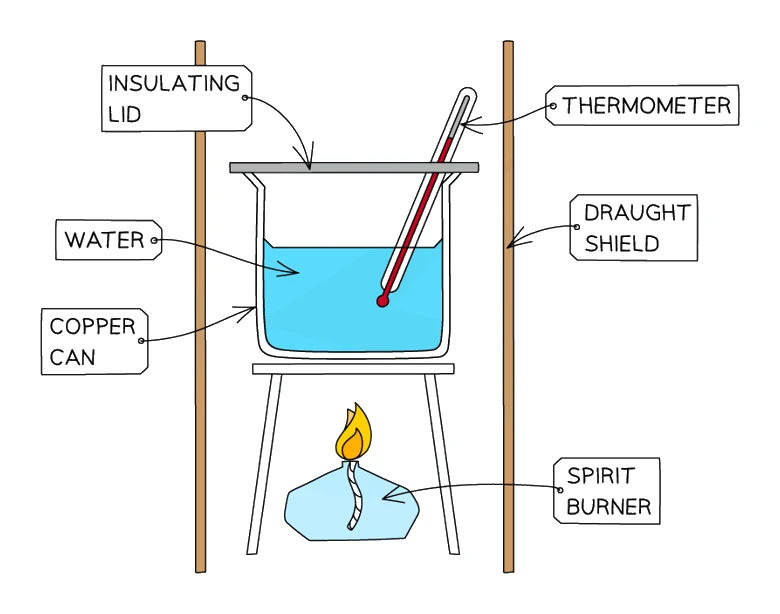
Calorimeter for combustion of a fuel
- Method:
- Weigh out a fixed mass of water inside a copper can, and clamp the can above the burner
- Weigh the spirit burner with the fuel; record the initial mass
- Read the starting temperature of the water against a thermometer dipping into the can
- Light the burner and stir the water gently
- When the water has risen by about 20 °C, blow out the flame and record the final temperature
- Re-weigh the burner; the loss in mass is the mass of fuel burnt
- Main sources of error:
- Heat lost to the surrounding air rather than to the water
- Heat absorbed by the copper can rather than the water
- Incomplete combustion (visible black soot on the underside of the can confirms this)
Common exam question
Why the measured value is lower than the data-book value
Question: Give reasons why the value of ΔH from the experiment is lower than the data-book value, or why the temperature reached is lower than the calculated maximum (1–2 marks).
Asked in 3 of the 23 papers. Any of these earns a mark: heat is lost to the surroundings (or to the apparatus), the fuel undergoes incomplete combustion, the metal can absorbs some of the heat, or some fuel evaporates instead of burning (or is impure). The solution version has one answer, heat lost to the surroundings, and "energy is lost" is ignored unless heat or thermal energy is named.
Two papers ask you to name the black solid on the base of the can, and one also asks why it forms: it is carbon (soot), made by incomplete combustion because the supply of air (oxygen) is limited.
3. Calculating energy changes
The heat-energy formula
Q = m c ΔT
- Q = heat energy transferred, in joules (J)
- m = mass of the substance being heated, in grams (g) — usually the mass of the solution, or the mass of water in a combustion experiment
- c = , the energy needed to raise the temperature of 1 g of substance by 1 °C. For water, c = 4.18 J g⁻¹ °C⁻¹
- ΔT = change in temperature, in °C (the same numerical value as the change in kelvin)
Common exam question
Calculating the heat energy change with Q = mcΔT
Question: Calculate, or show by calculation, the heat energy change Q in joules, given c = 4.2 J/g/°C and that 1 cm³ of solution weighs 1 g (2–4 marks, usually 2).
Asked in 10 of the 23 papers, once rearranged to find the temperature rise from a given Q. One mark is the substitution (mass × 4.2 × temperature change), one the answer; a correct answer with no working scores both, but in a "show that" question the rounded target is accepted only with the substitution shown. The mass is that of the liquid being heated: both solutions added together when two are mixed, the liquid alone when a solid is dropped in (its mass is not added), and the water in the can when a fuel burns, never the fuel. Any sign written on Q is ignored, a wrong temperature change still earns the rest by follow-through, and when kJ are wanted the ÷ 1000 is the last mark.
Worked example
Calculating heat energy from a neutralisation experiment
A student mixes 100 cm³ of sodium hydroxide solution with 22 cm³ of hydrochloric acid, and the temperature rises by 7 °C. Calculate the heat energy transferred to the solution (take c = 4.2 J g⁻¹ °C⁻¹).
Solution:
- M1: mass of solution = 100 + 22 = 122 g (add both volumes together; density ≈ 1 g cm⁻³)
- M2: Q = m × c × ΔT = 122 × 4.2 × 7
- M3: Q = 3586.8 J ≈ 3.59 kJ
Sign convention
- If the temperature rises, the reaction is exothermic and ΔH is negative
- If the temperature falls, the reaction is endothermic and ΔH is positive
- After computing Q with positive numbers, attach the correct sign at the end
Energy per gram and molar enthalpy of combustion
- For a fuel, the answers most often wanted are:
- Energy released per gram: Q ÷ (mass of fuel burnt)
- Energy released per mole (the ): ΔH = Q ÷ (moles of fuel)
- These two values make different fuels easy to compare
Common exam question
Calculating the molar enthalpy change in kJ/mol
Question: Calculate the molar enthalpy change, ΔH, in kJ/mol, from the heat energy change and the mass of reactant or fuel used, including a sign (3–5 marks).
Asked in 10 of the 23 papers, mostly on Paper 1. One mark a step: the moles of the substance (mass ÷ Mr, or the amount given), Q ÷ moles, the J to kJ conversion (at either stage), then the sign: negative when the temperature rose, positive when it fell. A correct signed answer without working scores full marks, but the sign is a mark on its own, so the right number unsigned loses the final mark.
For a fuel the mass burnt is the burner's loss in mass; the moles come from that and the fuel's Mr. Keep two or three significant figures in the moles: one scheme rejects moles cut to one figure, which shifts the answer. Give the significant figures asked for (two papers demand two); otherwise any number except one is accepted.
Worked example
Molar enthalpy change of combustion of a fuel
A spirit burner containing methanol, CH₃OH (Mr = 32), is weighed, used to heat 200 g of water in a copper can, and weighed again. The burner loses 0.80 g of methanol and the water temperature rises from 20.5 °C to 35.5 °C. Calculate the molar enthalpy change of combustion of methanol, in kJ/mol (c = 4.2 J/g/°C).
Solution:
- Temperature rise = 35.5 − 20.5 = 15.0 °C
- Q = m × c × ΔT = 200 × 4.2 × 15.0 = 12 600 J (the mass is the water's, not the fuel's)
- Moles of methanol burnt = 0.80 ÷ 32 = 0.025 mol
- Energy per mole = 12 600 ÷ 0.025 = 504 000 J/mol = 504 kJ/mol
- The temperature rose, so the reaction is exothermic: ΔH = −504 kJ/mol (−500 kJ/mol to 2 significant figures)
4. Energy level diagrams
What an energy level diagram shows
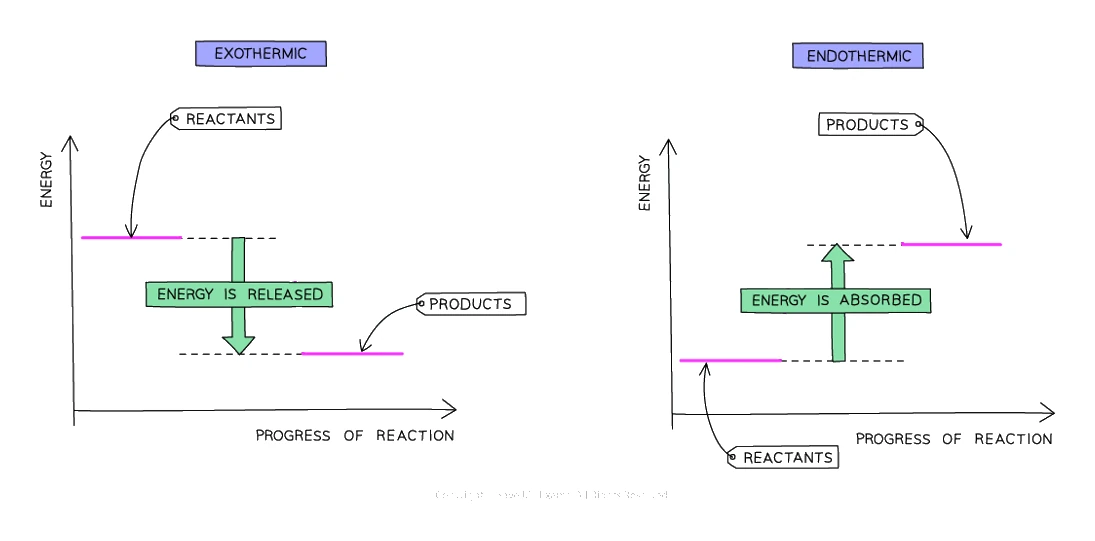
- An (sometimes called a reaction profile in later topics) plots the chemical energy of the species on the y-axis against the progress of reaction on the x-axis
- A flat horizontal line at the left marks the energy of the reactants
- A second flat horizontal line at the right marks the energy of the products
- A vertical arrow between the two lines indicates the , ΔH
Reading the two cases
| Diagram | Reactant level vs product level | Arrow direction | Sign of ΔH |
|---|---|---|---|
| Exothermic | Reactants higher than products | Arrow points down | ΔH negative |
| Endothermic | Reactants lower than products | Arrow points up | ΔH positive |
- The vertical gap between the two lines IS the magnitude of ΔH; longer arrows mean larger energy changes
Common exam question
Drawing or completing an energy level diagram
Question: Draw, or complete, a reaction profile or energy level diagram showing the reactants, the products, ΔH and sometimes the activation energy (2–4 marks).
Set in 7 of the 23 papers, all on Paper 2; sometimes the profile is printed and you add only the ΔH and Ea arrows. The marks: two horizontal levels with the products to the right and lower than the reactants (higher if endothermic); each level labelled with the formulae (the words reactants and products can cost a mark); and a vertical arrow between the levels labelled ΔH, double-headed or pointing from reactants to products, never from products back to reactants (rejected). For activation energy, draw a hump between the two lines and an arrow from the reactants level up to the peak labelled Ea; one drawn from the peak down to the reactants line is rejected.
Drawing the wrong type loses the mark for the products level's position; the ΔH arrow, hump and Ea arrow can still score. Axis labels and an unrequested hump are ignored.
5. Bond energy
Energy in to break bonds, energy out to make bonds
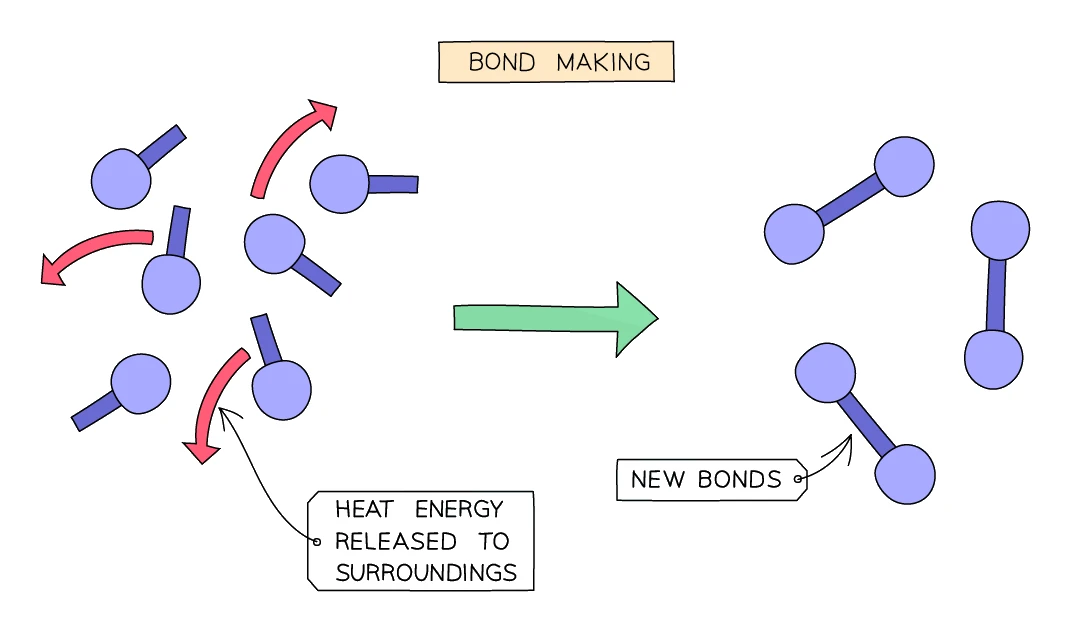
- During a reaction:
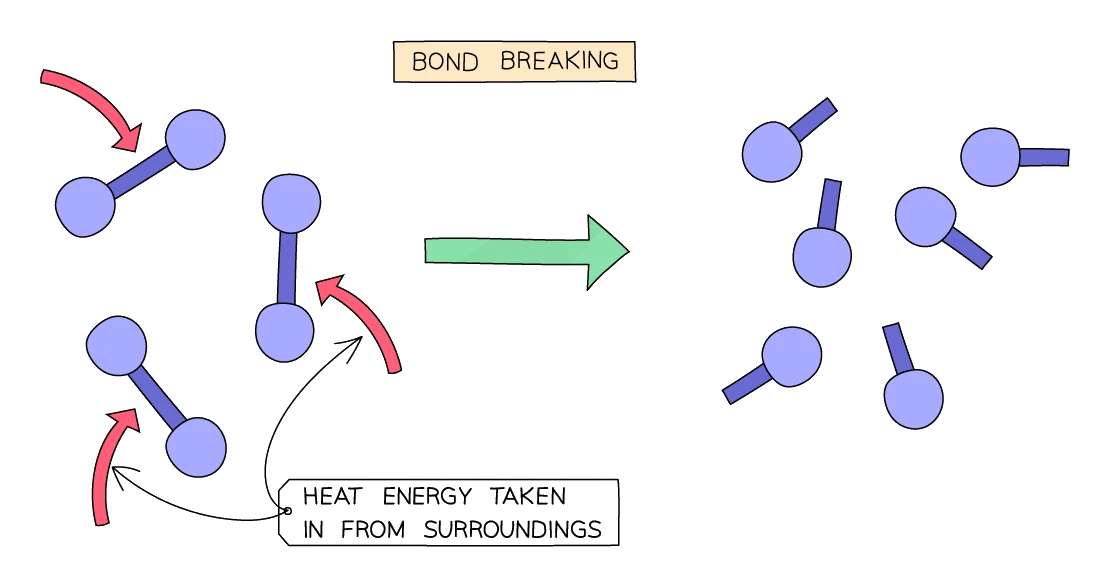
- Existing bonds in the reactants must be broken — this takes energy IN (an endothermic step)
- New bonds in the products are formed — this gives energy OUT (an exothermic step)
- Whether the overall reaction is exothermic or endothermic depends on which of these is larger:
- If energy released from forming new bonds > energy needed to break old bonds → exothermic (ΔH negative)
- If energy needed to break old bonds > energy released from forming new bonds → endothermic (ΔH positive)
- Mnemonic for the direction: bond breaking is the END of the bond, so it is END-othermic; bond making is EX-othermic
Bond energy values
- The of a given bond is the energy needed to break one mole of that bond, in the gas phase, in kilojoules per mole (kJ mol⁻¹)
- Bond energies are quoted in data books as positive values (the amount of heat that has to be supplied to snap that bond apart)
- Stronger bonds have larger bond energies (e.g. the triple bond N≡N is much larger than the single bond N−N)
Calculating ΔH from bond energies
- General method:
- Write out the equation with every bond shown explicitly (a "displayed formula")
- Energy in = sum of the bond energies of every bond in the reactants
- Energy out = sum of the bond energies of every bond in the products
- ΔH = (energy in) − (energy out)
- A negative answer means the products are at lower energy → exothermic; a positive answer → endothermic
Common exam question
Bond-energy calculations and the sign of ΔH
Question: Use the bond energies given and the displayed formulae to calculate the enthalpy change of the reaction, including a sign, or show that it is approximately the value stated (3–4 marks).
Set in 8 of the 23 papers, all on Paper 2. One mark is the total for the bonds broken, one for the bonds made, and the last is broken minus made with its sign; count each bond across every molecule in the equation. The totals are marked ignoring sign, but the final ΔH needs one: negative when more energy is released making bonds than taken in breaking them. Bonds unchanged by the reaction may be left out of both totals (either route is accepted).
For "show that", working must be shown and the bare target value scores nothing; when a value is asked for, a correct signed answer needs no working. Two papers reverse it, giving ΔH and asking for one bond energy (second worked example below).
Worked example
Calculating ΔH from bond energies
Hydrogen reacts with fluorine: H₂ + F₂ → 2HF. Use the bond energy data to calculate ΔH. Bond energies: H−H = 436 kJ/mol, F−F = 158 kJ/mol, H−F = 568 kJ/mol.
Solution:
- Energy in to break the bonds in the reactants = 436 (H−H) + 158 (F−F) = 594 kJ
- Energy out when the bonds in the products form = 2 × 568 (two H−F) = 1136 kJ
- ΔH = energy in − energy out = 594 − 1136 = −542 kJ/mol
- More energy is released forming the two H−F bonds than is taken in breaking H−H and F−F, so the reaction is exothermic
Worked example
Finding an unknown bond energy from ΔH
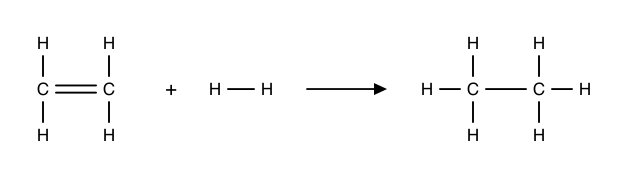
Ethene reacts with hydrogen to form ethane: C₂H₄ + H₂ → C₂H₆, ΔH = −124 kJ/mol. Bond energies: C=C = 612 kJ/mol, C−H = 412 kJ/mol, H−H = 436 kJ/mol. Calculate the bond energy of the C−C bond.
Solution:
- Bonds broken: one C=C, one H−H and four C−H, so 612 + 436 + (4 × 412) = 2696 kJ
- Bonds made: one C−C (call it x) and six C−H, so x + (6 × 412) = x + 2472 kJ
- ΔH = broken − made: −124 = 2696 − (x + 2472) = 224 − x
- x = 224 + 124 = 348 kJ/mol
- Quicker: only the bonds that change need counting, and 612 + 436 − (x + 2 × 412) = −124 gives the same x
Common exam question
Explaining why a reaction is exothermic using bond energies
Question: Explain, in terms of the bonds broken and the bonds made, why the reaction is exothermic (2–3 marks), or why its enthalpy change is zero (2 marks).
Set in 5 of the 23 papers, with the zero version in 2 more, all on Paper 2. The credited ideas: breaking bonds takes in energy (endothermic), making bonds releases energy (exothermic), and the comparison, more energy is released making the new bonds than is taken in breaking the old ones. On three marks each idea is a mark (the comparison mark depends on the first two), but a full comparison sentence on its own scores all the marks on either version. Reversing either direction (energy released on breaking, or needed for making) scores zero, and contradicting yourself caps the answer at one mark. Arguments about the number of bonds are ignored.
For the zero case (an ester forming or hydrolysing), say that the same bonds are broken and made, C−O and O−H, so the energy taken in equals the energy given out.
6. Practical: investigating temperature changes
Goal of the practical
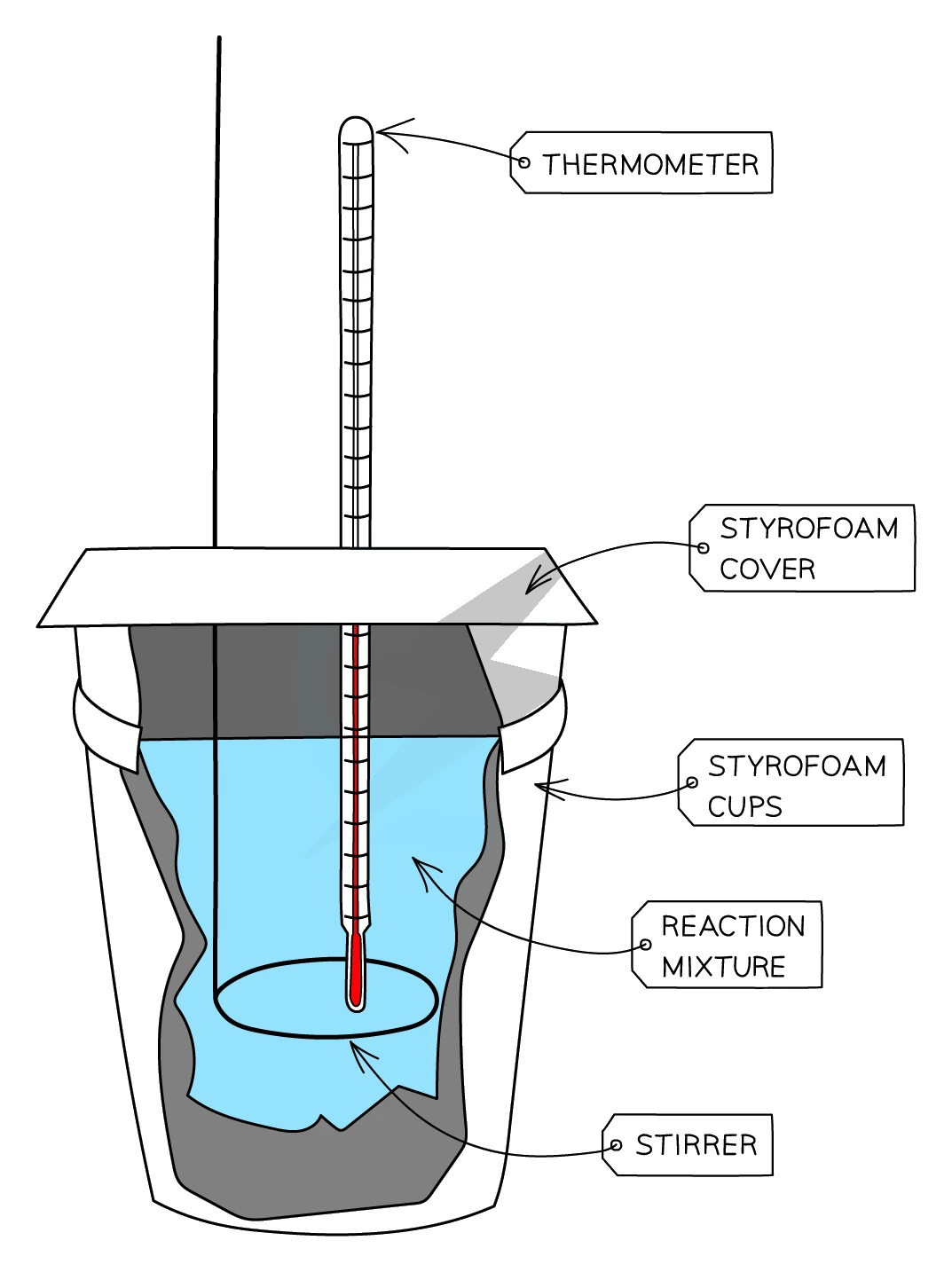
- Use a polystyrene-cup calorimeter to record how the temperature of a neutralisation reaction varies with the volume of one reactant added, and use the data to identify the volume that gives the largest temperature change
Apparatus
- 100 cm³ polystyrene cup with a fitted lid
- Thermometer (0–110 °C, 0.5 °C divisions) and stirring rod
- 25 cm³ measuring cylinder (×2: one for each reactant)
- 25 cm³ dilute sodium hydroxide solution per run
- Dilute hydrochloric acid (same concentration as the alkali)
Method
- Measure 25 cm³ of NaOH solution into the polystyrene cup and place on the bench in the cup-and-lid assembly
- Read the temperature once it has settled — this is Tstart
- Measure 5 cm³ of HCl with the second measuring cylinder, add it to the cup, fit the lid, and stir gently with the thermometer
- Read the highest temperature reached — this is Tmax
- Empty and dry the cup, then repeat the run with 10 cm³ of HCl, then 15, 20, 25, 30 and 35 cm³ — stepping past the expected equivalence point so the peak of the curve can be seen clearly
Sample results table
| Volume of HCl added / cm³ | Start temp / °C | Final temp / °C | ΔT / °C |
|---|---|---|---|
| 5 | 21.0 | 22.6 | +1.6 |
| 10 | 21.0 | 24.0 | +3.0 |
| 15 | 21.0 | 24.8 | +3.8 |
| 20 | 21.0 | 25.4 | +4.4 |
| 25 | 21.0 | 26.0 | +5.0 |
| 30 | 21.0 | 25.4 | +4.4 |
| 35 | 21.0 | 24.6 | +3.6 |
Common exam question
Explaining the shape of the temperature graph
Question: Use the graph of temperature change against volume added to find the maximum change, then explain the shape of the graph, or state how the results show the reaction is complete (1–3 marks).
Set in 2 of the 23 papers, once adding portions of alkali to an acid and once portions of a solid. The three marks of the explanation: the temperature rises steadily as more alkali is added; the peak (where the two straight lines cross) is the volume at which the acid is completely neutralised; beyond it the temperature falls because no further reaction happens and the added solution is cool. The maximum read off the graph is accepted within a small range.
For the solid version, the reaction is complete when the temperature stops changing (the last readings are the same), and the likely cause of an anomalous point is not stirring or reading the thermometer too soon; "adding too little solid" is rejected.
- Plot ΔT (y-axis) against volume of HCl added (x-axis) and draw a smooth curve
- The peak of the graph indicates the volume of HCl at which the largest temperature rise occurs — for equal concentrations of acid and alkali this should be at 1 : 1 stoichiometry (25 cm³ in this example)
- Past the peak, additional acid cools the mixture relative to the maximum because the extra acid is not warming up further but is mixing in at room temperature