1. Explaining conductivity
Why most covalent substances do not conduct
- An electric current is a flow of charged particles
- In a metal wire the moving charges are electrons
- In a molten or aqueous ionic substance the moving charges are ions
- Most covalent compounds have no charged particles that are free to move, so they do not conduct
- This makes them useful as electrical insulators in a wide range of forms
- Solid: the plastic sheathing on household wiring (poly(ethene), PVC)
- Liquid: silicone oils inside transformer cores
- Gas: sulfur hexafluoride (SF6) inside high-voltage switchgear
Why ionic compounds conduct only when molten or dissolved
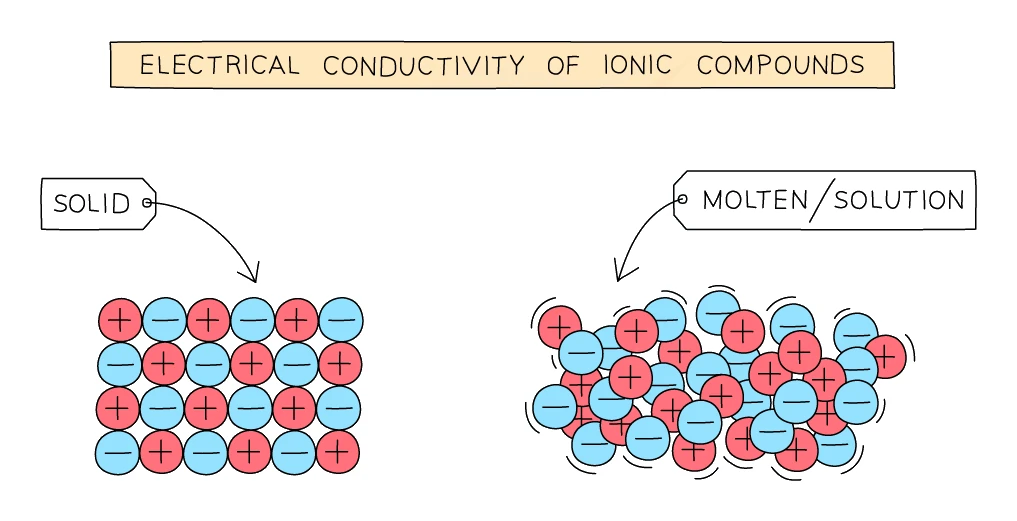
- In the solid state, the ions sit in fixed positions within the giant ionic lattice and cannot move past one another, so the solid does not conduct
- In the molten state, the lattice has broken down and the ions are free to move and carry charge through the liquid
- In aqueous solution, the water separates the ions from each other and the dissolved ions are again free to move and carry charge
- An ionic substance set up so that current can pass through it is called the
Common exam question
Why an ionic compound conducts only when molten or dissolved
Question: Explain why an ionic compound conducts electricity when molten or in solution but not when solid, or why the lamp lights only once the compound has melted (1–2 marks, or 4 with a metal to contrast).
Asked in 7 of the 23 papers. The credited ideas: the compound consists of ions, held in fixed positions in the lattice while solid; once melted or dissolved the ions are free to move and carry the current. Where a scheme makes it two marks, "ions" can be the mark the second one depends on, so name the ions before you say what moves.
Ionic conduction is ions moving, never electrons: an answer built on electrons flowing earns nothing, and five schemes reject it outright. If the question contrasts a metal with the compound, keep the carriers apart: the metal conducts through its delocalised electrons, the compound through its ions, and the wrong carrier on either side loses that mark.
Cations, anions, and the electrodes
- A cation is a positively charged ion (Na+, Mg2+, H+)
- An anion is a negatively charged ion (Cl−, O2−, SO42−)
- In an electrolysis cell, two electrodes dip into the electrolyte and are connected to a d.c. supply
- The cathode is the negative electrode
- The anode is the positive electrode
- Once the supply is switched on, the ions migrate toward the oppositely charged electrode
- Cations move to the
- Anions move to the
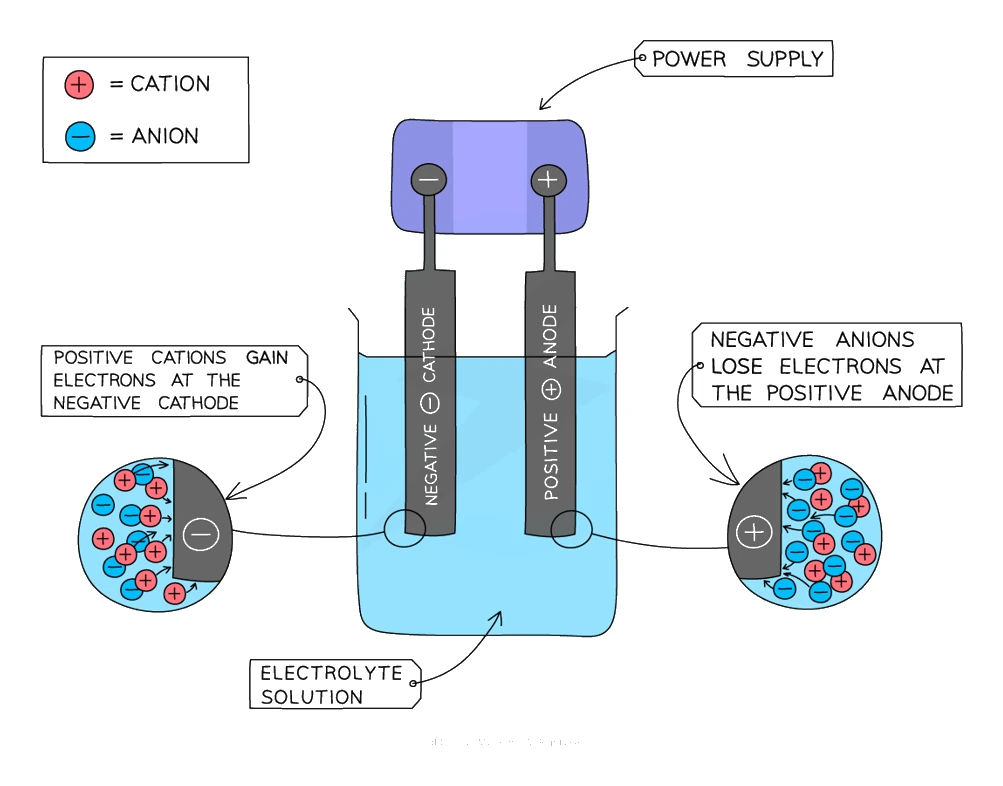
- Electrons flow in the external wire from the anode to the cathode, completing the circuit
2. Electrolysis experiments
Electrolysis of molten binary ionic compounds
- A binary ionic compound contains just two elements joined by ionic bonding (NaCl, PbBr2, MgO)
- When melted, all ions become free to move, so the molten compound is an
- During electrolysis of any molten binary compound, the products are simply the elements of the compound
- The metal cation is reduced at the cathode → the metal is deposited there
- The non-metal anion is oxidised at the anode → the non-metal is released there
Common exam question
Explaining how an element forms at an electrode
Question: Explain how sodium, copper, hydrogen or bromine forms at the named electrode during the electrolysis (2–4 marks).
Asked in 4 of the 23 papers, always as a chain of marks that follows one ion to the product. Give the steps in order: the ion's charge (copper ions are positive, bromide ions negative); so it is attracted to the oppositely charged electrode, which you name; there it gains electrons (cathode, reduction) or loses electrons (anode, oxidation); and becomes an atom. For a gas, add that the atoms join in pairs to form molecules. For hydrogen, say first that the water supplies the hydrogen ions.
A correct half-equation always earns the electron-transfer mark and usually one or two of the others, but never the attraction mark, so write the sentences too. Start from the ion, not the element: "sodium atoms are attracted to the cathode" is rejected, and muddling "bromide" with "bromine" is penalised.
More molten examples
- Molten potassium iodide, KI: potassium metal at the cathode, purple iodine vapour at the anode
- Molten magnesium oxide, MgO: magnesium metal at the cathode, colourless oxygen gas at the anode
- Molten aluminium oxide, Al2O3 (dissolved in cryolite to lower the melting point): aluminium at the cathode, oxygen at the anode — the basis of industrial aluminium extraction
Electrolysis of aqueous solutions
- An aqueous solution contains the dissolved compound's ions plus ions from water
- Water self-ionises slightly: H2O ⇌ H+ + OH−
- The cell contains four kinds of ion (metal cation, non-metal anion, H+, OH−) so which ion is discharged at each electrode has to be worked out
- At the (positive ion arrives), the choice is between the metal ion and H+
- The less reactive of the two is discharged
- If the metal is above hydrogen in the reactivity series, hydrogen gas is produced and the metal ion stays in solution
- If the metal is below hydrogen (Cu, Ag), the metal is deposited
- At the (negative ion arrives), the choice is between the non-metal anion and OH−
- If the solution contains a halide ion (Cl−, Br−, I−), the halide is discharged and the corresponding halogen (Cl2, Br2, I2) is released
- If no halide ion is present, oxygen is produced from water (sulfate, nitrate and similar polyatomic anions stay in solution)
Predicting products for the three required aqueous examples
| Solution | Cathode product | Anode product |
|---|---|---|
| Sodium chloride, NaCl(aq) | Hydrogen (Na is above H) | Chlorine (halide present) |
| Dilute sulfuric acid, H2SO4(aq) | Hydrogen | Oxygen (no halide) |
| Copper(II) sulfate, CuSO4(aq) | Copper (Cu is below H) | Oxygen (no halide) |
Common exam question
Why hydrogen and not sodium forms at the cathode
Question: Give a reason why hydrogen, rather than sodium, is produced at the negative electrode when sodium chloride solution is electrolysed (1 mark).
Asked in 2 of the 23 papers. The mark is a comparison of reactivity, either way round: sodium is more reactive than hydrogen, or hydrogen is less reactive and below sodium in the reactivity series. Answering with the ions is also accepted: hydrogen ions are more easily reduced than sodium ions. One scheme also lets "hydrogen ions are discharged" through, but the reactivity comparison is credited by both.
The discharged hydrogen ions come from the water, so hydroxide ions are left behind and the solution near the cathode turns alkaline: a follow-up asks why universal indicator goes blue or purple there, one mark for the colour, one for the hydroxide ions (or sodium hydroxide) present. In a solution of a salt or an acid, the hydroxide ions come from the water; "because the solution is alkaline" is rejected as their source.
3. Writing half-equations
Oxidation and reduction in terms of electrons
- is loss of electrons. is gain of electrons. (mnemonic: OIL RIG)
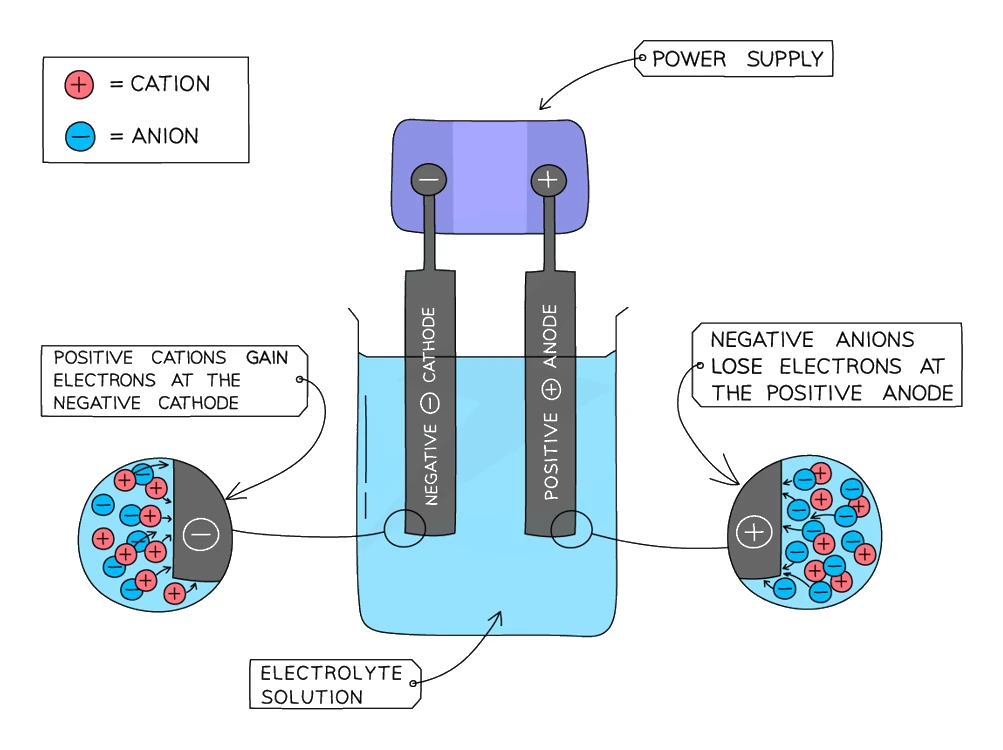
- At the anode, anions lose electrons → oxidation
- At the cathode, cations gain electrons → reduction
- A writes out the change at one electrode, showing the species, the electrons (e−), and the product
- The charge on each side of a half-equation must balance
Common exam question
Why an electrode reaction is oxidation or reduction
Question: State why the reaction shown by a given half-equation is an oxidation reaction, or a reduction reaction (1 mark).
Asked in 4 of the 23 papers, always for one mark and always answered in terms of electrons: oxidation because electrons are lost, reduction because electrons are gained. "Electrons are lost" on its own is enough. If you name the species, name the ion that changes: chloride ions lose electrons, magnesium ions gain electrons. "Chlorine loses electrons", "bromine loses electrons" and "magnesium gains electrons" are all rejected, because the element is the product, not the species that transfers the electrons. When oxygen forms from water, "water loses electrons" is accepted. An answer about gaining or losing oxygen is rejected.
Molten lead(II) bromide
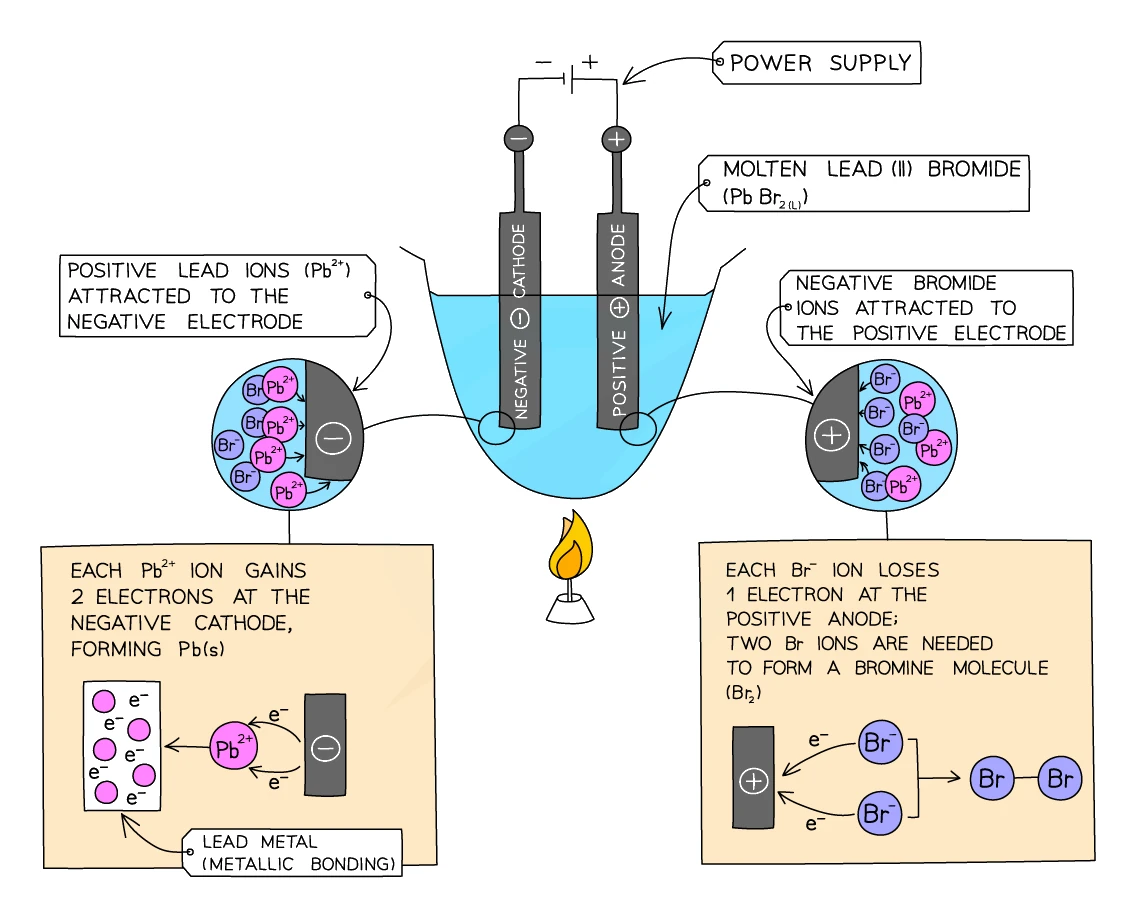
- Cathode: Pb2+ + 2e− → Pb (reduction)
- Anode: 2Br− → Br2 + 2e− (oxidation)
- Observations: silvery-grey molten lead collects at the cathode and red-brown bromine vapour is released at the anode
Aqueous sodium chloride
- Cathode: 2H+ + 2e− → H2
- Anode: 2Cl− → Cl2 + 2e−
Dilute sulfuric acid
- Cathode: 2H+ + 2e− → H2
- Anode: 2H2O → O2 + 4H+ + 4e−
- Water (not OH−) is the oxidised species because the solution is acidic and contains almost no OH−
Aqueous copper(II) sulfate
- Cathode: Cu2+ + 2e− → Cu
- Anode: 2H2O → O2 + 4H+ + 4e−
Common exam question
Writing an ionic half-equation for an electrode
Question: Write, or complete, the ionic half-equation for the product formed at the anode or cathode (1–2 marks).
Asked in 9 of the 23 papers, the most common electrolysis question. The species being discharged on the left, the product on the right, balance the atoms, then add electrons to balance the charge: on the left at a cathode (2H⁺ + 2e⁻ → H₂), on the right at an anode (2Cl⁻ → Cl₂ + 2e⁻). Electrons subtracted on the left (2Cl⁻ − 2e⁻ → Cl₂), multiples and fractions are all accepted.
State symbols are ignored, even when wrong, unless asked for; then they are the second of two marks, still earned by follow-through if the charge or balancing is wrong. The oxygen equation usually carries two marks, the first for the right species, the second for the balanced equation. Two correct equations against the wrong electrodes score one of two.
Worked example
Balancing the half-equation for oxygen at the anode
Dilute sodium sulfate solution is electrolysed with inert electrodes and oxygen is given off at the anode. Give the half-equation for the oxygen, starting from water.
Solution:
- Sulfate ions are not discharged, so the oxygen comes from water, which is oxidised to oxygen gas and hydrogen ions: H₂O → O₂ + H⁺ (not yet balanced)
- Balance the oxygen atoms: 2H₂O → O₂ + H⁺ (two on each side)
- Balance the hydrogen atoms: 2H₂O → O₂ + 4H⁺ (four on each side)
- Balance the charge: the left is neutral and the right is 4+, so four electrons are given up: 2H₂O → O₂ + 4H⁺ + 4e⁻
- Check: the right is (+4) + (−4) = 0, matching the left, and electrons on the right confirm that this is oxidation
- 2H₂O → O₂ + 4H⁺ + 4e⁻
The same working from hydroxide ions gives 4OH⁻ → O₂ + 2H₂O + 4e⁻, which earns the same marks when the question does not fix the starting species; when it prints 2H₂O as the start, the hydroxide version scores only one.
4. Practical: investigating the electrolysis of aqueous solutions
Goal of the practical
- Pass a current through aqueous NaCl, dilute H2SO4 and CuSO4, then collect and test whatever is released at the cathode and the anode for each electrolyte
Apparatus and method
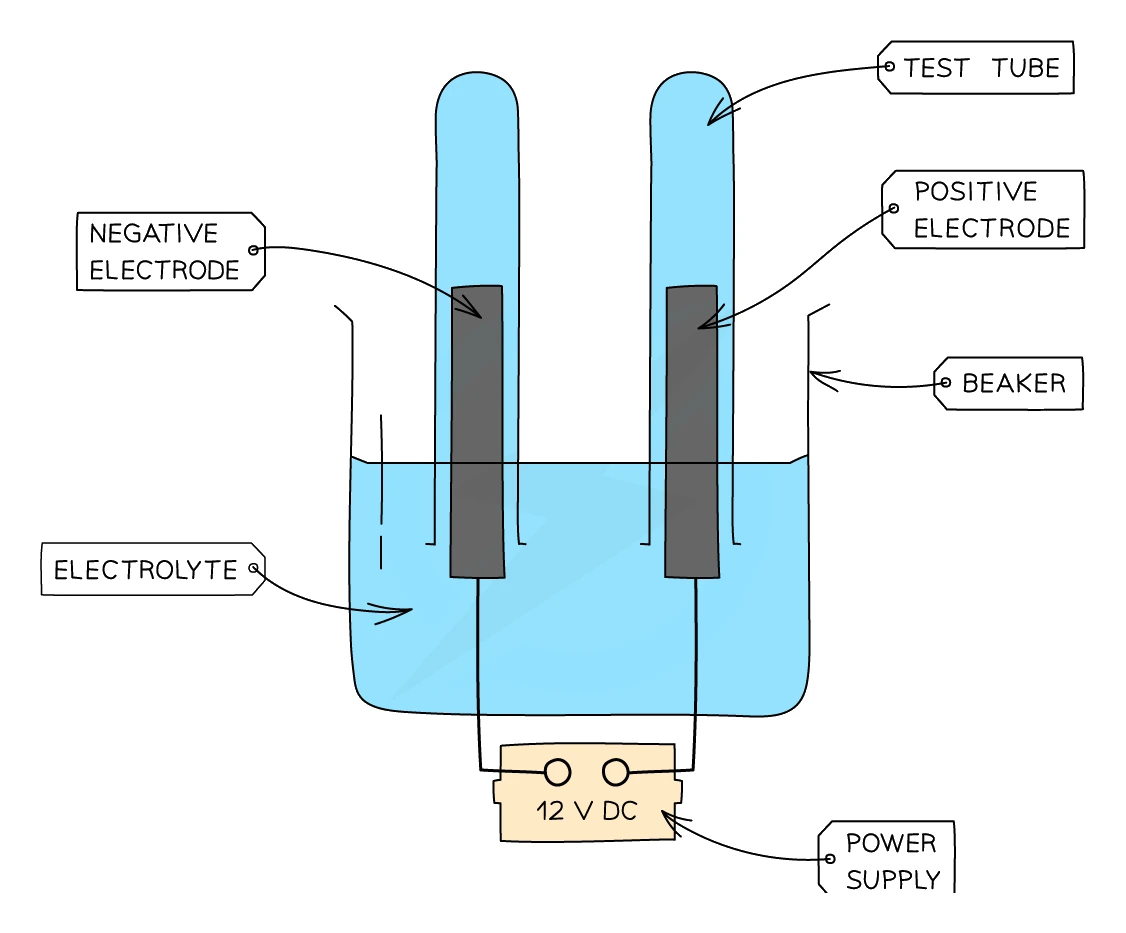
- A beaker containing the solution to be electrolysed
- Two inert graphite electrodes dipping into the liquid, connected to a low-voltage d.c. power supply
- Two small test tubes are filled with the same solution and inverted over the electrodes so that any gas produced collects inside them
- Switch on the supply, allow electrolysis to proceed until enough gas (or solid) has formed, then switch off and test the products
Exam tip
Electrode material, gas collection and the mass-time graph
Name platinum or graphite when asked for a material for inert electrodes (silver and gold are also accepted). To collect a pure sample of a gas, fill a test tube with the electrolyte (or water), invert it over the electrode and let the gas displace the liquid; any two of those three steps earn the two marks. If the mass gained by the cathode in copper(II) sulfate solution is plotted against time, the curve rises while copper deposits and levels off once all the copper(II) ions have been discharged, one mark for each part of the shape.
Identifying the products
- A gas that gives a pop with a lighted splint is hydrogen
- A gas that relights a glowing splint is oxygen
- A gas that bleaches damp blue litmus paper is chlorine
- A solid coating that builds up on the cathode is the metal — its colour is a clue to its identity (pink-brown for copper)
Common exam question
Gas tests and observations at the electrodes
Question: Give a test to show that the gas at an electrode is oxygen or hydrogen, or state what you would see at a named electrode (1 mark each).
A gas test is asked in 4 of the 23 papers and an observation in 3. Oxygen relights a glowing splint; hydrogen gives a squeaky pop with a lighted splint, and "glowing splint" for hydrogen is rejected. Chlorine bleaches damp litmus paper.
For what you would see, describe the appearance, not the identity: bubbles (effervescence) at an anode giving off a gas, since "oxygen" or "gas" alone is ignored; brown, orange or orange-brown vapour when bromine forms from molten lead(II) bromide; and a pink, pink-brown or brown solid coating the cathode in copper(II) sulfate solution. "Red" is rejected for copper, and so is "precipitate": the copper is a deposit on the electrode, not a solid formed in the solution.
Results
| Electrolyte | At the cathode | At the anode |
|---|---|---|
| Sodium chloride | Colourless gas, pops with a lighted splint (hydrogen) | Pale yellow-green gas, bleaches damp blue litmus (chlorine) |
| Dilute sulfuric acid | Colourless gas, pops with a lighted splint (hydrogen) | Colourless gas, relights a glowing splint (oxygen) |
| Copper(II) sulfate | Pink-brown solid builds up on the electrode (copper) | Colourless gas, relights a glowing splint (oxygen) |