Chemical Formulae, Equations and Calculations
Chemistry revision notes · Edexcel · 4CH1
1. Word equations and balanced symbol equations
Conservation of mass
- During a chemical reaction, atoms are rearranged but never created or destroyed
- This is the law of conservation of mass: the total mass of reactants equals the total mass of products
- It is why every chemical equation must be balanced
Word equations
- A word equation uses the full chemical names of the substances involved:
reactants → products
- The left of the arrow shows the reactants (the starting substances)
- The right of the arrow shows the products (the new substances formed)
- The arrow (→) is read as "produces" or "reacts to give"
- Reaction conditions (e.g. heat, the name of a catalyst) can be written above the arrow
Example. Magnesium burns in oxygen to form magnesium oxide:
magnesium + oxygen → magnesium oxide
Symbol (chemical) equations
- A symbol equation uses chemical formulae instead of full names
- Three rules to remember:
- The diatomic non-metals must be written as molecules: H₂, N₂, O₂, F₂, Cl₂, Br₂ and I₂
- can be written in brackets after each formula:
- (s) = solid
- (l) = liquid
- (g) = gas
- (aq) = aqueous (dissolved in water)
- The equation must be balanced — the same number of each kind of atom must appear on both sides
Example (combustion of sulfur):
S (s) + O₂ (g) → SO₂ (g)
Balancing equations
- Work across the equation from left to right, checking each element in turn
- Adjust the coefficient (the number written in front of each formula) until the counts match on both sides
- Never change the subscripts inside a formula — that would change what the substance is. Adding a 2 to make H₂O into H₂O₂ turns water into hydrogen peroxide
- Treat polyatomic groups that survive the reaction unchanged (NO₃⁻, SO₄²⁻, CO₃²⁻, etc.) as single units rather than counting their individual atoms
- Balance any element that appears on its own last
Example. Balancing the combustion of methane:
CH₄ + O₂ → CO₂ + H₂O
- Carbon: 1 on each side ✓
- Hydrogen: 4 on the left, only 2 on the right → put a 2 in front of H₂O:
CH₄ + O₂ → CO₂ + 2H₂O
- Oxygen: 2 on the left, now 4 on the right (2 from CO₂ + 2 from 2H₂O) → put a 2 in front of O₂:
CH₄ + 2O₂ → CO₂ + 2H₂O
- Re-check: C 1 = 1, H 4 = 4, O 4 = 4 ✓
Common exam question
Writing a chemical equation and its state symbols
Question: Write, complete or balance the chemical equation for a reaction described in words, or add the state symbols to a printed equation (1–2 marks).
An equation to write or balance is set on 19 of the 23 papers. For two marks, the first is for the correct formula of every substance and the second for balancing, and the second depends on the first, so check each formula (diatomic O₂, H₂ and Cl₂; the ion ratio in a salt) before the numbers in front. Multiples and fractions, such as 3½O₂, are accepted. State symbols that were not asked for are ignored even when wrong.
State symbols are asked for on 12 of the 23 papers, for one or two marks. Every solution, including a dilute acid, is (aq); water is (l), though (g) is also accepted for steam leaving a hot reaction; capital letters are allowed. Give (l) only to a pure liquid, never to a solution.
2. Relative formula mass (Mr)
- The (Mr) of a substance is the sum of the relative atomic masses of every atom in its chemical formula
- The relative atomic mass (Ar) of each element is read from the periodic table (it's the larger of the two numbers in each box)
- For an element written as just its symbol (e.g. Fe), Mr = Ar
- For a compound, multiply each Ar by the number of atoms of that element in the formula, then add the products
| Substance | Atoms present | Calculation | Mr |
|---|---|---|---|
| H₂O | 2 H + 1 O | (2 × 1) + 16 | 18 |
| CO₂ | 1 C + 2 O | 12 + (2 × 16) | 44 |
| CaCO₃ | 1 Ca + 1 C + 3 O | 40 + 12 + (3 × 16) | 100 |
| H₂SO₄ | 2 H + 1 S + 4 O | (2 × 1) + 32 + (4 × 16) | 98 |
| Mg(NO₃)₂ | 1 Mg + 2 N + 6 O | 24 + (2 × 14) + (6 × 16) | 148 |
- By the law of conservation of mass, the total Mr on the reactant side (with each Mr multiplied by its coefficient) equals the total Mr on the product side
Common exam question
Counting atoms and calculating a relative formula mass
Question: Calculate the relative formula mass (Mr) of a compound from its formula, or give the number of atoms, or of different elements, in the formula (1–2 marks).
An Mr calculation is on 11 of the 23 papers and an atom or element count on 9. For Mr, multiply each relative atomic mass by the number of that atom and add them: a one-mark version wants only the total; a two-mark version gives one mark for the written sum and one for the total; one scheme followed a wrong sum through to the total mark and another did not, so get the sum right. Units are ignored. Brackets are the trap: in Mg(NO₃)₂ everything inside the bracket is doubled, and a sum that leaves the bracket undoubled loses the first mark and keeps the second only where the total is followed through from your own sum.
For the counts, add every subscript for the atoms (a dot formula's water counts too: CuSO₄·5H₂O has 21 atoms) and count each element symbol once for the elements (four in that formula). "Different elements" and "atoms" are different numbers.
Worked example
Mr of a compound containing brackets
A student needs the relative formula mass of calcium hydroxide, Ca(OH)₂. Calculate it.
Solution:
- Identify all atoms: 1 Ca, and the bracket (OH)₂ means 2 O and 2 H
- Ar values: Ca = 40, O = 16, H = 1
- Mr = (1 × 40) + (2 × 16) + (2 × 1)
- Mr = 40 + 32 + 2 = 74
3. The mole and mass conversions
What a mole is
- A (symbol mol) is the chemist's unit for counting chemical particles
- One mole of any substance always contains exactly the same number of particles — the Avogadro constant:
- The "particles" can be atoms, molecules, ions, electrons or formula units — whichever the substance is made of
- 1 mole of helium (He) → 6.02 × 10²³ atoms
- 1 mole of water (H₂O) → 6.02 × 10²³ molecules
- 1 mole of sodium chloride (NaCl) → 6.02 × 10²³ formula units
Molar mass
- The molar mass is the mass, in grams, of one mole of a substance
- Numerically:
- For an element, molar mass = Ar in grams
- For a compound, molar mass = Mr in grams
- Examples:
- 1 mol of carbon (Ar = 12) weighs 12 g
- 1 mol of water (Mr = 18) weighs 18 g
- 1 mol of sodium chloride (Mr = 58.5) weighs 58.5 g
Converting between mass and moles
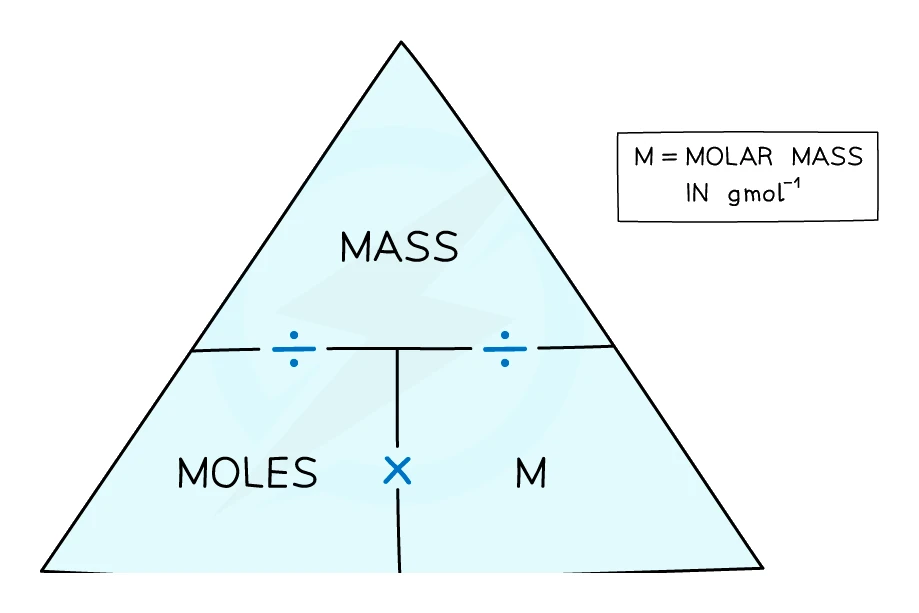
- The key relationship is:
- where n = number of moles, m = mass in grams, and Mr = molar mass in g/mol
- Rearranged:
- mass = moles × Mr
- Mr = mass ÷ moles
Example. How many moles are in 5.0 g of NaOH?
- Mr(NaOH) = 23 + 16 + 1 = 40
- n = 5.0 / 40 = 0.125 mol
Example. What is the mass of 2.5 mol of glucose, C₆H₁₂O₆?
- Mr(C₆H₁₂O₆) = (6 × 12) + (12 × 1) + (6 × 16) = 180
- m = 2.5 × 180 = 450 g
Common exam question
Counting particles with the Avogadro constant
Question: Given that one mole contains 6.0 × 10²³ particles, calculate the number of atoms, molecules or electrons in a stated mass or amount, or the mass of one atom (2–3 marks).
Set in 6 of the 23 papers. Find the moles first, from mass ÷ Mr or from the equation, then multiply by the value of the constant the question quotes, which may be 6.0, 6.02 or 6.022 × 10²³. The last mark is often for the form of the answer: standard form, or the number of significant figures the question names. A correct answer with no working scores in full. The mark most often lost is a factor that comes from the formula or the equation: five waters in each formula unit, sixty atoms in each molecule, an Mr of 2 (not 1) for hydrogen gas. Going the other way, the mass of one atom is the molar mass divided by the constant.
Exam tip
Working, significant figures and standard form
In every calculation on these papers a correct final answer scores full marks even without working, but the working is what earns credit when the answer is wrong, and a slip can only be carried forward if the later steps are on the page. Round nothing until the end: a value given to one significant figure is penalised, and so is incorrect rounding. When the question says "to three significant figures" or "in standard form", that instruction is the final mark, and an answer written out in full instead of in standard form has stopped at two of three marks.
4. Reacting masses and percentage yield
Reacting masses
- A balanced equation tells you the ratio in which substances react
- Using that ratio, you can work out the mass of any product (or reactant) from the mass of any other species in the reaction
The three-step recipe:
- Find the moles of the substance you are given (mass ÷ Mr)
- Use the equation's mole ratio to convert to moles of the substance you want
- Convert moles back to mass (moles × Mr)
Example. What mass of magnesium oxide forms when 2.4 g of magnesium burns completely in oxygen?
2Mg + O₂ → 2MgO
- Moles of Mg = 2.4 / 24 = 0.10 mol
- Mole ratio Mg : MgO = 2 : 2 = 1 : 1, so 0.10 mol of MgO is formed
- Mr(MgO) = 24 + 16 = 40, so mass of MgO = 0.10 × 40 = 4.0 g
Percentage yield
- The actual yield is the mass of product you actually recover in the lab
- The theoretical yield is the mass that would form if the reaction went perfectly with no loss — calculated from the balanced equation and reacting masses
- The compares the two:
- Yields are never 100 % in practice. Common reasons:
- Some of the reactant is left unreacted
- The reaction is a reversible reaction so the products partially turn back into reactants
- Product is lost during filtration, washing, drying or transfer between vessels
- Side reactions form other products you didn't want
Example. A student decomposes 10.0 g of calcium carbonate by heating:
CaCO₃ (s) → CaO (s) + CO₂ (g)
They recover 4.5 g of calcium oxide. What is the percentage yield?
- Mr(CaCO₃) = 100, Mr(CaO) = 56
- Theoretical: moles of CaCO₃ = 10.0 / 100 = 0.10 mol → 0.10 mol of CaO → 0.10 × 56 = 5.6 g theoretical
- Percentage yield = (4.5 / 5.6) × 100 = 80.4 %
Common exam question
Calculating a maximum mass and a percentage yield
Question: Use the equation to calculate the maximum mass of a product from a given mass or amount of reactant, sometimes in tonnes, and then the percentage yield from the mass actually obtained (2–4 marks).
A maximum-mass calculation is on 7 of the 23 papers and a percentage yield on 5. The marks follow the three steps: moles of the given substance (mass ÷ Mr), the mole ratio from the equation, then moles × Mr of the product. Skipping the ratio, the commonest slip, costs exactly one mark: an answer double or half the right value keeps the rest. Any number of significant figures is accepted except one. Tonnes can be converted to grams (× 10⁶) or kept throughout.
For the yield, one mark is for the theoretical mass (or moles) and one for actual ÷ theoretical × 100. Dividing the actual mass by the moles of reactant instead of by the theoretical mass scores nothing.
Worked example
Showing that a reactant is in excess
A mass of 2.0 g of calcium carbonate is added to 50 cm³ of dilute hydrochloric acid containing 0.050 mol of HCl. Show by calculation that the acid is in excess.
CaCO₃ + 2HCl → CaCl₂ + H₂O + CO₂ (Mr of CaCO₃ = 100)
Solution:
- Moles of CaCO₃ = 2.0 ÷ 100 = 0.020 mol
- The equation needs 2 mol of HCl for every 1 mol of CaCO₃, so 0.020 mol of CaCO₃ needs 2 × 0.020 = 0.040 mol of HCl
- 0.050 mol of HCl is present, which is more than 0.040 mol, so the acid is in excess
The other route scores equally: 0.050 mol of HCl could react with 0.025 mol of CaCO₃, which is 2.5 g, more than the 2.0 g used. Whichever you choose, the second mark is the comparison, so compare the same kind of quantity (moles with moles, or grams with grams) and end by stating which reactant is in excess.
5. Empirical and molecular formulae
Definitions
- The gives the actual number of each kind of atom in one molecule of the substance
- e.g. ethanoic acid: C₂H₄O₂
- The gives the simplest whole-number ratio of the atoms
- e.g. ethanoic acid: CH₂O
- For organic molecules, the empirical formula and the molecular formula are often different
- For ionic compounds, the formula given (e.g. NaCl, MgCl₂) is always the empirical formula
Common exam question
Empirical formula from a molecular formula
Question: Give the empirical formula of a compound whose molecular formula is shown, or explain what the term means using that compound as the example (1–2 marks).
Set in 6 of the 23 papers. Divide every subscript by the highest common factor: C₆H₁₂O₆ becomes CH₂O, and the symbols may be written in any order. When the subscripts share no factor, as in C₃H₈, the empirical and molecular formulae are the same. For the definition, the mark is for the simplest whole-number ratio of the atoms of each element, and a second mark, when asked, is for applying it to the compound named. A related one-mark question asks why every alkene has the empirical formula CH₂: because the number of hydrogen atoms is always double the number of carbon atoms.
Calculating an empirical formula
Use a table to keep the working tidy:
- List each element in its own column
- Write the mass (or % by mass) of each
- Write each element's Ar
- Calculate moles = mass ÷ Ar
- Divide every mole value by the smallest — this gives the simplest ratio
- If the ratio isn't whole numbers, multiply all values by the same factor (×2, ×3, etc.) until they are
Example. A 24 g sample of magnesium burns fully and the magnesium oxide formed weighs 40 g. Find its empirical formula.
| Mg | O | |
|---|---|---|
| Mass / g | 24 | 40 − 24 = 16 |
| Ar | 24 | 16 |
| Moles | 24 / 24 = 1 | 16 / 16 = 1 |
| Divide by smallest | 1 | 1 |
Empirical formula: MgO
Example. A compound contains 40.0 % carbon, 6.7 % hydrogen and 53.3 % oxygen by mass. Find its empirical formula.
| C | H | O | |
|---|---|---|---|
| % mass | 40.0 | 6.7 | 53.3 |
| Ar | 12 | 1 | 16 |
| Moles | 40.0 / 12 = 3.33 | 6.7 / 1 = 6.7 | 53.3 / 16 = 3.33 |
| Divide by smallest (3.33) | 1 | 2 | 1 |
Empirical formula: CH₂O
Common exam question
Empirical formula from percentages or masses
Question: Given the percentage composition by mass, or the masses of each element from an experiment, calculate the empirical formula, sometimes then the molecular formula from a given Mr (2–4 marks).
The most common calculation in the topic, on 12 of the 23 papers. Divide each mass or percentage by the element's relative atomic mass (first mark), divide the results by the smallest (second) and write the formula (third). Dividing by atomic numbers, or the Ar by the mass, scores nothing for those marks; in the practical version only the first mark, for the masses from the weighings, survives. When the ratio is not whole, multiply through: 1 : 1.33 becomes 3 : 4. Keep at least two significant figures in the mole values. A correct formula alone scores full marks. For the molecular formula, divide the given Mr by the empirical formula's Mr and multiply every subscript by the result (one or two further marks).
Calculating a molecular formula
- A molecular formula is always a whole-number multiple of the empirical formula
- To find it, the question must also give the actual Mr of the compound
Procedure:
- Calculate Mr of the empirical formula
- Divide: n = (real Mr) ÷ (empirical Mr)
- Multiply every subscript in the empirical formula by n
Example. A compound has empirical formula CH₂O and Mr = 180. Find its molecular formula.
- Mr(CH₂O) = 12 + 2 + 16 = 30
- Multiplier: 180 / 30 = 6
- Molecular formula: C₆H₁₂O₆ (glucose)
Practical: formula of magnesium oxide
Aim. Find the empirical formula of magnesium oxide by burning a known mass of magnesium in air.
Method:
- Weigh the empty crucible with its lid
- Add a coil of clean magnesium ribbon (around 10 cm); reweigh the crucible + lid + ribbon; calculate the mass of magnesium used
- Heat strongly with a Bunsen burner. Lift the lid briefly every few seconds so that more air (oxygen) can reach the ribbon, but lower it again quickly so very little white magnesium oxide smoke escapes
- Continue heating until no further glow can be produced and the mass has stopped changing
- Allow the crucible to cool and reweigh; calculate the mass of magnesium oxide formed
Calculation: apply the empirical-formula procedure with the two columns "Mg" and "O":
- mass of Mg from step 2
- mass of O = (mass of MgO) − (mass of Mg)
- moles of each = mass ÷ Ar
- simplest mole ratio → empirical formula
Typical result: ratio Mg : O = 1 : 1, so the formula is MgO.
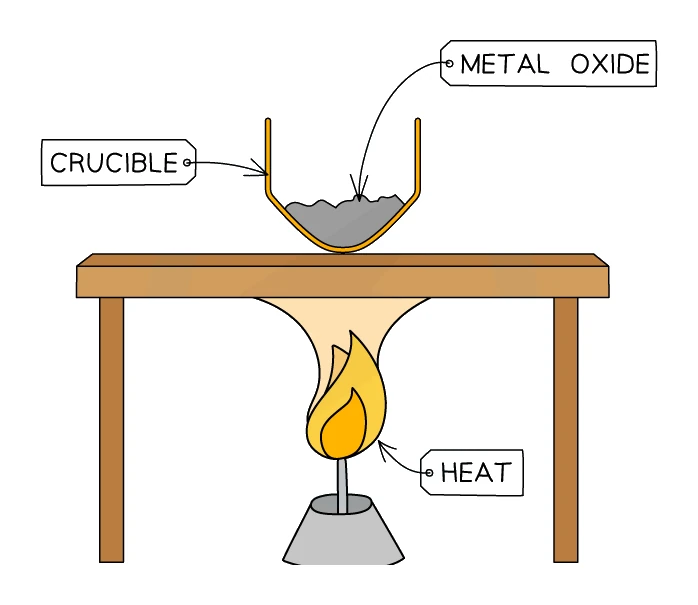
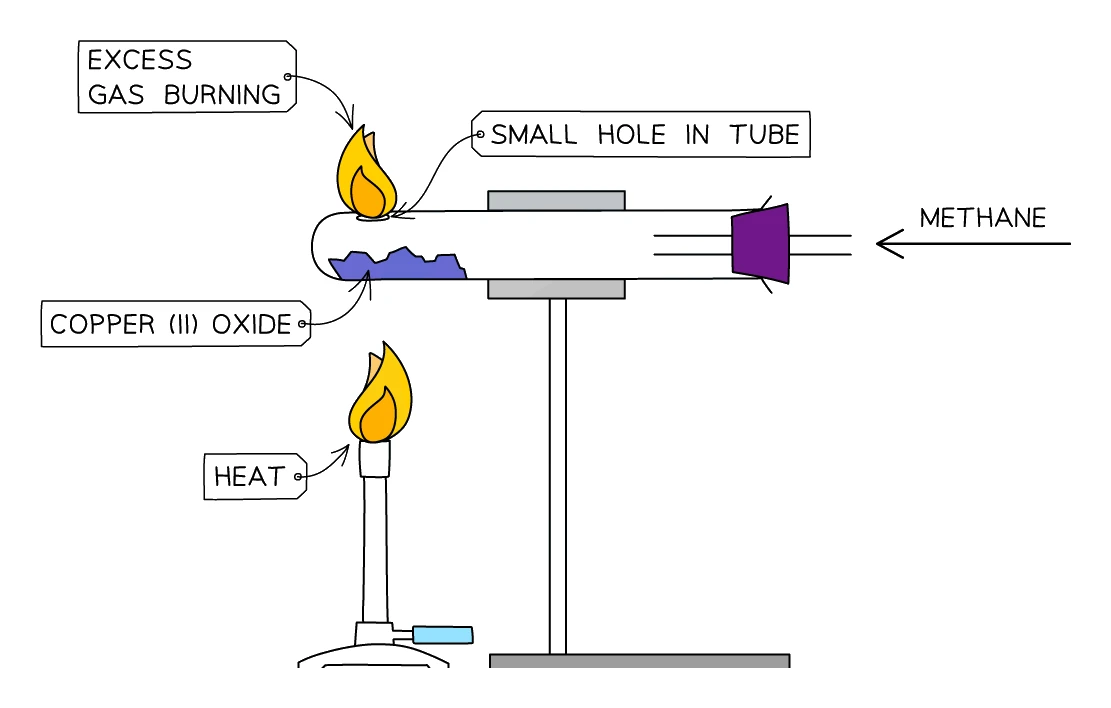
The specification allows the formula of a metal oxide to be found by combustion, as here, or by reduction, for example passing a stream of methane or hydrogen over heated copper(II) oxide so that the oxygen is removed; the mass lost gives the mass of oxygen and the mass remaining gives the mass of copper, which are then turned into a mole ratio in the same way.
Common exam question
Heating to constant mass
Question: Describe what the student should do to make sure all the water has been driven off (or the oxide fully reduced or oxidised), or state how the results show that the reaction is complete (1–2 marks).
Asked on 9 of the 23 papers, across the hydrated salt, magnesium oxide and metal oxide reduction practicals. The two-mark answer is two actions: heat again and reweigh, then repeat until the mass no longer changes; the phrase "heat to constant mass" earns both marks on its own. If the question asks why the heating is repeated, the reason is to make sure all the water has been given off, or that the reaction is complete. When a results table gives the mass at intervals, the reaction is finished where consecutive readings are the same.
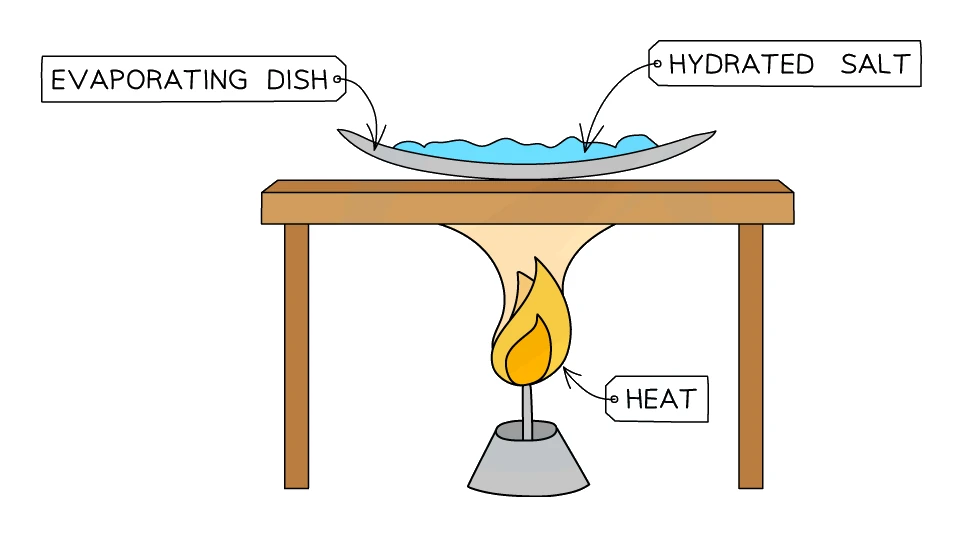
Practical: formula of a hydrated salt
- A hydrated salt is a crystalline solid that has fixed numbers of water molecules locked into its structure
- The trapped water is called the water of crystallisation
- The formula is written with a dot: e.g. CuSO₄·5H₂O (copper(II) sulfate pentahydrate)
Aim. Find x in CuSO₄·xH₂O by heating to drive off the water.
Method:
- Weigh an empty evaporating dish
- Add a known mass of the blue hydrated copper(II) sulfate crystals; reweigh
- Heat gently on a tripod and gauze, stirring with a glass rod, until the salt is completely white (all water has been driven off as steam — this is the anhydrous salt)
- Cool and reweigh; the mass lost is the mass of water
Calculation: apply the empirical-formula procedure with "anhydrous salt" and "water" as the two components.
- Mr(CuSO₄) = 159.5, Mr(H₂O) = 18
- Moles of each = mass ÷ Mr
- Simplest ratio gives 1 : x
For copper(II) sulfate, the result is CuSO₄·5H₂O (so x = 5).
Common exam question
Finding x in a hydrated salt from heating results
Question: Use the masses of the tube empty, with the hydrated salt and with the anhydrous salt to calculate x in a formula such as MgSO₄·xH₂O (3–5 marks).
Set in 7 of the 23 papers, with the Mr of the anhydrous salt and of water given. The marks are the steps: mass of anhydrous salt and mass of water lost by subtraction (one mark each when asked separately), moles of each (mass ÷ Mr), then moles of water ÷ moles of salt = x. A correct x with no working scores full marks. Follow-through from a wrong mass is allowed, but only when the final ratio comes out as a whole number, because x must be an integer: a ratio of 4.12 is given as 4. Do not round the mole values to one significant figure on the way, as that is penalised. In a "show that" version the value is printed, so only the written steps can score.
Worked example
Finding x in hydrated sodium carbonate
A student heats a sample of hydrated sodium carbonate, Na₂CO₃·xH₂O, in a test tube to constant mass and records the results in the table. Use them to find x. (Mr of Na₂CO₃ = 106; Mr of H₂O = 18)
| Measurement | Mass in g |
|---|---|
| empty test tube | 18.25 |
| test tube and Na₂CO₃·xH₂O before heating | 21.11 |
| test tube and Na₂CO₃ after heating to constant mass | 19.31 |
Solution:
- Mass of anhydrous Na₂CO₃ = 19.31 − 18.25 = 1.06 g
- Mass of water lost = 21.11 − 19.31 = 1.80 g
- Moles of Na₂CO₃ = 1.06 ÷ 106 = 0.0100 mol
- Moles of H₂O = 1.80 ÷ 18 = 0.100 mol
- x = 0.100 ÷ 0.0100 = 10, so the formula is Na₂CO₃·10H₂O
The alternative route the mark schemes also accept: the hydrated salt weighs 21.11 − 18.25 = 2.86 g, so its Mr is 2.86 ÷ 0.0100 = 286, and 286 − 106 = 180 is the mass of water in one mole, which is 180 ÷ 18 = 10 waters.
6. Concentration of solutions
Solute, solvent and solution
- The solute is the substance that dissolves
- The solvent is the liquid in which the solute dissolves
- The solution is the homogeneous mixture that results
- Most reactions in solution chemistry happen between solutes dissolved in water (an aqueous solution)
What concentration means
- Concentration is the amount of solute dissolved in a fixed volume of the solution
- The greater the amount of solute in a given volume, the more concentrated the solution
- Edexcel uses two units of concentration:
- g/dm³ — grams of solute per dm³ of solution
- mol/dm³ — moles of solute per dm³ of solution
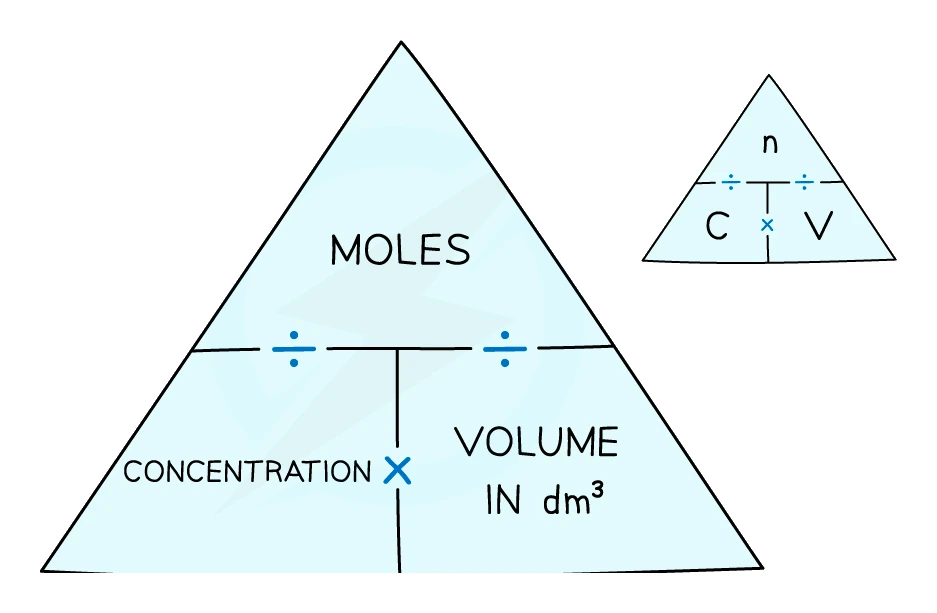
The key formula
- For concentration in mol/dm³:
- where:
- c = concentration in mol/dm³
- n = moles of solute
- V = volume of solution in dm³
- Rearranged:
- = × volume (in dm³)
- volume (in dm³) = moles ÷ concentration
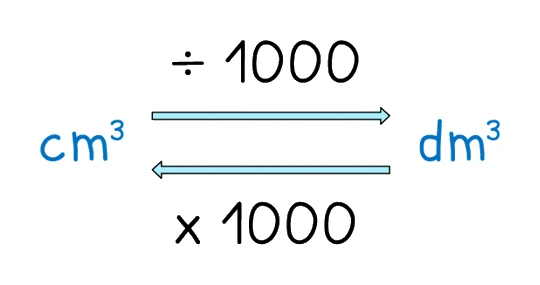
Unit conversion:
- cm³ → dm³: divide by 1000
- dm³ → cm³: multiply by 1000
Example. What is the concentration, in mol/dm³, of a solution made by dissolving 8.0 g of NaOH in water to make 250 cm³ of solution?
- Mr(NaOH) = 40, so moles of NaOH = 8.0 / 40 = 0.20 mol
- Volume = 250 / 1000 = 0.25 dm³
- c = 0.20 / 0.25 = 0.80 mol/dm³
Example. 25.0 cm³ of 0.10 mol/dm³ sodium carbonate is exactly neutralised by dilute hydrochloric acid. The equation is:
Na₂CO₃ + 2HCl → 2NaCl + H₂O + CO₂
If 20.0 cm³ of the acid is required, what is its concentration?
- Moles of Na₂CO₃ = 0.10 × (25.0 / 1000) = 0.00250 mol
- Mole ratio HCl : Na₂CO₃ = 2 : 1, so moles of HCl = 2 × 0.00250 = 0.00500 mol
- Volume of HCl = 20.0 / 1000 = 0.020 dm³
- c(HCl) = 0.00500 / 0.020 = 0.25 mol/dm³
Common exam question
Concentration from a titration result
Question: Given the volumes of both solutions and the concentration of one, calculate the concentration of the other in mol/dm³, or the volume, mass or amount in moles of one reactant (3–4 marks).
Set in 10 of the 23 papers, every one of them a Paper 2. The three marks are the three steps: moles of the known solution (concentration × volume in dm³, so divide the cm³ by 1000), the mole ratio from the equation, then divide by the other volume in dm³ (or multiply by Mr for a mass). A fourth mark, where there is one, is for rounding to the significant figures asked for. Skipping the ratio, or using it the wrong way round, costs exactly one mark in every scheme: an answer double or half the right one keeps the rest. An answer that is just one volume divided by the other, with the concentration never used, scores nothing. Forgetting the ÷ 1000 costs one mark, and one significant figure is penalised once.
7. Volumes of gases at RTP
Avogadro's law
- Avogadro's law states that, at the same temperature and pressure, equal volumes of any gases contain equal numbers of molecules
- Consequence: at the same temperature and pressure, the ratio of any two gases is the same as the volume ratio of those gases
Molar gas volume
- RTP stands for room temperature and pressure, taken as 20 °C and 1 atm
- At RTP, one mole of any gas occupies a volume of 24 dm³ (equivalently 24 000 cm³)
- This value is called the molar gas volume at RTP
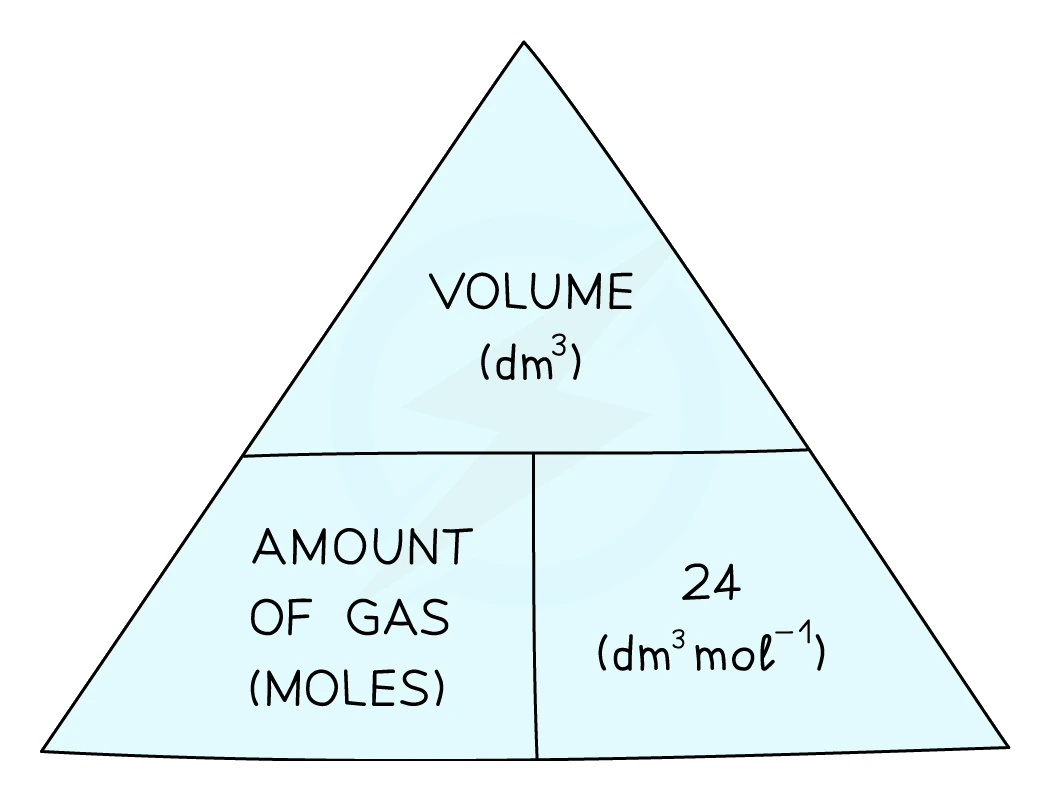
The key formula
- For a gas at RTP:
- or equivalently, when V is given in cm³:
- Rearranged:
- volume (dm³) = moles × 24
- volume (cm³) = moles × 24 000
Example. What volume does 88 g of CO₂ occupy at RTP?
- Mr(CO₂) = 44, so moles = 88 / 44 = 2.0 mol
- Volume = 2.0 × 24 = 48 dm³
Example. Methane burns completely:
CH₄ (g) + 2O₂ (g) → CO₂ (g) + 2H₂O (g)
What volume of oxygen reacts with 100 cm³ of methane, and what total volume of gas products forms? All volumes are measured at the same temperature and pressure.
- Mole ratio CH₄ : O₂ = 1 : 2, so volume of O₂ needed = 2 × 100 = 200 cm³
- Total moles of products per mole of CH₄ = 1 (CO₂) + 2 (H₂O) = 3
- Total volume of products = 3 × 100 = 300 cm³
Common exam question
Gas volume at RTP from a mass, or a mass from a volume
Question: Using a molar volume of 24 dm³ (24 000 cm³) at rtp, calculate the volume of gas formed from a given mass of reactant, or the mass or moles of a substance from a measured gas volume (2–4 marks).
Set in 11 of the 23 papers, all of them Paper 2. The molar volume is printed on every paper but one (which instead asks you to show by calculation that a mole of gas occupies about 24 000 cm³), so the marks are for the chain: moles of the given substance, the mole ratio, then moles × 24 dm³ (or volume ÷ 24 000 cm³ going the other way). Match the molar volume to the unit on the answer line: when 24 dm³ is given and cm³ are wanted, the × 1000 is the final mark. Masses in tonnes usually come with "give your answer in standard form", which is again the final mark. The ratio is the step most often skipped and costs one mark; a wrong number of moles is carried forward through the rest.
Worked example
Gas volume at RTP
Calculate the volume of carbon dioxide, measured at RTP, produced when 25 g of calcium carbonate decomposes completely.
CaCO3 → CaO + CO2 (Mr of CaCO3 = 100; molar gas volume = 24 dm³/mol at RTP)
Solution:
- Moles of CaCO3 = mass ÷ Mr = 25 ÷ 100 = 0.25 mol
- The mole ratio CaCO3 : CO2 is 1 : 1, so moles of CO2 = 0.25 mol
- Volume = moles × 24 = 0.25 × 24 = 6 dm³
Mixing units is the main source of dropped marks: use 24 dm³/mol for an answer in dm³, or 24 000 cm³/mol for cm³. If the question wanted cm³, multiply the dm³ answer by 1000 (6 dm³ = 6000 cm³).