1. The atom
Atoms and molecules
- An atom is the smallest particle of an element that still has that element's chemical properties
- A molecule is two or more atoms chemically bonded together to form one identifiable unit
Inside an atom
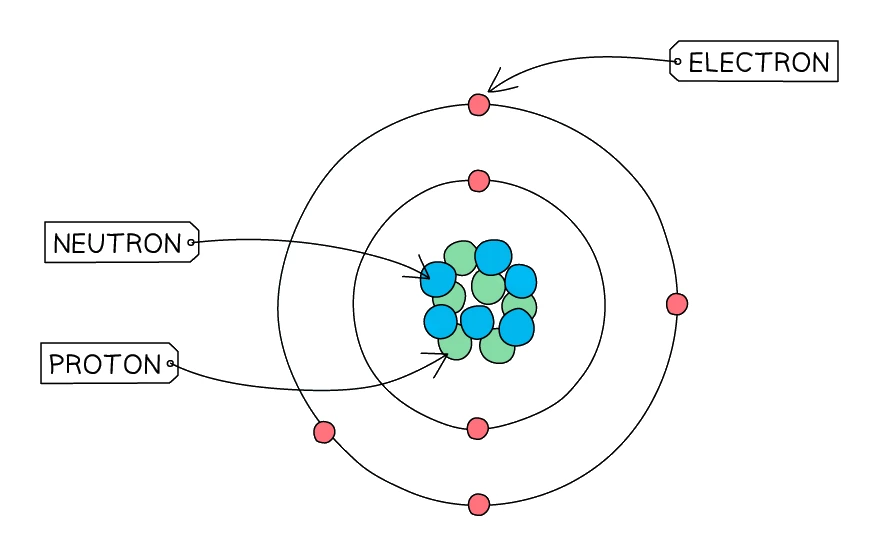
- Every atom contains three types of subatomic particle:
- Protons — positive charge, found in the nucleus
- Neutrons — no charge, found in the nucleus
- Electrons — negative charge, found in shells around the nucleus
- The nucleus is the dense centre of the atom holding the protons and neutrons together
- It is positively charged (because of the protons)
- move around the nucleus in (also called energy levels)
- Almost all of the atom's mass sits in the nucleus; the mass of an electron is negligible
Relative masses and charges
- Subatomic particles are far too small for their masses to be measured in grams or their charges in coulombs
- Their masses and charges are quoted relative to each other instead
| Particle | Relative mass | Relative charge |
|---|---|---|
| Proton | 1 | +1 |
| Neutron | 1 | 0 |
| Electron | negligible (about 1/1840) | −1 |
- A proton and a neutron have almost identical masses; both are given a relative mass of 1
- An electron is roughly 1840 times lighter than a proton, so its mass is treated as negligible in exam answers
Common exam question
Completing the relative mass and charge table
Question: Complete a table of the relative masses and relative charges of the proton, neutron and electron, with some of the cells already filled in (2 marks).
Set in 3 of the 23 papers. Four cells are left blank: all four right earns both marks, two or three right earns one. The values are proton mass 1 and charge +1, neutron mass 1 and charge 0, electron charge −1; the electron's tiny mass has been printed for you every time so far, as 1/2000 or 0.0005. Which cells are blank changes from paper to paper, so know all six.
The neutron has the same mass as the proton and a charge of zero, not a negative one. One scheme accepts a bare + or − for the charges, but +1 and −1 is the safe form.
2. Atomic number and mass number
- (Z): the number of in the nucleus of an atom
- Each element has its own unique atomic number — no two elements share one
- In a neutral atom, the number of electrons also equals Z
- (A): the total number of protons + in the nucleus
Counting subatomic particles
-
Number of protons = Z
-
Number of electrons = Z (for a neutral atom)
-
Number of neutrons = A − Z
-
Example. An atom of beryllium has atomic number 4 and mass number 9, so it has:
- 4 protons
- 4 electrons
- 9 − 4 = 5 neutrons
Common exam question
Atomic number, mass number and counting the particles
Question: State what is meant by atomic number or mass number, or give the number of protons, neutrons and electrons in an atom from its symbol or from its name with a mass number (1–2 marks).
Asked in 4 of the 23 papers. Atomic number is the number of protons in the nucleus; mass number is the number of protons plus neutrons. Mentioning electrons in the atomic-number definition is ignored rather than penalised, so it earns nothing: that mark is for protons, and the mass-number mark is for protons plus neutrons.
From a symbol, the smaller number is the atomic number: protons equal it, and so do electrons in a neutral atom; neutrons are mass number minus atomic number. One mark is for the protons (with the electrons), the other for the neutrons. Most multiple-choice versions hide a wrong option built from the electron count: a mass number counts the nucleus only.
Reading the periodic table
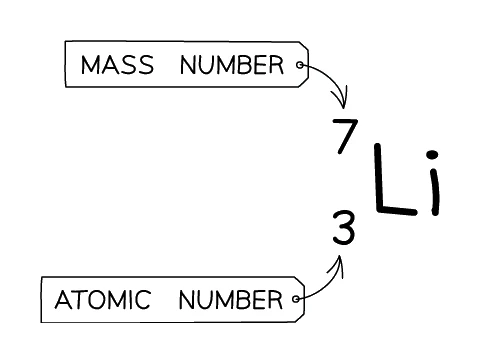
- Both Z and A are given alongside every element on the periodic table
- The larger of the two numbers is the mass number
- The smaller is the atomic number
Common exam question
Using a table of proton, neutron and electron counts
Question: From a table of the numbers of protons, neutrons and electrons in several lettered species, pick out an atom, a positive or negative ion, an element in a given group, or a mass number (1 mark each).
Set in 4 of the 23 papers, always as question 1 or 2. An atom has equal numbers of protons and electrons. Fewer electrons than protons makes a positive ion with a charge of protons minus electrons, so three fewer electrons means 3+; more electrons than protons makes a negative ion. The mass number is protons plus neutrons whatever the electrons are, and a species whose atomic number equals its mass number has no neutrons.
Rows with the same number of protons are the same element, so they are isotopes when the neutrons differ. For an atom's group, turn its electron count into a configuration (7 electrons is 2,5, so group 5); a full outer shell means 2, 10 or 18 electrons.
3. Isotopes
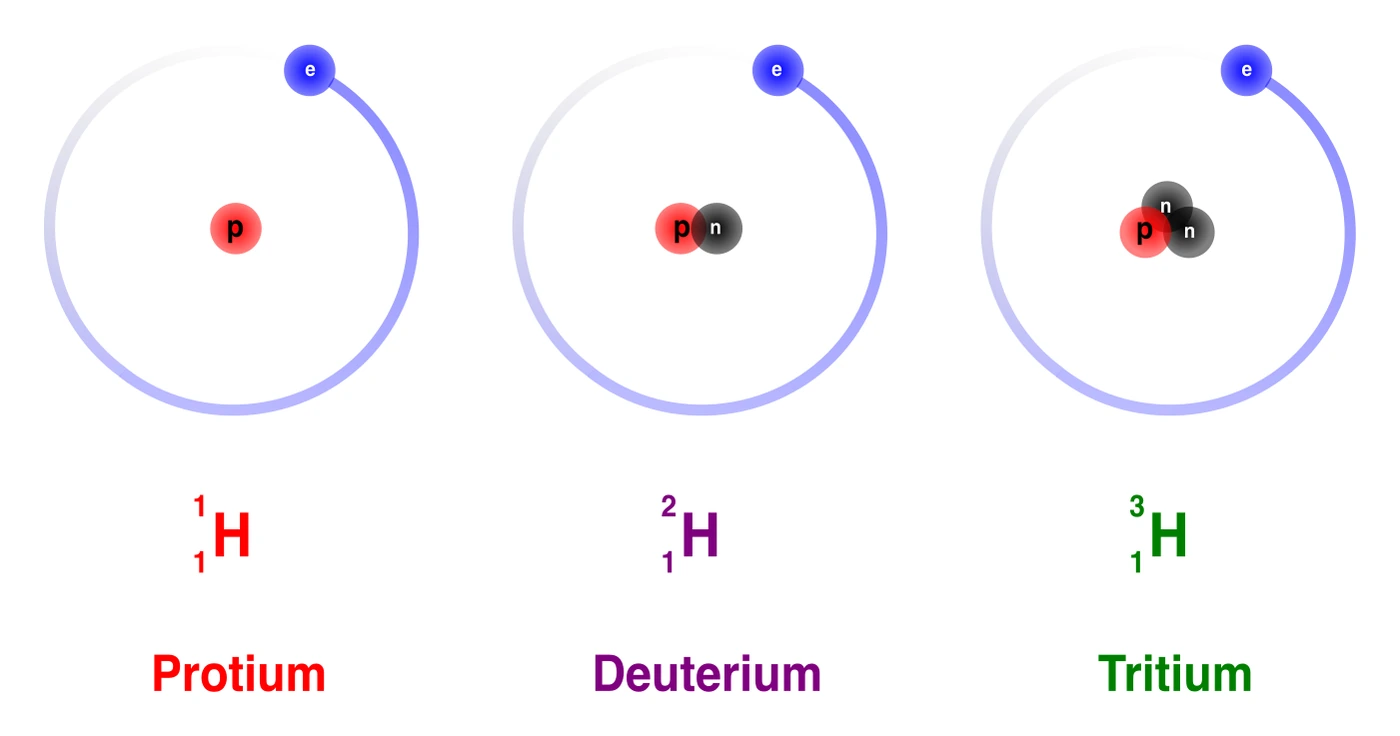
- Isotopes are atoms of the same element with the same number of but a different number of
- All isotopes of an element share:
- the same (so the same number of protons and electrons)
- the same chemical properties (chemistry is set by the electron count, which equals the proton count)
- Isotopes differ in:
- (different neutron count)
- some physical properties like density and rate of diffusion
- Isotopes are written with the mass number as a left-superscript on the element symbol:
- ¹²C, ¹³C, ¹⁴C are three isotopes of carbon
- All three have 6 protons; they have 6, 7 and 8 neutrons respectively
Common exam question
Defining isotopes or explaining why two atoms are isotopes
Question: State the meaning of the term isotopes, or explain in terms of subatomic particles why two given atoms are isotopes, or give one similarity and one difference between them (2 marks).
Asked in 6 of the 23 papers, and the two marks never move: one for the same number of protons, one for a different number of neutrons. Quoting the numbers is accepted, as in "both have 6 protons, but one has 6 neutrons and the other 8".
Answering with atomic number and mass number is risky: it earns both marks in the plain definition, but when the question is about particles, or is built on a table of them, the schemes either cap it at one mark or ignore it. Build the similarity on protons rather than electrons. "Same number of electrons" is accepted by some schemes and ignored by others, and one rejects "different number of electrons" outright.
Common exam question
Why isotopes have identical chemical properties
Question: State or explain why two isotopes of an element react in the same way, or have identical chemical properties (1–2 marks).
Set in 2 of the 23 papers. The credited idea is the same electron configuration, or simply the same number of electrons, because chemistry is decided by the electrons. In the two-mark version the first mark is for the same number of protons, which is what makes them the same element, and the second is for the electrons.
In the two-mark version any mention of neutrons is ignored, so a neutron-based answer scores nothing. Both schemes also ignore "the same number of outer-shell electrons": give the whole configuration or the whole electron count. In the one-mark version "same number of protons" is ignored as well, because it does not explain the chemistry.
Why isotopes matter
- Most elements in nature are a mixture of their isotopes in fixed natural proportions
- This is why most relative atomic masses on the periodic table are not whole numbers — they are weighted averages over the natural isotope mix (see section 5)
4. Electronic configuration
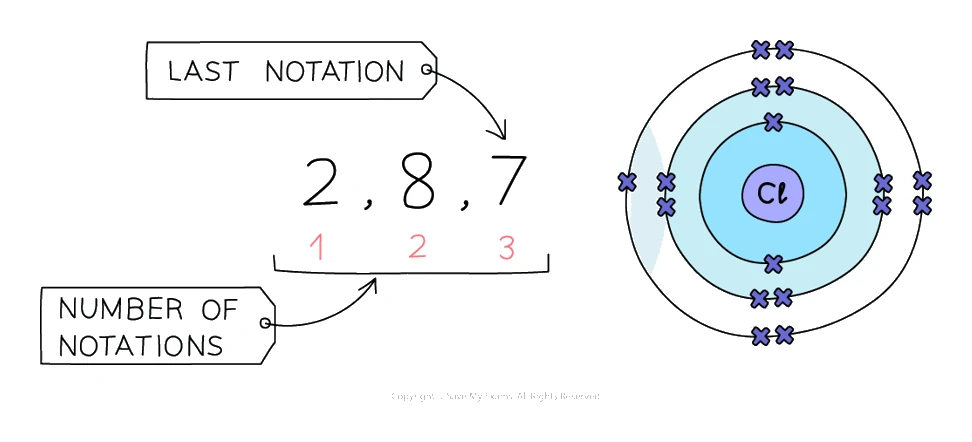
- Electrons occupy around the nucleus, filling from the innermost shell outwards
- For the first 20 elements, the shell capacities are:
- 1st shell: up to 2 electrons
- 2nd shell: up to 8 electrons
- 3rd shell: up to 8 electrons
- 4th shell starts to fill once the 3rd has reached 8
- An electronic configuration is written as the number of electrons in each shell, separated by commas, starting from the innermost shell:
- sodium (Z = 11): 2,8,1
- chlorine (Z = 17): 2,8,7
- calcium (Z = 20): 2,8,8,2
Reading an electronic configuration
- The total of all the numbers equals the (= number of electrons)
- The number of electrons in the outermost shell equals the element's group number for groups 1–7 (this is why same-group elements behave alike chemically)
- The number of shells used equals the element's period number on the periodic table
Common exam question
Reading a diagram of an atom
Question: From a diagram of an atom, name a labelled particle or the nucleus, or give its atomic number, mass number, group, period, or the charge on its ion (1 mark each).
Asked in 7 of the 23 papers, usually as question 1. Particles marked + are protons, unmarked nucleus particles are neutrons, the central cluster is the nucleus, and the particles on the rings are electrons. Protons give the atomic number and the element, protons plus neutrons the mass number, rings the period, outer electrons the group.
Groups 1 to 3 lose their outer electrons and form 1+, 2+ and 3+; groups 5 to 7 gain and form 3−, 2− and 1−. Give size and sign, because "positive" alone is ignored.
5. Relative atomic mass
- (Ar): a weighted-average mass for an element, calculated from the masses and percentage abundances of all of its naturally occurring isotopes, expressed relative to 1/12 the mass of a carbon-12 atom
Calculation from isotope abundances
- Multiply each isotope's percentage abundance by its mass number, sum the products, then divide by 100:
- Add one term to the top of the fraction for every isotope present
- Example. Natural chlorine consists of 75% ³⁵Cl (mass 35) and 25% ³⁷Cl (mass 37); applying the formula:
- This is why chlorine appears on the periodic table with Ar = 35.5, not a whole number
Common exam question
Calculating relative atomic mass from isotope abundances
Question: Calculate the relative atomic mass of a sample from the mass numbers and percentage abundances of its isotopes, rounded as instructed (2–4 marks).
Asked in 9 of the 23 papers. Multiply each mass number by its percentage and add the products, divide the total by 100, then round exactly as instructed. A correct rounded answer alone earns full marks in every scheme that asks for a value; the unrounded value alone drops the last mark when a rounding is specified, so show every line. Decimal fractions (0.752 rather than 75.2, with no division by 100) are accepted.
Two traps. Copying the periodic-table value scores zero: the question is about this sample's abundances. When protons and neutrons are given, add them for each mass number first: one scheme gives a separate mark for that, and neutron counts used as masses lose it. One paper asks you to show that the value is a given number, which is the same working.
Worked example
Relative atomic mass from a table of isotopes
The table gives the make-up of a sample of silicon. Use the information in the table to work out the relative atomic mass of the sample, to one decimal place.
| Isotope | Protons in each atom | Neutrons in each atom | Abundance in the sample (%) |
|---|---|---|---|
| 1 | 14 | 14 | 92.2 |
| 2 | 14 | 15 | 4.7 |
| 3 | 14 | 16 | 3.1 |
Solution:
- Mass numbers first: 14 + 14 = 28, 14 + 15 = 29, 14 + 16 = 30
- Multiply each by its abundance and add: (28 × 92.2) + (29 × 4.7) + (30 × 3.1) = 2581.6 + 136.3 + 93.0 = 2810.9
- Divide by 100: 2810.9 ÷ 100 = 28.109
- Round as asked: Ar = 28.1
The answer sits close to 28 because the lightest isotope dominates; an answer of about 14 means the neutron counts were used as the masses.