1. Solubility rules for ionic compounds
Why solubility matters
- Knowing which salts dissolve in water and which do not decides which preparation method to use
- A soluble salt is built up in solution first and then crystallised out by evaporation
- An insoluble salt is dropped out of solution by precipitation — mixing two soluble salts whose ions exchange to form the wanted insoluble product
Solubility patterns to memorise
| Type of salt | Soluble in water | Insoluble exceptions |
|---|---|---|
| Sodium, potassium and ammonium salts | All | — |
| Nitrates | All | — |
| Chlorides | Most | Silver chloride, lead(II) chloride |
| Sulfates | Most | Barium sulfate, calcium sulfate, lead(II) sulfate |
| Carbonates | Sodium, potassium and ammonium carbonates only | The rest are insoluble |
| Hydroxides | Sodium, potassium and ammonium hydroxides; calcium hydroxide is sparingly soluble (limewater) | Most other metal hydroxides |
- Calcium hydroxide solution is what you know as limewater, used as the test for carbon dioxide
Common exam question
Predicting which pair of solutions gives a precipitate
Question: Which pair of solutions gives a precipitate (an insoluble salt) when they are mixed? (1 mark, multiple choice)
Set in 2 of the 23 papers. Swap the partners of the two salts and test each new pairing against the solubility rules. Every sodium, potassium and ammonium salt and every nitrate stays dissolved, so a pair such as sodium sulfate with potassium nitrate can never precipitate. A precipitate needs one of the insoluble exceptions to form: calcium sulfate from copper(II) sulfate and calcium chloride, copper(II) carbonate from sodium carbonate and copper(II) sulfate, or calcium carbonate from potassium carbonate and calcium nitrate. Check carbonates and hydroxides first, because only their sodium, potassium and ammonium compounds dissolve (calcium hydroxide slightly).
2. Acids and bases as proton donors and acceptors
Acids release H⁺ ions
- An acid is a substance that donates a proton (H⁺ ion) when it dissolves in water — a proton donor
- The free hydrogen ion is what makes the solution acidic
- Examples:
- HCl(aq) → H⁺(aq) + Cl⁻(aq)
- HNO3(aq) → H⁺(aq) + NO3−(aq)
- H2SO4(aq) → 2 H⁺(aq) + SO42−(aq)
Bases accept H⁺ ions
- A base is a substance that can accept a proton — a proton acceptor
- Bases neutralise acids to give a salt plus water
- Typical bases include:
- Metal oxides (e.g. CuO, MgO)
- Metal hydroxides (e.g. NaOH, Ca(OH)2, Fe(OH)3)
- Metal carbonates (e.g. CaCO3, ZnCO3)
- Ammonia, NH3
Bases versus alkalis
- A base that is also soluble in water is called an
- So every alkali is a base, but not every base is an alkali — many bases (CuO, Fe(OH)3, ZnCO3) are not water-soluble
- In water, an alkali produces OH⁻ ions; the OH⁻ ions are the proton acceptors
- Common alkalis to know:
- Potassium hydroxide, KOH — gives K⁺ ions and OH⁻ ions in water
- Sodium hydroxide, NaOH — gives Na⁺ ions and OH⁻ ions in water
- Aqueous ammonia, NH3(aq) — partially reacts with water to give NH4+ ions and OH⁻ ions
- Aqueous ammonia is also called ammonia solution or, historically, "ammonium hydroxide"; the gas itself is NH3, the ion is NH4+
Exam tip
Explaining why the hydroxide ion is a proton acceptor
When a question shows H⁺(aq) + OH⁻(aq) → H₂O(l) and asks why OH⁻ is a proton acceptor, repeating that it "accepts a proton" is ignored. The two marks are for the chemistry behind the label: a hydrogen ion is a proton, because a hydrogen atom that loses its only electron is left as a bare proton, and the hydroxide ion bonds with that H⁺ to form water. Saying that the acid donates its proton to the hydroxide ion also earns the second mark. The same reasoning makes an acid a proton donor: in water it releases H⁺ ions.
3. Reactions of acids
Acid + metal → salt + hydrogen
- Only a metal above hydrogen in the reactivity series reacts with a dilute acid (see topic 13 section 1)
- General reaction:
metal + acid → salt + hydrogen
- Test for the gas: a lit splint at the mouth of the tube gives the squeaky pop of hydrogen
- Examples (using a +2 metal):
- Zn(s) + 2 HCl(aq) → ZnCl2(aq) + H2(g)
- Zn(s) + H2SO4(aq) → ZnSO4(aq) + H2(g)
- Acid → salt naming rule:
- Hydrochloric acid gives a chloride
- Sulfuric acid gives a sulfate
- Nitric acid gives a nitrate
Common exam question
Completing the equation for a reaction of an acid
Question: Complete the chemical equation for an acid reacting with a metal or a carbonate, by writing the products or by adding the state symbols (1–2 marks).
Set in 8 of the 23 papers. For the products, a metal gives the salt and hydrogen and a carbonate gives the salt, carbon dioxide and water. Multiples or fractions are allowed and state symbols are ignored even when wrong; for the carbonate, one mark is for the carbon dioxide and water, the other for the correct salt with the equation balanced.
For state symbols, the solid metal or carbonate is (s), the dilute acid and the salt formed are (aq), hydrogen or carbon dioxide is (g) and water is (l). Capitals are accepted, but all must be right for the single mark; a two-mark version splits the reactants from the products. In a precipitation both solutions are (aq) and only the precipitate is (s).
Acid + base → salt + water
- Reacting any acid with a base is a and always gives the same two products: a salt plus water
acid + base → salt + water
| Acid + base | Equation |
|---|---|
| HCl + NaOH | NaOH(aq) + HCl(aq) → NaCl(aq) + H2O(l) |
| H2SO4 + CuO | CuO(s) + H2SO4(aq) → CuSO4(aq) + H2O(l) |
| HNO3 + ZnO | ZnO(s) + 2 HNO3(aq) → Zn(NO3)2(aq) + H2O(l) |
Acid + metal carbonate → salt + carbon dioxide + water
- Acids react with metal carbonates to give three products: a salt, carbon dioxide gas, and water
acid + metal carbonate → salt + carbon dioxide + water
- A distinguishing feature is the as carbon dioxide is released — passing the gas through limewater turns it milky, confirming CO2
- Examples:
- CuCO3(s) + 2 HCl(aq) → CuCl2(aq) + CO2(g) + H2O(l)
- ZnCO3(s) + H2SO4(aq) → ZnSO4(aq) + CO2(g) + H2O(l)
- Na2CO3(s) + 2 HNO3(aq) → 2 NaNO3(aq) + CO2(g) + H2O(l)
Common exam question
Observations when an acid reacts with a metal or carbonate
Question: State what you would observe when a metal or a carbonate is added to a dilute acid (1–2 marks).
Set in 3 of the 23 papers. The observation is effervescence (bubbles, fizzing); in the two-mark version the second mark is for the metal getting smaller or disappearing. "A gas is given off" and "hydrogen is produced" are ignored: they name a product rather than something you can see. For a metal the scheme also accepts that the metal dissolves, a colourless solution forms or the mixture gets hot; for a carbonate, that the solid disappears. "Crystals form" is ignored, since nothing crystallises while the acid is still reacting.
The follow-up test for the hydrogen is asked in 5 of the 23 papers, twice straight after an acid and metal equation: a lighted splint gives a squeaky pop. A glowing splint is rejected (that is the oxygen test), and "burns with a squeaky pop" on its own is not enough.
4. Preparing soluble salts
Method A — acid plus an insoluble base
-
Used when the metal involved is insoluble as its base (most transition-metal oxides, carbonates and hydroxides)
-
Works for almost any soluble salt of an unreactive or moderately reactive metal — e.g. CuSO4, ZnCl2, Fe(NO3)3
-
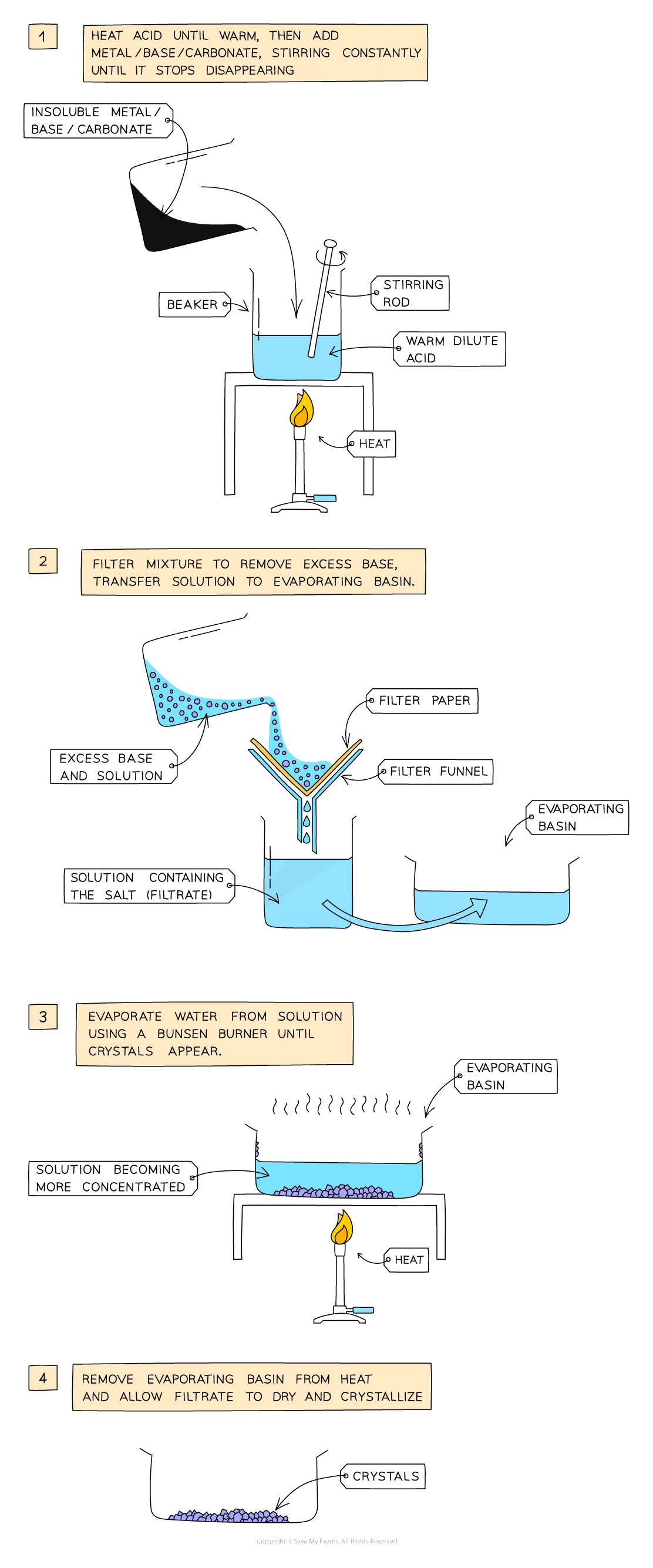
Step-by-step:
- Warm a fixed volume of the dilute acid gently in a beaker (warming speeds up the reaction)
- Add the insoluble base a little at a time, stirring, until no more dissolves — the base is then in excess, which guarantees that no acid is left over
- Filter off the unreacted base, collecting the salt solution as the in a clean container
- Pour the filtrate into an evaporating basin and heat gently to evaporate most of the water
- Stop heating when crystals start to form on a cold glass rod dipped into the solution — the solution is now saturated
- Leave the saturated solution in a warm place to cool and crystallise slowly; any remaining liquid and let the crystals dry on filter paper
-
Worked example: copper(II) sulfate from copper(II) oxide and dilute sulfuric acid
CuO(s) + H2SO4(aq) → CuSO4(aq) + H2O(l)
- Reason to add the base in excess: any unreacted acid would become dangerously concentrated during the evaporation step
- Reason for slow crystallisation: large, well-formed crystals only grow when the solvent leaves slowly
Common exam question
Why the metal or base is added in excess
Question: State or explain why an excess of the metal or the insoluble base is used when preparing a soluble salt (1–2 marks).
Asked in 3 of the 23 papers, and a fourth asks why the mixture is filtered afterwards. The mark is for completeness: an excess makes sure that all of the acid reacts (is neutralised). For a second mark, follow it through: the solution then contains only the salt, since leftover acid would contaminate the crystals, while unreacted solid is simply filtered off. That is also the answer to why the mixture is filtered: to remove the excess, unreacted solid.
Do not answer with rate: "to speed up the reaction" is the credited answer to a different question, why powder is used rather than ribbon. The opposite question also appears: when two solutions are mixed in equal amounts in moles, it is so that neither reactant is left over to contaminate the salt.
Common exam question
Obtaining pure, dry crystals of a soluble salt
Question: Describe how to obtain pure, dry crystals of the salt from the solution, or from the reaction mixture (4–5 marks).
Set in 8 of the 23 papers. Four steps recur in every scheme, and some schemes give heating and evaporating some of the water a mark each: heat the solution until some water has evaporated and crystals first form on a cold glass rod (a saturated solution); leave it to cool so crystals form; pour off or filter off the remaining liquid; and dry the crystals gently (filter papers, a warm oven, a desiccator). A fifth mark comes first: filter off the excess solid, or, for a salt made by titration, repeat with the same volumes but no indicator.
Heating to dryness is the costly slip: the crystallisation marks go and one, at most two, survive. Not heating at all loses marks too. Two of the schemes reject a hot oven or direct Bunsen heating for drying, washing is ignored, and washing the crystals after drying loses the drying mark.
Method B — acid plus an alkali (titration method)
- Used when both reactants are soluble — adding excess of one would just contaminate the salt solution, so a titration is used to find the exact end-point first
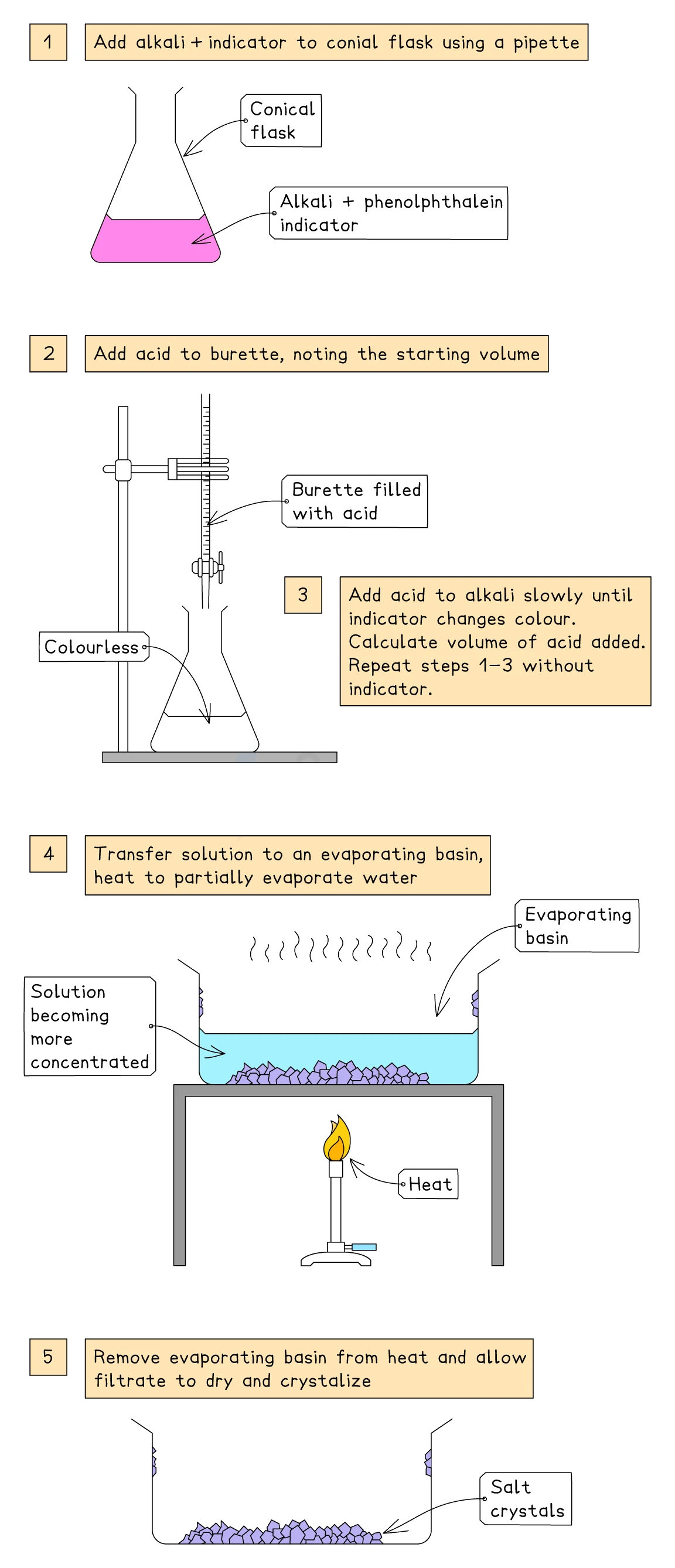
- Step-by-step:
- Pipette a fixed volume of the alkali (e.g. 25.0 cm3) into a conical flask with a few drops of indicator
- Titrate with the acid from a burette to find the exact volume needed for neutralisation (see topic 15 section 3 for full titration technique)
- Repeat the reaction without the indicator, using the same volumes that were found in the titration — the resulting solution is now a clean salt solution, free of dye
- Evaporate, cool, decant and dry as in method A
- The indicator-free repeat is essential because the indicator itself would contaminate the salt sample
5. Preparing insoluble salts by precipitation
The principle
- An insoluble salt cannot be crystallised out of a salt-plus-water solution — it would just stay dissolved up to its low solubility
- Instead, the salt is made by precipitation: two soluble salts whose ions can pair up to form the wanted insoluble salt are mixed
AB(aq) + CD(aq) → AD(s) ↓ + CB(aq)
-
One product is the wanted (the insoluble salt); the other product is a soluble salt that stays in the surrounding solution and is washed away
-
The reaction is sometimes called a double displacement or double decomposition reaction
-
Choosing the reactants: pick a soluble salt of each ion that needs to combine — nitrates are always soluble, so a nitrate of the metal is the standard starting material when the salt's other ion is a halide, sulfate or carbonate
-
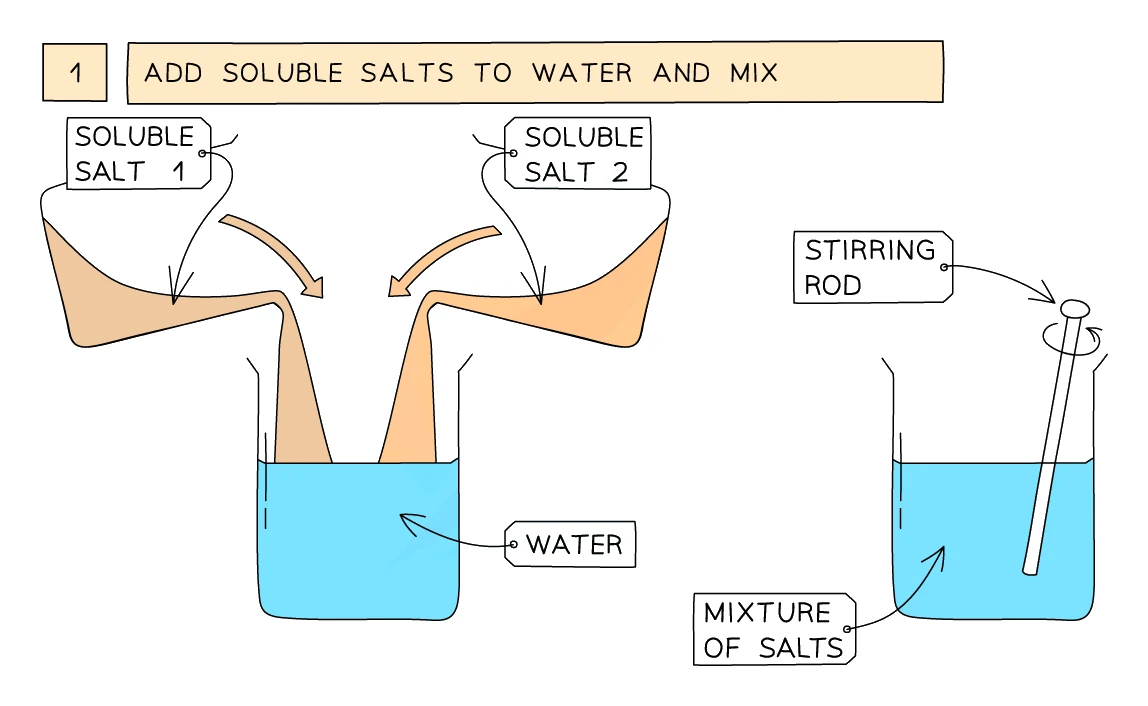
Step-by-step:
- Measure equal volumes of the two soluble salt solutions of similar concentration into a beaker and stir
- The wanted salt forms immediately as a fine solid suspended in the liquid
- Filter, keeping the residue (the precipitate) on the filter paper
- Wash the residue with distilled water to flush away any soluble salt clinging to the precipitate
- Leave the washed solid to dry on a watch glass in a warm oven
Common exam question
Obtaining a pure, dry sample of an insoluble salt
Question: Describe how a pure, dry sample of the insoluble salt is obtained after the two solutions have been mixed, or how to make it from the two solutions (3–4 marks).
Set in 3 of the 23 papers. The three marks are filter to collect the precipitate, wash the residue with distilled water to rinse away the soluble salt, and dry it gently (a warm place, a warm oven or filter papers). When the question starts from the two solutions, the first of four marks is for mixing them; volumes do not matter, but mixing solids scores nothing.
Keep that order. Washing before filtering is ignored, and washing again after drying loses the drying mark. Direct heating of the product is rejected. The expensive mistake is treating it as soluble: an answer built on evaporating and crystallising the mixture scores one mark, at most two, and just heating the mixture to dryness earns the drying mark at best.
6. Required practical preparations
Practical: making copper(II) sulfate (a soluble salt by the insoluble-base route)
- Apparatus: 100 cm3 beaker; measuring cylinder; spatula and stirring rod; Bunsen burner, tripod, gauze and heatproof mat; filter funnel, filter paper, conical flask; evaporating basin
- Materials: dilute sulfuric acid (1.0 mol dm−3); solid copper(II) oxide
- Method:
- Measure 40 cm3 of dilute sulfuric acid into the beaker and warm it gently with the Bunsen
- Add black copper(II) oxide powder a spatula-tip at a time, stirring, until no more dissolves — undissolved black solid in a clear blue solution means the base is in excess
- Filter the warm mixture; the blue filtrate is impure copper(II) sulfate solution, and the black residue is the unreacted copper(II) oxide
- Pour the filtrate into an evaporating basin and warm gently until crystallisation just begins on a cold glass rod
- Set the basin aside in a warm place for several hours to let bright-blue copper(II) sulfate crystals form slowly
- Decant any remaining mother liquor and dry the crystals between sheets of filter paper
- Word and symbol equations:
copper(II) oxide + sulfuric acid → copper(II) sulfate + water
CuO(s) + H2SO4(aq) → CuSO4(aq) + H2O(l)
- Final product appearance: well-formed, deep-blue, regular-shaped crystals of CuSO4·5H2O
Practical: making lead(II) sulfate (insoluble salt by precipitation)
- Apparatus: 100 cm3 beaker; measuring cylinder; stirring rod; filter funnel, filter paper, conical flask; wash bottle of distilled water; watch glass; oven or warm cupboard for drying
- Materials: aqueous lead(II) nitrate (0.4 mol dm−3); aqueous potassium sulfate (0.4 mol dm−3)
- Lead salts are toxic — wear gloves and dispose of waste solutions in the chemical-waste container, not down the sink
- Method:
- Measure 30 cm3 of lead(II) nitrate solution into the beaker
- Add 30 cm3 of potassium sulfate solution and stir briefly — a fine white of lead(II) sulfate appears immediately
- Filter the mixture, keeping the white residue on the filter paper; the clear filtrate is potassium nitrate solution and is discarded
- Wash the residue twice with a few cm3 of distilled water from a wash bottle, letting each wash drain through completely
- Transfer the washed solid to a watch glass and dry it in a warm oven
- Word and symbol equations:
lead(II) nitrate + potassium sulfate → lead(II) sulfate + potassium nitrate
Pb(NO3)2(aq) + K2SO4(aq) → PbSO4(s) + 2 KNO3(aq)
- Final product appearance: a fine, dry, white powder of lead(II) sulfate